Feature Article — ‘Surfing on the Waves of Trends’ (a beauty blogger’s guide to keeping up — and knowing when not to)
Popular culture — including fashion and beauty trends — changes fast. Write a feature article sharing tips on how to keep up with the latest trends in style and beauty.
About 400 words. Booklet pages 8–11, continuing onto the supplementary sheet. A witty, well-structured feature article in a beauty-blogger voice: where to find trends fast (social media, magazines), how to actually pull off makeup and hairstyles (YouTube), and a mature closing turn — cultivate your own style rather than blindly follow the herd. Organised with its own subheadings.
Show original handwritten pages (5)
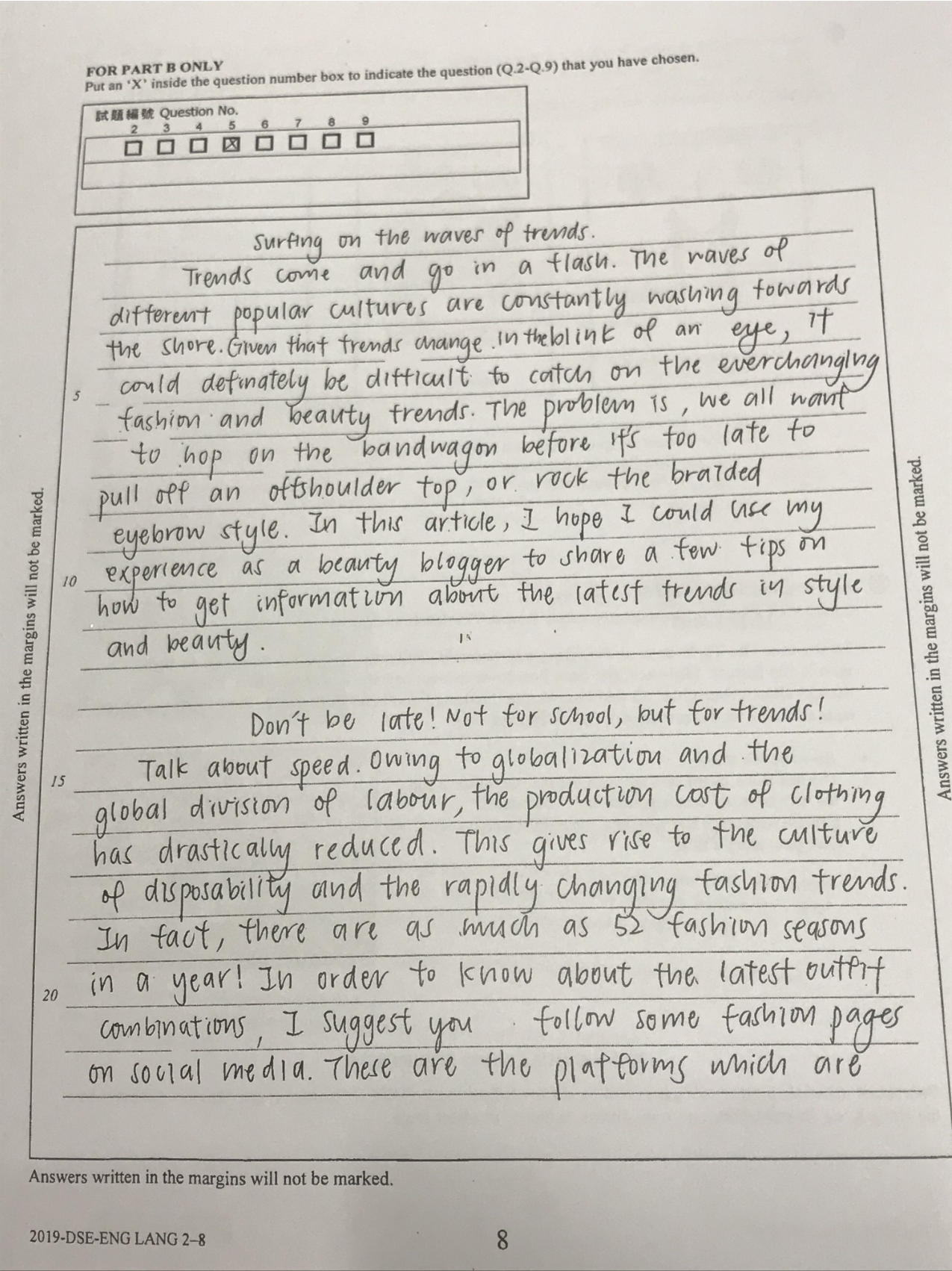
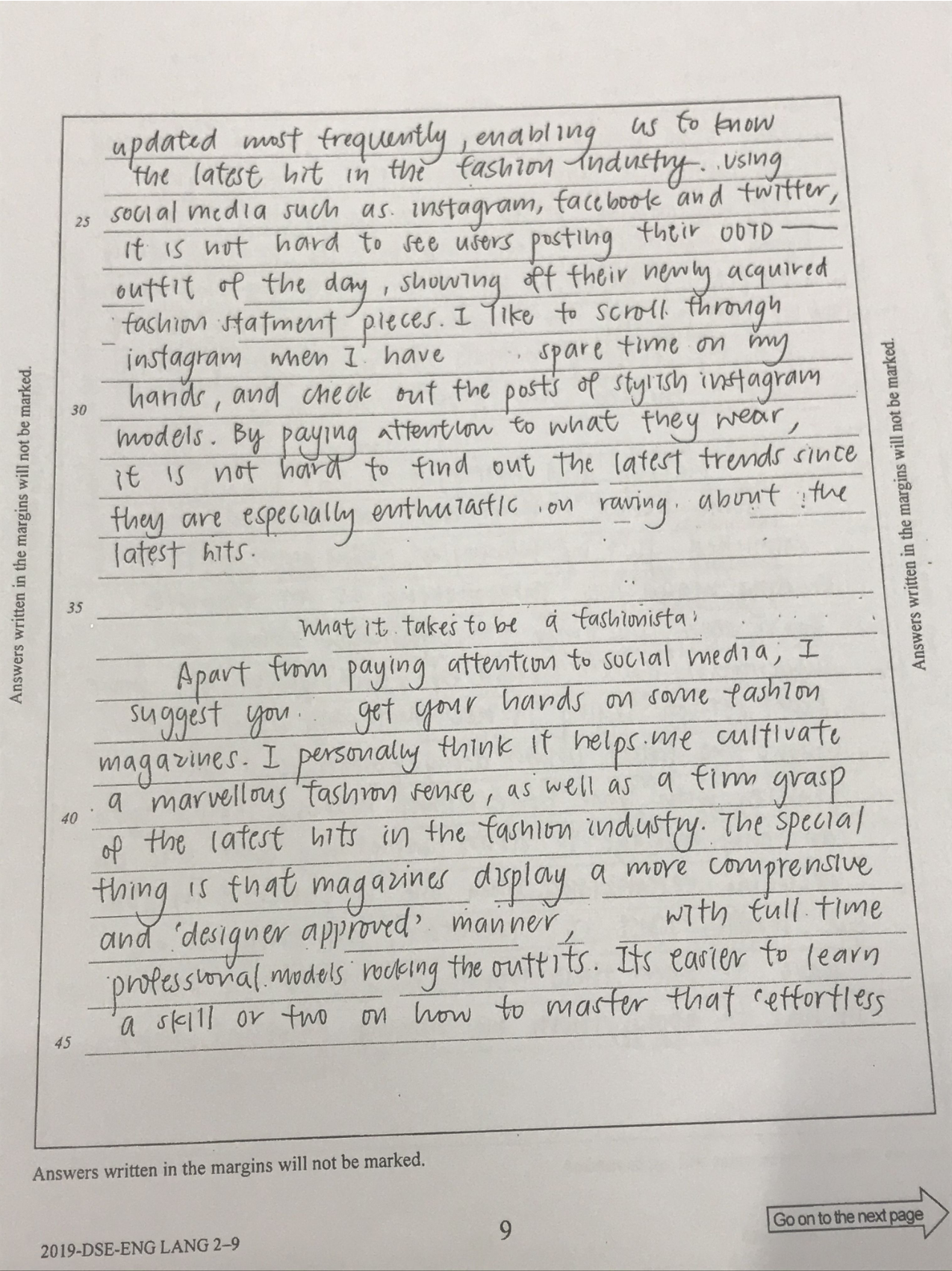
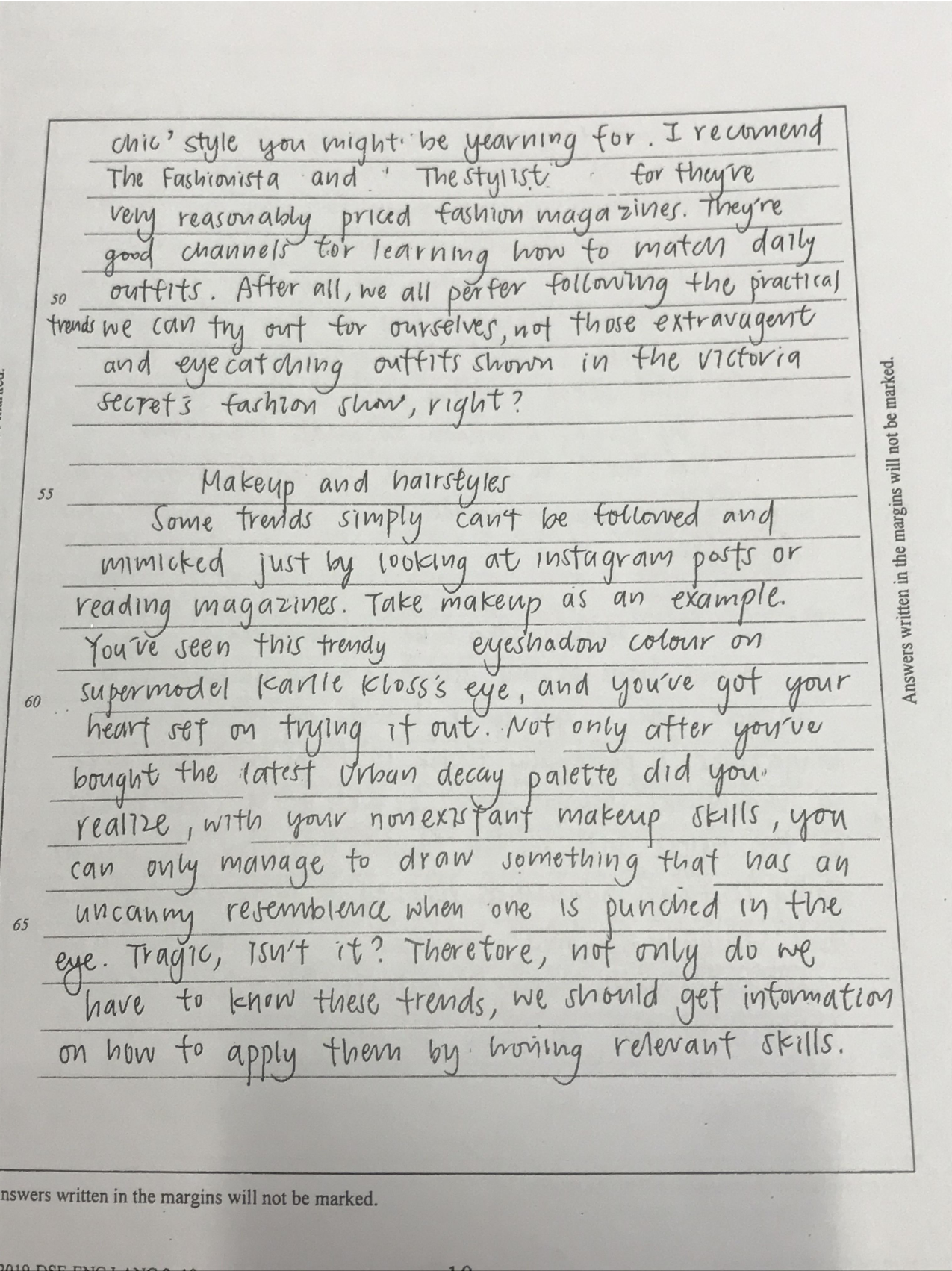
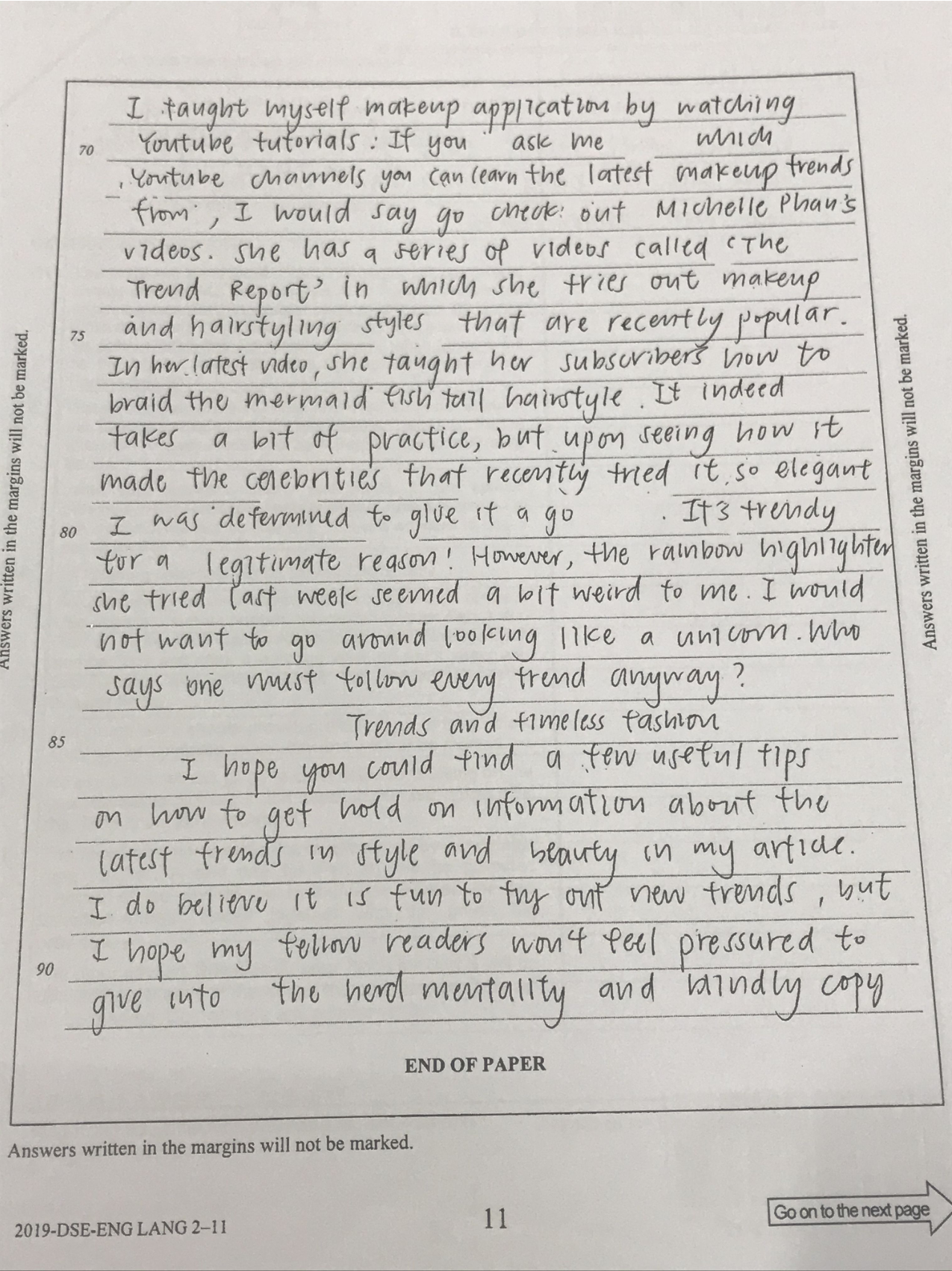

The writing, with corrections marked inline
Strengths to praise
A catchy title and the writer’s own section subheadings — “What it takes to be a fashionista”, “Makeup and hairstyles”, “Trends and timeless fashion” — turn this into a real magazine feature, easy to scan and clearly organised.
“you can only manage to draw something that has an uncanny resemblance when one is punched in the eye. Tragic, isn’t it?” and “I would not want to go around looking like a unicorn”. The humour is on-brand for a pop-culture feature and keeps the reader smiling.
“OOTD — outfit of the day”, “Karlie Kloss”, the “Urban Decay palette”, “Michelle Phan’s… ‘The Trend Report’”. Real names and platforms make the advice feel authentic and of-the-moment.
“trends change in the blink of an eye”, “hop on the bandwagon”, “the culture of disposability”. The idioms and phrasing are apt and give the article real momentum.
The tips build logically: where to spot trends (social media), how to study them (magazines), and how to actually do them (makeup/hair via YouTube). Each section answers a real reader question.
After 80 lines of ‘how to keep up’, the close pivots: “don’t feel pressured to… blindly copy… Cultivating your own style and knowing what might suit you is more important.” Ending on individuality, not conformity, gives the piece a real point of view.
Grammar notes
| Issue | Explanation |
|---|---|
fix (line 4) definately → definitely | Spelling. definitely (contains ‘finite’). |
fix (line 4) catch on the everchanging trends → catch up on the ever-changing trends | Phrasal verb + spelling. To stay current you catch up on something (catch on = become popular / understand); and ever-changing is hyphenated. |
fix (line 7) an offshoulder top → an off-shoulder top | Spelling. The compound adjective is hyphenated: off-shoulder. |
fix (line 15) the production cost… has drastically reduced → …has drastically dropped | Voice. reduce usually needs an object or the passive (has been reduced); an intransitive verb like dropped / fallen is cleaner here. |
fix (line 17) as much as 52 fashion seasons → as many as 52 fashion seasons | Count vs mass. seasons are countable, so as many as (use as much as only for uncountable amounts). |
fix (line 31) enthusiastic on raving about → enthusiastic about raving about | Preposition. enthusiastic about (or recast: they love raving about the latest hits to avoid two ‘about’s). |
fix (lines 39–40) magazines display a more comprehensive… manner → …display them in a more comprehensive… manner | Missing words. You display something in a manner: add an object and in — display them in a more comprehensive… manner. |
fix (line 47) we all perfer → we all prefer | Spelling. prefer. |
fix (lines 49–50) the Victoria Secret's fashion show → the Victoria’s Secret fashion show | Proper noun. The brand is Victoria’s Secret; its show is the Victoria’s Secret Fashion Show. |
fix (lines 57–59) Not only after you’ve bought… did you realize → Only after you’ve bought… did you realise | Structure. The fronted-time inversion takes Only after… did you… (Not only pairs with but also, a different structure). |
fix (line 59) nonexistant → nonexistent | Spelling. nonexistent (ends -ent). |
fix (line 71) styles that are recently popular → styles that are currently popular | Word choice. recently describes a past action; for what is popular now use currently / now. |
fix (line 83) get hold on information → get hold of information | Preposition. The idiom is get hold of (obtain) something. |
notice (line 3) in the blink of an eye | Idiom. A vivid idiom for how fast trends change — used correctly and to good effect in the opening. |
notice (line 6) hop on the bandwagon | Idiom. ‘Jump/hop on the bandwagon’ (= follow a trend everyone’s following) is exactly on-topic and idiomatic. |
notice (line 87) herd mentality | Vocabulary. ‘Herd mentality’ (blindly following the crowd) sharply names what the conclusion warns against. |
Style suggestions
“social media such as instagram, facebook and twitter… stylish instagram models”
“social media such as Instagram, Facebook and Twitter… stylish Instagram models”
Brand and platform names are proper nouns — capitalise them (Instagram, Facebook, Twitter, YouTube).
“Not only after you’ve bought the latest Urban Decay palette did you realize, with your nonexistant makeup skills…”
“Only after buying the latest Urban Decay palette do you realise, with your non-existent makeup skills…”
The emphatic structure is Only after… do/did you…; ‘Not only’ needs a ‘but also’.
“they are especially enthusiastic on raving about the latest hits”
“they love raving about the latest hits”
Recasting removes the awkward ‘enthusiastic on’ and the doubled ‘about’.
“magazines display a more comprehensive and ‘designer approved’ manner, with full time professional models”
“magazines present looks in a more comprehensive, ‘designer-approved’ way, with full-time professional models”
Add the object and ‘in’; hyphenate ‘designer-approved’ and ‘full-time’.
“Don’t be late! Not for school, but for trends!” … “Makeup and hairstyles”
Format these as bold standalone subheadings (and keep them in a consistent style).
You’re already using subheadings — making them visually distinct is the finishing touch of the feature-article form.
“Given that trends change in the blink of an eye, it could definitely be difficult to catch up on the ever-changing fashion and beauty trends.”
“Because trends change in the blink of an eye, keeping up with fashion and beauty can be genuinely hard.”
‘Trends…trends’ repeats; one mention plus a tighter clause reads better.
Strong moment worth teaching from
Clean as written. The structural choice — subverting its own premise — is the lesson.
“Who says one must follow every trend anyway?… I hope my fellow readers won’t feel pressured to give into the herd mentality and blindly copy the latest trends. Cultivating your own style and knowing what might suit you is more important.” (lines 80–89)
For 80 lines the article teaches you how to chase trends — then, in the last section, it turns and gently undercuts that: don’t just follow the crowd; find what suits you. That late pivot gives the whole piece a thesis and a personality, lifting it from a how-to list into an article with something to say. A deliberate change of direction at the end is a powerful, transferable move.
Professional rewrite — the makeup paragraph
A model of the makeup paragraph — keeping the joke, fixing the inversion and spelling.
Student (verbatim)
Professional version
- Inversion: ‘Not only after… did you realize’ → ‘Only after… do you realise’.
- Spelling: ‘nonexistant’ → ‘non-existent’.
- Sharper joke: the ‘punched in the eye’ punchline is set up with a ‘runway vs…’ contrast.
- The self-deprecating humour — the best part — is kept.
Vocabulary to notice
| Word & alternatives | Definition | Usage notes |
|---|---|---|
| ever-changing constantly changing, fast-moving, fluid | (adj.) always changing; never staying the same. | “the ever-changing fashion and beauty trends”. Hyphenated; a tidy single adjective for something in constant flux. |
| bandwagon trend, craze, fad | (n., idiom) jump/hop on the bandwagon = join something popular that many others are doing. | “hop on the bandwagon”. Slightly disapproving (implies following the crowd) — fitting, given the article’s ending. |
| disposability throwaway culture, impermanence | (n.) the quality of being designed to be thrown away after use. | “the culture of disposability”. A precise, slightly academic noun — strong for the fast-fashion point. Adj disposable. |
| fashionista style icon, trendsetter, fashion lover | (n., informal) a devoted follower of fashion. | “What it takes to be a fashionista”. On-trend, register-appropriate for a pop-culture feature. |
| comprehensive thorough, complete, all-encompassing | (adj.) covering everything; complete. | “a more comprehensive… manner”. A useful upgrade on full or detailed; collocates with guide, coverage, overview. |
| uncanny eerie, striking, remarkable | (adj.) strange or surprising, often in an unsettling way. | “an uncanny resemblance”. The set phrase is an uncanny resemblance (a striking, almost eerie likeness) — used well in the makeup gag. |
| herd mentality groupthink, mob mentality, following the crowd | (n. phrase) the tendency to think and act like the majority. | “give in to the herd mentality”. A sharp term for blind conformity; pairs with follow / give in to / resist. |
Leave a Reply