Debate Speech — Abolish Class-Position Reporting (with Bill Gates quote)
The motion is: ‘The policy of reporting students’ class position should be abolished.’ Write a debate speech arguing for OR against the motion. (~400 words)
Show original handwritten pages (4)


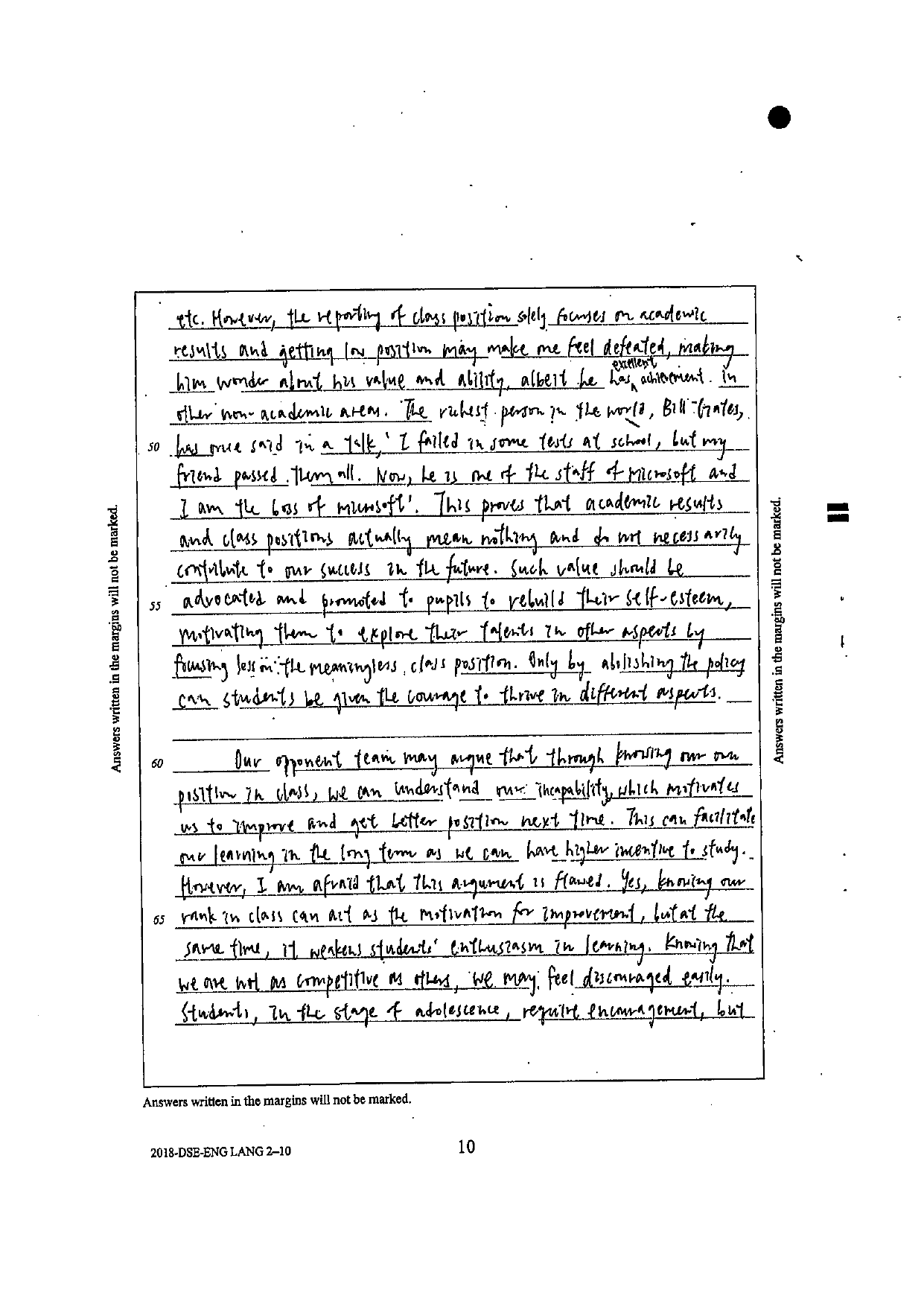
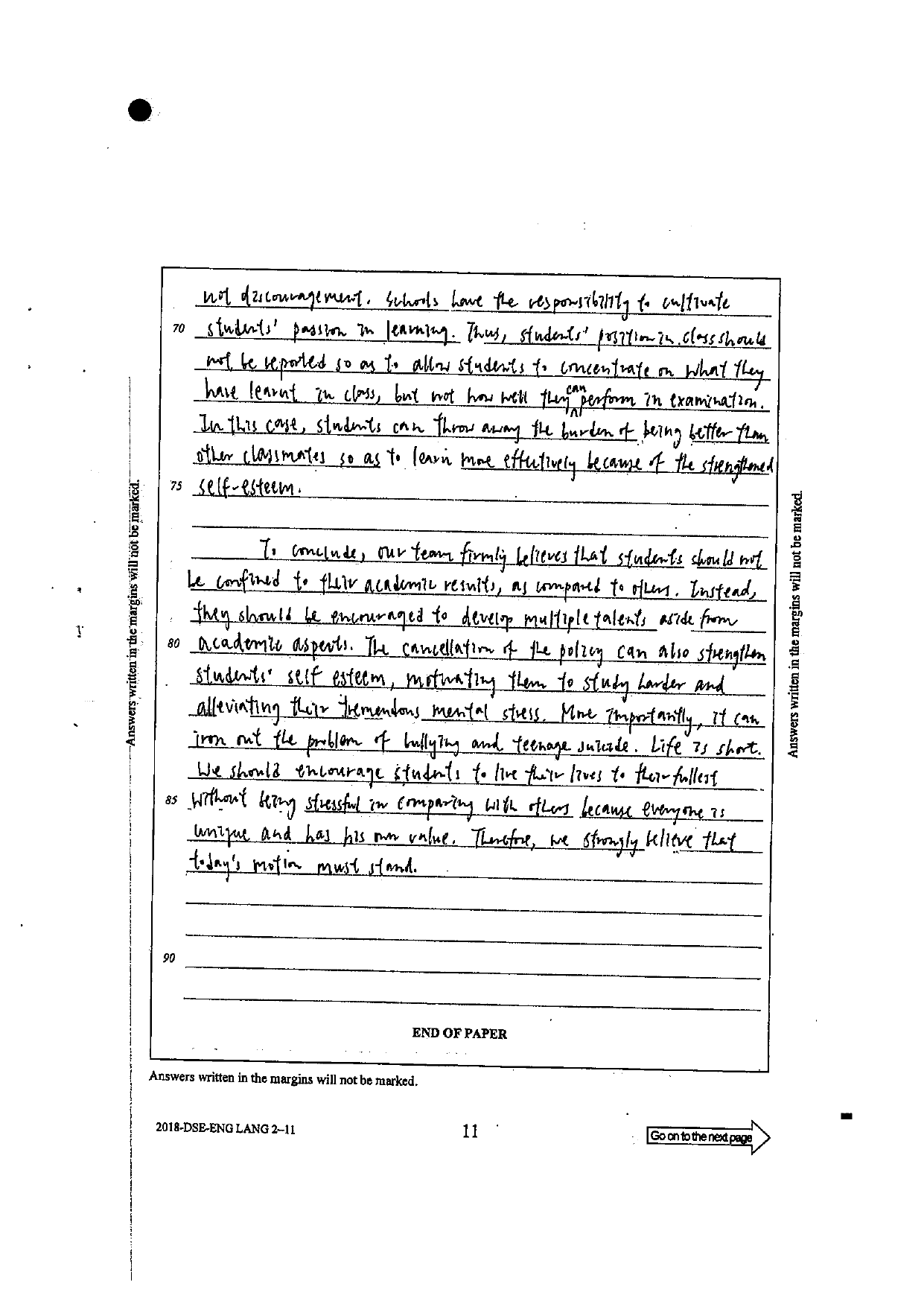
The writing, with corrections marked inline
Word count. Approximately 720 words against the ~400-word brief — about 80% over. Shorter than candidate 2018-005’s perfect 900-word piece on the same motion.
The Bill Gates quote is the distinguishing move (lines 65–69). “The richest person in the world, Bill Gates, once said in a talk: ‘I failed in some tests at school, but my friend passed them all. Now, he is one of the staff of Microsoft and I am the boss of Microsoft.’” The anecdote is well-known enough to read as recognised authority, and the punchline (staff vs boss) makes the candidate’s argument (academic results don’t determine career outcomes) impossible to refute without sounding like one’s arguing against Bill Gates. No other debate speech in the 2018 collection lands a named-celebrity quote with a comparable punchline.
The bullying-via-jealousy argument is original (lines 32–35). “Bullying happens mainly out of jealousy. At school, students who achieve good results and always rank high in class fall prey to bullying.” The candidate inverts the usual bullying narrative — instead of high-achievers as bullies, they are framed as victims of jealousy from lower-ranked peers. This is a non-obvious claim, and even if not fully empirically defended, the structural reframe earns marker attention.
The teenage-suicide reference grounds the stress argument (lines 26–28). “This can also iron out the problem of the spike in the number of teenage suicides recently, caused by the tremendous mental stress from academic results.” Invokes a recognised HK social crisis and ties it directly to the motion. The stakes raise sharply with one sentence.
How this compares with candidate 2018-005’s 42/42 on the same motion. Both pieces share the three-argument structure and proposition stance; both invoke HK-specific social phenomena (Tiger Moms in candidate 2018-005; teenage suicide here). Candidate 2018-005’s edge: the NSS-electives personal example, the triple-anaphora close, the HKU survey citation, and tighter sentence-level execution. 2018-010’s edge: the Bill Gates quote with the joke ending, the bullying-via-jealousy inversion, and the multiple-talents argument (music, photography). Both are genuinely 5**-band; the marker has placed candidate 2018-005 one band higher on M2 sentence-craft.
Why this isn’t a perfect 42. The M2 of 19 (two below perfect) almost certainly reflects sentence-level wobbles — stressful to maintain for stressed to maintain (line 13), is originated for originates (line 17), contributed by for added to by (line 18), the pronoun slip may make me feel defeated mid-paragraph (line 63), the small but persistent preposition slips (harassment to / for / on line 36, enthusiasm in / for line 87, passion in / for line 92, position at / in the end line 52). The argumentative substance is at the perfect level; the surface execution loses two marks.
Strengths to praise
“I failed in some tests at school, but my friend passed them all. Now, he is one of the staff of Microsoft and I am the boss of Microsoft.” A real named authority, a memorable anecdote, and a self-deprecating punchline that proves the argument. The marker has rewarded this with M1 = 21.
The candidate inverts the standard bullying narrative — in this argument, high-ranking students are the victims, not the perpetrators. Even if empirically contestable, the structural inversion shows the candidate is doing original thinking rather than reciting received wisdom.
Mental stress with teenage-suicide stakes (lines 7–28) → bullying with the jealousy inversion (lines 30–44) → multiple talents with the Bill Gates anecdote (lines 46–77). Each paragraph carries one argument; no argument is repeated. The structural backbone is clean.
“Our opponent team may argue that by knowing our own position in class, we can understand our weaknesses, which motivates us to improve…” The candidate states the opposition’s strongest case in full before refuting. The rebuttal that follows (knowing rank weakens enthusiasm, lines 85–99) is the standard counter-argument and the candidate executes it cleanly.
“Life is short. We should encourage students to live their lives to the fullest without being stressful in comparing with others, because everyone is unique and has his own value.” A short declarative philosophical sentence (Life is short) followed by a longer rationale and an aphorism (everyone is unique and has his own value). The close lands with rhetorical force.
“Some may develop their talents in other aspects like playing music, photography, etc.” Naming two specific non-academic talents grounds the abstract claim. The candidate doesn’t need to argue that talents vary; the two named examples carry the point.
Grammar notes
| Issue | Explanation |
|---|---|
(line 13) stressful to maintain → stressed to maintain | Stressful describes the cause; stressed describes the person experiencing it. The exam is stressful; I am stressed. |
(lines 16–17) Not only is students’ pressure originated → Not only does students’ pressure originate | Originate is an intransitive verb (you don’t originate something); the passive is originated doesn’t work. Originate + from directly: pressure originates from themselves. |
(line 18) contributed by their parents → added to by their parents / compounded by their parents | Contribute is intransitive (contribute to something), so the passive contributed by doesn’t work in this sense. Added to or compounded fits. |
(line 36) inflict bodily harm and verbal harassment to the victims → inflict bodily harm and verbal harassment on the victims | Inflict takes on: inflict damage on, inflict harm on. |
(line 52) overall position is nothing at the end → overall position is nothing in the end | The set phrase is in the end (= finally / ultimately). At the end works for physical / temporal endpoints (at the end of the book). |
(line 57) Talents vary from every individual → Talents vary from individual to individual | The set phrase is vary from X to X: vary from person to person, vary from country to country. |
(line 63) may make me feel defeated (pronoun shift) → may make him feel defeated | The candidate has been talking about ‘a student’ (third-person), but slips to ‘me’ mid-sentence. Maintain third-person. |
(line 66) has once said in a talk → once said in a talk | The present-perfect with once is non-standard. Past simple: once said, once told, once remarked. |
(line 68) he is one of the staff of Microsoft → he is on the staff at Microsoft / he works at Microsoft | One of the staff of is grammatical but reads oddly; the natural collocation is on the staff at or simply works at. |
(line 87) enthusiasm in learning → enthusiasm for learning | Enthusiasm takes for: enthusiasm for sports, enthusiasm for the project. |
(line 92) passion in learning → passion for learning | Same as above. Passion for. |
(line 95) but not how well they can perform → rather than on how well they can perform | The contrast structure needs ‘rather than on’ to match the earlier ‘on what they have learnt’. |
(lines 110–111) live their lives to their fullest → live their lives to the fullest | The set phrase is to the fullest, with definite article. Their fullest reads as possessive, which doesn’t fit the idiom. |
(line 111) without being stressful in comparing → without being stressed by comparing | Stressful → stressed (same as the earlier slip at line 13), and in comparing → by comparing. |
Style suggestions (where 5** could become perfect)
Professional rewrite — the multiple-talents paragraph (weak moment)
For comparison only, not a correction. The rebuttal here is competently handled, so the genuinely weakest stretch is the third body paragraph (lines 46–77). It carries the speech’s best asset — the Bill Gates anecdote — but buries it in baggy scaffolding: three flat connectives in a row (However… Yet… However), a third-person pronoun that slips to first person mid-sentence (getting a low position may make me feel defeated, line 63), and bald assertions (academic results and class positions actually mean nothing) that overstate the case the quote actually proves. The rewrite keeps the candidate’s argument and the Bill Gates quote intact, in roughly the same word count, and only fixes the language and the structure.
The candidate’s paragraph (corrected)
Rewritten by a professional debater
- One connective, one direction. The original turns the argument three times (However… Yet… However) so the reader loses the thread. The rewrite runs the paragraph in a single line of thought — a ranking measures one talent and hides the rest — so every sentence pushes the same way.
- The pronoun stays in third person. The candidate’s “may make me feel defeated” slips out of the a student / him frame mid-sentence. The rewrite holds he throughout, which keeps the example one consistent figure the audience can picture.
- The claim is sized to what the quote proves. The original’s “academic results and class positions actually mean nothing” overstates; the opposition can answer it in one line. The rewrite’s “Class position did not predict that. It rarely does” claims only what the Gates anecdote actually shows, and is therefore harder to refute.
- The named examples become concrete. “Music, photography, etc.” is a list that trails off. “The child who is twenty-fourth in the class and first on the stage” turns the abstract point (talents vary) into one image the floor will remember.
- The Bill Gates quote is preserved and given a landing. The candidate’s strongest move is kept almost verbatim, but the rewrite sets it up (“Consider the richest man in the world”) and pays it off (“Class position did not predict that”) instead of following it with a flat “This proves that…”.
Vocabulary to notice
| Word | Definition | Usage notes |
|---|---|---|
| instilled (with) | (v.) gradually established (a feeling, value, or attitude) in someone. | Pairs with value, sense, confidence, fear: instilled with the value that…, instilled a sense of duty in. |
| benchmark | (n.) a standard or point of reference. | Pairs with set, use, raise, against: a benchmark for performance, set a benchmark. |
| spike (in) | (n.) a sharp rise. | Pairs with cases, prices, demand, suicides: a spike in cases, a spike in teenage suicides. News-feature register. |
| uproot | (v.) to pull out by the roots; to remove completely. | Pairs with tree, problem, weed, family: uproot the problem of bullying, uproot poverty. Strong action verb. |
| fall prey to | (v. phrase) become a victim of. | Pairs with bullying, scam, illness, temptation: fall prey to bullying, fall prey to a scam. |
| inflict (on) | (v.) to impose something unwelcome on. | Takes on: inflict pain on, inflict damage on, inflict harm on. |
| undermine | (v.) to gradually weaken. | Pairs with confidence, authority, self-esteem, position: undermine students’ self-esteem. |
| distorted (value) | (adj.) pulled out of true shape or meaning. | Pairs with value, view, image, perception: a distorted view of success. |
| albeit | (conj.) although; even though. | Formal register. Pairs with adjectives or short phrases: useful, albeit limited; well-intentioned, albeit naive. Cleaner than ‘although’ in concession clauses. |
| advocate | (v.) to publicly recommend or support. | Pairs with policy, change, view, reform: advocate a new approach, advocate for change. |
| flawed | (adj.) having a defect. | Pairs with argument, plan, design, logic: a flawed argument, the logic is flawed. Useful rebuttal vocabulary. |
| confined (to) | (adj.) restricted to. | Pairs with space, role, results, area: confined to the classroom, confined to their academic results. |
| alleviate | (v.) to make a problem less severe. | Pairs with stress, pain, worry, suffering: alleviate students’ stress, alleviate the burden. |
| iron out (a problem) | (phr. v.) to resolve. | Pairs with problem, difficulty, issue, kink: iron out the problem, iron out the kinks. Slightly informal but acceptable in debate. |
| to the fullest | (idiom) as completely as possible. | Pairs with live, enjoy, experience: live life to the fullest. The definite article the is required; to their fullest is non-idiomatic. |
Leave a Reply