Letter to Parents — Sky100 Geography Field Trip (Section-Layout Format)
You are Chris Wong, the class teacher of 6A. You will be taking your class on a school trip next month to sky100, shown in the poster below. Write a letter to parents giving them the necessary information about the trip. (~200 words)
Show original handwritten pages (3)

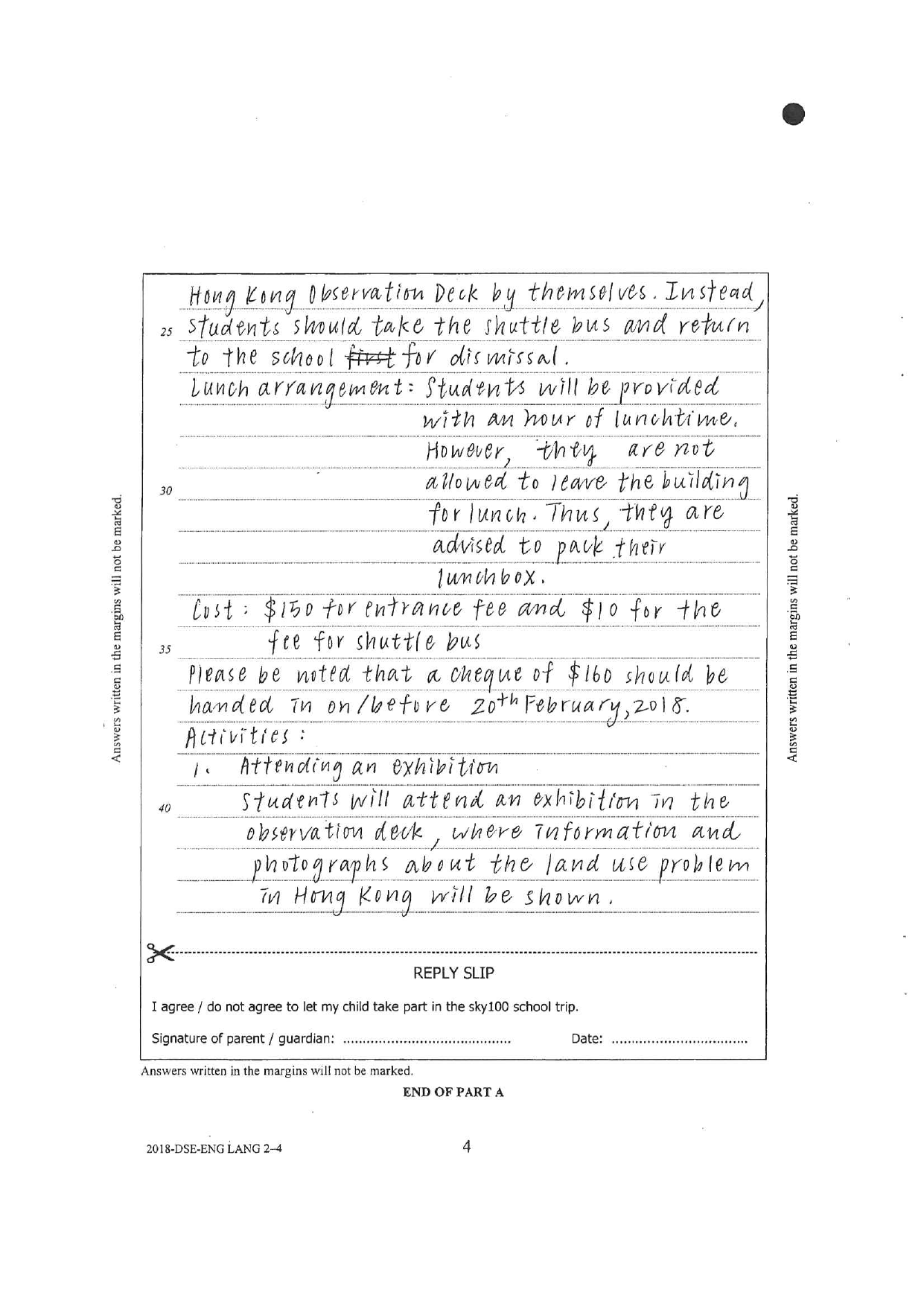
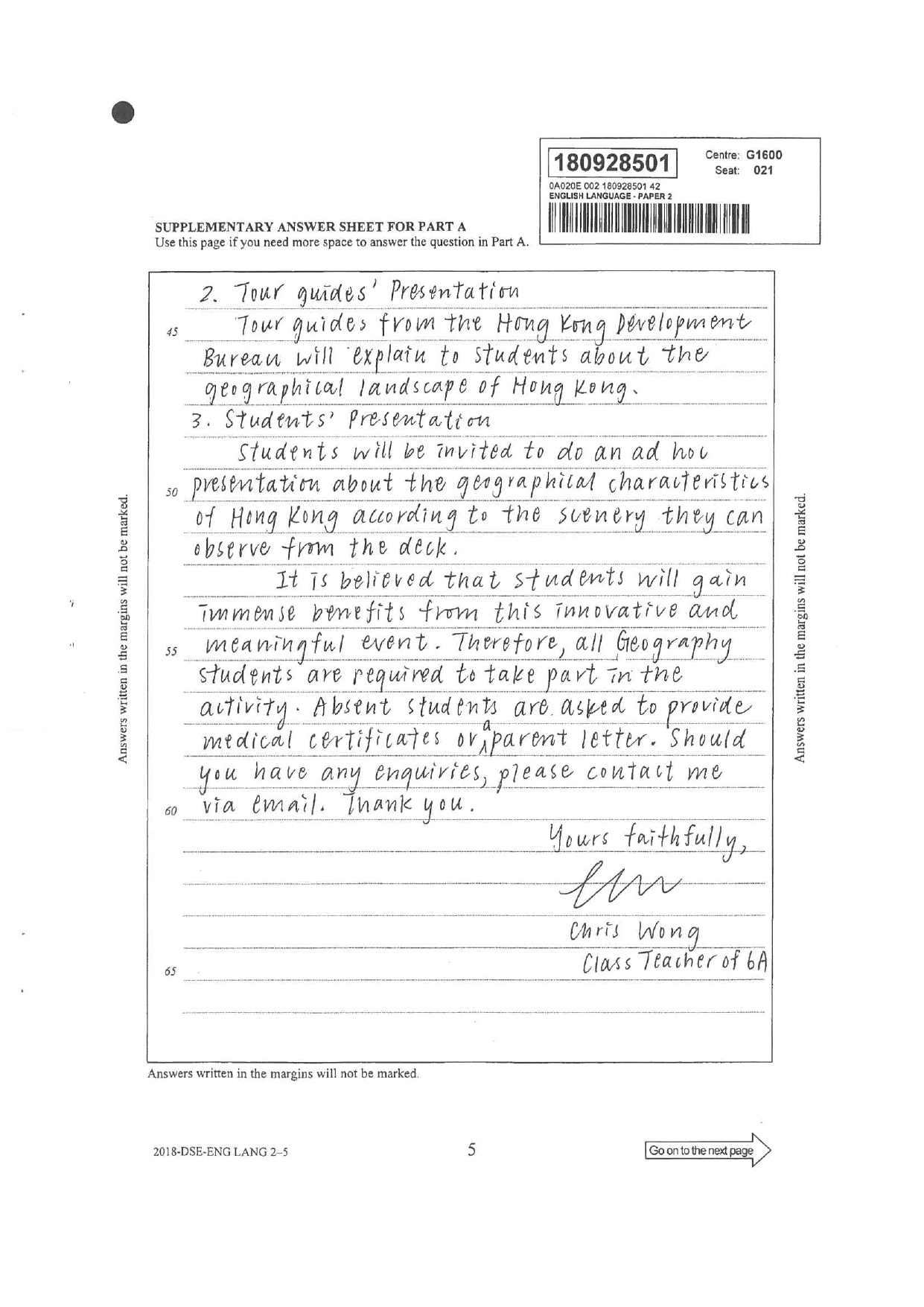
The writing, with corrections marked inline
The distinctive move: section-label layout. Candidate 2018-003 is the only 2018 Part A candidate in the collection to use visible section labels (Date:, Time:, Venue:, Lunch arrangement:, Cost:, Activities:) in the body of the letter, plus a numbered list of activities. This is the closest any 2018 candidate comes to writing a real school administrative letter, which is the genre the prompt actually invites.
Word count. Approximately 370 words against the ~200-word brief — about 85% over. The layout format keeps the over-shoot from compounding into prose density.
Strengths to praise
The only 2018 Part A in the collection to use real section labels (Date / Time / Venue / Lunch arrangement / Cost / Activities) and a numbered list of activities. Real school letters look exactly like this — the layout demands different skills (organising information for scanning, not paragraph-flow).
Six mentions of Geography across the letter. The candidate doesn’t just attribute the trip to a department in the opening — the entire letter then earns the attribution through its three subject-specific activities.
Naming the Hong Kong Development Bureau (which does run public engagement programmes) as the source of the tour guides anchors the activity in real-world institutional context. Other 2018 candidates name venues; this one names a partner organisation.
A real pedagogical move — the trip becomes an assessment opportunity, not just an outing. The candidate has noticed that Sky100’s view is a teaching tool.
Itemised cost ($180 entrance + $10 shuttle bus), named payment method (cheque), named deadline (20th Feb). Three concrete pieces of information a parent can act on.
Real school administrative procedure named in formal language — medical certificates or a parent’s letter. The only 2018 candidate to handle the absence question.
Grammar notes
| Issue | Explanation |
|---|---|
(line 21) provided by school → provided by the school | Missing definite article. The school, since a specific school is in context. |
(line 26) return to the school first for dismissal → return to the school for dismissal | The first is redundant; return for dismissal implies the sequence. |
(line 32) pack their lunchbox → pack their lunches | Lunchbox is the container; lunch is the food. Pack lunches or pack their own lunch is the natural form. |
(line 33) $180 for entrance fee → $180 for the entrance fee | Missing definite article before entrance fee. |
(line 34) fee for shuttle bus → shuttle-bus fee | Compound noun construction is tighter than the fee for X form. |
(lines 18, 35) Please be noted that → Please note that | Be noted is non-standard; the standard imperative is simply note that. |
(line 39) an exhibition in the observation deck → an exhibition on the observation deck | An observation deck is a surface; on, not in. |
(lines 45–46) explain to students about the geographical landscape → explain to students the geographical landscape | Explain X to Y is the standard pattern, no about. Tell about is OK; explain about is non-standard. |
(line 48) do an ad hoc presentation → give an ad hoc presentation | Presentations are given, not done: give a presentation, give a speech, give a talk. |
(line 57) medical certificates or parent letter → medical certificates or a parent’s letter | Two refinements: parent letter as a noun phrase reads strangely (compare parent-teacher meeting, which works); a parent’s letter is clearer. Article required. |
(line 59) contact me via Email → contact me via email | Email as a common noun is lowercase. (Email capitalised only when used as a proper noun for a specific product or as the start of a sentence.) |
Style suggestions (where 5* could become 5**)
1. Exhibition on Hong Kong’s land-use challenges — reinforces Module 3 of the HKDSE Geography syllabus.
2. Development Bureau guided tour on the geographical landscape — first-hand contact with the institution students will encounter in their reading.
3. Student ad-hoc presentation — each student picks one geographical feature visible from the window and presents for ninety seconds; counts toward the term’s oral assessment.
Strong moment worth teaching from
This is the single most teachable structural choice in the letter. While other 2018 candidates write the trip-letter in flowing paragraphs, candidate 2018-003 writes it the way a real class teacher would: visible labels for the practical fields, a numbered list for the activities, and brief descriptive sentences underneath each item.
Why this move is strong
- It matches the genre. A real school administrative letter looks like this. The candidate has read the prompt as a practical task, not as a writing prompt, and that genre-awareness is precisely what M1 and M2 = 19 each rewards.
- It absorbs the over-shoot. 370 words against a 200-word target would crush a paragraph-only letter. Laid out by section, the same words read as complete, not as too much.
- The numbered activities list invites parallel structure. Three activities, three short sentences, all opening with Students will… The list scaffolds the candidate into clean, comparable items.
- It anchors the Geography framing. The opening claims the trip is Geography-organised; the numbered list (land-use exhibition, Development Bureau tour, geographical-characteristics presentation) delivers on the claim.
Professional rewrite — the activities list (text-type fit)
The numbered activities list is candidate 2018-003’s strongest structural move and earns the matched M1 = M2 = 19. A professional rewrite preserves the list, names a curriculum link for each item, and turns the activities into a parent-comprehensible learning programme.
The student’s activities list (corrected)
1. Attending an exhibition — Students will attend an exhibition on the observation deck, where information and photographs about the land-use problem in Hong Kong will be shown.
2. Tour guides’ presentation — Tour guides from the Hong Kong Development Bureau will explain to students the geographical landscape of Hong Kong.
3. Students’ presentation — Students will be invited to give an ad hoc presentation about the geographical characteristics of Hong Kong according to the scenery they can observe from the deck.
Rewritten by a professional letter-writer
1. Land-use exhibition (30 min). The deck’s rotating exhibit currently focuses on Hong Kong’s land-use pressures — reclamation, agricultural decline, the country-park boundary debate. Direct support for Geography Module 3.
2. Development Bureau guided tour (45 min). Two Development Bureau geographers will lead the class through the panoramic windows, pointing out the city’s major geographical features and explaining the planning history behind each.
3. Student ad-hoc presentation (45 min). Each student picks one geographical feature visible from the deck — a reclaimed shoreline, a transport hub, a high-density housing block — and presents for 90 seconds to the class. The exercise counts toward this term’s Geography oral assessment.
- The activities are time-allocated. 30 min, 45 min, 45 min. Parents reading this know exactly how the day is structured and trust that the school has planned it.
- Each activity has a named pedagogical anchor. Direct support for Geography Module 3. Counts toward this term’s Geography oral assessment. The trip ceases to be an outing and becomes part of the assessment framework.
- The Development Bureau detail is enhanced. Two Development Bureau geographers. Naming the number and profession of the visiting guides makes the partnership feel real and substantive.
- The student-presentation activity is given parameters. One geographical feature visible from the deck… 90 seconds… counts toward… Concrete enough that a student can prepare for it on the bus ride there.
- The day’s rhythm is named in a single header. 9:30 — 12:30. Three hours of structured time, with the time allocations summing to 120 minutes plus 30 minutes of buffer / transitions. Real teacher letters timetable like this.
Vocabulary to notice
| Word | Definition | Usage notes |
|---|---|---|
| authentic | (adj.) genuine; real. | Pairs with experience, learning, voice, document: authentic learning experience, authentic source. Common in education writing. |
| field trip | (n.) an educational excursion outside the school. | Distinct from school trip (more generic) in the implication of pedagogical purpose. Geography uses field trip as the term of art. |
| metropolis | (n.) a large, important city. | Pairs with vibrant, sprawling, bustling, affluent: Hong Kong as a metropolis, a sprawling metropolis. Slightly elevated register. |
| shuttle bus | (n. phrase) a bus running back and forth between two fixed points. | Hyphenated as a compound modifier: shuttle-bus service, shuttle-bus fee. Standard for school-trip transport. |
| dismissal | (n.) the act of being formally allowed to leave at the end of an activity. | Pairs with after, at, time, point: school dismissal, dismissal at the gate, the dismissal time. Standard school administrative term. |
| ad hoc | (adj./adv., Latin) for a particular purpose only; without prior preparation. | Pairs with committee, presentation, decision, basis: an ad hoc presentation, an ad hoc committee. Italicised in some styles; not in others. |
| scenery | (n.) the natural features of a landscape considered in terms of their visual impression. | Pairs with spectacular, breathtaking, urban, natural: the scenery from the deck, urban scenery. Uncountable. |
| immense | (adj.) extremely large or great. | Pairs with benefit, value, importance, pressure: immense benefits, immense pressure. Slightly elevated. |
| innovative | (adj.) featuring new methods; advanced and original. | Pairs with activity, approach, method, idea, design: an innovative event, an innovative learning approach. Standard education vocabulary. |
| land-use problem | (n. phrase, HK / urban planning) issues relating to the allocation and management of land. | HK-specific topical phrase: Hong Kong’s land-use problem, the land-use debate. The Development Bureau is the relevant policy body. |
| medical certificate | (n. phrase) a document signed by a doctor confirming illness. | Pairs with provide, submit, attach, obtain: submit a medical certificate, obtain a medical certificate. Standard HK school absence-procedure term. |
| Yours faithfully | (closing salutation, BrE / HK English) the formal close for a letter to an unnamed recipient. | Used when the salutation is Dear Sir / Madam. When the recipient’s name is known, Yours sincerely is the standard close. |
| Development Bureau | (proper n., HK government) the bureau overseeing land, planning, and works in Hong Kong. | Real HK government department. Mentioning it by name (rather than ‘a government office’) is a small but meaningful authenticity move. |
Leave a Reply