Letter to Parents — Sky100 School Trip (Three-Purpose Framing)
You are Chris Wong, the class teacher of 6A. You will be taking your class on a school trip next month to sky100, shown in the poster below. Write a letter to parents giving them the necessary information about the trip. You may use the mindmap to help you write your letter. (~200 words)
Mindmap (suggested topics): Transportation · Cost · Purpose of trip · Lunch · ? (one blank for the candidate to fill).
Show original handwritten pages (3)
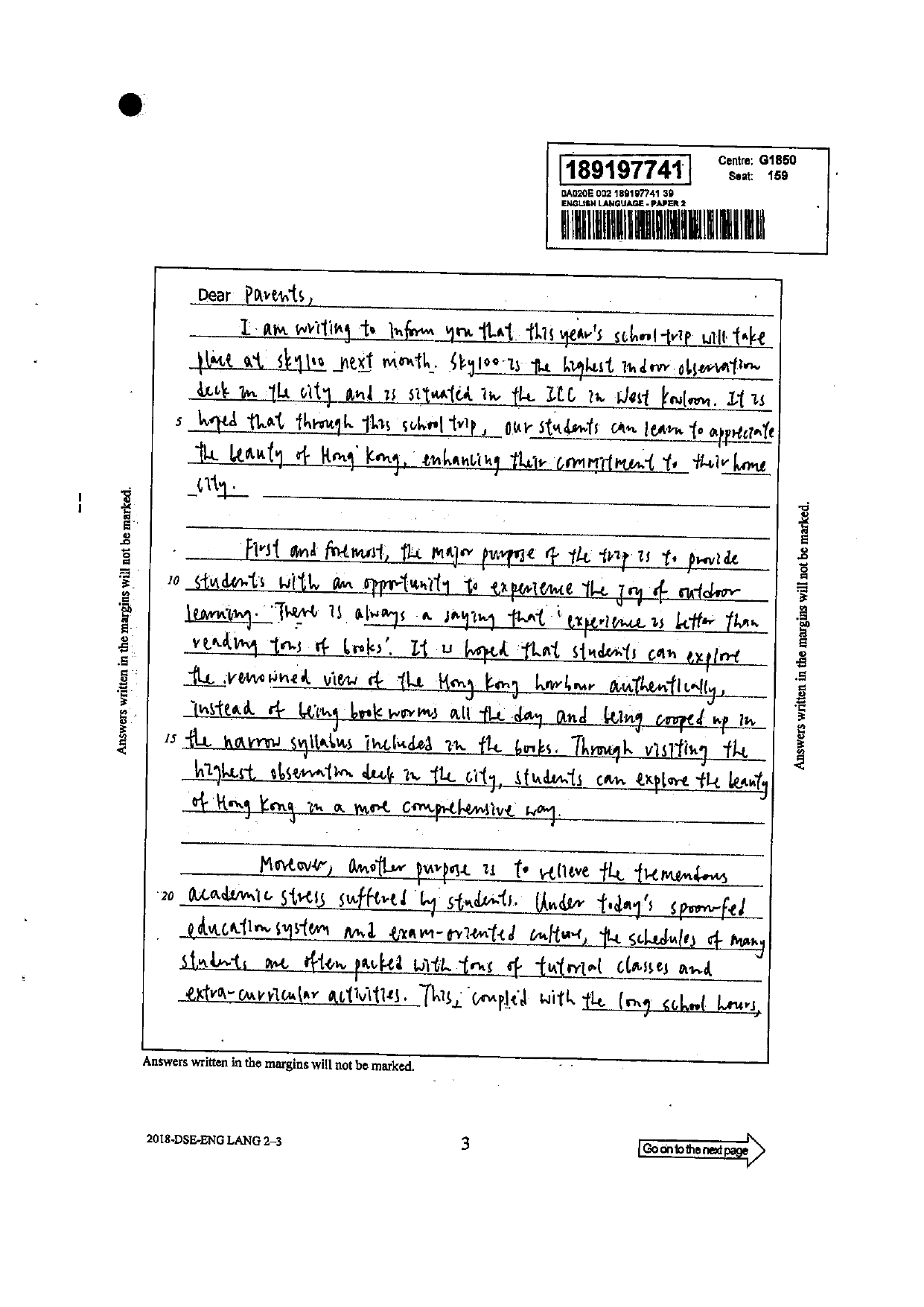


The writing, with corrections marked inline
Word count. Approximately 490 words against the ~200-word brief — about 145% over. Comparable to candidate 2018-005’s 460-word Part A, less than 2018-001’s 460w and far less than 2018-009’s 580w.
The distinctive move: the “last memory before graduation” framing. “Our children are going to graduate soon. After entering the university, they may not have a lot of chances to gather with their secondary school classmates so often. This school trip is likely to be their very last memory with their friends before facing the stressful public examination.” No other 2018 Part A in the collection invokes the imminent graduation as a trip rationale. The framing turns the trip from educational activity to final shared experience — a strong emotional argument to a parent reader.
Three-purpose structure. Outdoor learning + academic stress relief + memory-making before graduation. Each purpose has its own paragraph; each has its own justification. This is the most consciously-structured three-purpose framing in the 2018 Part A set.
The Bill-Gates-style aphorism opens the outdoor-learning paragraph. “There is a common saying that ‘experience is better than reading tons of books.’” Citing a (general) saying gives the educational argument borrowed authority — the candidate doesn’t have to defend the experience-vs-books claim because the proverb already does.
The dim-sum specific. The lunch paragraph names a specific Hong Kong food category (well-reputed dim sum) rather than generic local cuisine. Small but real authenticity move.
Subsidies for financial-aid applicants. “Subsidies will be provided for the applicants of our school’s financial aid scheme.” The candidate is the only one of the four MSC 2018 candidates to name a means-tested support mechanism. Parents who fall into the bracket read this and feel the school has thought about them.
What holds it at 35 not higher. The M2 of 16 reads as the weaker half of the markers’ assessment. The likely cost is sentence-level — well-reputated, section vs session, deliver us, all the day — small slips spread across the piece. The substance and structure are 5* / 5** band; the surface puts it at the lower end of 5*.
Strengths to praise
No other 2018 Part A in the collection invokes the imminent graduation as a trip rationale. The candidate notices that 6A students are about to disperse and uses that fact as the trip’s emotional warrant. A parent reading this might be the last time responds differently than to this is an educational opportunity.
Purpose 1 (outdoor learning, lines 9–17), Purpose 2 (stress relief, lines 19–29), Purpose 3 (memory-making, lines 31–38). Each gets its own paragraph with a clear topic sentence. The structural skeleton is real and visible to the marker.
“Under today’s spoon-fed education system and exam-oriented culture, the schedules of many students are often packed with tons of tutorial classes and extra-curricular activities.” The candidate names HK’s education system in critical terms (spoon-fed, exam-oriented) and uses the critique as the trip’s justification. This is sharper than the generic ‘HKDSE stress’ framing used by the other 2018 Part As.
“Taste all kinds of famous gourmet food in Hong Kong, including the well-reputed dim sum.” The dim sum reference grounds the ‘Sky100 restaurant’ in something a parent can picture. The other 2018 Part As mention lunch without specifying cuisine.
“Subsidies will be provided for the applicants of our school’s financial aid scheme.” The only 2018 Part A to mention means-tested support. A parent in financial difficulty reads this and feels included; a parent not in that bracket reads this and sees an inclusive school.
“To ensure everyone’s safety, there will be a briefing session beforehand. Several teachers and volunteers will accompany our students.” Two concrete safety mechanisms (pre-trip briefing + multiple adults). Parent letters that discuss safety usually do so generically; this candidate names the procedures.
Grammar notes
| Issue | Explanation |
|---|---|
(line 4) situated in the ICC → situated at the ICC | Buildings take at: situated at the ICC, situated at the harbour. In would mean inside. |
(line 14) all the day → all day | The fixed phrase is all day, no article. All the day doesn’t exist as an idiomatic time-span. |
(line 27) honing their mental health → improving their mental health | Hone means to refine or sharpen a skill; you don’t hone health. Improve, restore, support fit. |
(line 28) yield to depression thanks to → yield to depression under | Thanks to implies a positive cause (thanks to your help); for negative causes, under, due to, because of. |
(line 43) More to say → In addition / Furthermore | More to say isn’t a standard discourse marker; the natural form is in addition, furthermore, what’s more. |
(line 44) after visit → after the visit | Missing definite article. After the visit. |
(line 45) the well-reputated → the well-reputed | The past participle of repute is reputed, not reputated. Compound: well-reputed. |
(line 48) if your children suffers → if your child suffers | Subject-verb agreement: children suffer (plural verb) or your child suffers (singular). The intended meaning here is per-child. |
(line 51) briefing section → briefing session | A session is a meeting; a section is a part. Likely a spelling confusion. |
(line 52) follow our students → accompany our students | Follow implies tracking behind; accompany is the standard verb for adult supervision of a group. |
(line 41) deliver us from school to the destination → take us from school to the destination | Deliver for people implies a parcel-like transit; take, bring, transport are the natural verbs. |
(line 60) Best regards → Yours sincerely / Yours faithfully | For a formal parent letter from a class teacher, Yours sincerely (when the addressee’s name is known) or Yours faithfully (when generic) is conventional. Best regards is more business-email register. |
Style suggestions (where 5* could become 5**)
• Total cost: HK$200 per student
• Included: coach, Sky100 entrance, lunch at the Sky100 restaurant (Chinese cuisine, including dim sum)
• Subsidies: full coverage for students on the school’s financial aid scheme
• Allergies: please email me by <date> with any dietary needs
Professional rewrite — the “last memory” paragraph (text-type fit + authenticity)
This paragraph carries the candidate’s most original argument and the most emotionally resonant claim in the letter. A professional rewrite makes the framing land in language a parent would actually use about their own child.
The student’s paragraph (corrected)
Rewritten by a professional letter-writer
- The paragraph addresses the parent directly. That may matter most to you, as a parent. The candidate’s original makes a school-side claim; the rewrite locates the argument inside the parent’s emotional register.
- The trip is framed as a counter-memory. We don’t want them to remember the last week of secondary school as another week of mock exams. We want them to remember it as the afternoon they stood, together, at the highest point in the city, and looked out. Two sentences with parallel structure (we don’t want / we want) that turn the abstract claim (create an unforgettable memory) into a specific image (stood, together, looked out).
- The dispersal is named in three forms. To universities, gap years, and the rest of their lives. The candidate’s after entering the university imagines a single path; the rewrite acknowledges the actual diversity of post-secondary trajectories.
- The closing image is visual. Stood, together, at the highest point in the city, and looked out. A picture the parent can hold — their child, the class, the height, the looking. A debate-essay closer is rarely this filmic.
Vocabulary to notice
| Word | Definition | Usage notes |
|---|---|---|
| observation deck | (n.) a high-level platform built for viewing. | Sky100’s standard descriptor in HK travel and education writing. |
| renowned | (adj.) widely known and admired. | Pairs with view, restaurant, expert, museum: the renowned view of Victoria Harbour, a renowned chef. |
| cooped up | (phr. adj.) confined in a small space. | Conversational register: cooped up indoors all day, cooped up in the office. Works in trip-letter context to argue for getting out. |
| syllabus | (n.) the subjects studied for a particular course. | Plural: syllabuses or syllabi. Pairs with narrow, broad, demanding, prescribed: the narrow syllabus, a demanding syllabus. |
| spoon-fed | (adj.) given excessive guidance, without independent effort. | Pairs with education, students, learning, instructions: spoon-fed education system, spoon-fed students. Critical register. |
| exam-oriented | (adj., HK English) focused primarily on examination performance. | Pairs with culture, system, learning, school. Stock critical phrase about HK education. |
| deprivation (of) | (n.) the state of being deprived. | Pairs with sleep, food, freedom, time: sleep deprivation, deprivation of free time. |
| yield (to) | (v.) to give way to. | Pairs with pressure, temptation, depression, force: yield to pressure, yield to despair. Slightly literary register. |
| remarkable | (adj.) worthy of attention; striking. | Pairs with memory, achievement, success, experience: remarkable memories, a remarkable achievement. |
| cherish | (v.) to hold dear; to value highly. | Pairs with memory, moment, friendship, time: cherish the memory, cherish the moment. Warm register; suits farewell-trip writing. |
| gourmet | (n./adj.) a person who is a connoisseur of fine food; or relating to such food. | Pairs with food, cuisine, restaurant, experience: gourmet food, a gourmet dinner. Slightly elevated register. |
| dim sum | (n., HK / Chinese) small steamed or fried dishes traditionally served at yum cha. | Always lowercase in English; usage in the candidate’s letter is appropriate to HK context. |
| briefing session | (n. phrase) a meeting to inform people before an event. | Pairs with safety briefing, briefing session, pre-trip briefing. Standard HK school-letter convention. |
| financial aid scheme | (n. phrase, HK English) a means-tested support programme. | HK education term: apply for the financial aid scheme, the school’s aid scheme. Naming it in a parent letter signals institutional awareness of mixed-income families. |
| widening (one’s) horizons | (v. phrase) to broaden one’s knowledge or experience. | Plural horizons. Common closer in trip-letter contexts: widening their horizons through this event. |
Leave a Reply