Letter of Advice to J.C. — Pursuing a Veterinary Career
You write an advice column for Teen magazine and you have received the following letter:
Write a letter of advice. (~400 words)
Show original handwritten pages (4)
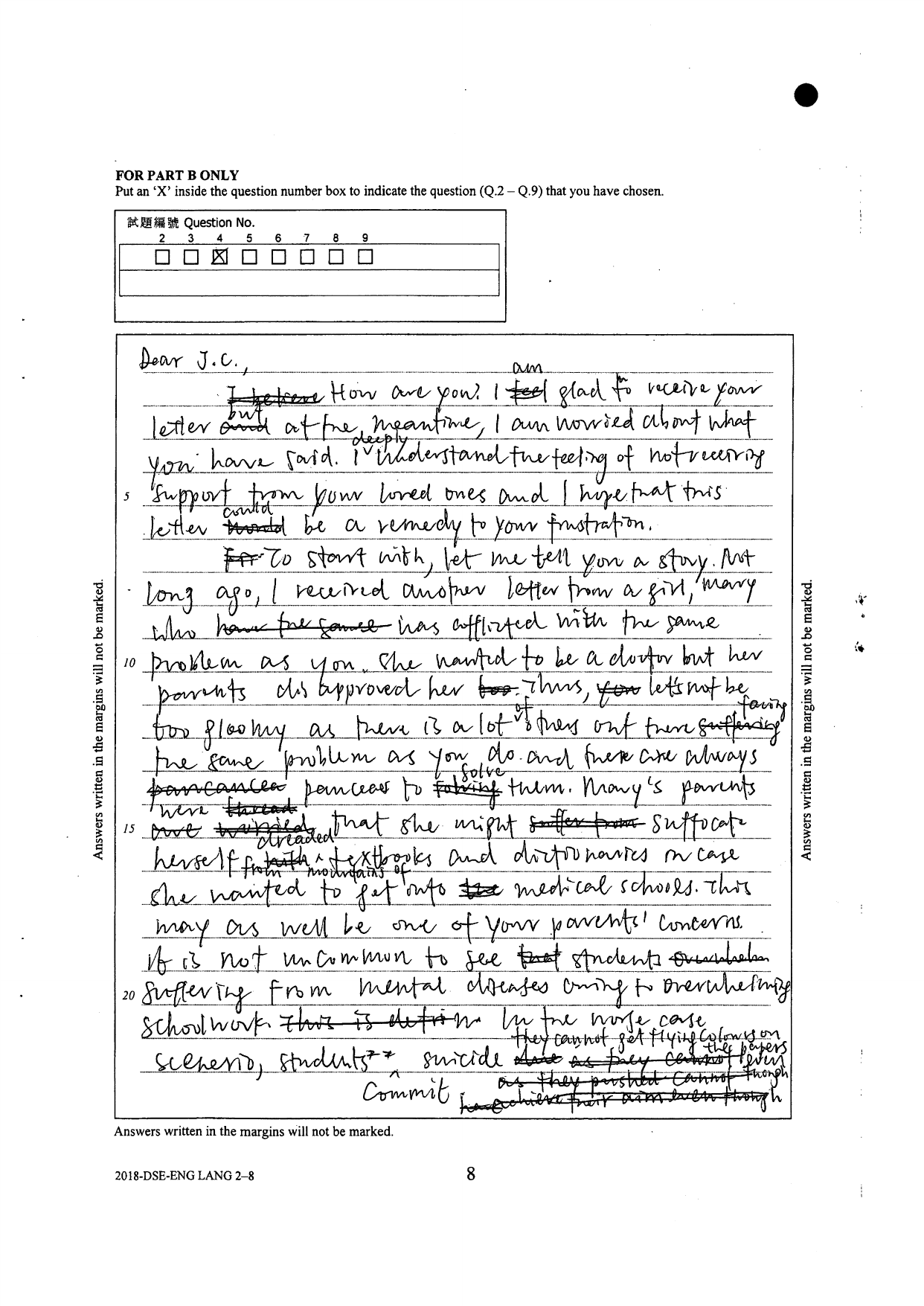
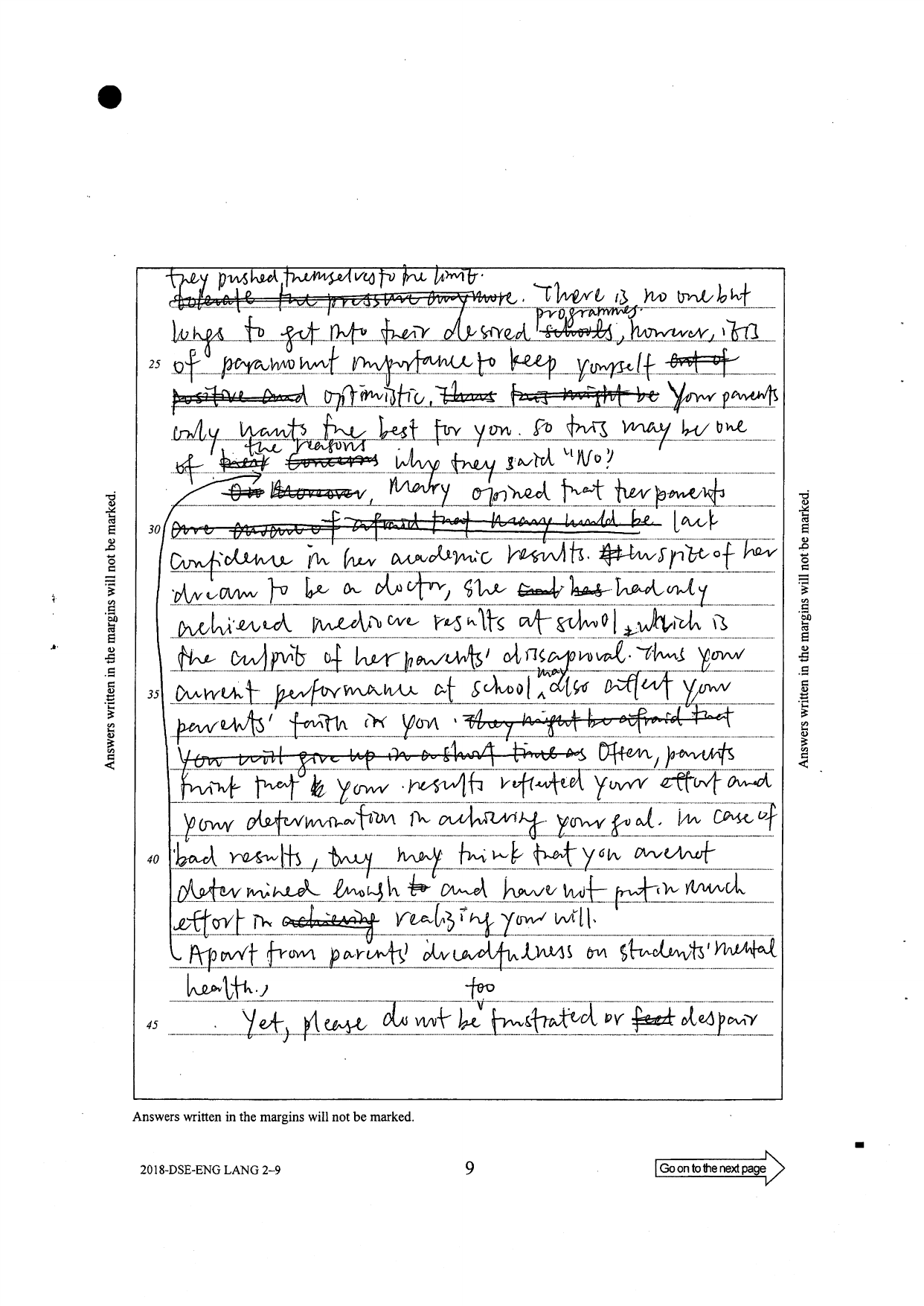


The writing, with corrections marked inline
Word count. Approximately 600 words against the ~400 brief — about 50% over, in line with the strong Q4 / Q5 Part B answers across the 2018 collection.
Transcription caveat. The handwriting on this piece is small, cramped, and densely revised; multiple stretches genuinely could not be transcribed without significant guesswork. The yellow-highlighted spans mark the lowest-confidence reads. The analysis below leans on what the surface form clearly shows — structural moves, opening and closing, and the recognisable case-study technique.
What the markers are rewarding (architecture + emotional intelligence). Two moves carry this piece into 5** territory: (1) an embedded case-study of another reader (another letter from a girl who’s confronted with the same problem) that lets the columnist write from precedent rather than abstract advice; (2) a sustained reframing of the parents’ opposition as worry from love, not opposition from ignorance. The candidate consistently positions the parents as concerned, not wrong — the rhetorical move that distinguishes a magazine advice columnist from a teenager venting on a forum.
How this compares with the perfect Q4 (2018-001). Both pieces use a case study; both reframe parental opposition. 2018-001 names a specific publication (South China Morning Post) and a specific institution (CUHK medicine); candidate 2018-006 names a similar ‘wanted to be a doctor’ case but doesn’t source it. 2018-001 also lands a Steve Jobs quote and the ‘Lunch with Big Brothers’-style invented framing; candidate 2018-006 leans more on emotional empathy than on cited evidence. Both are valid Q4 strategies; the perfect-marks piece wins on specificity.
Why this isn’t a perfect 42 itself. The M1 = 20 (a notch below perfect) almost certainly reflects sentence-level wobbles — the candidate’s prose tangles in places (especially the parental-psychology paragraph and the close), which the markers will register as a Language ceiling. The Content and Organisation work is at the perfect-marks level; the surface execution carries one fewer mark.
Strengths to praise
“How are you? I feel glad to receive your letter and at the same time, I am worried about your future.” A real advice columnist opens with the relationship, not the diagnosis. The candidate captures this exactly — warmth first, content second.
“I have received another letter from a girl who is confronted with a similar problem to yours. She wanted to be a doctor but her parents disapproved.” The columnist offers precedent: this isn’t a unique problem; another reader is right there with you. The parent-doctor case parallels the parent-vet case structurally, so the case-study earns its place without needing to be literal.
“Your parents only want the best for you.” The candidate returns to this framing several times across the letter — the parents aren’t against vet work, they’re worried about J.C. This is the same reframing move the perfect-marks Q4 piece uses, and it’s the rhetorical key to the advice-letter genre.
“Construct a timetable for your study schedule every day and follow it strictly… you can organise family outings on holidays to show that you can balance your study and your family life.” The candidate moves from emotional advice to behavioural advice with specific actions (timetable, family outings on holidays). The behavioural prescription gives J.C. something to do, not just feel.
“You are only 16 years old, and that’s reasonable.” The candidate accepts J.C.’s frustration as legitimate without dismissing it or moralising. This is the columnist’s most important register: I hear you, your feelings make sense, and here’s how to think about it.
“Yet, please don’t be frustrated or feel despair.” The piece opens with despair-acknowledgement (line 17) and closes with despair-rejection. The framing is intentional and circular — the kind of structural symmetry that suggests planning.
Grammar notes (transcribable spans)
| Issue | Explanation |
|---|---|
(line 4) at the meantime → at the same time | The set phrase is at the same time; in the meantime works for ‘during the interval’ but not in this comparative sense. |
(line 6) have lots of insecurity → have a lot of insecurity / feel insecure | Insecurity is usually uncountable; lots of insecurity works but a lot of insecurity is the more standard collocation. Alternatively, reframe as feel insecure. |
(line 8) I hope this letter would be → I hope this letter will be | After hope, the future-indicative will is the standard form. Would would follow wish or a hypothetical conditional. |
(lines 12–13) a girl who’s confronted with this problem as you → a girl who is confronted with a similar problem to yours | Same as you sounds redundant with confronted with; the cleaner version uses similar to yours. |
(line 15) your case is too gloomy → your case is not too gloomy / your case isn’t hopeless | The candidate’s intent (this isn’t as bad as it feels) needs the negative; too gloomy as written reads as if the candidate is calling the case bleak. |
(lines 17–18, 21–22) only wants the best for you (with plural subject ‘parents’) → only want the best for you | Subject-verb agreement: your parents only want. |
(line 35) Furthermore the notion of → Furthermore, on the notion of | Missing preposition. On the notion of introduces the topic; furthermore alone needs a comma if leading. |
(line 39) construct a timetable for your study schedule → build a study schedule / draw up a timetable | Construct a timetable for a schedule is doubled; either build a timetable or build a study schedule works. |
(lines 48–49) balance your study and your family life → balance your study and family life | The second your is redundant; study and family life are paired without repeating the possessive. |
(line 49) even though spending time with your family → even while spending time with your family | Even though introduces a clause (even though I tried); even while introduces a gerund phrase. |
(line 74) be frustrated or feel despair → minor: feel despair → feel despairing / despair | Feel despair works as a noun-feel construction; despair on its own (as a verb) is tighter. |
(lines 39–40) your study schedule everyday → your study schedule every day | Everyday (one word) is an adjective (everyday clothes); every day (two words) is the adverb of frequency. |
Style suggestions (where 5** could become perfect)
First: build a daily study schedule and show your parents you can stick to it — this directly answers their worry about your maturity.
Second: organise a family activity once a month — not as a chore, but as a signal that family time is still your priority.
Third: read about veterinary careers and bring something specific to the dinner table next week — an article, a salary range, a graduate’s story.
Professional rewrite — the opening + case-study paragraph (text-type fit)
The candidate’s opening pair of moves — greeting + case-study — is the architectural foundation of the piece, and the marker has rewarded it with 21 from M2. A professional rewrite preserves both moves and tightens them into the kind of magazine column that gets clipped and shared.
The student’s paragraphs (corrected)
To start with, let me tell you a few facts. First of all, I have received another letter from a girl who is confronted with a similar problem to yours. She wanted to be a doctor but her parents disapproved. Your case is not gloomy — there is no dead end here. Like that girl, you ought to keep yourself positive and optimistic. There’s no need to despair, as your parents only want the best for you.
Rewritten by a professional advice columnist
I’ll call her ‘K’. She wrote to me last spring with almost the same letter as yours — only it was medicine instead of veterinary, and her parents wanted accounting. Six months and a lot of dinner-table conversations later, she’s in pre-medical at HKU. Her parents made the change, not her. What I want to do in the rest of this letter is tell you how she did it.
- The opening reframes ‘don’t worry’ into ‘you’re right to worry, and here’s how it usually ends’. Real advice columns don’t dismiss the feeling; they validate it and pivot to precedent. The candidate’s I am worried about your future moves too quickly to the columnist’s concern; the pro version stays with J.C.’s.
- The case-study reader is named (‘K’). Giving her a pseudonym makes the precedent feel real, not generic. The candidate’s a girl who is confronted with a similar problem is right but anonymous.
- The resolution is named. Six months… pre-medical at HKU. Her parents made the change, not her. The most useful fact in a precedent case-study is the outcome. The candidate’s version stops at the setup.
- The transition to advice is named. What I want to do in the rest of this letter is tell you how she did it. Tells J.C. exactly what the next paragraphs will deliver. The candidate’s version moves to advice without this signpost.
Vocabulary to notice
| Word | Definition | Usage notes |
|---|---|---|
| remedy (to / for) | (n.) a means of solving a problem. | Pairs with find, offer, seek, propose: a remedy to / for the situation. Either preposition works in this context. |
| confronted with | (adj. phrase) facing a situation that must be dealt with. | Pairs with problem, choice, decision, difficulty: confronted with a similar problem, confronted with a difficult choice. |
| disapprove (of) | (v.) to consider unacceptable. | Standard verb takes of: her parents disapproved of her choice. The candidate’s ‘her parents disapproved’ is acceptable as elliptical. |
| gloomy | (adj.) dark; pessimistic; hopeless. | Pairs with view, outlook, situation, mood. The candidate’s ‘your case is not gloomy’ uses the metaphorical sense correctly. |
| optimistic | (adj.) hopeful and confident about the future. | Pairs with view, outlook, attitude, person. The opposite is pessimistic. Useful in advice-column vocabulary. |
| despair | (n./v.) complete loss of hope. | Useful as both noun (feel despair) and verb (do not despair). Slightly literary register. |
| overbearing | (adj.) unpleasantly overpowering. | Often applied to people or institutions: an overbearing parent, an overbearing manager, overbearing schoolwork. The candidate’s use captures the burden sense. |
| mental distress | (n. phrase) psychological suffering. | Clinical / journalistic register. Pairs with severe, acute, prolonged: severe mental distress. |
| capable (of) | (adj.) having the ability to do something. | Takes of + gerund: capable of becoming a vet, capable of doing the work. |
| timetable | (n., BrE / HK English) a planned schedule of activities. | Pairs with construct, build, follow, draw up. AmE equivalent: schedule. |
| work-life balance | (n. phrase) the equilibrium between professional and personal activities. | Standard HR / advice-column term: maintain work-life balance, achieve work-life balance. Applied to students: study-life balance. |
| initiative | (n.) the power to take action. | Pairs with take, show, demonstrate, on one’s own: take the initiative, show initiative. |
| extensive knowledge | (n. phrase) wide-ranging and deep understanding. | Pairs with of, in, about: extensive knowledge of animals, extensive knowledge in veterinary medicine. |
| positive and optimistic | (adj. pair) outlook contrasts. | Useful in advice writing. The candidate uses positive and optimistic together (slightly redundant); a cleaner contrast is optimistic without being naive. |
Leave a Reply