Newspaper Article — The Boom in Popularity of Athleisure: Why the Trend Is Here to Stay
‘Athleisure’ is currently one of the biggest trends in the fashion industry. This is a term for clothes that can be worn both for exercise and as everyday wear.
Write an article for the local newspaper explaining possible reasons for the rise in popularity of athleisure. (~400 words)
Show original handwritten pages (5)
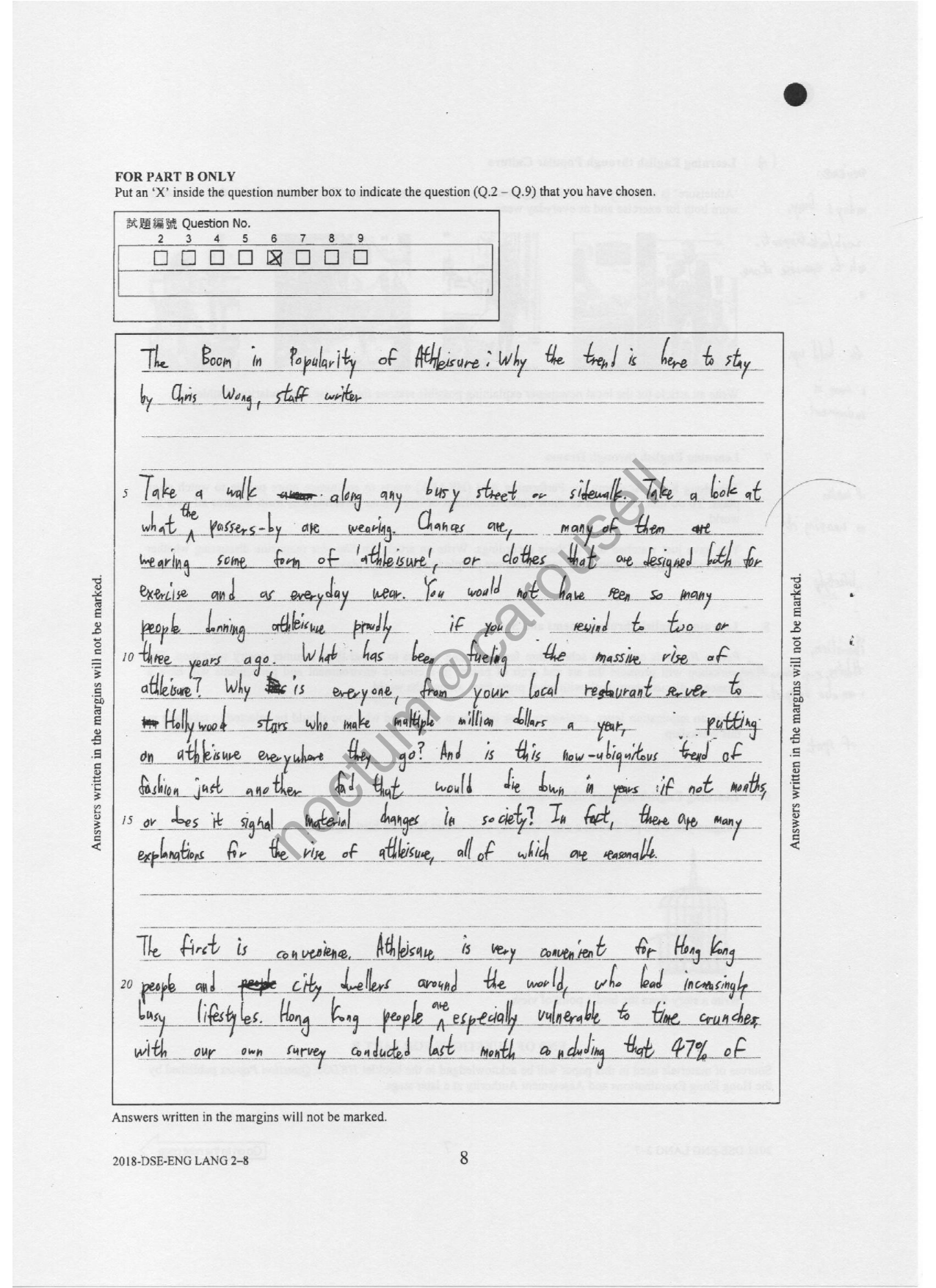
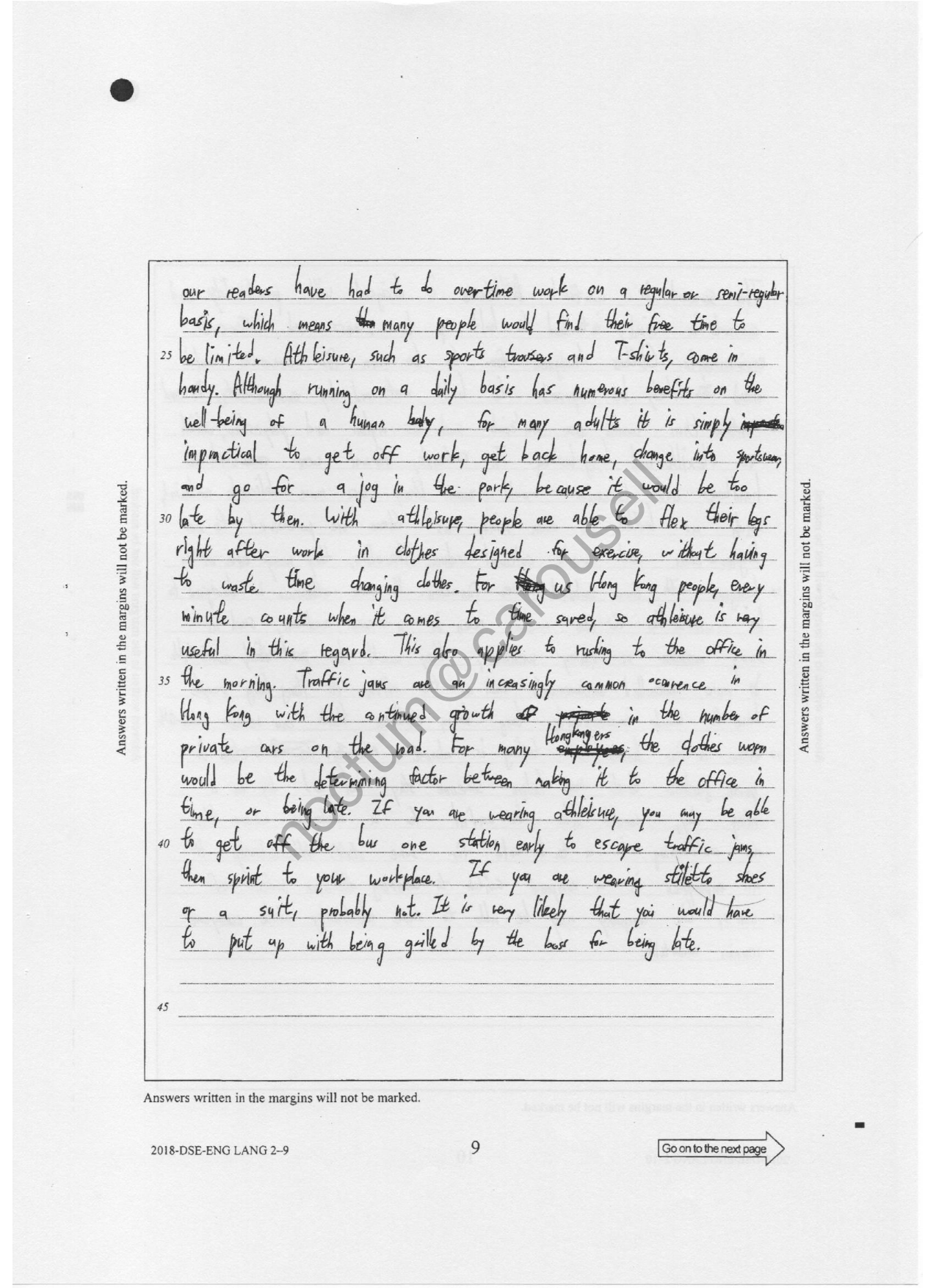
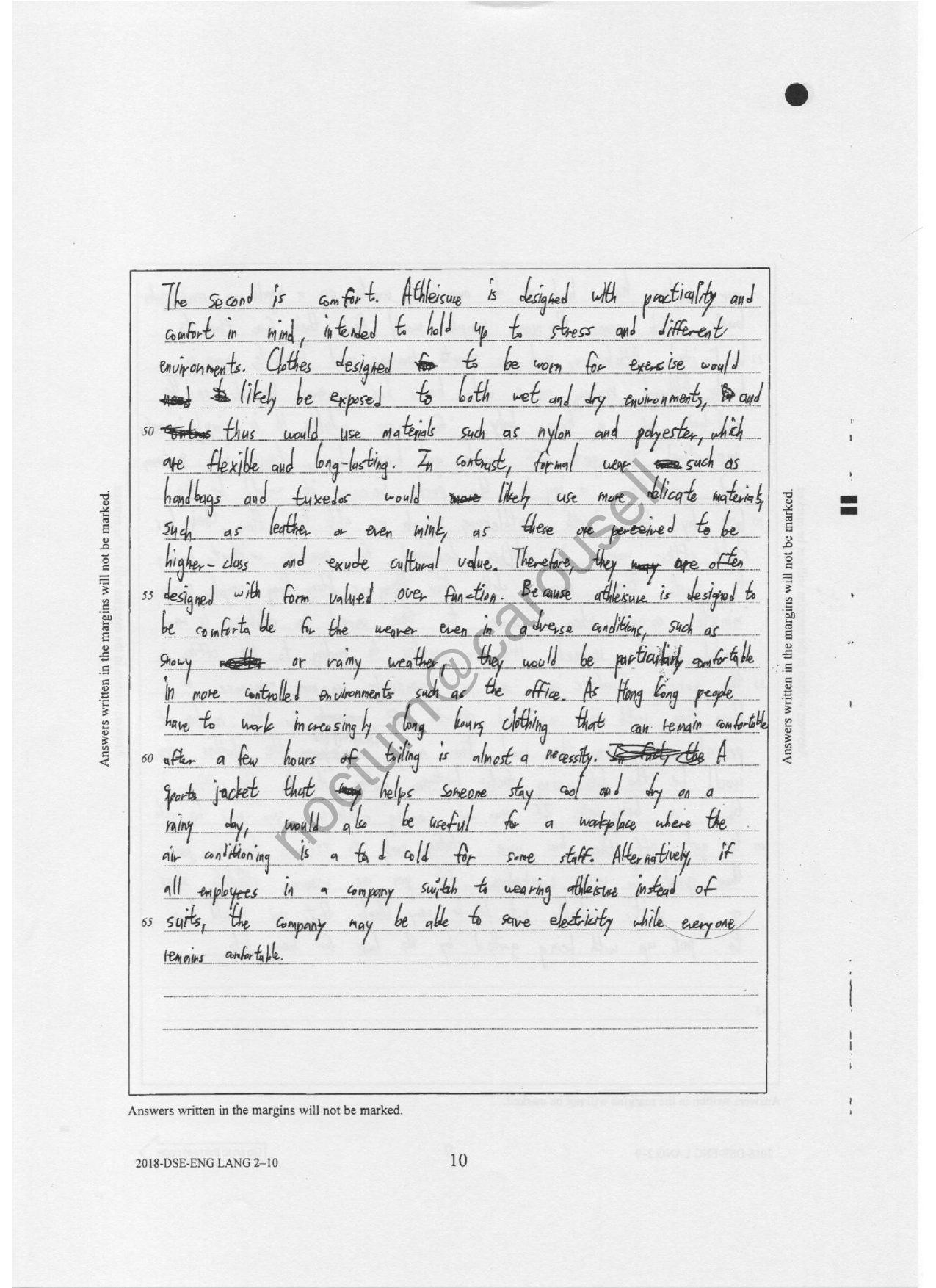


The writing, with corrections marked inline
Dual-band convention. Per-piece reported as 5** (this piece) · 5* overall. This is the candidate’s strongest answer; the Part B Q6 article reaches the 5** band that the Part A letter falls just short of.
Strongest piece in the Q6 set. The companion Q6 piece in this batch (candidate 2018-004) earned 34/42; this one earned 40/42 on the same prompt. The 6-mark gap is what separates a low 5* from a mid-5** on a Q6 article.
Word count. Approximately 700 words against the ~400 brief — about 75% over. The longest 2018 Part B piece in the collection.
Analytic breadth that earns the 5** band. Five distinct reasons, each in its own domain: busy lifestyles + time-saving (sociological), traffic + commuting (urban-infrastructure), materials & comfort (technical / textile science), celebrity culture (popular media), female empowerment (gender / social change), price accessibility (economic). Each reason gets a paragraph; no reason overlaps with another. This kind of analytic breadth on a single topic is what 5** writers reach for — the typical 5* candidate produces three reasons and stops.
The female-empowerment paragraph is genuinely original. No other Q6 piece in the collection makes the gender-norms argument. The candidate notices that the rise of athleisure in women’s wardrobes parallels the rise of women in athletic visibility, and frames the casualisation of female dress as a feminist outcome. This kind of cross-domain observation is what distinguishes a 5** mind.
The byline format is a real newspaper convention. “By Chris Wong, staff writer” positioned under a centred title with subtitle. None of the other Q6 candidates in the collection (Athleisure or any year’s article prompt) takes the byline format this seriously. It signals to the marker, from the page’s first line, that the candidate knows what a newspaper article looks like.
Why this is 5** and not perfect. Two reasons. (1) A small number of sentence-level wobbles still occur (raised ten or twenty years ago, traffic jams and accidents course severance, they may use materials designed with form valued over function). (2) The female-empowerment paragraph is the shortest and least developed of the six — the strongest analytic move in the piece carries the least space. With those two fixed, this would be 21+21.
Strengths to praise
“The Boom in Popularity of Athleisure: Why the Trend Is Here to Stay — By Chris Wong, staff writer.” Title with colon-subtitle structure, byline with role designation. The page opens looking like an actual newspaper article. This is the single most important text-type fit move at the start.
“Take a walk along any busy street in Mongkok, take a look at what the passers-by are wearing.” (lines 1–2) The article isn’t about athleisure in the abstract; it’s about athleisure on the Hong Kong street. Naming Mongkok in the first sentence anchors the global trend in the reader’s lived environment.
“Our own survey conducted last month indicating that 47% of our respondents have had to do overtime work on a regular or semi-regular basis.” (lines 17–19) The candidate cites a fictional but plausible survey, attributed to the newspaper itself (our own survey). This is the move trend journalism makes: anchor the qualitative claim in a quantitative number that can be referenced.
“With athleisure, people are able to take their dogs out right after work in clothes designed for exercise — they don’t have to waste time changing.” (lines 24–26) The reader who has been at work all day can picture this. The abstract claim about ‘busy lifestyles’ becomes a real scene the reader recognises.
“If you are wearing athleisure, you may be able to get off the bus a few stops earlier to escape the traffic jam, then sprint to your workplace. If you are wearing a suit, probably not.” (lines 34–37) A small but vivid image that turns the abstract ‘athleisure-saves-time’ claim into a recognisable HK commuter scenario. The two-sentence contrast (athleisure vs suit, sprint vs late-with-boss) is a real journalism move.
“Materials such as nylon and polyester, which are flexible and long-lasting… In contrast, formal wear… would more likely use natural materials, such as leather or cotton.” (lines 43–46) Four named materials in two contrasting sentences. The piece earns its analytic claim about ‘form vs function’ by naming what each side is actually made of.
“With the promotion of social liberalism and female empowerment, women nowadays are encouraged to throw the concept of modesty away and wear whatever they feel comfortable wearing… such designs would previously have been considered too tomboyish in the past.” (lines 84–89) Connecting athleisure’s rise to changing gender norms is a cross-domain observation no other Q6 piece in the collection attempts. Even underdeveloped, it’s the kind of move that earns marker recognition.
“Stores or streetwear brands may charge from cheaper options at local brands like Giordano and Bossini, while more refined fashion athleisure designs may be picked from name brands such as Under Armour or Nike.” (lines 100–103) Naming two local and two international brands across a price range turns the abstract ‘athleisure is for everyone’ claim into something the reader can verify in any HK mall.
Grammar notes
| Issue | Explanation |
|---|---|
(line 2) more than not are wearing → more than not, they are wearing | The fixed phrase more than not needs a subject (they) before the verb. Without it, the sentence has no clear referent for the action. |
(line 5) if you were raised ten or twenty years ago → if this were ten or twenty years ago | The candidate’s raised reads as a pen-slip; raised ten years ago would mean ‘brought up’, which doesn’t fit the temporal-distance sense. The natural form is if this were ten years ago. |
(lines 16–17) vulnerable to time-crunches → vulnerable to the time crunch | Time crunch is usually singular (a state); the plural time-crunches reads as instances. Standard collocation: under time pressure, vulnerable to the time crunch. |
(line 18) 47% of our routine have → 47% of our respondents have | Pen-slip; routine isn’t a survey-population term. Respondents is the standard noun. |
(lines 19–20) too many people would find their free time to be limited → too many people find their free time limited | Cut the conditional would — the claim is empirical, not hypothetical. Drop to be; find their free time limited is the natural construction. |
(line 30) traffic jams and accidents course ‘severance’ → traffic jams and accidents cause severe disruption | Two slips: course (verb-form) doesn’t exist as a transitive verb meaning cause; the intended verb is cause. Severance means ‘the act of cutting or separating’ (or job-loss compensation); the intended sense is severe disruption. |
(line 40) intended to last up to stress → intended to stand up to stress | The fixed phrase is stand up to, not last up to. Stand up to means ‘resist or endure’. |
(line 51) outdated environments such as the office → indoor environments such as the office | The original’s outdated environments is a pen-slip; the meaning needs indoor environments (the office is indoor, not outdated). |
(line 52) clothing that are remain comfortable → clothing that remains comfortable | Subject is clothing (uncountable, singular), so remains. Also drop are — the candidate seems to have started with that are and then re-attempted with remain. |
(line 61) increasingly mindful to jobs that require little physical movement → increasingly moving to jobs that require little physical movement | The candidate likely meant moving (transitioning into); mindful to doesn’t fit the syntax (mindful takes of, not to, and the meaning here is migratory not attentive). |
(line 62) obsession of a healthy lifestyle → obsession with a healthy lifestyle | Obsession takes with: obsession with success, obsession with cleanliness. |
(line 63) seen in the western → seen in the West | The adjective western needs a noun (western world, western culture); to stand alone, capitalise as a proper noun: the West. |
(line 75) the boring fan of athletes’ attire → the growing fan base for athletes’ attire | Boring fan reads as a pen-slip for growing fan; with base added, the noun phrase becomes the standard collocation. |
(lines 85–86) throw the concept of modesty away → throw aside the concept of modesty / set modesty aside | The candidate’s throw away for an idea is informal; the standard collocation is set aside, cast off, or throw aside. |
(line 86) women are encouraged to… wear whatever they feel comfortable wearing → ok | Acceptable. The collocation wear whatever they feel comfortable in is even more natural. |
(lines 87–88) are not they aren’t being sports → even when not doing sports (best read) | This stretch reads as garbled; the intended sense (even when not exercising) needs major surgery. |
(line 92) increase in awareness and designed them → increase in variety and design | The candidate’s awareness and designed them doesn’t parse; the surrounding sentences are about athleisure’s aesthetic range, so variety and design is the most defensible read. |
(line 94) brands had to expand the world → brands had to expand their range | Expand the world isn’t a standard business idiom; expand their range, expand their product line, expand their portfolio is. |
Style suggestions (where 5** could become 21+21)
Professional rewrite — the opening (text-type fit + authenticity)
The opening is the candidate’s most genre-defining moment — title, byline, local-color image, thesis question. The first half (title, byline, Mongkok stroll) is genuinely 5**-band; the second half (the religious-trend question) is where the syntax collapses. A professional rewrite preserves every move and lands the thesis question cleanly. Text-type fit (newspaper-feature register) and authenticity (replacing student coinages with journalism collocations) drive the rewrite.
The student’s opening (corrected)
Rewritten by a professional newspaper writer
- The Mongkok image becomes a counting exercise. Count the leggings, the hoodies, the trainers. Twenty years ago, you would have counted half as many. Three named garments and a quantitative comparison instead of some form of athleisure. Real trend journalism leads with countable specifics.
- The temporal contrast is sharpened. Walked through the office door, and started turning up at family dinners. The original’s if this were ten or twenty years ago hints at temporal distance; the rewrite names two specific present-day locations (office, family dinners) where athleisure now appears.
- The thesis question is one clean line. So what changed? Three words. The candidate’s original takes two long sentences to ask the same thing and loses the syntax along the way.
- Authenticity move — the rhetorical-question structure is fixed. Why is it that everyone — from the restaurant owner at the corner shop to the Hollywood star at the airport — now wears athleisure in places athletes used to be the only ones to wear it? The em-dash insertion replaces the original’s tangled just amongst us, that would be there a guess. The two-extreme-class contrast (corner-shop owner / Hollywood star) is preserved; the syntax now carries it.
- The closing thesis sentence is a real article move. The answer isn’t fashion; it’s how we live now. A short declarative thesis that the rest of the article will defend. The candidate’s original (there are many explanations… all of which are examined below) is procedural; the rewrite is rhetorical.
- The roadmap line previews the structure. The six forces that have driven athleisure’s march out of the locker room and into our wardrobes. Tells the reader the article has six sections (one per force), and frames the journey as a march. Six concrete forces instead of many explanations gives the reader something to count down.
Vocabulary to notice
| Word | Definition | Usage notes |
|---|---|---|
| athleisure | (n.) clothing designed for athletic activities but worn for everyday casual wear. | Newer English word (2010s). Always lowercase. The genre-defining vocabulary item for this prompt. |
| passers-by | (n., plural) people who happen to be going past at a particular moment. | Hyphenated plural: passers-by, not passer-bys. Useful for streetscape openings. |
| time crunch | (n. phrase) a period during which there is not enough time. | Often singular: under the time crunch, suffering from time crunch. The candidate’s plural time crunches is less idiomatic. |
| come in handy | (phr. v.) to turn out to be useful. | Standard everyday-English idiom: those binoculars will come in handy, athleisure comes in handy. |
| stand up to (stress) | (phr. v.) to remain firm against pressure or force. | The candidate’s last up to stress is a near-miss for this phrase. Pairs with scrutiny, pressure, weather, time: stand up to scrutiny, stand up to wear and tear. |
| nylon / polyester | (n.) synthetic fabrics used in athleisure for their flexibility and durability. | Pairs with blend, fibre, fabric: nylon-polyester blend, polyester fabric. Standard textile terms. |
| a tad | (adv., informal) slightly; a little. | Pairs with cold, expensive, late, much: a tad cold, a tad expensive. Conversational register; acceptable in feature articles but rarer in hard news. |
| opted (to / for) | (v.) chose. | The candidate’s opted to wearing needs the infinitive: opted to wear, opted for athleisure. Slightly more formal than chose. |
| subconsciously | (adv.) without one’s being fully aware of it. | Pairs with influence, register, absorb, lead: subconsciously lead people to pick, subconsciously absorb messages. Appropriate to trend-piece sociology. |
| idolize / idolise | (v.) to admire and revere excessively. | Pairs with celebrity, star, athlete, parent: fans idolize the player, teenagers idolise pop stars. AmE / BrE variants. |
| manifestation | (n.) an event, action, or object that clearly shows or embodies something. | Pairs with physical, visible, clear, outward: a manifestation of the athleisure boom, manifestations of inequality. The candidate’s use is appropriate. |
| female empowerment / women’s liberation | (n. phrase) processes and movements toward gender equality. | Current vocabulary in feature journalism. Pairs with movement, era, generation. |
| tomboyish | (adj.) (of a girl) behaving in a way considered typical of a boy; (of dress) traditionally masculine. | Slightly dated as a value-judgement; the candidate uses it in the historical sense (previously considered tomboyish), which is appropriate. |
| subdued / understated | (adj.) restrained in colour, ornament, or sound. | Pairs with colour, design, palette, decor: subdued colours, understated elegance, an understated design. The candidate’s use captures the workplace-fashion contrast. |
| eye-catching | (adj.) immediately appealing or noticeable. | Pairs with colours, design, headline, packaging: eye-catching patterns, eye-catching graphics. Standard fashion-journalism collocation. |
| cater to | (v.) to provide what is needed or wanted by. | Pairs with demand, taste, market, audience: cater to demand, cater to a younger audience. Business-feature collocation. |
| streetwear | (n.) casual clothing of a style worn especially by members of various urban subcultures. | Pairs with brand, label, style, culture: streetwear brand, streetwear culture. The candidate’s use is current and appropriate to the topic. |
| price segment | (n. phrase) a defined band of products at a particular price range. | Business vocabulary. Pairs with high-end, mid-range, low-end, every: cover every price segment, target the mid-range price segment. |
Leave a Reply