Debate Speech — Abolishing the Reporting of Students’ Class Position
You are representing your school at an inter-school debating competition. The motion is: ‘The policy of reporting students’ class position should be abolished.’
(The prompt also includes a sample class list showing student names with subject grades and a column for Overall Position, to provide context for what ‘class position’ refers to.)
Write a debate speech arguing for OR against the motion. (~400 words)
Candidate 2018-008 argues for the motion (affirmative) — pair-comparison with candidate 2018-005 (proposition, 42/42 PERFECT) in the same collection.
Show original handwritten pages (5)
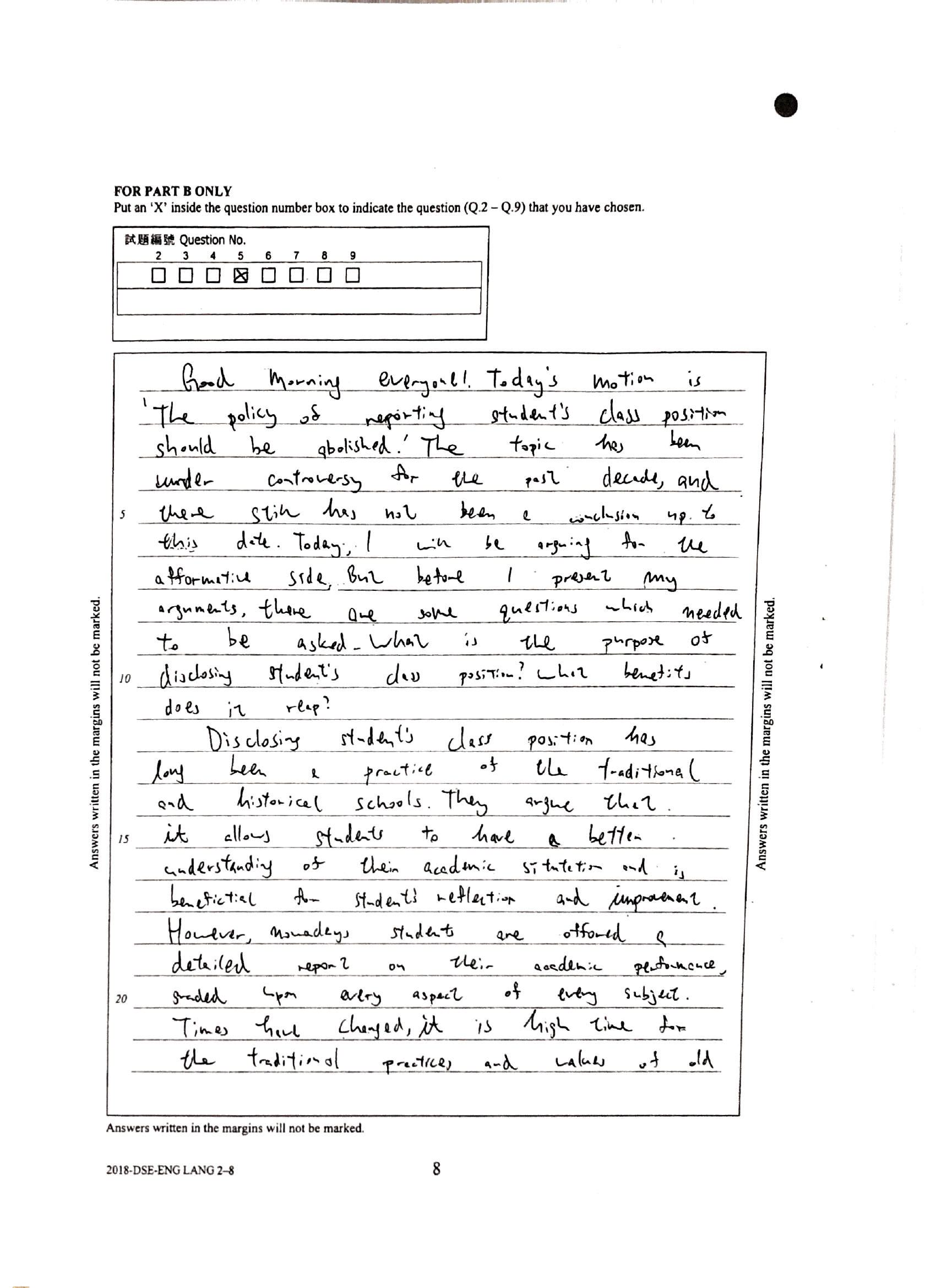
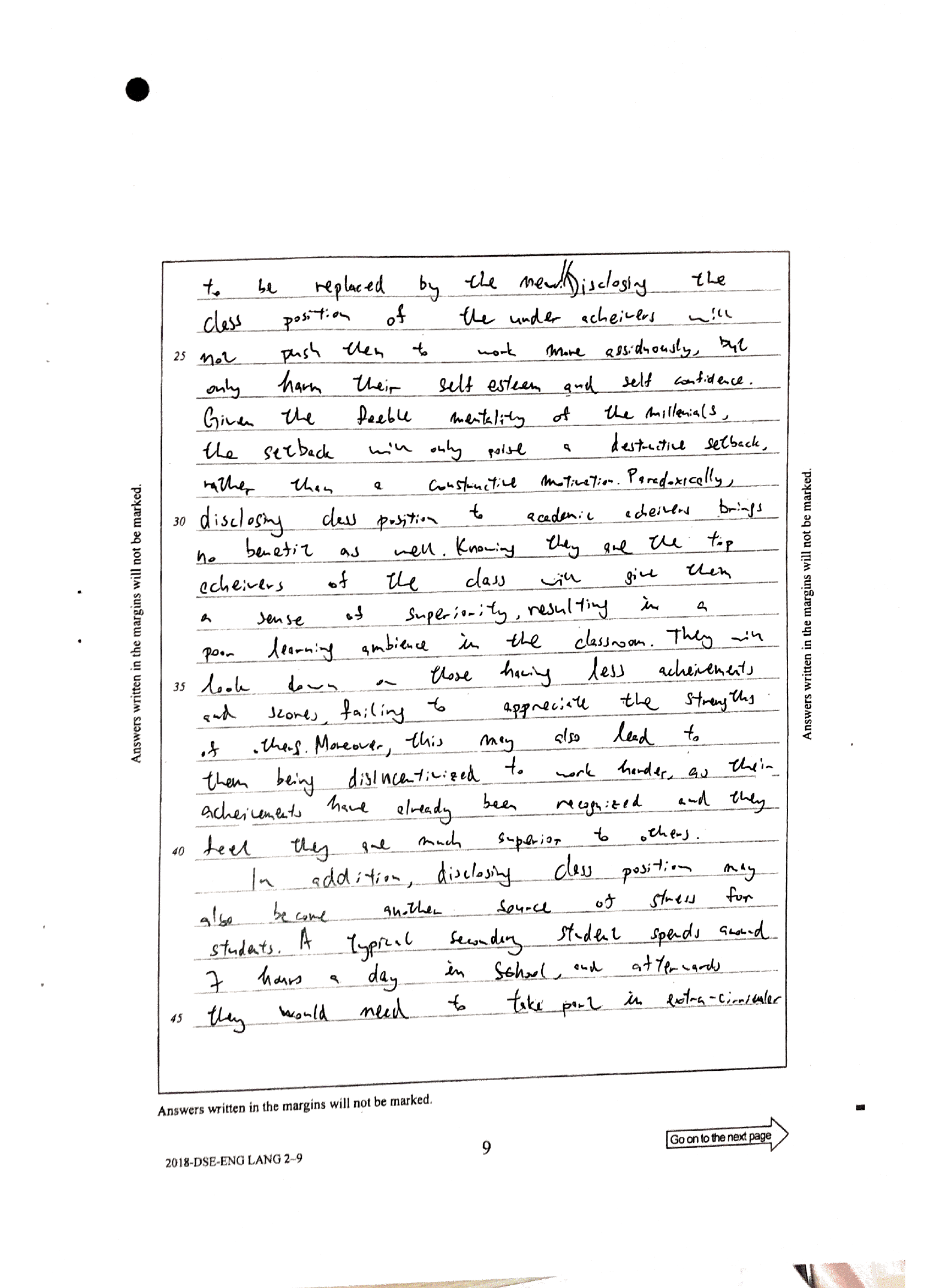


The writing, with corrections marked inline
Word count. Approximately 600 words against the ~400-word brief — roughly 50% over, on a par with the perfect-marks Q4 piece in the same year.
Dual-band convention. Per-piece grade is reported as 5** (this piece) · 5* overall because the candidate’s overall English Language subject grade is 5*, but the marks on this individual answer land in the 5** band.
Structural read. The speech follows textbook debate architecture: greeting + motion + topic framing (Para 1, lines 1–11) → refutation of the historical defence (Para 2, lines 13–41: under-achievers + top achievers) → HK-stress argument (Para 3, lines 43–67) → opposition steel-man (Para 4, lines 69–78) → opposition rebuttal (Para 5, lines 80–93) → personal-experience conclusion (Para 6, lines 95–106). The opposition acknowledgement is the move that lifts the piece above many candidate debate speeches at the 5* boundary — though, as Suggestion 5 below notes, the candidate’s framing of that acknowledgement is the single move that needs the most repair.
What separates this from the perfect-marks Q5 proposition piece (candidate 2018-005). Both candidates over-write substantially, both reach for sophisticated vocabulary, both build clean tripartite arguments. The differences: (1) the perfect-marks piece never lets a sentence fall apart structurally — this one has at least three sentences where the syntax breaks (lines 25–29, 88–93, 103–104); (2) the perfect-marks piece reinforces its persona at every sign-post — here the ‘debater’ voice flickers in the middle paragraphs; (3) the perfect-marks piece names sources (HKU Faculty of Social Science survey with 65% / 48% figures) — here the closest equivalent is the 7-hours / 2-hours figure at lines 45–48, which is excellent but isolated. Two or three additional specific citations would have moved this to 21 + 21.
Strengths to praise
“What is the purpose of disclosing students’ class position? What benefits does it reap?” Two questions, posed to the audience, that immediately put the burden of proof on the policy’s defenders. This is a classic debate move — before refuting, force the other side to justify the status quo — and the candidate executes it cleanly.
Affirmative side, under controversy, arduously, double whammy, destructive setback, ambience, disincentivised, staggering, pressurised, susceptible, fallacy, scourge, conviction. The vocabulary doesn’t sit decoratively — disincentivised (line 39) compresses the “they stop working hard because they’ve already won” idea into a single verb; scourge (line 103) in the conclusion makes the closing claim sound civic and weighty.
The candidate doesn’t just say “class rankings demotivate weak students” — they make a symmetrical case: rankings hurt weak students (lines 23–29) and they make strong students complacent (lines 30–41). Showing that the policy fails at both ends of the class is rhetorically much stronger than picking only the more obvious half.
“A typical secondary student spends around 7 hours a day in school, and afterwards they would need to take part in extracurricular activities… around 2 hours.” The numbers may be approximate but they make the audience’s mental image vivid. Embedding the motion in the lived experience of the HK student is the kind of context-aware argument that lifts a debate speech out of the generic.
Paragraph 4 sets up the strongest plausible counter (‘class position promotes competition, competition improves achievement’), and Paragraph 5 (lines 80–93) refutes it (‘teenagers are susceptible… competition turns hostile… cheating… the friendly nature is eliminated’). Many candidate debate speeches forget the opposition entirely; this one engages it directly.
“Having studied in a school where the policy does not exist, I have been able to stay motivated while being relatively stress-free.” The candidate offers themselves as living evidence of the alternative they’re proposing. In debate the personal anecdote is often a closer’s tool — it humanises the abstract policy claim and gives the judges a face to anchor the position.
“Times have changed; it is high time the traditional practice was replaced by the new.” Conceding that the practice has historical legitimacy, then arguing that history isn’t a defence, is exactly the move needed to neutralise the ‘but we’ve always done it this way’ objection without seeming dismissive.
Grammar notes
| Issue | Explanation |
|---|---|
(line 9) questions which needed to be asked → need to be asked | The questions are being asked now (in the speech), not earlier. Present-tense passive: need to be asked. |
(line 11) What benefits to does it reap? → What benefits does it reap? | Stray to before the verb — almost certainly a pen-slip. |
(line 21) graded upon every aspect → graded on every aspect | Grades are given on a criterion, not upon. (Upon works in formal time expressions: upon arrival, upon reflection.) |
(lines 22–23) Times have changed, it is high time the traditional practices… to be replaced → Times have changed; it is high time the traditional practice was replaced | Two issues: (a) comma splice between the two independent clauses — use a semi-colon or full stop; (b) high time takes the past subjunctive: it is high time we left, not it is high time to leave. |
(line 25) will not just lead to work more arduously → will not just drive them to work harder | The verb lead needs an object (lead them to), and the adverbial more arduously can be replaced with the simpler harder for clean parallelism. |
(line 36) having less achievements → having fewer achievements | Countable noun rule: fewer with count nouns, less with uncountables. Achievements are countable (you can have one, two, several). |
(lines 38–39) this may also lead to them being disincentivised → ok / slight refinement | Acceptable. A tighter version: this may also disincentivise them, dropping the passive. |
(line 48) around 2 hours, which is → which account for around 2 hours | Verb agreement: the subject is activities (plural), so account, not is. |
(line 53) getting into a top university from the stiff competition → amid stiff competition | The competition isn’t a source they emerge from; it’s the medium they have to navigate. Amid or in the face of fits the picture. |
(line 58) nor would it have positive influence → nor would it have a positive influence | Missing article. Influence in this sense is a count noun: a positive influence, a corrupting influence. |
(line 80) On first place the argument seems to hold water → At first glance, the argument seems to hold water | On first place is not a standard English phrase. The idioms are at first glance, on the face of it, at first sight. |
(lines 82–83) Teenagers being susceptible and easily influenced by peers, will become → Teenagers, being susceptible and easily influenced by peers, will become | Comma placement: the participial phrase being susceptible… is non-restrictive, so it needs commas on both sides. |
(lines 88–89) resulting acts such as cheating → resulting in acts such as cheating | Result takes in: X results in Y, resulting in Y. |
(line 90) students could be effectively learn → students could not effectively learn | Almost certainly be is a mis-write for not. The sentence requires a negation to match damaged and cheating in the previous clauses. |
(lines 92–93) the fallacy that… would do not stand → does not stand | Subject is the fallacy, singular present-tense; does not stand is the natural form. (Would do not is grammatically tangled.) |
(line 101) I have stayed in conviction → I remain in the conviction / I remain convinced | Stay in conviction isn’t a fixed phrase in English; remain convinced is the natural form. |
(lines 103–104) a scourge rather than a blessing of the negative effects brought upon → a scourge rather than a blessing, given the negative effects it brings | The clause “of the negative effects brought upon” dangles — brought upon needs an object (upon whom?). Replacing it with a participial clause repairs the syntax. |
Style suggestions (where strong writing could become outstanding)
Professional rewrite — the opening (the strongest moment)
The opening is the candidate’s most confident move — greeting, motion, decade-long context, rhetorical questions, statement of side, all in one paragraph. A professional rewrite tightens the syntax and lets the rhetorical questions land as the centrepiece they’re designed to be.
The student’s opening (corrected)
Rewritten by a professional debater
- Conventional debate framing. “The motion before this House is… I propose it.” This is the formula adjudicators expect; the original’s “I will be arguing for the affirmative side” is correct but loose.
- The two questions are placed where they can do their rhetorical work. The original buries them after “some questions which need to be asked”; the rewrite makes them the structural device of the speech.
- The second question turns the attack outward. “Whose interests, exactly, does it serve?” is sharper than “what benefits does it reap?” because it implies the policy serves someone — presumably not students — and demands the opposition name them.
- The closing line previews the structure. “On both counts the policy is indefensible” tells the audience the speech will answer both questions and find them wanting. The original’s closing sentence (“What benefits does it reap?”) is itself one of the questions, leaving no preview.
Professional rewrite — the opposition steel-man paragraph (the weakest moment)
Paragraph 4 in the original tries to do two things at once: name the opposition’s argument and seem to endorse it (“a class position should not be abolished”). The result is a paragraph the audience can’t parse — is this the candidate’s view or the opposition’s? A professional debater would explicitly flag the move.
The student’s paragraph (corrected)
Rewritten by a professional debater
- The framing is announced. “I anticipate the opposition’s strongest reply, and I want to engage it honestly.” The audience now knows: this paragraph is a steel-man, not a concession.
- The opposition’s case is stated in their best light. “Ranking creates competition, competition creates effort, effort lifts the whole class.” The three-clause cadence mimics the rhetorical move opponents themselves would use — the steel-man works only if the audience finds the opposition’s case temporarily attractive.
- The most attractive specific is named. “Take the strong student off the leaderboard and the weak student loses a target to chase.” This is the concrete mechanism the opposition would point to; naming it is the move that earns the right to refute it.
- The pivot to the rebuttal is announced. “I will now show why it does not survive contact with how teenagers actually behave.” The candidate’s next paragraph (susceptibility, cheating) is given its target ahead of time; the audience knows where the argument is going.
Vocabulary to notice
| Word | Definition | Usage notes |
|---|---|---|
| affirmative side | (n. phrase, debate) the side proposing the motion. | The opposite is the negative side. Always paired in debates: I will be arguing for the affirmative / negative side. The British convention is proposition / opposition. |
| controversy | (n.) prolonged public disagreement. | Pairs with under, surrounding, over: the issue is under controversy, surrounded by controversy, the controversy over X. |
| arduously | (adv.) with great effort and difficulty. | Adjective: arduous. Pairs with work, climb, journey, task. More formal than hard. |
| ambience | (n.) the character or atmosphere of a place. | Soft, often positive connotation: a calming ambience, a friendly ambience, the ambience of the classroom. Variant spelling ambiance (French) is also accepted. |
| disincentivise | (v.) to discourage someone from doing something by removing an incentive. | Newer verb but well-established in policy and education writing. The reform disincentivised early retirement; the bonus structure disincentivised collaboration. |
| staggering | (adj.) astonishingly large or shocking. | Pairs with numbers, statistics, sums: a staggering 90%, a staggering loss, the figure is staggering. Works well in argumentative writing. |
| pressurised | (adj./v., BrE) subjected to pressure. | Note: in physics use pressurised cabin; in social use HK English / British English uses pressurised students where American English would say pressured. |
| susceptible (to) | (adj.) easily influenced or affected by something. | Takes to: susceptible to colds, to flattery, to peer pressure. The collocation teenagers being susceptible to peer pressure is standard. |
| fallacy | (n.) a mistaken belief, especially one based on faulty argument. | Pairs with logical, common, popular. The verb is commit a fallacy; the rebuttal phrase is this is a fallacy because…. |
| scourge | (n.) a cause of great suffering, often used metaphorically. | Pairs with social ills: the scourge of unemployment, the scourge of racism, the scourge of bullying. Slightly biblical/civic register — works well in formal closings. |
| conviction | (n.) a firmly held belief. | Pairs with deep, strong, personal, religious. I remain convinced / I hold the conviction that… — useful for closing positions. |
| whammy | (n., informal) a powerful blow, especially a disadvantageous one. | Usually double whammy, occasionally triple whammy. Informal register — tone is closer to journalism than to formal debate. |
| on solid ground | (idiom) on a firm and defensible basis. | Often negated: the argument is on no solid ground, the claim does not stand on solid ground. Useful rebuttal phrase. |
| hold water | (idiom) to be sound, defensible, or logically valid. | Almost always used with arguments, claims, or theories: the theory does not hold water, the argument holds water on the surface but not in detail. |
| at first glance | (idiom) on first impression, before closer examination. | Standard rebuttal opener: At first glance the argument seems plausible, but…. Variants: on the face of it, at first sight, prima facie. |
| steel-man | (v./n., rhetorical) to present an opposing argument in its strongest form before refuting it. | Opposite of straw-man (presenting it in its weakest form). The steel-man is the move debate judges reward most heavily. |
Leave a Reply