Letter to Parents — Sky100 School Trip
You are Chris Wong, the class teacher of 6A. You will be taking your class on a school trip next month to sky100, shown in the poster below. Write a letter to parents giving them the necessary information about the trip. You may use the mindmap to help you write your letter. (~200 words)
Mindmap (suggested topics): Transportation · Cost · Purpose of trip · Lunch · ? (one blank for the candidate to fill).
Show original handwritten pages (3)

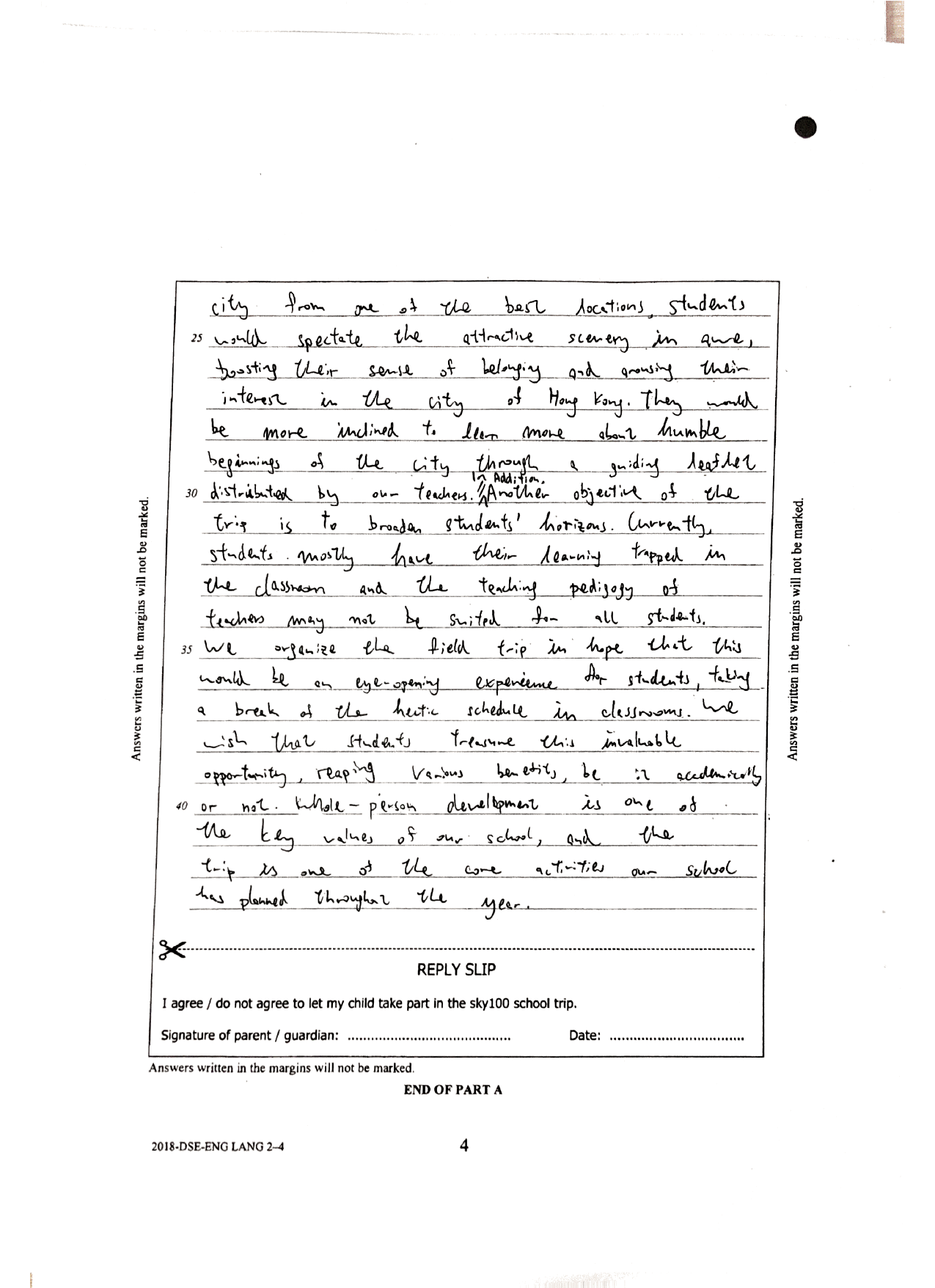

The writing, with corrections marked inline
Word count. Approximately 340 words against the ~200-word brief — about 70% over. Tighter than the perfect-marks 2018-001 letter (420 words) but still substantial.
Transcription caveat. The handwriting on this piece is small and cramped, particularly on page 22 (the purpose paragraphs). Several phrases were marked unclear — the most defensible reads have been used in the inline corrections, with yellow highlights on phrases the transcriber is least confident about. Coaches may want to consult the original page image when working with this analysis.
Where the marks come from. The Content / Organisation criteria are well-served: the letter has six clean paragraphs (purpose → timing → historical objective → pedagogical objective → cost / lunch → close), each with a defined function. The Language criterion is where the 5* / 5** gap shows — sentence-level syntax stumbles in places (the ‘planning to be enjoyed’ / ‘dorm volatile’ / ‘key valve’ phrasings on page 22 are the worst offenders), and the resulting impression is of a fluent but occasionally over-reaching writer.
Notable design choice. Unlike the 2018-001 letter (which sends students to the school canteen for lunch to save cost), this candidate has the school provide lunch as part of the $200 trip cost. Both are defensible answers to the same mindmap prompt; the contrast is useful for coaching on how the same brief admits more than one rational logistics plan.
Comparison with the other 2018 Part A pieces. Vocabulary range here is mid-tier (field trip, attraction, vantage points, eye-opening, invaluable, queries) — less ambitious than 2018-001’s vocabulary (conducive, alluring, entrepot, bolster, hone, envisaged), and similar to the 2018-007 piece. The structural fluency is comparable across all three.
Strengths to praise
“The school has decided to organise a field trip for students to Sky100.” The first-person plural (the school… we believe) is the right register for a class teacher writing on the school’s behalf. Many candidates start with “I am writing to inform you…”; this candidate writes from the institutional “we”, which is the more appropriate voice for a school-trip announcement.
13th May, Saturday, 9:30 gate, dismissed at 5 in the afternoon. Four concrete time-anchors in two sentences. The parent knows the date, the day of the week, the morning rendezvous, and the afternoon return. The 2018-001 letter mentions a 12:00–3:00 window but doesn’t name the day of the week or the gate time; this one is more useful as a planning document.
The historical/cultural objective (lines 19–29: grasp the historical background… sense of belonging towards the city) and the pedagogical objective (lines 30–43: learning confined in the classroom… eye-opening experience) are given separate paragraphs with their own framing. The structure is sound even where the sentence-level prose tangles.
“Students mostly have their learning confined in the classroom, and the teaching methods may not be suited for all students.” This is a real claim, not a generic platitude — it acknowledges that different students learn differently, and positions the trip as a remedy. Parents whose child struggles with classroom learning will read this as speaking to their situation.
“The total cost of the trip is $200, which includes transportation costs and lunch.” A parent who only reads the cost paragraph still knows what they’re paying for and what’s included. (Compare with the 2018-001 letter, which gives the breakdown $150 + $20 — both are defensible designs.)
Unlike candidate 2018-001 who sends students to the school canteen, this candidate has the school provide lunch as part of the trip cost. The choice is logistically simpler (no two-stop morning) and signals that the school takes responsibility for the day end-to-end. Either choice is correct; this one trades $30 for convenience.
“Should you have any queries, please do not hesitate to contact the school… We will try to get back to you as soon as possible.” The construction Should you + verb is a formal-letter convention that signals genre-awareness; the closing promise of responsiveness pre-empts the parental anxiety about being ignored. Both moves are standard but well executed.
Grammar notes
| Issue | Explanation |
|---|---|
(line 5) it is a guidance for students → it is a good opportunity for students | Guidance is uncountable and abstract (advice given to someone); a trip is not a guidance. Opportunity is the right noun for the role the trip is playing. |
(line 6) to look at the classroom → to look beyond the classroom | The point of the trip is to step outside the classroom, not to look at it. Almost certainly a phrasing slip; the intended sense is beyond. |
(lines 16–17) planning to be enjoyed at experience and feeling → (syntactically tangled) | This phrase couldn’t be cleanly repaired with one-word fixes. The intended sense seems to be spending time enjoying the experience and the views. The structure planning to be enjoyed at + noun isn’t a valid English construction. |
(lines 21–22) provide students the opportunity → provide students with the opportunity | Provide takes with: provide students with materials, with feedback, with opportunities. |
(line 25) witness the extreme history Hong Kong is → witness the rich history Hong Kong has | Two refinements: (a) extreme doesn’t collocate with history (extreme suggests intensity at one end of a scale; rich, fascinating, complex fit history); (b) the verb is after a noun (history Hong Kong is) is grammatically loose — has as in Hong Kong has a history of is the natural form. |
(lines 27–28) they may not be involved to lean about → they may not have been involved in learning about | Three fixes: tense (may not have been), preposition (involved in, not to), and the verb (learning, not lean). The last is almost certainly a pen-slip. |
(line 29) our upbringing of the city → the city’s development | Upbringing refers to how a child is raised; cities have development or growth, not an upbringing. |
(line 32) learning trapped in the classroom → learning confined in the classroom | Trapped carries a negative emotional charge (suggesting students don’t want to be there); confined is more neutral. In a parent letter the candidate doesn’t want to suggest the classroom is a problem. |
(line 33) the teaching pedagogy of teachers → the teaching methods | Two issues: pedagogy already means ‘teaching method’, so teaching pedagogy is redundant; of teachers is also redundant (whose else would the pedagogy be?). One short noun phrase replaces a tangled one. |
(line 35) in hope that → in the hope that | Missing definite article. In the hope that + clause is the fixed phrase. |
(lines 37–38) taking a break of the dorm volatile in classroom → taking a break from the classroom routine | This phrase appears garbled; the intended sense seems to be a break from routine classroom work. Dorm volatile is not a standard English collocation and may be a transcription error. |
(lines 38–39) students receive less invaluable opportunity → students receive an invaluable opportunity | Less invaluable is contradictory — invaluable already means extremely valuable; less + invaluable creates a double-negative that the sentence can’t cash. Drop less. |
(line 40) it is undoubtedly is → it is undoubtedly | Double verb — the second is is a repetition slip. Cut. |
(lines 40–41) the key valve of our school → part of the key values of our school | Two refinements: valve → values (almost certainly a pen-slip or transcription error); and part of the key values is the standard collocation. |
(line 43) alongside the year → throughout the year | Alongside means next to, in parallel with; it doesn’t pair with a time span. Throughout the year is the natural temporal modifier. |
(line 46) the lunch from the student → (transcription unclear) | This phrase’s intended sense is uncertain. The most likely read is lunch [provided] for the students; from the student would mean the student is supplying the lunch, which contradicts the next clause (organised and provided by the school). |
(lines 48–49) enjoy the classroom and be rewarded with interest knowledge → enjoy the trip and be rewarded with the knowledge they pick up | Two fixes: enjoy the classroom contradicts the earlier ‘break from the classroom’ framing — almost certainly meant enjoy the trip; interest knowledge is non-standard — interesting knowledge, but better still the knowledge they pick up. |
Style suggestions (where strong writing could become outstanding)
• Cost: HK$200 per student (paid by the school’s standard trip-payment slip)
• Included: coach transfer to Sky100; entrance fee; school-provided lunch
• Subsidies: available on request from the form office
Professional rewrite — the historical-objective paragraph (the strongest moment)
The candidate’s best move is the ‘sense of belonging towards the city’ framing — positioning Sky100 not as sightseeing but as historical orientation. A professional rewrite tightens the argument and lets the inter-generational frame carry the weight.
The student’s paragraph (corrected)
Rewritten by a professional letter-writer
- The pedagogical claim is announced in five words. We want the students to see the city. The original takes 30 words to get to the same place.
- The vantage point is concrete. The harbour, the cargo cranes, the new towers — three named features the parent can picture, instead of one of the best vantage points.
- The inter-generational frame is named. Most teenagers know the MTR map of the city and not much else… the kind of sense of place their parents grew up with. The original gestures at this idea (they may not have been involved in learning…); the rewrite states it plainly, and gives the parent a generational claim to nod at.
- The closing line lands the argument as a deliberate gift to the parent. An attempt to give them… — signalling that the school is acting on the parent’s behalf, which is the unspoken contract a class-teacher letter is bound by.
Professional rewrite — the pedagogical-purpose paragraph (the weakest moment)
This paragraph has the most syntactic breakdowns in the piece — dorm volatile in classroom, less invaluable opportunity, key valve, alongside the year. The candidate’s instincts are right (classroom learning has limits, the trip is part of school values) but the sentences can’t carry the load. A clean rewrite preserves the substance.
The student’s paragraph (corrected)
Rewritten by a professional letter-writer
- One paragraph, one claim. We want to teach in a different setting. The original packs three different claims (classroom limits, trip benefits, school values) into one paragraph; the rewrite makes the first the topic sentence and lets the others support it.
- The pedagogical mechanism is named, not metaphorised. Often catches the students who don’t catch fire indoors — concrete claim about a specific group of students. The original’s eye-opening experience to students is a generic placeholder.
- The institutional frame is short and authoritative. The school runs four such trips a year as part of our whole-person learning programme. The original tries to claim institutional weight (key valve / values of our school) but loses the sentence to a coined collocation. Replacing it with a specific number (four such trips a year) and a named programme does the same work without the wobble.
- The closing line is one word longer than necessary, deliberately. This is one of them. The two-beat sentence registers as the close, signalling to the parent that the paragraph is done and the next thing is logistics.
Vocabulary to notice
| Word | Definition | Usage notes |
|---|---|---|
| field trip | (n.) an educational excursion outside school. | Distinct from school trip in some registers (field trip implies pedagogical focus; school trip is more generic). The candidate uses both, which is fine. |
| attraction | (n.) a place that people visit for interest or enjoyment. | Pairs with tourist, popular, main, top: tourist attractions, the main attraction, the top attraction in the city. |
| vantage point | (n.) a position giving a good view. | Often used metaphorically: from this vantage point, from the vantage point of history. The literal sense (one of the best vantage points) suits a Sky100 letter. |
| grasp (v.) | (v.) to understand fully. | Pairs with abstract objects: grasp the concept, grasp the history, grasp the importance. Stronger than understand; suggests effortful comprehension. |
| ownership (towards) | (n.) a sense of personal investment or responsibility. | Usually pairs with of rather than towards: ownership of the project, ownership of the decision. Sense of ownership towards the city is HK English — defensible but less standard. |
| eye-opening | (adj.) revelatory; causing one to see something new. | Pairs with experience, journey, day, encounter: an eye-opening trip, an eye-opening conversation. Common in school-letter and travel writing. |
| invaluable | (adj.) extremely valuable. | Note: invaluable means too valuable to be valued (a positive). Doesn’t combine with less: there’s no scale to be less on. |
| pedagogy | (n.) the method and practice of teaching. | Already means teaching method; the phrase teaching pedagogy is redundant. Use one or the other. |
| queries | (n., plural) questions or doubts. | Standard letter-close usage: any queries, should you have any queries, queries should be directed to…. Slightly more formal than questions. |
| do not hesitate | (verb phrase) the conventional formula for an open invitation to contact. | Almost exclusively used in formal correspondence closings: please do not hesitate to contact us, do not hesitate to call. Fixed phrase. |
| organise (BrE) / organize (AmE) | (v.) to arrange or plan. | HK English uses BrE spelling. Pairs with trip, event, programme, activity: the school has organised a trip. |
| shuttle (n.) | (n.) a bus or vehicle running a regular service between two points. | Pairs with service, bus, train: a shuttle bus to the airport, the school shuttle, a shuttle service. |
| dismiss | (v.) to allow students to leave at the end of a session. | Standard school usage: classes are dismissed at 3:30, students will be dismissed at the gate. Different from dismiss (= reject) in argumentative writing. |
| throughout (the year) | (prep.) continuously during a period. | Pairs with time spans: throughout the year, throughout the term, throughout the day. Replaces alongside when the meaning is ‘over the course of’. |
| whole-person development | (n. phrase) the HK education stock phrase for development across intellectual, social, physical, moral, and aesthetic dimensions. | Standard HK school-policy term. Parents recognise it immediately as code for more than just academic results. |
Leave a Reply