‘Passion is the fire that lights your way’ — an advice column to a would-be vet (Part B)
You write an advice column for Teen magazine and you have received the following letter:
Write a reply giving advice. (about 400 words)
Show original handwritten pages (5)
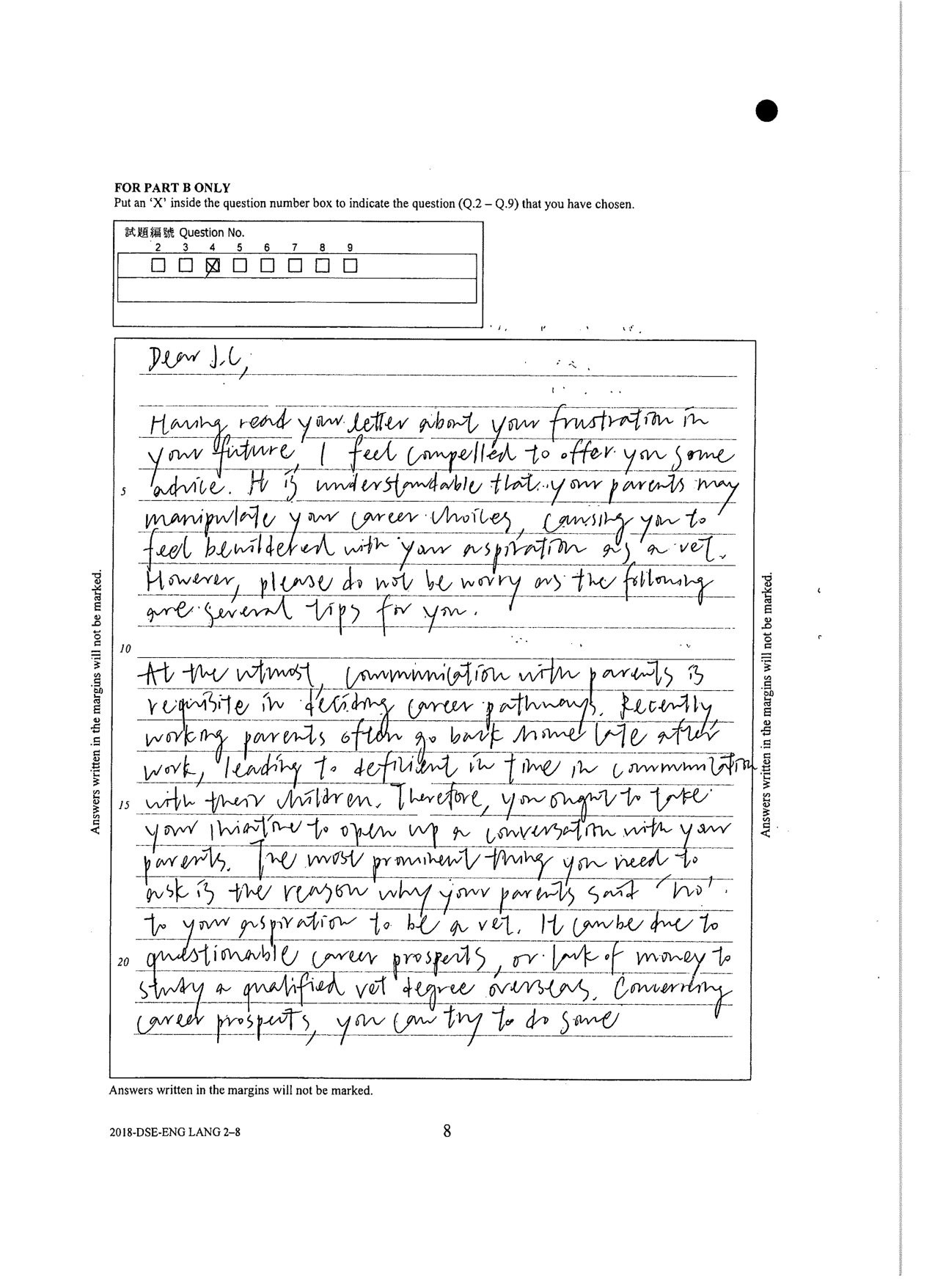


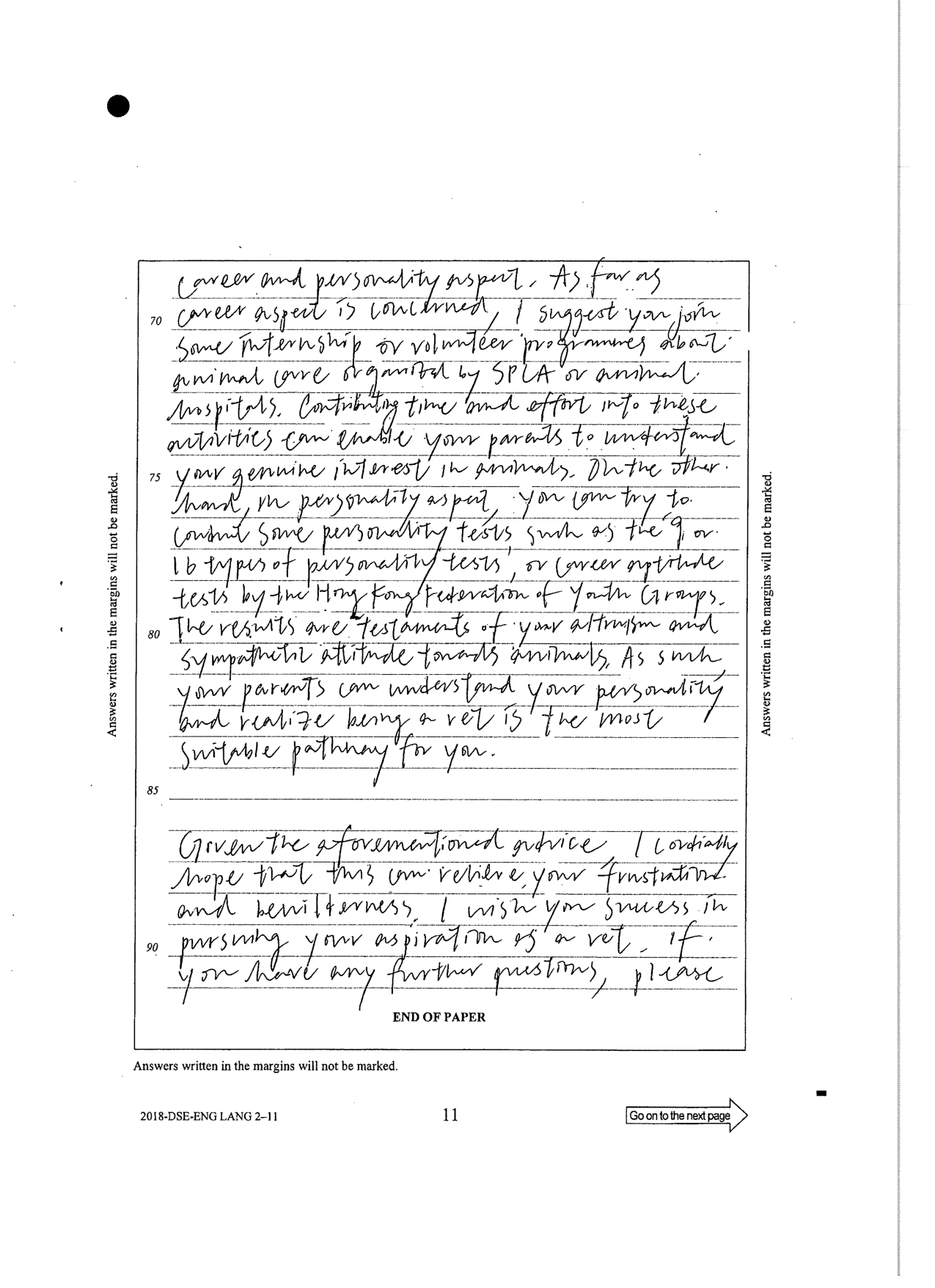
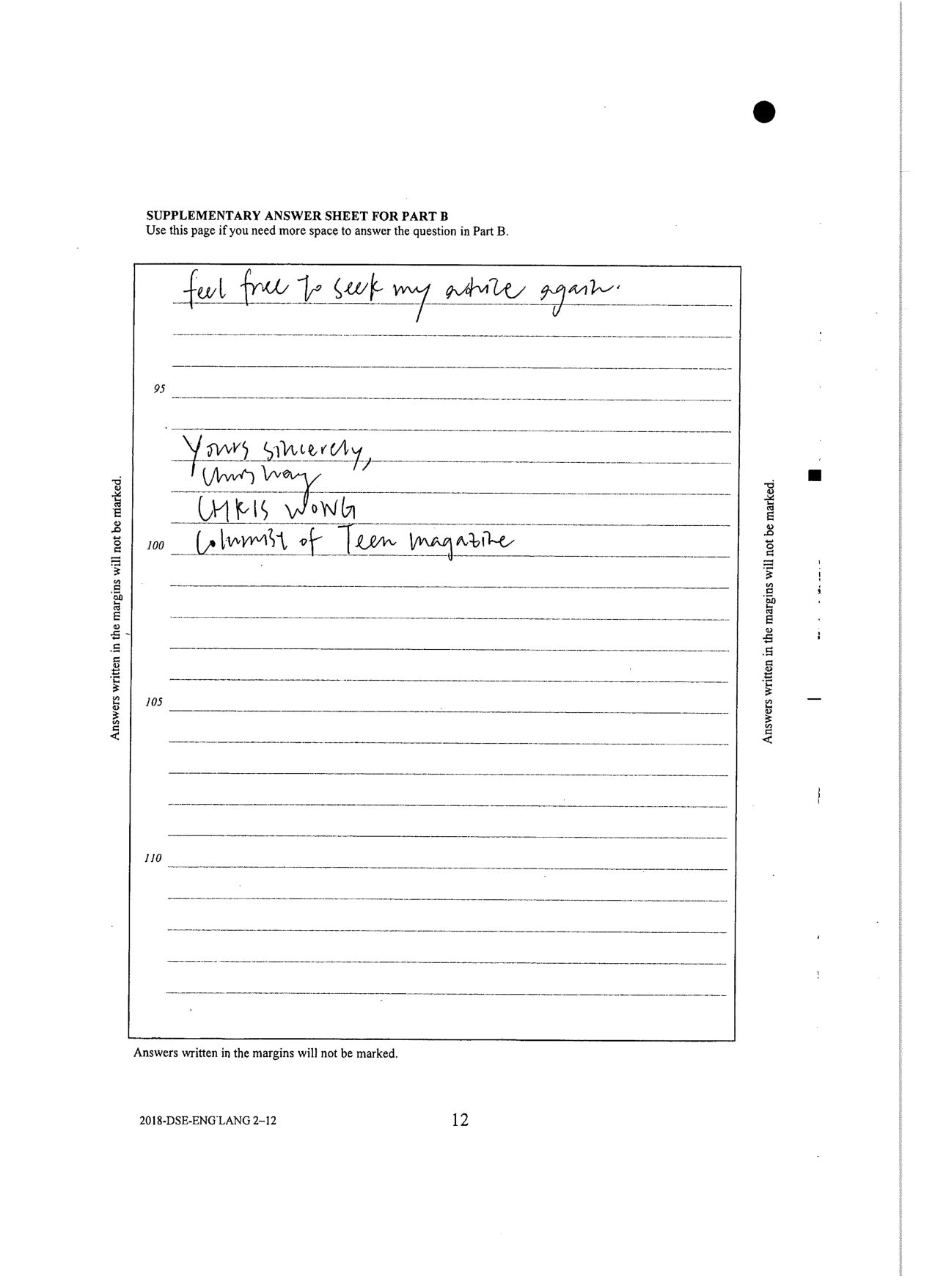
The writing, with corrections marked inline
Strengths to praise
It opens by naming and validating the reader’s feeling (“It is understandable that your parents may… causing you to feel bewildered”), promises help (“the following are several tips for you”), and closes warmly as a columnist (“feel free to seek my advice again. Yours sincerely, Chris Wong, Columnist of Teen magazine”). Pitch-perfect for the genre.
The advice builds logically: first communicate with parents and find the real reason for the ‘no’; then address each worry (career prospects, cost); then prove your commitment through internships and aptitude tests. Each tip answers a different part of J.C.’s problem.
Three different kinds of proof — a named newspaper case (a CUHK-medicine girl who transferred to a CityU vet degree), the HKDSE/IB top-scorers who chose unusual degrees, and a Steve Jobs quotation. Real, varied evidence is far more convincing than bare assertion.
The tone is consistently encouraging without being preachy — “please continue to let your fire of passion ignite regardless of others’ opinions” and the reassuring close. It reads like an adult who genuinely wants to help.
requisite, assiduous, succumbing to, testaments of your altruism — ambitious words used (almost always) accurately and in natural collocations, which is a hallmark of the top band.
Grammar notes
| Issue | Explanation |
|---|---|
fix (line 7) please do not be worry → please do not worry | Verb form. Worry is already a verb, so be is wrong; either do not worry or, with the adjective, do not be worried. Do not be worry mixes the two. |
fix (line 12) leading to deficient in time in communication → leading to a lack of time for communication | Adjective used as a noun. Deficient is an adjective and cannot follow leading to; you need a noun — a deficiency in / a lack of. The doubled in…in is also awkward: a lack of time for communication. |
fix (line 14) your iniative to open up a conversation → your initiative… | Spelling. Initiative has a second t: i-n-i-t-i-a-t-i-v-e. The phrase itself — take the initiative to — is idiomatic and well chosen. |
fix (line 27) a case incentioned in South China Morning Post → a case mentioned… | Word formation. Incentioned is not a word — the intended verb is mentioned (or reported): a case mentioned in the South China Morning Post. Add the before the newspaper’s name. |
fix (line 30) her parents’ opposition become a barrier → …became a barrier | Tense. The anecdote is in the past, so the past tense is needed: became, not the base form become. (The same verb is used correctly elsewhere; here it slipped.) |
fix (line 34) transcended the barrier… and genuified vet → …and became a qualified vet | Invented word + missing verb. Genuified is not a word and the clause has no finite verb; the meaning is and became a qualified vet. Keep a clear subject–verb: she… became a qualified vet. |
fix (line 41) Steve Job has said that → Steve Jobs has said… | Proper noun. The Apple founder is Steve Jobs (with s). Quoting a named authority is excellent technique — just spell the name correctly. |
fix (line 55) archaelogy in peking University → archaeology in Peking University | Spelling. Archaeology keeps the -aeo-: a-r-c-h-a-e-o-l-o-g-y. (See the next two rows for the capitals and computer.) |
fix (line 55) or computor degree → or a computer degree | Spelling. Computer ends -er, not -or. An article also helps: a computer-science degree. |
fix (line 55) peking University… london School of music → Peking… London… Music | Capitalisation. Proper nouns take capitals: Peking University, London School of Music. Names of specific institutions are always capitalised. |
fix (line 57) despite some critisms from parents → …some criticisms… | Spelling. Criticisms = c-r-i-t-i-c-i-s-m-s (the candidate spells it in full correctly at line 40; here a syllable dropped out). |
fix (line 65) by utilizing strategies in / to your parents → …by showing these strategies to your parents | Garbled clause across the page-break. After deleting to your parents the writer left by utilizing strategies in then re-added to your parents on the next line, so the preposition reads in to. Tidy to one clean phrase, e.g. …prove to your parents how committed you are by showing them these strategies. |
fix (line 85) relieve your frustration and bewilderness → …and bewilderment | Word formation. The noun from bewildered is bewilderment, not bewilderness. (The candidate uses bewildered correctly at line 6.) |
notice (line 10) requisite in deciding career pathways | Precise, formal word. Requisite (= required, necessary) is exactly right and elevates the register without sounding forced. |
notice (line 36) so assiduous in studying vet | Advanced, well-used adjective. Assiduous (= showing great care and diligence) fits the diligent-student idea precisely; a strong band-5 vocabulary choice. |
notice (line 42) passion is the fire that lights your way | Vivid, apt metaphor — and tied to a real authority (Steve Jobs). Memorable closing image for a paragraph; persuasive without being clichéd. |
Style suggestions
“communicate with your parents, but also trust your abilities… instead of your parents. Although your parents may not be supportive…”
“communicate with them, but also trust your own abilities… Although they may not be supportive at first…”
Your parents recurs many times; pronouns (them / they) once the referent is clear keep the prose from feeling repetitive.
“Speaking from a case incentioned in South China Morning Post half year ago, a girl studying in CUHK medicine wanted to transfer… but her parents’ opposition become a barrier.”
“The South China Morning Post recently reported a similar case. A CUHK medical student wanted to transfer to a vet degree at CityU, but her parents objected.”
One idea per sentence makes the evidence land harder; it also fixes ‘half year ago’ (→ half a year ago / recently).
“it is also pivotal for you to prove… how you are interested in being a vet by utilizing strategies in to your parents.”
“It is also vital to show your parents how committed you are, using the two strategies below.”
This is the one genuinely tangled sentence; rebuilding it removes the stray in to and the repetition left by the crossing-out.
“Given the aforementioned advice, I cordially hope that this can relieve your frustration and bewilderness.”
“I hope this advice eases some of your frustration.”
Advice columns usually sign off briefly and personally; given the aforementioned is a little legalistic for Teen magazine.
“please do not be worry as the following are several tips for you. At the utmost, communication…”
“please don’t worry — here are a few things you can try. First and most importantly, talk to your parents…”
At the utmost is not idiomatic for ‘most importantly’; a plain connector reads more naturally to a teen reader.
“career and personality aspect. As far as career aspect is concerned… in personality aspect, you can try…”
“there are two things you can do — one practical, one about who you are. First, on the practical side… Second…”
Signposting the two strands in plain words is friendlier than the repeated aspect, and keeps the long middle section easy to follow.
“Steve Job has said that, passion is the fire that lights your way! (including your parents.)”
“As Steve Jobs said, passion is the fire that lights your way.”
The bracketed ‘(including your parents.)’ muddies a strong line; let the quotation stand on its own.
“your parents may manipulate your career choices”; “pay unremitting efforts”
“your parents may try to steer your career choices”; “make unremitting efforts”
Manipulate is harsher than the empathetic tone intends, and we make (not pay) efforts — small collocation tweaks that keep the warm voice.
Strong moment worth teaching from
A couple of slips (incentioned, become) but the technique is the lesson.
“Speaking from a case incentioned in South China Morning Post half year ago, a girl studying in CUHK medicine wanted to transfer to a vet degree in CityU, but her parents’ opposition become a barrier. She contacted me and I advised her to explain her passion in animals and the demand of vets to her parents. She eventually transcended the barrier…” (lines 26–35)
Instead of vague encouragement, the writer reaches for a specific, sourced parallel case — and even casts the columnist as the person who helped. Concrete evidence like this is what separates a persuasive reply from a generic one; the lesson for students is to support advice with a named example wherever they can.
Professional rewrite — the tangled ‘prove your commitment’ sentence
Rebuilding the one genuinely garbled sentence (the crossing-out left a stray ‘in to’), keeping the writer’s meaning.
Student (verbatim, edits folded in)
Professional version
Vocabulary to notice
| Word & alternatives | Definition | Usage notes |
|---|---|---|
| requisite necessary, essential, indispensable | (adj./n.) required for a purpose; a thing that is needed. | “communication… is requisite in deciding career pathways”. Formal; as an adjective often before the noun (the requisite skills). |
| bewildered confused, perplexed, baffled | (adj.) completely puzzled or confused. | “causing you to feel bewildered”. Noun is bewilderment (not bewilderness); verb bewilder. |
| assiduous diligent, industrious, sedulous | (adj.) showing great care, effort and persistence. | “so assiduous in studying vet”. High-register praise for hard work; adverb assiduously. |
| succumb (to) give in, yield, surrender | (v.) to stop resisting something; to give way to pressure. | “without succumbing to criticisms”. Always with to; also succumb to illness/temptation. |
| unremitting relentless, ceaseless, unflagging | (adj.) never relaxing or stopping. | “pay unremitting efforts” (better: make unremitting efforts). Pairs with effort, pressure, care. |
| altruism selflessness, generosity, benevolence | (n.) unselfish concern for the welfare of others. | “testaments of your altruism”. Adjective altruistic; apt for caring about animals’ welfare. |
| aspiration ambition, goal, dream | (n.) a strong desire to achieve something. | “your aspiration as a vet” / “pursuing your aspiration”. Often plural (career aspirations); verb aspire to. |
Leave a Reply