Debate Speech — Against Abolishing Class-Position Reporting (Opposition First Speaker)
You are representing your school at an inter-school debating competition. The motion is: ‘The policy of reporting students’ class position should be abolished.’
(The prompt also includes a sample class list showing student names with subject grades and a column for Overall Position.)
Write a debate speech arguing for OR against the motion. (~400 words)
This candidate argues against the motion — i.e., in favour of keeping the class-position policy — speaking as the first speaker of the opposition team. The natural sibling in the collection is candidate 2018-003 (also opposition, 40/42): same prompt, same side, six-mark gap.
Show original handwritten pages (4)


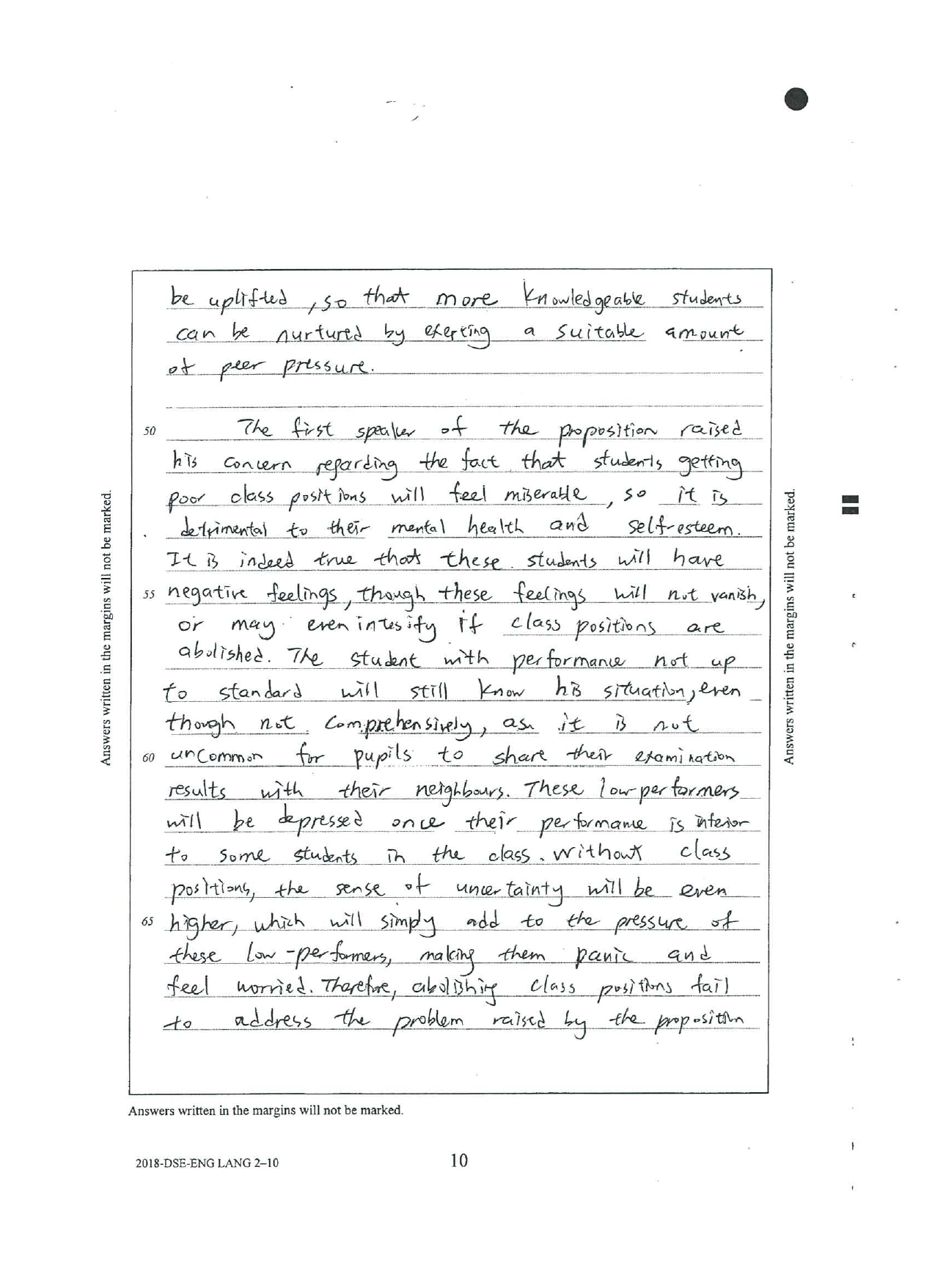

The writing, with corrections marked inline
The natural pair piece. The closest comparison in the collection is candidate 2018-003 (also opposition first speaker, 40/42). Same prompt, same side, six-mark gap. 2018-003 wins on three measures: (1) the Kong-Kids / adversity-training framing gives the opposition case a culturally-specific anchor; (2) the suicide-rate opening steel-mans the proposition before answering it; (3) the rebuttal reframes the proposition’s remedy as a category mistake (treat the workload, not the ranking).
Where this piece still scores high. The exam-difficulty argument (lines 10–34) is genuinely original — rankings normalise against variable test difficulty — and is not present in 2018-003. The rebuttal of the proposition’s mental-health point (lines 49–66) engages directly with the imagined opposition speaker rather than a generic strawman. With cleaner syntax on lines 60–61 (the broken “These low-performers will…” cascade) this could easily have been 36–37/42.
Word count. Approximately 500 words against the ~400 brief — about 25% over. This is the most disciplined of the three 2018 pieces in the collection (the 42/42 Q4 letter and the 39/42 Q5 affirmative-side speech both ran ~600 words).
No supplementary sheet used. The candidate finished within booklet pages 8–11 (END OF PAPER printed on the last line of page 11). The supplementary (page 12) is blank.
Strengths to praise
“Good morning, honourable adjudicators, members of the proposition team, ladies and gentlemen. I am the first speaker of the opposition team…” All four audiences addressed and the speaker’s role named — the polished inter-school form, not the generic “Good morning everyone.”
The candidate argues that rank-order normalises against task difficulty — a real piece of psychometric reasoning. Most candidates say “rankings motivate” or “rankings let you compare”; this one identifies a specific failure mode of raw scores and offers ranking as the corrective.
Our exam performance, our class position, we have no choice but to study diligently. The pronoun stays anchored to students throughout, positioning the speaker as a member of the affected class rather than an external commentator — the rhetorical asset of an opposition-side first speaker.
“The first speaker of the proposition raised his concern regarding the fact that students getting poor class positions will feel miserable.” The candidate cites a specific speaker on a specific point — the cross-floor engagement adjudicators expect of debate speeches but rarely receive in essay-format answers.
“It is not uncommon for pupils to share their examination results with their neighbours.” Instead of denying the mental-health harm, the candidate concedes it and shifts ground: abolishing official rankings won’t end the comparison, it’ll just push it underground. The move a real policy debate would make — concede the harm, contest the remedy.
“Let us say ‘no’ to the cancellation of class position policy! Thank you!” The closing call (Let us say ‘no’) gives the audience a verb to follow; the exclamation gives the speaker a beat to bow on. Many candidate debate speeches fade out; this one lands.
Against a 400-word brief, this is the tightest word-discipline of any 2018 piece in the collection (the 42/42 Q4 letter ran ~600, the 5** Q5 affirmative speech ~600). Each paragraph carries a single argument or move; nothing is repeated for length.
Grammar notes
| Issue | Explanation |
|---|---|
(line 4) my firm disagreement on → my firm disagreement with | Disagreement takes with for a position or person, and over for the topic. On doesn’t collocate here. |
(lines 10–11) evaluation on our exam performance → evaluation of our exam performance | Evaluation takes of (the thing being evaluated): an evaluation of the proposal, an evaluation of student work. On would work with commentary on, reflection on. |
(lines 16–18) though I can conclude that it is solely caused by…? → but can we conclude that it is solely caused by…? | The question mark requires a question structure (can we?), not a declarative (I can). The candidate is using a rhetorical question to set up the refutation; the syntax has to match. |
(lines 26–27) an overall upward or downward shift of scores will be resulted → will result | Result is intransitive in this sense: X results in Y or Y results from X. Be resulted is not a valid passive form. |
(line 29) which is rather independent of the difficulty of the paper → ok | Acceptable. Rather here means fairly / quite, which is fine; a tighter version would drop it. |
(lines 36–37) the fact that it triggers positive competition → they trigger positive competition | The subject earlier in the sentence is rankings (plural), so the pronoun and verb should follow: they trigger, not it triggers. |
(line 42) we can have more depth → we can gain more depth | Have depth describes a state; gain depth describes acquiring it — which is what the sentence means. (Develop deeper understanding would be even cleaner.) |
(line 43) our understanding on various aspects of knowledge → our understanding of various aspects | Understanding takes of, not on. Same rule as evaluation of. |
(line 45) be uplifted → be elevated / be improved | Uplift in modern English mostly carries the sense of emotionally raising / inspiring, not improving academic performance. For academic outcomes, improve, raise, elevate. |
(lines 45–47) more knowledgeable students can be nurtured by staying in a suitable environment → more knowledgeable students will be nurtured in a suitable environment | Two refinements: (a) drop by staying — the participial phrase is doing the work the preposition in does more cleanly; (b) will be is the more natural modal here than can be. |
(line 58) even though not competitiveness → even though not through competitiveness | The contrast is between through competitiveness and the alternative route (sharing results with neighbours). Adding through repairs the parallelism. |
(lines 60–61) These low-performers will… → (broken off) | This sentence appears to break off mid-thought, then the next sentence (The class without class positions…) restarts on a new topic. Likely a transcription gap; the intended sense is something like these low-performers will be deprived of accurate information about their standing. |
(line 61) The class without class positions, the sense of uncertainty → In the class without class positions, the sense of uncertainty | Missing preposition In — without it, the noun phrase becomes a dangling absolute that the next clause has to ignore. |
(lines 64–65) abolishing class positions don’t address → abolishing class positions does not address | The gerund abolishing is the singular subject; verb takes does, not don’t. |
(line 73) the cancellation of class position policy → the cancellation of the class position policy | Missing definite article. Class position policy as a noun phrase needs the in this construction. |
(lines 70–71) the achievements of class position, namely increasing understanding on performance → the achievements of class-position reporting — namely, a clearer understanding of performance | Two minor improvements: hyphenate class-position reporting as a compound modifier; replace on with of. |
Style suggestions (where strong writing could become outstanding)
Professional rewrite — the exam-difficulty argument (the strongest moment)
This is the candidate’s most original argument: rankings normalise away the noise of variable exam difficulty. A professional rewrite tightens the logic and lands it on a sharper image.
The student’s paragraph (corrected)
Rewritten by a professional debater
- The claim is announced in five words. “Exam papers vary in difficulty; ranks do not.” The original needs forty words to get to the same place. In debate, the audience needs to grasp the argument before the evidence arrives.
- The worked example is numerical. “45% on a hard paper and 75% on an easy one” gives the audience figures to anchor the abstract claim. The candidate’s version stays at the level of difficulty varies, scores vary.
- The closing line is the keeper. “Ranking is the natural ruler of academic performance.” A metaphor (ranking-as-ruler) compresses the entire argument into seven words. The candidate’s closing line (the evaluation can be carried out more accurately) is correct but procedural.
- The rhetorical question is gone. The original’s “can we conclude that it is solely caused by our lack of knowledge?” was clever but indirect. The rewrite makes the claim positively and lets the audience supply the rebuttal on the opposition’s behalf.
Professional rewrite — the rebuttal paragraph (the weakest moment)
Paragraph 4 (lines 49–66) has the most interesting claim in the piece (that abolition doesn’t end the comparison, it just pushes it underground), but the sentence-level syntax falls apart in the middle — the half-sentence at lines 60–61 (These low-performers will…) breaks off, and the next clause is missing its preposition (The class without class positions, the sense of uncertainty). A professional rewrite preserves the substance and repairs the sentences.
The student’s paragraph (corrected)
Rewritten by a professional debater
- The opening triplet is the rebuttal’s structural spine. “He is right that the damage exists. He is wrong about the remedy.” In three short sentences the candidate has named the opponent, conceded the premise, and contested the conclusion — all without losing rhetorical posture.
- The empirical claim is given specific instances. “The cousin who got into the science stream” is the kind of household-level example that makes a Hong Kong audience nod — everyone has heard this comparison made at a dinner table.
- The metaphor of distortion vs transparency carries the argument. “What the school’s data made transparent, the family’s gossip will make distorted.” The contrast (school = accurate, family = inaccurate) gives the audience a way to remember the argument 20 minutes later.
- The final image (makes the wound deeper while pretending to heal it) is the closer. A debate rebuttal that doesn’t close with an image is forgettable; this one ends on the strongest possible characterisation of the opposition’s position.
Vocabulary to notice
| Word | Definition | Usage notes |
|---|---|---|
| honourable adjudicators | (n. phrase, debate) the formal address to competition judges. | Standard inter-school debate convention. The full opening salutation runs honourable adjudicators, members of the proposition / opposition team, ladies and gentlemen. |
| opposition team / proposition team | (n. phrase, debate) the two teams in a competitive debate. | The proposition argues for the motion; the opposition argues against. In American conventions: affirmative / negative. |
| comprehensive | (adj.) complete; including all or most aspects. | Pairs with understanding, view, overview, analysis, coverage. More formal than complete. |
| strive (for) | (v.) to try very hard to achieve something difficult. | Pairs with excellence, perfection, improvement, justice. Used in motivational and exam-paper rhetoric: strive for excellence, strive for the best. |
| indicator | (n.) a sign or measure that shows the state of something. | Pairs with reliable, leading, key, useful, poor. Common in policy and statistical writing: a leading economic indicator, a poor indicator of ability. |
| induce | (v.) to cause or bring about. | Pairs with abstract effects: induce sleep, induce panic, induce a response. Slightly more formal than cause. |
| grasp (n.) | (n.) understanding or hold. | Pairs with good, firm, clear, weak: a good grasp of the subject, a firm grasp on the issue. |
| trigger (v.) | (v.) to cause something to happen. | Pairs with competition, response, reaction, emotion, memory. Often used in arguments about cause-and-effect chains. |
| leaderboard | (n.) a ranked list of competitors. | From sports / gaming. Common in education writing about competitive academic environments. Slightly informal but acceptable in argumentative essays. |
| nurture (v.) | (v.) to care for and encourage growth. | Pairs with students, talent, ability, environment. The noun phrase nature vs nurture is a fixed idiom. |
| peer pressure | (n. phrase) influence from one’s social group. | Usually negative (succumbing to peer pressure), but can be positive (positive peer pressure). The candidate uses it positively here, which is the less common but valid sense. |
| detrimental (to) | (adj.) harmful or damaging. | Takes to: detrimental to health, detrimental to one’s career. More formal than harmful. |
| intensify | (v.) to make or become stronger. | Pairs with feelings, pressure, conflict, debate, search. Often used in arguments about escalating effects. |
| deprive (of) | (v.) to prevent from having or enjoying something. | Takes of: deprived of sleep, deprived of opportunity, deprived of information. Common in arguments about rights and access. |
| apparent | (adj.) clearly visible or understood. | Pairs with obvious, plainly, immediately: it is immediately apparent that… — useful conclusion-setter in debate and essay writing. |
| constructive (vs destructive) | (adj.) helpful and tending to produce good results. | The opposite is destructive. Common policy contrast: constructive criticism vs destructive criticism, constructive engagement, constructive competition. |
Leave a Reply