A School-trip Letter to Parents — sky100, reframed as a history field trip (Part A)
You are Chris Wong, the class teacher of 6A. You will be taking your class on a school trip next month to sky100, shown in the poster. Write a letter to parents giving them the necessary information about the trip. You may use the mindmap to help you. (about 200 words)
Show original handwritten pages (4)

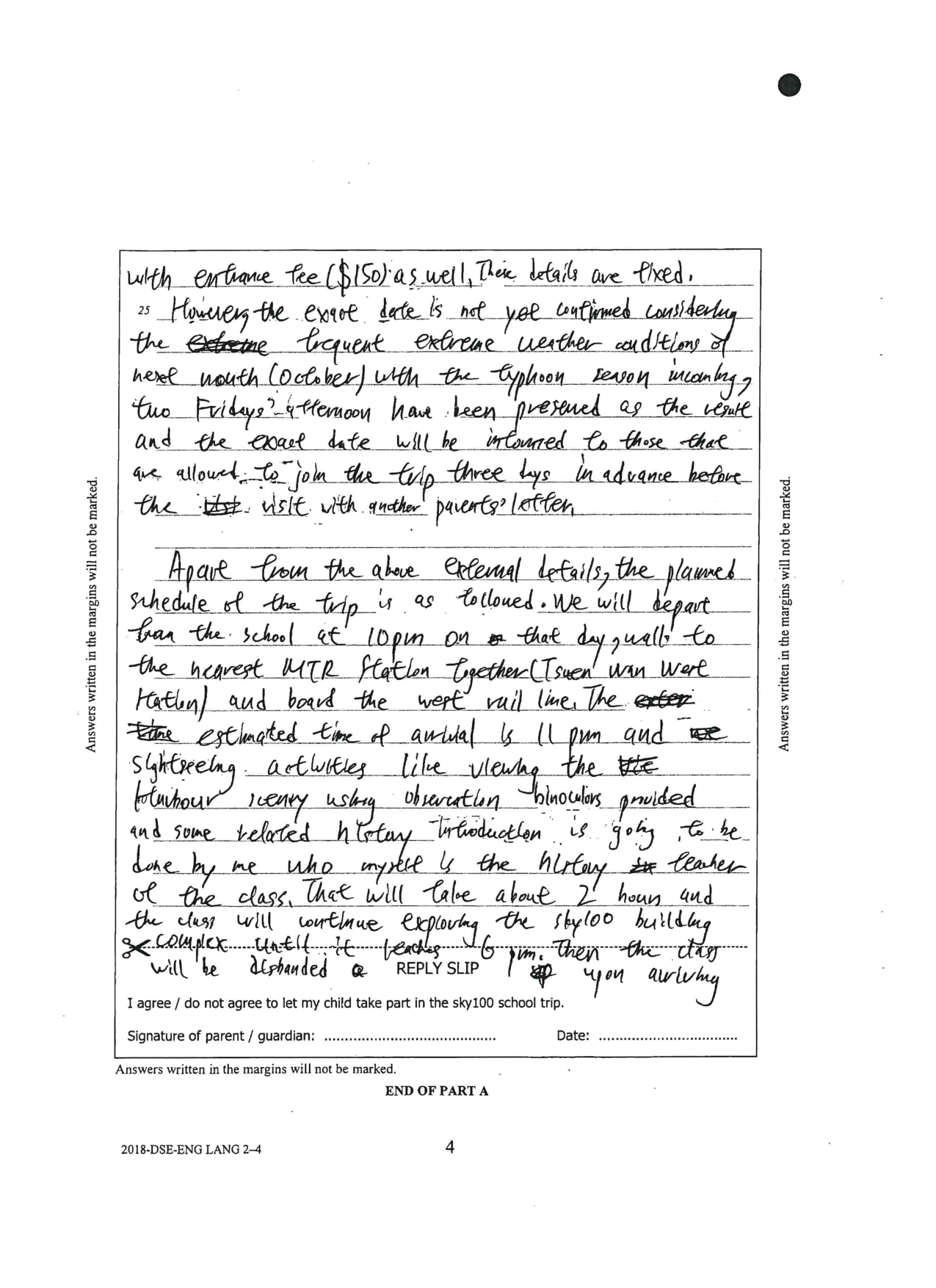

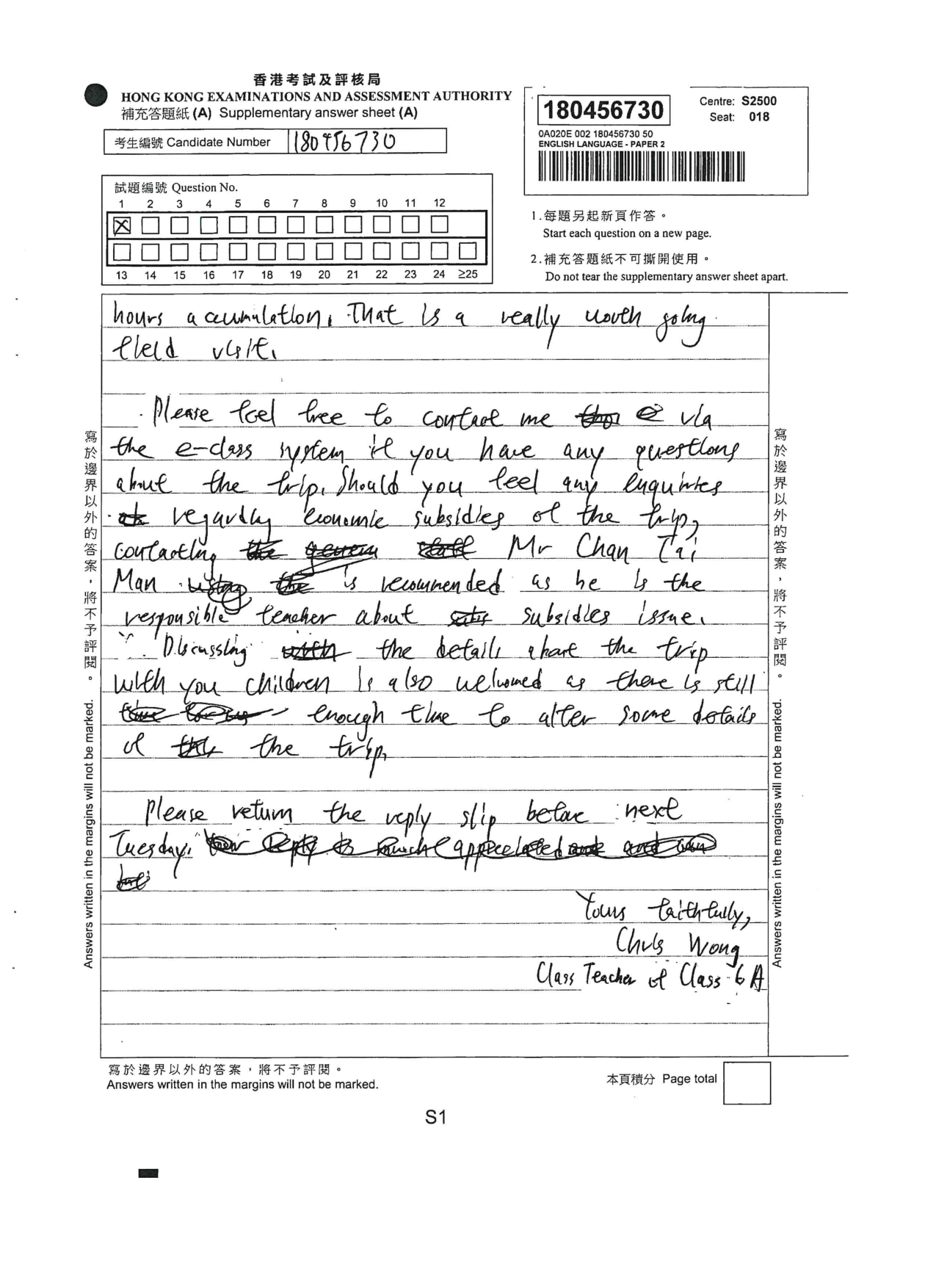
The writing, with corrections marked inline
Strengths to praise
The opening states who is writing and why, then promises the practical details — “the exact destination, date, transportation information and approximate cost will be explained”. A parent knows exactly what the letter will cover.
Destination, transport (train, B1 Exit, the cost split of train fee + lunch), a sensible caveat that the date is weather-dependent in typhoon season, the on-the-day schedule and supervision — the letter does the real work a circular must do.
The trip is justified as “a history investigation and local history learning event” tied to a joint History/Liberal-Studies project and even to “Other Learning Experiences (OLE)” for university admission. Reaching for a learning purpose is exactly what the higher content marks reward.
Salutation, a clear call to action (“Please return the reply slip before next Tuesday”), a contact channel (the e-class system; Mr Chan for subsidies) and a full sign-off (“Yours faithfully, Chris Wong, Class Teacher of Class 6A”).
Grammar notes
| Issue | Explanation |
|---|---|
fix (line 2) our class are going to have a school trip → our class is going… | Subject–verb agreement. Treated as a single unit, the collective noun class takes a singular verb: our class is going. (Use a plural verb only when you mean the members acting individually.) |
fix (line 3) a school trip in next month → …a school trip next month | Redundant preposition. Time phrases with next take no preposition: next month, not in next month. (Compare in October, which does take in.) |
fix (line 33) the planned schedule of the trip is as followed → …is as follows | Fixed expression. The set phrase is as follows (always singular, with -s), regardless of what comes after: The schedule is as follows. As followed is a common slip. |
fix (line 34) depart… at 10pm… estimated time of arrival is 11pm → …at 10am… 11am | am/pm confusion. A school day-trip that “reaches 6pm” cannot depart at 10pm and arrive at 11pm; these should be 10am and 11am. Check that a stated timeline is internally consistent. |
fix (line 41) done by me who myself is the history teacher → …by me, who am the history teacher | Redundancy + agreement. Myself is redundant after me; and a relative clause referring to me takes am: by me, who am the history teacher (or simply by me, the history teacher). |
fix (line 79) Discussing the details… with you children → …with your children | Possessive determiner. Before the noun children you need the possessive your, not the object pronoun you: with your children. A frequent time-pressure slip (it recurs across the corpus). |
notice (line 64) counts into "Other Learning Experience" (OLE) | Genuine awareness of context. Linking the trip to OLE and the JUPAS assessment shows the writer understands what makes a school activity ‘count’ in Hong Kong — a persuasive, well-judged appeal to parents. |
notice (line 17) only takes five minutes of walking from the B1 Exit | Concrete, useful detail. Precise directions (the B1 Exit, a five-minute walk) are exactly the reassuring specifics a circular should give. |
notice (line 47) voted - and passed by the Class Association | Nice civic framing. Presenting the trip as collectively decided (‘the will of the students’) is a thoughtful touch that helps win parents over. |
Style suggestions
“I am writing to inform you that our class are going to have a school trip in next month.”
“I am writing to tell you about our class trip to sky100 on [date].”
A circular usually puts the what/where/when in the first line; name the destination and date straight away.
“We will depart… and board the west rail line. The estimated time of arrival is 11pm and sightseeing activities… is going to be done by me…”
“We will leave school at 10am and travel by West Rail. We expect to arrive at about 11am. I will then lead the sightseeing…”
One idea per sentence makes a timetable far easier to follow; it also fixes the activities… is agreement.
“depart… at 10pm… arrival is 11pm… until it reaches 6pm”
“depart at 10am… arrive at about 11am… until 6pm”
Re-read times before submitting — a day that ends at 6pm cannot begin at 10pm.
“It poses significance to explain the meaning and purpose of the trip apart from those physical details.”
“Beyond the practical arrangements, I would like to explain why this trip matters.”
Poses significance is stiff; parents respond better to direct, warm phrasing.
“Please return the reply slip before next Tuesday.”
“Please return the reply slip by Tuesday, [date].”
A dated deadline avoids confusion once the letter is filed at home.
“External details… will be presented below… these details will dispel your doubts regarding the trip. Regarding the external details…”
“The arrangements below should answer any questions you have.”
Details, trip and regarding recur closely; varying them tightens the opening.
“Including the train fee of twelve dollars and a lunch… the total fee will be around two hundred dollars with entrance fee ($150) as well.”
“The total cost is about $200: a $150 entrance fee, a $12 train fare and lunch.”
A colon and a short list make the breakdown instantly scannable.
“counts into ‘Other Learning Experience’ (OLE)… to stand out… in the JUPAS… assessment”
“it also counts as an Other Learning Experience (OLE), which strengthens students’ university applications”
Briefly explaining OLE/JUPAS keeps every parent on board, not only those fluent in the acronyms.
Strong moment worth teaching from
Phrasing is stiff in places, but the persuasive instinct is the lesson.
“this field trip is a history investigation and local history learning event. By actually viewing the landscape of the Victoria Harbour, 6A students can have a glimpse of the grand view and most vitally has the necessary visual materials to complete their joint-subject… (history and liberal study)… This event also counts into ‘Other Learning Experience’ (OLE)…” (lines 53–65)
A weaker letter would stop at ‘it will be fun’. This writer argues the trip’s academic payoff — a cross-subject project, real visual material, and OLE/JUPAS value. Even at Level 3, that persuasive reach is genuine and worth praising; the lesson is to answer ‘why does this matter?’ for the reader.
Professional rewrite — the muddled schedule paragraph
Rebuilding the timeline (fixing am/pm and the run-on), keeping the writer’s content.
Student (verbatim, edits folded in)
Professional version
Vocabulary to notice
| Word & alternatives | Definition | Usage notes |
|---|---|---|
| dispel remove, allay, banish | (v.) to make a doubt, fear or feeling disappear. | “these details will dispel your doubts”. Collocates with doubts, fears, myths, rumours; formal and apt here. |
| approximate rough, estimated, ballpark | (adj.) close to the actual but not exact. | “approximate cost”. Adverb approximately; useful hedge when a figure isn’t final. |
| subsidy / subsidies grant, financial support, allowance | (n.) money paid to help cover a cost. | “regarding economic subsidies of the trip”. Spelt subsidies in the plural; verb subsidise. Correctly used. |
| disband break up, dismiss, disperse | (v.) to (cause a group to) stop operating and separate. | “the class will be disbanded… upon arriving”. More natural for an organisation; for a class trip, dismissed fits better. |
| binoculars field glasses | (n., plural) a handheld device for viewing distant objects with both eyes. | “observation binoculars provided”. Always plural; a pair of binoculars. |
| itinerary schedule, programme, plan | (n.) a planned route or day-by-day plan for a journey. | Not used, but a precise upgrade on schedule for a trip letter: the itinerary is as follows. |
Leave a Reply