Debate Speech — Abolish Class-Position Reporting [PERFECT 42/42]
You are representing your school at an inter-school debating competition. The motion is: ‘The policy of reporting students’ class position should be abolished.’
(The prompt also includes a sample class list showing student names with subject grades and a column for Overall Position.)
Write a debate speech arguing for OR against the motion. (~400 words)
Candidate 2018-005 argues for the motion (proposition) — pair-comparison with candidate 2018-003 (opposition, 40/42) in the same collection.
Show original handwritten pages (6)


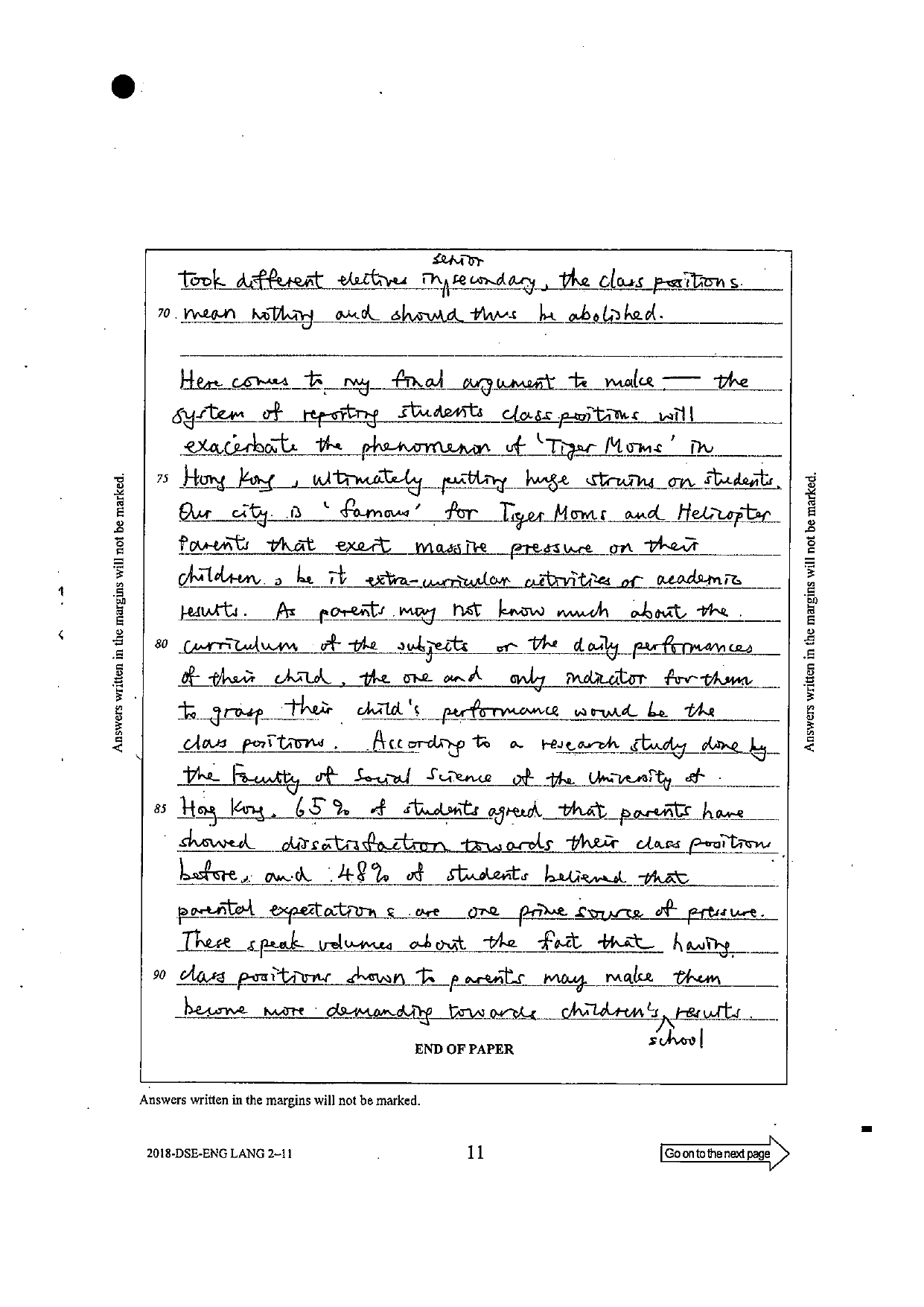
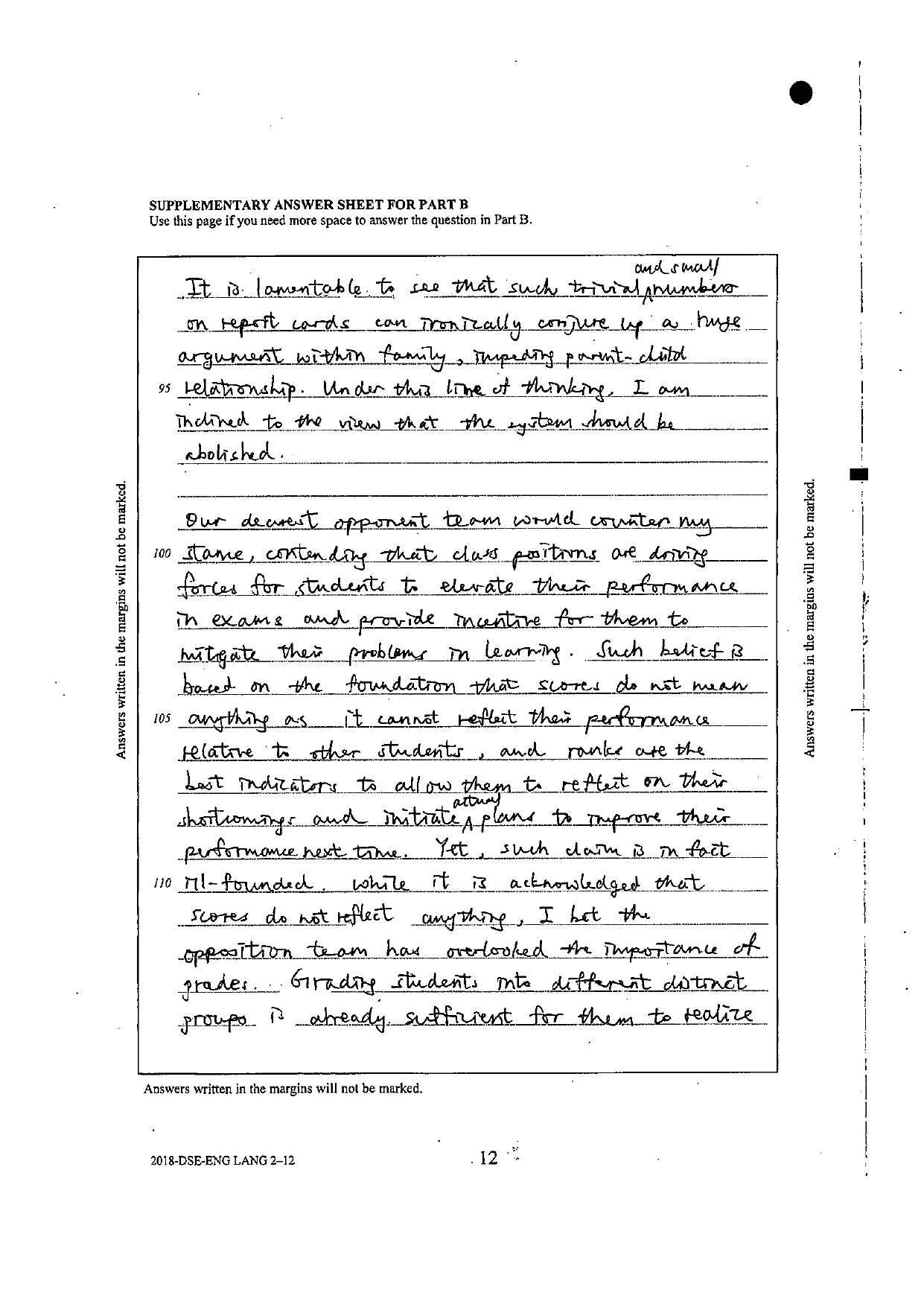

The writing, with corrections marked inline
Word count. Approximately 900 words against the ~400-word brief — more than double, the longest 2018 Part B in the collection. The marker decided every word earns its place.
What makes this perfect. Three things distinguish it from very strong 5** pieces. (1) Genuine debate-form conventions: full salutation, named captain and team, ‘my team has three points to make’, each point named in turn, full opposition steel-man + rebuttal, formal ‘Today’s motion must stand’ close. (2) Personal-story content inside a structural argument: the candidate offers themselves as Exhibit A on the NSS-electives unfairness (lines 58–65). (3) Sourced empirical evidence: the Tiger Mom argument is anchored to a specific HKU Faculty of Social Science survey with two figures (65% / 48%) at lines 83–88.
The single most teachable rhetorical moment in the piece. Three sentences with identical ‘it is the system of [+gerund] that [+verb]’ structure, each mapping one of the three earlier arguments — revealing/distorting (purpose), exposing/creating unfairness (NSS), showing/triggering (Tiger Moms). The candidate isn’t just decorating the close; they are retrieving the three-point structure announced at line 17 and binding it to the motion. Real debate coaches teach exactly this manoeuvre.
Then a second triple lands: three direction-shifts (To all the audience… To all the adjudicators… To all students…), each carrying a rhetorical question. Then the formal Today’s motion must stand. Thank you! Teach this paragraph as the model of how a debate speech ends — recap, address, declare.
Strengths to praise
Five named audiences (adjudicators, guests, opponents, teachers, students) plus self-identification with role and team, plus motion stated verbatim. The formal debate-floor opening that adjudicators listen for in the first five seconds — observed more thoroughly here than in any other Q5 in the collection.
One of the most distinctive openings in the collection. Four single-word questions, each an emotional state, alliterating on /d/, walking the audience through the emotional gradient of a report card. The questions construct shared recognition before the argument arrives.
From complacent winner → loser fallen into a dark abyss → system favourable to the churning out of exam machines → the meaning of education — to cultivate the talent of individuals. Four moves that escalate from individual psychology to institutional critique to philosophy of education, in roughly 70 words.
“I am a striking example of this… I chose English Literature and Chinese History as my electives… even though I topped the list among the students taking my elective last year. It turned out my class position is nowhere near excellent.” The candidate stops being a debater and becomes Exhibit A — the move that makes the abstract claim impossible to refute as merely theoretical.
Naming the institution (HKU Social Science), giving two figures (65% / 48%), and using both to triangulate the same claim. The figures don’t need to be real for the rhetorical move to land — the marker is rewarding the form. No other Part B in the collection cites academic research.
The opposition’s argument is stated in its full form (driving forces, elevate performance, mitigate problems) before being refuted, and the rebuttal turns on a substantive distinction (grades, not ranks) rather than dismissal. The formal structure debate adjudicators reward most.
Inordinate, afflicted, aggravated, complacent, deemed, churning out, exam machines, NSS curriculum, flying colours, ill-founded, exacerbate, lamentable, impede, utilitarianism prevails, future pillars, patently obvious, prerequisite. The broadest range of any 2018 Part B. Each word does work.
Grammar notes
| Issue | Explanation |
|---|---|
(line 17) should be abolished in no time → should be abolished without delay | In no time means very quickly (informal); for legislative claims, without delay is the standard collocate. |
(line 17) my team have → my team has | BrE allows plural agreement with team, but in formal writing the singular is the safer choice, especially when the unit is treated as a single agent. |
(line 20) worth-noting → worth noting | Compound-adjective form is noteworthy; the gerund construction worth noting takes no hyphen. |
(line 21) distortion on the genuine purpose → distortion of the genuine purpose | Distortion takes of: a distortion of the truth, a distortion of the data. |
(line 24) attach inordinate importance towards → attach inordinate importance to | Attach importance to is the fixed collocation. Importance towards doesn’t collocate. |
(line 31) seeing these numbers in the report card → seeing these numbers on the report card | A report card is a surface, not a container. On the card. |
(line 32) first intention to do → first impulse / first instinct | Intention to do requires an infinitive (intention to leave); for the spontaneous reaction, impulse or instinct fits. |
(line 43) would, therefore, favorable to the churning out → would, therefore, be favourable to the churning out | Missing copula be. The sentence has the modal would but no verb. BrE / HK English spelling: favourable. |
(line 44) but not upholding the meaning → but not uphold the meaning | Parallelism with would be favourable to: both branches of the contrast need the same form. |
(line 55) impose a different mode of assessment to students → impose a different mode of assessment on students | Impose on is the fixed collocate: impose a rule on, impose a tax on, impose a burden on. |
(line 56) makes no cence → makes no sense | Spelling slip. |
(line 63) even if I topped the list → even though I topped the list | Even if introduces a hypothetical; the candidate’s context is factual (I did top the list), so even though. |
(line 65) far from excellent → nowhere near excellent | Far from excellent reads as a slight understatement; the intended sense is sharper with nowhere near. |
(lines 85–86) parents have showed → their parents have shown | Past participle: shown (irregular). Also: clarify possessive (their parents). |
(line 88) parental expectations are one prime source → parental expectations were one prime source | Sequence of tenses: the survey is a past finding (believed), so the reported claim takes the past too. |
(lines 93–94) conjure up huge argument within family → conjure up a huge argument within a family | Missing indefinite articles. |
(line 105) scores do not mean anything as it cannot reflect → scores do not mean anything as they cannot reflect | Pronoun number: scores is plural, so they, not it. |
(line 116) while simultaneously will not impose → while simultaneously not imposing | Parallelism: is sufficient… while not imposing. The original’s will not impose breaks the parallel. |
(line 121) distort the real meaning → distorts the real meaning | Subject is singular (the system) — verb agreement. |
(line 128) as teacher → as a teacher | Missing indefinite article. |
(line 132) anymore → any longer / any more | BrE / HK English: any more (two words) for time/quantity. Anymore (one word) is more AmE; both are widely accepted now. |
Style suggestions (where 42/42 could become legend)
Professional rewrite — the rebuttal paragraph (text-type fit)
The candidate’s steel-man is genuinely strong; the rebuttal that follows it has one of the few sentence-level wobbles in the piece (scores do not mean anything as it cannot reflect… while simultaneously will not impose at lines 105 and 116). What an editor would change if forced to find anything: tighten the syntax, sharpen the concession, make the grades-vs-ranks distinction structurally explicit.
The student’s paragraph (corrected)
Rewritten by a professional debater
Where the opposition is right: students do need to know how their work compares to their peers’. Where the opposition is wrong: that comparison does not have to be a rank. A grading band — A, B, C, D — tells a student their work is strong, adequate, or weak, without telling them they came 22nd out of 32. Grades give the feedback. Ranks give the wound. Today’s motion asks us to keep the first and abolish the second.
- The opposition’s claim is stated as two sentences. The original packs the steel-man into a long compound sentence; the rewrite gives it space to land.
- The concession is named. Where the opposition is right… Where the opposition is wrong is a formal debate convention the candidate gestures at but doesn’t use.
- The distinction is made as a binary. Grading bands vs ranks — the candidate’s argument is sound but lives inside one long sentence; the rewrite extracts it.
- The aphorism closes the paragraph. Grades give the feedback. Ranks give the wound. A debate paragraph that ends on a quotable line is one the adjudicator remembers when scoring.
- The motion is restated in the closing line. The original ends procedurally; the rewrite returns to the motion.
Vocabulary to notice
| Word | Definition | Usage notes |
|---|---|---|
| affirmative team / proposition | (n. phrase, debate) the side proposing the motion. | HK / American convention: affirmative. British: proposition. Always paired: affirmative vs negative. |
| inordinate | (adj.) unusually or disproportionately large. | Pairs with importance, pressure, amount, time: attach inordinate importance to, an inordinate amount of. |
| flying colours | (idiom) with great success, especially in an exam. | Fixed phrase: pass with flying colours, achieve flying colours. BrE / HK English. |
| churning out | (phr. v.) producing in large quantities, often mechanically. | Often pejorative: churning out graduates, churning out exam machines. The candidate’s use captures the industrial-education critique. |
| utilitarianism | (n.) a doctrine that judges acts by their usefulness or outcomes. | Used here as critique — utilitarianism prevails implies values reduced to measurable usefulness. Sophisticated for an HKDSE answer. |
| exacerbate | (v.) to make worse. | Pairs with problem, situation, condition, phenomenon: exacerbate the housing crisis, exacerbate the phenomenon of Tiger Moms. Formal. |
| lamentable | (adj.) regrettable; deserving sorrow. | Pairs with state, condition, fact, situation: it is lamentable to see. Slightly literary register; works in formal speech. |
| conjure up | (phr. v.) to bring into being as if by magic. | Pairs with image, memory, argument, scene: conjure up an image, conjure up an argument. Slightly poetic. |
| impede | (v.) to obstruct or delay. | Pairs with progress, growth, relationship, performance: impede progress, impede the parent-child relationship. Formal. |
| ill-founded | (adj.) (of a claim) lacking sound basis. | Pairs with claim, argument, belief, fear: an ill-founded claim. Useful rebuttal vocabulary. |
| prerequisite | (n.) something that must come first. | Pairs with for, of: a prerequisite for promotion, a prerequisite of admission. Useful for closing arguments. |
| patently obvious | (adv. + adj.) extremely clear; manifestly. | Used emphatically: it is patently obvious that, patently absurd. The intensifier patently signals certainty. |
| future pillars (of society) | (n. phrase) people who will hold up future society. | Stock political-speech phrase, often applied to young people. Slightly grand register; suits debate closes. |
| Tiger Mom / Helicopter Parent | (n., HK / popular psychology) controlling parenting styles. | Tiger Mom: strict, high-achievement-focused (from Amy Chua). Helicopter Parent: hovering, over-involved. Both common in HK education discourse. |
| grade-fixated | (adj., HK English) obsessively focused on grades. | Hyphenated compound modifier. Used critically about HK education: the grade-fixated examination system. |
| stem up | (phr. v., HK English) to spring up; to arise. | Common HK English coinage; not idiomatic in standard English (which would use well up, rise up, take hold). Defensible in context but worth replacing for the highest band. |
Leave a Reply