Debate Speech — Against Abolishing Class-Position Reporting (Opposition First Speaker, “Kong Kids” framing)
The motion is: ‘The policy of reporting students’ class position should be abolished.’ Write a debate speech arguing for OR against the motion. (~400 words)
Candidate 2018-003 argues against the motion — i.e., in favour of keeping class-position reporting — matching the opposition stance taken by candidate 2018-007 (also in this 2018 collection, at 34/42). The two opposition speeches make a clean pair-comparison: same side, six-mark gap.
Show original handwritten pages (4)
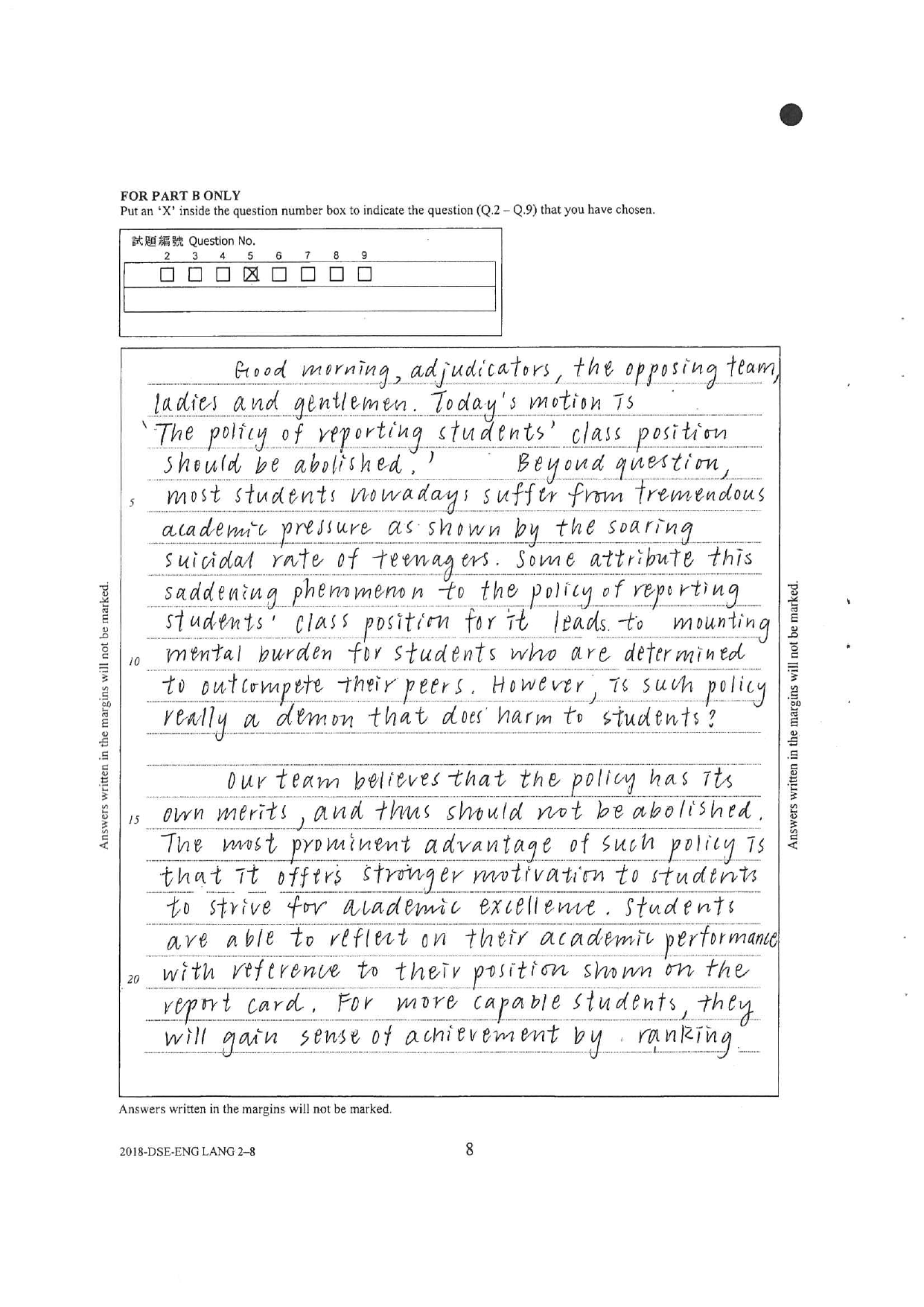


The writing, with corrections marked inline
The pair-piece with candidate 2018-007 (also opposition, 34/42). Same prompt, same side, six-mark gap. Candidate 2018-003’s advantages over 2018-007: (1) the Kong-Kids / adversity-training framing gives the opposition case a culturally-specific anchor; (2) the suicide-rate opening reframes the standard pro-abolition argument before the speech makes its own case; (3) the rebuttal ‘What the school ought to do is address the workload, not abolish a policy’ reframes the proposition’s strongest argument as a category mistake.
Word count. Approximately 640 words against the ~400-word brief — about 60% over. Long, but considerably tighter than the longest 5** debate speech in this collection (candidate 2018-005 at 900w).
Why this isn’t a perfect 42. The M2 of ^19 (two below perfect) reflects sentence-level wobbles: missing articles (such policy, sense of achievement, the tremendous burden), the broken syntactic cascade in the rebuttal paragraph at lines 67–69 (What the school ought to do is sometimes the workload), the close that trails off (ask yourself) at lines 75–76. The substance is at the perfect level; the surface execution loses two marks. With one careful re-read pass, this would be 21+21.
This paragraph is the single biggest reason for the M1 = 21. The candidate names a real HK colloquial anxiety — Kong Kids (港孩), the privileged HK youth perceived as unable to cope with adversity — and uses it to flip the proposition’s framing. The class-position policy is reframed not as a stressor but as resilience training. This re-purposes a cultural anxiety in service of the opposition case.
The paragraph then lands on a three-clause aphoristic close (lines 52–54): “accepting the mistakes we have made, embracing the failure we have to face, and simply, moving on.” A culturally-anchored argument plus a rhythmic, philosophical sentence — this is the move that distinguishes a HK-context-aware writer from a generic essayist.
Strengths to praise
The candidate names a real HK anxiety and uses it to flip the proposition’s framing. The policy isn’t a stressor; it’s adversity training. This is the kind of culturally-anchored argument that distinguishes a HK-context-aware writer from a generic essayist. (See Spotlight above for the extended treatment.)
Lines 4–11: by stating the proposition’s strongest case first (soaring suicide rate, mounting mental burden) and then turning on it with a rhetorical question (is such a policy really a demon?), the candidate earns the right to challenge it. This is the ‘steel-man-then-reframe’ opening that polished debate writing uses — engaging the opposition’s case head-on rather than ignoring it.
Lines 19–27: “For more capable students, they will gain a sense of achievement by ranking top… As for weaker students, it is also encouraging, if not rewarding, to see their position rise gradually…” The proposition usually argues the policy hurts weak students; the candidate shows it can serve both. The symmetry forces the proposition to defend a more demanding claim.
Lines 66–72: “What the school ought to do is address the workload of students, which is often the culprit… Are we doing good to students when we just abolish a policy instead of teaching them to cope with adversities and failures?” The candidate reframes the proposition’s remedy as misdirected: the stress is real; the cause is the workload; abolishing the policy treats a symptom and leaves the cause. The strongest single argumentative move in the speech.
Lines 74–76: “Before we cheer for the abolition of the policy of reporting students’ class position, ask yourself this question.” Ending on an open imperative to the audience rather than the conventional I urge this House… leaves the moment of decision in the listener’s lap. Less formal than the standard close convention, but rhetorically pointed.
Grammar notes
| Issue | Explanation |
|---|---|
(line 5) suicidal rate → suicide rate | Suicidal is the adjective describing the person (suicidal thoughts, suicidal teenagers); the rate is a suicide rate (using the noun as modifier). |
(line 10) is such policy really a demon → is such a policy really a demon | Such + singular count noun takes an indefinite article: such a policy, such a problem, such a person. The candidate omits the article here, again on line 15, and again on line 65. |
(line 20) gain sense of achievement → gain a sense of achievement | Missing indefinite article. A sense of achievement, a feeling of satisfaction. |
(line 23) made enough efforts → made enough effort | Effort in this collocation is uncountable: make an effort / make efforts (plural OK in some contexts), enough effort (singular). Enough efforts reads slightly oddly. |
(line 32) weaker students will even care less → weaker students will care even less | Adverb placement: care even less (the intensifier modifies the comparative less, not the verb). |
(lines 39–40) training for students’ adversity in question → training for students’ resilience in the face of adversity | Adversity in question reads as ‘the specific adversity being discussed’; the intended sense is ‘the capacity to face adversity’, which is resilience. |
(lines 41–42) the young generations are criticized → the young generation is criticized | Generation in this sense is singular (referring to the current cohort), so generation with singular agreement. |
(line 47) they experienced regression → they experience regression | Sequence of tenses: the surrounding sentence uses present tense (students will come across), so the embedded verb should be present too. |
(line 50) indispensably a life lesson → ok / slightly elevated | The adverb indispensably works but reads slightly formal; undeniably would fit too. |
(lines 67–69) What the school ought to do is sometimes the workload of students, which is sometimes (and isn’t) culprit → What the school ought to do is address the workload of students, which is often the culprit | The original’s syntax collapses: it’s missing the verb (address) and the parenthetical (and isn’t) contradicts the claim. The rewrite supplies the verb and resolves the ambiguity. |
(line 70) doing good to students → doing students a favour / helping students | Do good to is grammatical but archaic; the natural form is do someone a favour, do good for, or simply help. |
(line 71) cope with adversities → cope with adversity | Adversity is usually uncountable in this sense: cope with adversity, face adversity. |
(lines 75–76) ask yourself (terminal sentence with no object) → ask yourself this question / ask yourself whether the cure is worse than the disease | The candidate’s close trails off (ask yourself.) without naming what to ask. Adding a referent (this question) or specifying the question completes the sentence. |
Style suggestions (where 5** could become perfect)
Professional rewrite — the Kong Kids paragraph
This is the candidate’s most distinctive paragraph and the single biggest reason for M1 = 21. A professional rewrite preserves the Kong Kids framing, glosses the term for full impact, and lands the argument’s closing aphorism harder.
The student’s paragraph (corrected)
Rewritten by a professional debater
- The paragraph announces its weight. My second argument is the one I most want this House to hear. A debate paragraph signposted this way commands more adjudicator attention than one introduced procedurally.
- The Kong Kids term is glossed. The privileged HK teenagers who, when life refuses them anything, cannot cope with the refusal. The candidate’s poor ability in grappling with failures is correct but procedural; the rewrite’s phrasing is the kind of definition a sociologist would write.
- The argument is concretised with a number. The experience of being thirteenth. A specific rank-number turns the abstract regression in academic performance into something the audience can picture.
- The triple-anaphora ‘the world / workplace / university will rank them’ lands the inevitability. The candidate’s original implies this but doesn’t state it; the rewrite makes the post-school ranking environment explicit, which is the argument’s actual stakes.
- The closing sentence is a small philosophical statement. To learn how to stand back up. Five words. The candidate’s conducive to their personal development says the same thing in seven words and the wrong register.
Vocabulary to notice
| Word | Definition | Usage notes |
|---|---|---|
| soaring | (adj.) rising rapidly. | Pairs with rate, prices, costs, demand: the soaring suicide rate, soaring inflation. News-feature register. |
| attribute (to) | (v.) to regard as caused by or belonging to. | Takes to: attribute the phenomenon to the policy, attribute success to hard work. |
| outcompete | (v.) to do better than (a rival). | Pairs with peers, rivals, competitors: outcompete their peers. Slightly elevated. |
| Kong Kids (港孩) | (n., HK colloquial) HK youth perceived as privileged, sheltered, and unable to cope with adversity. | Real HK media / sociological term. Originated in 2010s discourse about over-protective parenting. Often used critically. |
| grapple (with) | (v.) to struggle to deal with. | Pairs with problem, issue, difficulty, question: grapple with the question, grapple with failures. Active engagement implied. |
| bottleneck (in studies) | (n., metaphorical) a point of obstruction or congestion. | Used in education and business: a bottleneck in learning, hit a bottleneck in their studies. Useful for the ‘plateau’ sense. |
| disheartening | (adj.) discouraging. | Pairs with experience, situation, result, news: a disheartening situation, disheartening results. Stronger than discouraging. |
| indispensable | (adj.) absolutely necessary. | Pairs with part, role, lesson, member, tool: an indispensable life lesson, an indispensable role. Adverb: indispensably. |
| conducive (to) | (adj.) making something likely to happen or develop. | Always takes to + noun/gerund: conducive to personal development, conducive to learning. |
| strenuous | (adj.) requiring great exertion. | Pairs with effort, work, exercise, opposition: strenuous efforts, strenuous training. Formal register. |
| substantial | (adj.) of considerable importance, size, or worth. | Pairs with argument, evidence, increase, amount: no less substantial is the argument that…, substantial evidence. |
| regression | (n.) a return to a less developed state. | Pairs with academic, statistical, mental: regression in academic performance, regression analysis. Slightly technical. |
| culprit | (n.) the person or thing responsible for a problem. | Pairs with real, main, true, hidden: the workload is the real culprit, the main culprit behind the crisis. Useful in causal-attribution arguments. |
| short-sighted | (adj.) lacking imagination or foresight. | Pairs with move, decision, policy, plan: a short-sighted move, a short-sighted policy. Used critically in policy debates. |
| in light of | (prep. phrase) considering; taking into account. | Pairs with fact, evidence, situation, news: in light of the stressful environment, in light of recent events. Formal register. |
| remedy | (n.) a means of counteracting or removing. | Pairs with find, propose, offer, seek: the best remedy for stress, find a remedy. Medical / policy register. |
Leave a Reply