Letter to the Principal — A Tea Gathering at the Elderly Home
You are the chairperson of the Social Service Club in your school. The school would like to develop closer links with the community. Write a letter to your principal, Ms Lee, proposing a new community project that the school can carry out with a home for the elderly in your district.
In your letter persuade your principal to accept your project by
- describing one activity that could be carried out, and
- identifying the benefits for the elderly home.
Sign your letter Chris Wong. (~200 words)
Show original handwritten pages (3)
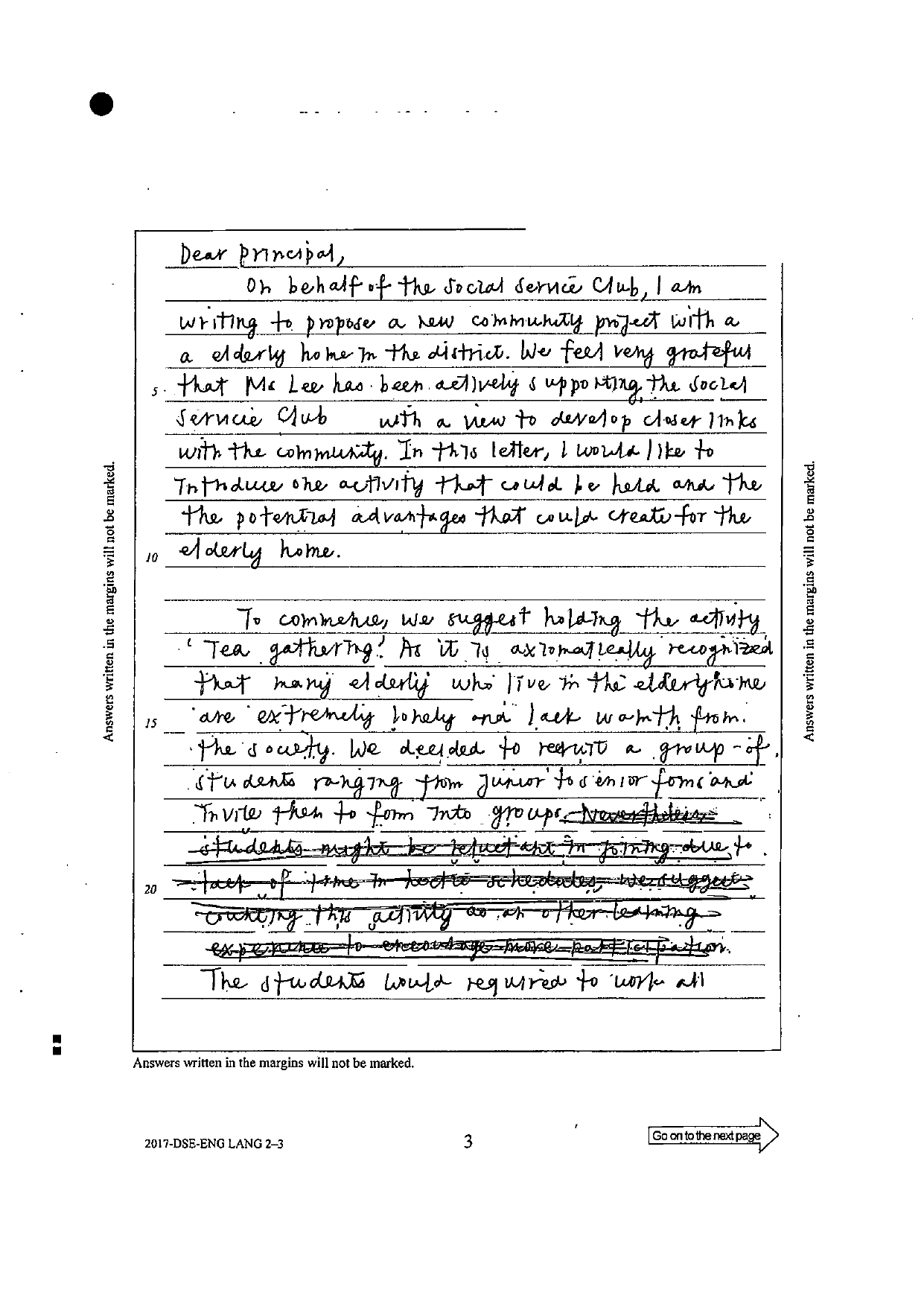
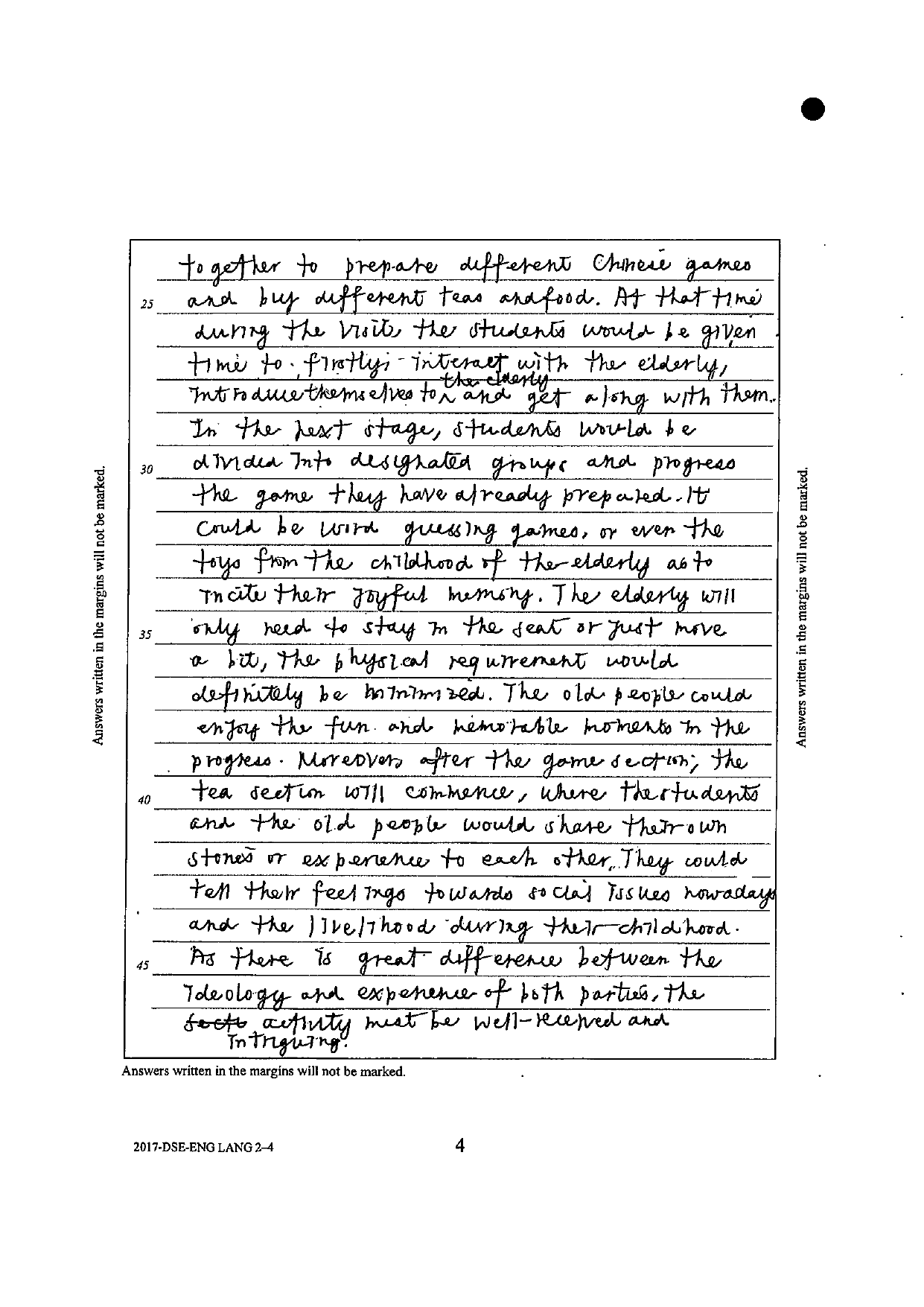

The writing, with corrections marked inline
Word count. Roughly 500 words against the 200-word brief — two-and-a-half times the target, the same over-length pattern as sister 2017-011. The activity paragraph alone runs to about 250 words because the candidate has chosen to engineer the event in real detail (recruitment · preparation · stage 1: ice-breaker · stage 2: games · stage 3: tea section). The markers have evidently judged that the structural ambition justifies the length, as they did with 2017-011.
The closing salutation is conventional. The candidate signs off Yours sincerely, which is the right pairing with the named addressee Dear Ms Lee (BrE convention: Yours sincerely when the recipient is named; Yours faithfully when they aren’t). Sister 2017-011 uses the less standard Yours faithfully — here 2017-012 has the convention exactly right.
The two-stage event design is what earns the top band. Most Q.1 candidates propose an activity. This candidate proposes a two-stage event with documented accessibility design: stage 1 is the ice-breaker (students introduce themselves, interact, get along); stage 2 is structured play (word-guessing games or toys from the elderly’s childhood); stage 3 is the tea section where stories and feelings are exchanged. The accessibility design (“The elderly will only need to stay in their seat or just move a bit”) is the move that signals the candidate has thought about the physical realities of the elderly residents, not just the warm idea of visiting them. This is the level of practical engineering an institution actually needs to see in a proposal.
The closing slip. “I will be too happy to meet” — the candidate has written too happy and inserted happy to meet as a correction above the line, but the visible reading is the unedited too happy. Too happy in English means excessively happy, more than is appropriate; the candidate means most happy or only too happy (the idiom “to be only too happy to” = “very willing to”). This single registerless moment at the very end of the letter is the most likely thing M2 docked the one mark for.
What earned the top of the band — the markers’ reward structure
The 2017 Q.1 mark scheme assesses Content (does the letter address both bullet points with substance?), Language (is the writing accurate, varied, register-appropriate?), and Organisation (is the structure clear and the development logical?). The strengths below name the move in the script that delivered each maximum — and identify the small place that probably cost the missing mark.
“the students would be given time to firstly interact with the elderly, introduce themselves… In the next stage, students would be divided into designated groups and play the games they have already prepared… after the games section, the tea section will commence…” The candidate doesn’t describe one activity; they sequence three: the ice-breaker, the games, the tea-and-stories closing. Each stage has a purpose and the transitions are signposted (firstly · in the next stage · moreover after the games section). A principal reading this proposal can see the event running in time order. The structural decision is the difference between “an activity” and “an event the school could actually run”.
“The elderly will only need to stay in their seat or just move a bit; the physical requirement would definitely be minimised.” Most Q.1 elderly-visit candidates assume the elderly residents can simply join in. This candidate has thought about mobility constraints (some residents will be in wheelchairs, some recovering from surgery, some prone to falls) and built the activity around the constraint. The sentence is the rhetorical move of someone who has either visited an elderly home or has thought hard about who lives in one. Markers reading for Content register the move as evidence the candidate is treating the subject seriously.
The benefits paragraph runs on a clear two-clause architecture: “To the elderly… they can share their own experiences…” → “Furthermore, to the elderly home itself, the employees can be relieved from their burden…”. The first benefit is psychological-emotional (the residents’ loneliness); the second is operational (the workers’ reduced caseload for the day). The candidate then adds a third layer (“a sense of cohesion can be produced, fostering a harmonious society in the elderly home”) which works as the synthesis of the first two. The architecture answers the brief’s identify the benefits for the elderly home in a way that treats elderly home as both the residents and the institution.
“It could be word-guessing games, or even the toys from the childhood of the elderly to incite their joyful memories.” Naming the toys-from-childhood as a game prop is the move of a candidate who has thought about what would actually work for an elderly Hong Kong audience — the residents of a 2017 elderly home would have grown up in the 1940s–60s with marbles, paper-folding, hand-clapping rhymes, traditional Chinese chess pieces. The candidate doesn’t name the specific toys (which would risk getting the period wrong), but the gesture toward childhood-period objects is a culturally-specific design choice that warmer the proposal than the generic we will play games.
“As there is a great difference between the ideology and experience of both parties, the activity must be well-received and intriguing.” The candidate closes the activity-description paragraph by naming the very thing the event is designed to bridge: the generational gap in worldview (ideology) and lived experience between the students and the residents. That gap-naming is the rhetorical move of a writer who understands that the value of the event is not the activities themselves but the contact between two generations who would otherwise never share a room. The marker reading for Content can lift this sentence as evidence that the candidate has thought about why the project matters, not just what it would consist of.
The vocabulary is consistently formal-policy: chairperson, on behalf of, propose, actively supporting, with a view to, develop closer links, axiomatically recognised, recruit, designated groups, paramount advantage, foster a harmonious society, conducive, feasible, cordially hope, the proposal is accepted. The register doesn’t crack — no guys, hang out, fun stuff, the old folks, none of the casual register that pulls other Q.1 scripts down. The one slight register dip is the final-line too happy to meet, which is doing the work of most happy to meet but with the wrong intensifier.
The activity-paragraph runs on a deliberate rhythm: a 30-word setup (“As it is axiomatically recognised that many elderly… we decided to recruit a group…”), then a short procedural sentence (“The students would be required to work all together to prepare different Chinese games and buy different teas and foods”), then a long staged-event sentence (“At that time during the visit, the students would be given time to firstly interact with the elderly, introduce themselves… and get along with them”), then a punctuating short sentence (“The old people could enjoy the fun and memorable moments in the process”). The variation is the kind of rhythmic awareness that distinguishes 5** from 5*.
“axiomatically recognised”, “of paramount advantage”, “feasible and conducive”, “fostering a harmonious society”. These are not borrowed phrases; the candidate uses them with the right grammatical fit and the right semantic load. Axiomatically in particular is the kind of word that can sound forced when a candidate is reaching for register, but here the candidate uses it correctly to mean “taken for granted, not requiring proof” — which is exactly the rhetorical work the proposal needs (no one needs persuading that elderly people in care are lonely).
Para 1: institutional opening + naming of the activity. Para 2: detailed activity description with three stages. Para 3: two benefits (residents’ psychology + workers’ burden) plus synthesis (cohesion). Para 4: institutional closing with thanks and meeting offer. The structure is symmetric (introduction frames + closing thanks; the activity paragraph balances the benefits paragraph in length). A marker can trace the argument with a finger on the page, which is the operational definition of full marks on Organisation.
To commence opens the activity paragraph. Moreover opens the benefits paragraph. All in all opens the closing paragraph. Within paragraphs, sequence is signalled (firstly · in the next stage · moreover after the games section) and benefits are layered (To the elderly… Furthermore, to the elderly home itself… Most importantly…). Every transition is named. A marker reading for structural visibility can verify the architecture in a single re-read.
Mid-way through paragraph 2 (lines 18–22), the candidate writes a sentence about students being reluctant to join (“Nevertheless, students might be reluctant in joining due to lack of time in hectic schedules; we suggest treating this activity as an other learning experience to encourage more participation”) and then crosses it through. The crossing-out is the right editorial call — the proposal letter is addressed to the principal, not the student body, and an aside about student reluctance shifts the audience mid-paragraph. The candidate has caught the audience-drift in real time and corrected it. Markers reading the manuscript can register the editorial control.
Grammar notes — the residual slips
At 41/42 there is very little to fix that would change the mark. The slips below are listed for completeness so the script can serve as a teaching example: a near-perfect Part A still contains technical residue. Each item shows what an editor would tidy and why — the kind of polish a candidate would do in a fair-copy version.
| Issue | Explanation |
|---|---|
(line 1) Dear principal → Dear Ms Lee |
The prompt names the principal explicitly (Ms Lee) and the candidate later uses the name in line 5 (Ms Lee has been actively supporting the Social Service Club). Standard BrE letter convention is to use the named addressee in the salutation when the prompt has given the name; Dear principal reads as if the writer doesn’t know who the principal is. A small consistency point: name the addressee in line 1 to match the named addressee in line 5. |
(line 4) a elderly home → an elderly home |
Article slip. Elderly begins with a vowel sound, so the indefinite article is an, not a. The slip is in the opening sentence, which makes it a small register cost on first impression. |
(line 6) with a view to develop closer links → with a view to developing closer links |
Fixed-phrase grammar. The phrase with a view to takes the gerund (-ing form), not the bare infinitive: with a view to developing, with a view to expanding, with a view to improving. The structure is parallel to looking forward to V-ing (I look forward to hearing, not I look forward to hear). A common HK English slip. |
(lines 8–9) the the potential advantages that could create → the potential advantages that it could create |
Two slips. (i) Duplicated the the at the line break — a copying slip where the candidate’s eye jumped to the next line; the duplicate is invisible to the writer in cursive but visible to a marker. (ii) That could create needs a subject: the activity creates the advantages, so that it could create. Without the pronoun, the relative clause has no subject and reads as if the advantages are creating themselves. |
(lines 16–18) recruit a group of students… and invite them to form into groups → recruit a group of students… and invite them to form themselves into groups |
Missing reflexive object. Form into needs a direct object (the thing being formed); the candidate’s invite them to form into groups reads as if them is the subject of form (correct) but with no object. The cleanest fix is the reflexive: form themselves into groups. The same idea is also more naturally expressed as organise themselves into groups. |
(line 23) The students would required to work all together → The students would be required to work all together |
Missing passive auxiliary. The construction is the passive modal would be required; the candidate has dropped the be. Without it, required reads as if it were the past participle in a perfect tense, which leaves the sentence ungrammatical. |
(lines 29–31) students would be divided into designated groups and progress the game → students would be divided into designated groups and play the games |
Verb slip. Progress as a transitive verb takes an abstract object (progress the discussion, progress the negotiations); games are played, run, conducted. The candidate’s progress the game reads as if the game were a project to be moved forward, which isn’t the intended sense. Play the games is the right verb-noun pairing. |
(lines 31–33) It could be word guessing games, or even the toys → They could be word-guessing games, or even toys |
Two slips. (i) Number mismatch: games is plural, so the pronoun is they, not it. (ii) Word guessing games is a compound noun that needs the hyphen: word-guessing games (modifier word-guessing + head noun games). The definite article in the toys is also unnecessary — the candidate is referring to a category, not a specific set of toys. |
(line 34) incite their joyful memory → evoke their joyful memories / spark their happy memories |
Two slips. (i) Incite means to provoke or stir up, usually in a negative or violent context (incite a riot, incite hatred); the neutral verb for “bringing memories to mind” is evoke, spark, stir, awaken. (ii) Memory as a count noun in the plural (memories) is what the candidate means — one event can spark many specific memories. Memory in the singular reads as the faculty of memory itself. |
(lines 35–37) stay in the seat or just move a bit, the physical requirement would definitely be minimized → stay in their seat or just move a bit; the physical requirement would definitely be minimised |
Two slips. (i) Comma splice: two independent clauses joined by a comma. The right punctuation is either a semicolon (stay in their seat… ; the physical requirement…) or a conjunction (so the physical requirement…). (ii) The seat reads as if there were a specific designated seat; their seat is the natural possessive (each elderly resident’s own chair). |
(lines 38–39) memorable moments in the progress → memorable moments in the process |
Word substitution. Progress means forward movement or improvement; process means the sequence of steps that make up an activity. The candidate means the latter: the moments occur during the running of the event. A handwriting-pressure slip, since progress and process are visually similar in cursive. |
(line 42) share their own stories or experience to each other → share their own stories or experiences with each other |
Two slips. (i) Experience in this sense is countable (each resident has had specific experiences they would relate); experiences with the plural-s. (ii) Share X to Y reads as one-directional transmission (share information to subordinates); the candidate means mutual exchange, which takes the preposition with (share with each other, share among themselves). |
(lines 59–60) society are still catering them with affiliation → society is still catering for them with affection |
Three slips in one phrase. (i) Subject-verb: society is singular → is, not are. (ii) Cater takes the preposition for in the “provide for” sense (cater for the elderly, cater for the disabled); without the preposition, the verb shifts to its “food-service” sense (cater an event). (iii) Affiliation means formal connection or membership (political affiliation, religious affiliation); the candidate means affection (warmth of feeling). The lexical slip is the costliest of the three because the wrong word changes the meaning. |
(line 63) the employees can be relieved from burden → the employees can be relieved of their burden |
Preposition. The fixed phrase is relieved of (a burden, a duty, a responsibility); relieved from is occasionally used but relieved of is the standard. The candidate also drops the possessive their before burden, which the noun takes naturally in this construction. |
(line 64) care the elderly at that day → care for the elderly on that day |
Two prepositions. (i) Care in the “look after” sense takes for: care for the elderly, care for the children, care for a patient. Without for, care shifts to its “feel concerned about” sense (I care about you). (ii) At that day — days take on, not at: on that day, on Monday, on the day of the visit. (At works for specific times: at noon, at 3pm.) |
(line 65) cohension → cohesion |
Spelling slip. Cohesion (the noun from cohesive) has -sion, not -tion. The candidate has written cohension with an extra n and the wrong suffix; the right form is co-he-sion. The word itself is the right one for the meaning (a sense of cohesion = a feeling of togetherness). |
(line 70) We are cordially hope the proposal is accepted → We cordially hope the proposal will be accepted |
Two slips. (i) The candidate has written are before cordially hope, producing a doubled verb (are… hope); the auxiliary is unnecessary, and the present-tense hope stands on its own. (ii) The proposal is accepted is present-tense passive (a current fact); the writer is expressing a future wish, which takes the future modal will be accepted. The candidate’s present tense reads as if the proposal had already been accepted at the moment of writing. |
(line 71) Thank you for your precious time of reading → Thank you for your precious time in reading / Thank you for taking the time to read this |
Preposition. Time of reading reads as if reading were a specific event being timed (the reading); the candidate means the activity of reading. Time in reading or, more naturally, time to read this recovers the intended sense. |
(lines 71–72) I will be too happy to meet → I will be only too happy to meet / I would be most happy to meet |
The most consequential slip in the script. Too happy in standalone English means excessively happy (carrying the sense of more than is appropriate); it does not mean very happy. The fixed idiom the candidate is reaching for is only too happy to V (= “very willing to V”), or the simpler most happy to V. The candidate has inserted happy to meet as a correction above the line but not struck through the too, so the visible reading is the unedited too happy to meet. Probably the one mark M2 docked. |
Style suggestions — post-near-perfect polishing
The upgrade path from 41 to 42 is narrow but visible: fix the closing-line idiom, tighten the activity paragraph’s middle section, and name the project (as sister 2017-011 does) rather than just the activity. None of the moves below would have moved the band; the script is already 5** at the top. They are the polish a teacher would set as exercises for a candidate already operating at this level.
Professional rewrite — the closing paragraph (weak moment)
For comparison only, not a correction. The closing is where the letter loses its single mark: the doubled auxiliary in “We are cordially hope”, the preposition slip in “precious time of reading”, and the idiom collapse in “I will be too happy to meet” all sit in four consecutive sentences. The rewrite keeps the candidate’s register (formal-policy) and the candidate’s architectural moves (assurance → thanks → meeting offer) but restores the idiom and converts the unanchored too happy into the conventional follow-up request a proposal letter actually needs.
The student’s closing paragraph (corrected)
Rewritten by a professional letter-writer
- The assurance is named, not asserted. The student’s “we are assured… could be feasible and conducive” piles three softening hedges in one clause (assured · could be · feasible). The rewrite asserts the claim cleanly: “feasible to run and of real benefit”. The named activity (the Tea Gathering) does the work that this activity was doing.
- The meeting offer is concrete. The student closes with “I will be too happy to meet” — an idiom collapse and an unanchored offer (meet about what? when? with what materials?). The rewrite specifies all three: discuss the proposal with you in person · a draft schedule, participating-student list, consent and supervision arrangements. A proposal letter that names what the meeting will produce is harder to defer than one that just hopes for one.
- The implementation question is pre-empted. Naming consent and supervision arrangements in the closing signals that the writer has thought about the safeguarding question a real principal would ask about a student-elderly contact event. The student’s closing leaves the implementation unexamined.
- The doubled auxiliary disappears. “We are cordially hope” → the rewrite drops the cordially register flag (the warmth is now in the offer of materials and time) and uses the simpler “I would be grateful”.
- The thanks moves to last. Closing a letter with “Thank you for taking the time to read this” is the conventional position; the student’s sequence (thanks → meeting offer) inverts it and produces the awkward “too happy to meet” as the very last reader-impression. Letting the thanks sit at the end lets the meeting-offer carry the substance.
- The idiom is gone, not corrected. Rather than replacing too happy with most happy or only too happy, the rewrite avoids the idiom entirely. A high-stakes closing is the wrong place to reach for a fixed phrase; a plain construction (I would be grateful for the chance to discuss) lands with less risk and more force.
Vocabulary to notice
| Word | Definition | Usage notes | Synonyms / alternatives |
|---|---|---|---|
| on behalf of | (prep. phrase) representing, in the interests of (a person or organisation). | Pairs with speak, write, act, sign, accept. The textbook opening to a letter from an organisational role. The candidate’s “On behalf of the Social Service Club, I am writing…” is the standard formula. | representing, in the name of, for, as the representative of |
| with a view to | (prep. phrase) with the intention or aim of (doing something). | Takes the gerund (-ing form), not the bare infinitive: with a view to developing, with a view to expanding, with a view to improving. The candidate uses the phrase in the right register but with the bare infinitive (with a view to develop) — a common HK English slip on this construction. | aimed at, intended to, in order to, for the purpose of |
| commence | (v.) to begin formally; to start an undertaking. | Pairs with proceedings, operations, work, hostilities, the ceremony. Slightly more formal than begin or start; carries an institutional / ceremonial weight that suits a proposal letter. The candidate’s “To commence, we suggest holding the activity…” uses the verb to open a paragraph, which is a high-register move. | begin, start, initiate, embark on, kick off |
| axiomatically (recognised) | (adv.) in a way that is self-evident or unquestionable; taken for granted as obviously true. | From mathematics and philosophy (an axiom = a statement accepted without proof). In rhetorical usage the adverb signals that the writer is treating something as common knowledge rather than arguing for it. The candidate’s “it is axiomatically recognised that many elderly… are extremely lonely” uses it correctly — the loneliness of elderly residents is being asserted as needing no proof. | self-evidently, undeniably, without question, as a given |
| incite | (v.) to encourage or stir up (violent or unlawful behaviour); to provoke into action. | Pairs with riot, violence, hatred, rebellion, anger. Carries a strongly negative register; the verb for “positive provocation” (waking up memories, kindling interest) is evoke, spark, stir, awaken, kindle. The candidate’s “incite their joyful memories” is the only register slip in the activity paragraph — the verb is too strong for the warm context. | evoke, spark, stir, awaken, kindle, rouse |
| designated | (adj.) officially assigned to a particular role or purpose. | Pairs with area, group, person, driver, time, seat, location. Slightly bureaucratic; signals formal allocation rather than casual grouping. The candidate’s “students would be divided into designated groups” uses it correctly to signal that the grouping is pre-planned, not ad hoc. | assigned, allocated, appointed, nominated |
| minimise | (v.) to reduce to the smallest possible amount or degree. | Pairs with risk, impact, damage, effort, disruption, exposure. Slightly more formal than reduce; conveys deliberate engineering rather than passive reduction. The candidate’s “the physical requirement would definitely be minimised” uses the right verb for the engineered-accessibility sense. | reduce, lower, decrease, lessen, curtail |
| paramount | (adj.) more important than anything else; supreme. | Pairs with importance, concern, interest, duty, advantage. Slightly literary / formal; appropriate for a proposal letter making a strong claim. The candidate’s “this activity is of paramount advantage to elderly minds” uses the adjective in its “supreme” sense; the more idiomatic collocation is of paramount importance, but paramount advantage is defensible. | supreme, foremost, chief, dominant, overriding |
| aforementioned | (adj.) referred to previously in the same text. | Pairs with the, said, fact, person, point, reasons. Slightly legal / formal; signals that the writer is referring back to something already stated. The candidate’s “as aforementioned, they can share their own experiences…” uses it correctly to refer back to the staged-event design in paragraph 2. | previously mentioned, the said, the above, the foregoing |
| unleash | (v.) to release (a strong or violent force) that has been held back. | Pairs with storm, fury, attack, potential, creativity, emotions. Carries the metaphorical force of releasing something previously contained; appropriate when the candidate describes the elderly being able to release feelings that have been bottled up. The candidate’s “they can unleash their sentiments of feeling lonely” uses the verb correctly. | release, let loose, set free, give vent to |
| sentiments | (n., plural) feelings, opinions, or attitudes (especially as expressed). | Pairs with express, share, convey, harbour, profess, public. Slightly more formal than feelings; carries the sense of feelings that are about to be voiced or have been voiced. The candidate’s “unleash their sentiments of feeling lonely” uses the noun in its “feelings being expressed” sense. | feelings, emotions, views, opinions, attitudes |
| cater (for) | (v.) to provide what is needed or required by (a person, group, or audience). | Pairs with needs, audience, market, taste, the elderly, customers. Takes the preposition for in the “provide for” sense (cater for the elderly, cater for a wide audience); takes the preposition to in the “pander to” sense (cater to popular taste, cater to demand). The candidate writes cater them without a preposition, which collapses both senses. | serve, provide for, look after, accommodate, attend to |
| cohesion | (n.) the action or fact of forming a united whole; close association of people united by common interests or aims. | Pairs with social, group, team, community, lack of, sense of. The right noun for “togetherness as an institutional quality” (more clinical than warmth, more institutional than unity). The candidate’s “a sense of cohesion can be produced” uses the standard policy-discourse collocation; the spelling slip (cohension) is the candidate’s residual. | unity, solidarity, togetherness, integration, bonding |
| fostering (a harmonious society) | (v., participial) encouraging the development of (a relationship, environment, or situation). | Pairs with relationship, environment, culture, atmosphere, growth, talent. Slightly more formal than encouraging; carries the sense of nurturing something into being. The candidate’s “fostering a harmonious society in the elderly home” uses the participial form in its standard institutional sense. | encouraging, nurturing, cultivating, promoting, building |
| conducive (to) | (adj.) making a certain situation or outcome likely or possible. | Pairs with environment, atmosphere, conditions, study, learning, sleep. Takes the preposition to + noun/gerund. The candidate’s “this activity could be feasible and conducive to the elderly home” uses the adjective in its standard sense, though the pairing with feasible (which means “practically achievable”) makes the doublet slightly redundant — both adjectives are pointing the same direction. | favourable, helpful, beneficial, supportive, propitious |
| cordially | (adv.) in a warm and friendly manner; sincerely (in formal correspondence). | Pairs with invite, welcome, greet, hope, thank. The standard adverb in formal letters for expressing warm feeling in a controlled register. The candidate’s “We cordially hope the proposal is accepted” uses the standard letter-writing collocation; the duplicated auxiliary (We are cordially hope) is the slip, not the adverb itself. | warmly, sincerely, heartily, graciously |
Leave a Reply