The ‘Three Goods’ — an advice column to a would-be vet (Part B)

Year: 2018 Part: B Question: Q4 Genre: advice-column reply letter Grade band: Level 4 (this piece) · Level 3 overall Marks: 12 + 12 = 24 / 42 · booklet pp. 8–11 + supp. Candidate: 2018-002
Question prompt — Q4 (Learning English through Social Issues)

You write an advice column for Teen magazine and you have received the following letter:

“I’ve been thinking about my future. I love animals and I’ve always wanted to be a vet. But when I told my parents, the first thing they said was ‘No!’ I feel really frustrated. What should I do?” — J.C., 16 years old

Write a reply giving advice. (about 400 words)

Show original handwritten pages (7)
Booklet p.8 - Q4 box and the empathetic opening to J.C.
Booklet p.8 — Q4 chosen; the opening
Booklet p.9 - reframing the parents' refusal as a misunderstanding
Booklet p.9 — the parents’ ‘no’ reframed
Booklet p.10 - good attitude and good information gathering
Booklet p.10 — the first two ‘goods’
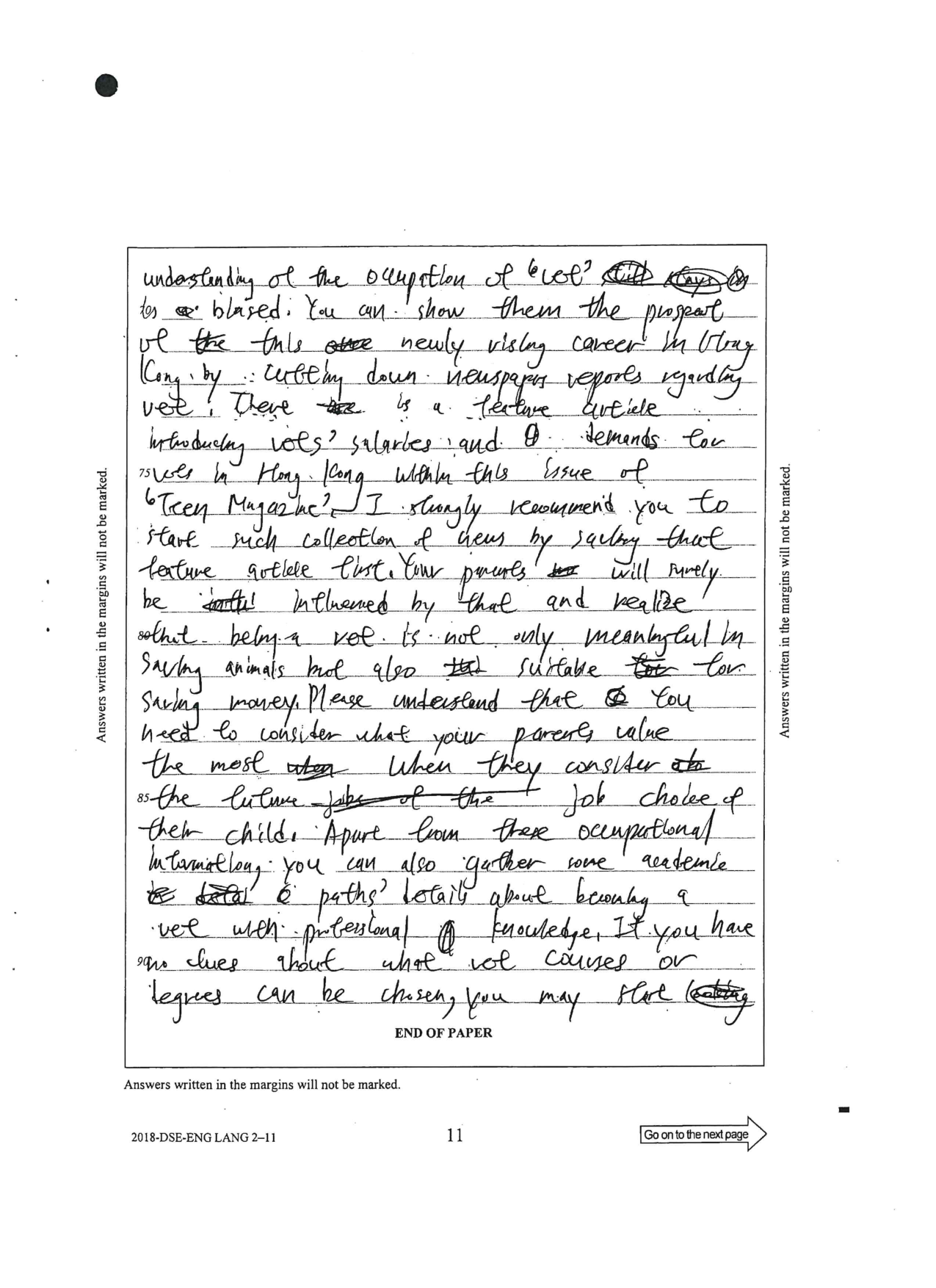
Booklet p.11 - newspaper evidence and what parents value
Booklet p.11 — evidence; what parents value
Booklet p.12 pre-printed supp - the third good: a good opportunity
Booklet p.12 (supp.) — the third ‘good’
Loose supplementary sheet - choosing the right moment to talk
Loose supp. (S2) — the right moment
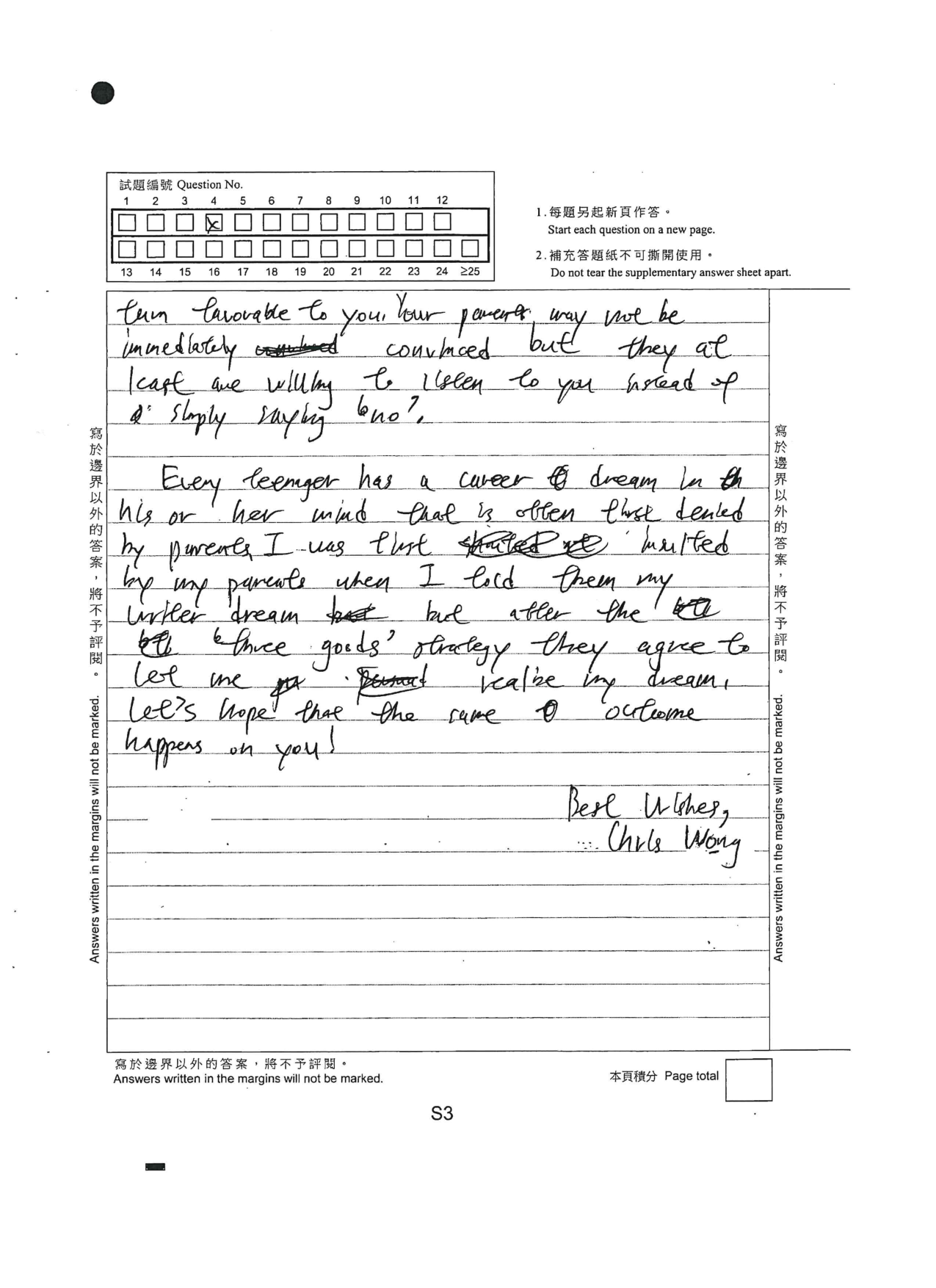
Loose supplementary sheet - personal disclosure and the sign-off
Loose supp. (S3) — personal close & sign-off

The writing, with corrections marked inline

Legend: green = the candidate’s own insertion  |  dotted underlineour fix = our small correction  |  every inline fix has a matching row in Grammar notes. Line numbers show every 5th.
Booklet p.8 (lines 1–21)
1Dear J.C,
2Thank you for writing to me about your career
3problem! The first thing I want to express to you
4before explaining anything else is how much I appreciate you for
5having the courage to ask for advice
6tryingto for solving your problem. That’s
7already the first step to success and with the
8some ’tricks’ and suggestions explained below, I
9have the faith in you that the this partial
10frustration to current frustration of yours will
11soon become history and your parents will
12respect your choice as the result and no longer
13ignore your will.
14What I want to point out to you before giving you
15some practical methods is that the fact that your parents
16to [?] accept your choice [?] refusing to
17accept your choice of career is most possibly
18caused by the lack of necessary information [?]
19but not disliking you as a person or as their
20beloved child. [?] To resolve to your problem,
21it is a necessity that we first understand the
Booklet p.9 (lines 22–44)
22true [?] reasons for such case. They simply say ’no’
23because they they’re under the wrong
24impression that being a vet brings or
25working hard in preparation for becoming a vet
26brings their child more [?] harm than
27good. Your parents still love you and you’re
28still their good child. to Too many teenagers
29generate the misconception that once their career
30choice’s not recognized by their parents, their
31parents don’t love them anymore. That wrong
32concept just makes the relationship worse and
33is of no practical use tono practical use in solve solving the
34problem. That is why I use a whole paragraph
35to analyse your parents’ misconception and your
36possible misunderstanding towards them so please
37bear that in mind before continu continuing
38reading.
39To erase such wrong wrong concept, it’s quite
40crucial for you to have two three ’goods’ —
41good attitude, good information gathering
42and good opportunity to present to your parents.
43good attitude means that you’ve a greater
44chance to [?] of convincing your parents.
Booklet p.10 (lines 45–66)
45Consider this, if you were your mother, would you
46really listen with attention [?] if your
47child simply told you ’I want to be a vet
48vet’? The chance is low and we have to adopt
49a softer approach. You can show your determination
50by starting joiningstarting to join charity organizations, which
51serve stray dogs dogs and cats at weekend
52using your free time. These actions are always
53louder than words and your parents will soon
54realize your career dream limbs withdream links with your
55personality trait. That kind of good att
56attitude to is so shown by real action
57is what you really need now.
58Afte After knowing the first ’good’, you may
59wonder what’s the meaning of good information
60gathering. Are you a spy – serving in
61intelligence agencies (like James Bond?
62Definitely not! Your parents have generation gap
63with you and that’s the totally usual
64case happens on most of the families
65involved in (often written to me, don’t be
66discouraged by the fact that your parents?
Booklet p.11 (lines 67–89)
67understanding of the occupation of ’vet’? [?] [?] [?]
68to be biased. You can show them the prospect
69of the this [?] newly rising career in Hong
70Kong by writing down newspaper reports regarding
71vet! There are is a feature article
72introducing vets’ salaries and [?] demands for
73vets in Hong Kong within this issue of
74’Teen Magazine’? I strongly recommend you to
75start such collection of news by saying that
76feature article first. Your parents [?] will surely
77be worth! influenced by that and realize
78what being a vet is not only meaningful in
79saving animals but also the suitable for for
80saving money. Please understand that [?] You
81need to consider what your parents value
82the most when when they consider [?]
83the future jobs of the job choice of
84their child. Apart from these occupational
85information, you can also gather some academic
86to detail [?] paths? totally about becoming a
87vet with professional [?] knowledge. If you have
88no clues about what vet courses or
89degrees can be chosen, you may start looking
Booklet p.12 (Supplementary Answer Sheet for Part B) (lines 90–111)
90to look for [?] City [?] University’s [?]
91website and there are quite a lot of [?]
92information about studying to vet university
93degree locally. Remember that your parents
94may not [?] probably [?] don’t [?] know
95about all these [?] details and that
96is why [?] collecting them is necessary for
97present presently to them.
98Only information gathering and [?] attitude are not
99enough to secure that your parents will [?] change
100their mind. A good moment to talk and discuss
101discuss the issue with them is vital. [?]
102[?] and to and that is the third ’good’?
103good opportunity to present to your parents. Find
104a [?] Saturday night or family day when
105all of you are having good mood mood
106[?] and are ready for some [?] close
107parents-children interaction. Don’t strictly throw
108up the question but try to create a cosy
109atmosphere first. You can do so by making [?]
110cups of tea for them and maybe even
111offering [?] some shoulder massages to
Supplementary answer sheet (A) — S2 (lines 112–133)
112let them understand that you care and love them as well.
113At the suitable moment, let’s say when they ask how’s
114going with you recently which is often the
115common topic between children and parents,
116tell them that one thing has troubled you
117for long and that only they, their and [?]
118few true supporters and ’carers’ of you, can
119[?] give you a hand in solving [?]
120this problem. They will are going to grow deepergrow a deeper
121and deeper interest in that issue and we
122that moment show them the [?] amount of
123information you gathered before and [?]
124presure to them with detailspresent this to them with details. Hardly can I
125imagine your parents will refuse to listen to
126you under such circumstances. In many cases,
127the [?] content of [?] what you mention
128does matter yet the theme you choose to
129mention them matters even more.
130The above three ’goods’ are in fact a step to
131step-to-step approach in solving your problem.
132Remember to implement them with [?] [?]
133carefulness and [?] things will surely
Supplementary answer sheet (A) — S3 (lines 134–148)
134turn favorable to you. Your parents may not be
135immediately convinced convinced but they at
136least are willing to listen to you instead of
137of simply saying ’no’.
138Every teenager has a career [?] dream in [?]
139his or her mind that is often first denied
140by parents. I was that [?] hurtedhurt
141by my parents when I told them my
142writer dream but but after the [?]
143[?] ’three goods’ strategy they agree to
144let me go [?] realise my dream,
145let’s hope that the same [?] outcome
146happens on you!
147Best wishes,
148Chris Wong

Strengths to praise

A warm, validating advice-column voice
Voice & register lines 1–13

It names and accepts the reader’s feeling and praises the act of asking — “how much I appreciate you for having the courage to ask for advice” — then promises that “this… current frustration of yours will soon become history”. Exactly the reassuring register the genre wants.

A genuine organising framework
Structure & cohesion lines 39–42, 130

The whole reply hangs on “three ‘goods’ — good attitude, good information gathering and good opportunity”, described at the end as “a step-to-step approach”. A clear scaffold like this lifts a long answer above a list of tips.

Reframes the ‘no’ rather than just fighting it
Argumentation lines 14–33

It argues the parents’ refusal is “most possibly caused by the lack of necessary information, but not disliking you” and warns against the “misconception” that disagreement means lost love. Treating the parents charitably is mature, persuasive advice.

Concrete, do-this-tomorrow strategies
Task fulfilment lines 50–75, 103–111

Volunteer at charities that “serve stray dogs and cats”, show parents a Teen Magazine feature on vets’ salaries and demand, and pick “a Saturday night or family day” with tea (or even “shoulder massages”) to raise the topic. Specific actions, not platitudes.

Builds rapport with personal disclosure
Persuasive technique lines 138–146

The columnist admits being “hurt by my parents when I told them my writer dream” and how the ‘three goods’ won them round — “let’s hope that the same outcome happens on you!”. Sharing a parallel struggle makes the advice land.

Grammar notes

IssueExplanation
fix (line 9) this partial current frustration of yoursthis current frustration…Wrong word. Partial (= incomplete / biased) doesn’t fit; the writer means the present frustration. Drop it (or use painful): this current frustration of yours.
fix (line 15) the fact that your parents refusing to accept your choice… is most possibly caused byyour parents’ refusal to accept… is most likely caused byMissing finite verb. The subject clause has no main verb — parents refusing needs are refusing, or recast as a noun phrase: your parents’ refusal to accept your choice is most likely caused by… Also prefer most likely to most possibly.
fix (line 33) is of no practical use to solving the problem…of no practical use in solving…Preposition. Use in this sense takes in + -ing: of no practical use in solving the problem. (The candidate already fixed solvesolving; only the preposition remains.)
fix (line 50) by starting joining charity organizationsby starting to join…Verb pattern. Start + another verb takes the infinitive or a single -ing, not two: start to join or simply join. Starting joining doubles the -ing.
fix (line 54) your career dream limbs with your personality trait…dream links with…Wrong word. Limbs (arms/legs) should be links: your career dream links with your personality. An easy slip of similar-looking words; read back unusual collocations.
fix (line 120) They are going to grow deeper and deeper interest…grow a deeper and deeper interestMissing article. A singular countable noun needs an article: grow a deeper interest (or develop deeper and deeper interest, treating it as uncountable).
fix (line 124) presure to them with detailspresent this to them with detailsWrong word + structure. Presure is a misspelling and the verb needs an object: the sense is present this (information) to them in detail. (If pressure was intended, the meaning would be too forceful for the gentle approach advised.)
fix (line 136) willing to listen to you instead of / of simply saying ‘no’…instead of simply saying ‘no’Repeated word across the page-break. Of is written twice (end of one line, start of the next): keep just one — instead of simply saying ‘no’. Watch for doubled words when a sentence wraps to a new sheet.
fix (line 140) I was… hurted by my parentsI was hurt…Irregular verb. Hurt is invariant: hurt–hurt–hurt. The past participle is hurt, never hurted: I was hurt by my parents.
notice (line 4) how much I appreciate you for having the courage to ask for adviceWarm, validating opening. Praising the reader for reaching out is textbook advice-column technique — it builds trust before any advice is given.
notice (line 40) three 'goods' — good attitude, good information gatheringA memorable scaffold. Naming and numbering a framework (the ‘three goods’) gives a long reply shape and makes the advice easy to remember — a strong structural choice.
notice (line 52) These actions are always louder than wordsApt idiom. A neat echo of ‘actions speak louder than words’, used exactly where the advice is about showing commitment through deeds.

Style suggestions

How to read these: fluency smoother, more varied sentences  |  authenticity a truer, more natural voice  |  text-type sharper advice-column conventions
Split the long opening sentence
fluency lines 14–21

“What I want to point out to you before giving you some practical methods is that the fact that your parents refusing to accept your choice… is most possibly caused by the lack of necessary information but not disliking you…”

“Before the practical tips, one thing matters most: your parents’ ‘no’ is probably about missing information, not about loving you any less.”

This sentence runs ~40 words with a doubled that the fact that; breaking it and cutting the repetition makes the key idea land.

Catch the doubled words
fluency lines 102, 136–137

“and to and that is the third ‘good’”; “instead of / of simply saying ‘no’”

“…and that is the third ‘good’”; “instead of simply saying ‘no’”

Words get doubled where the pen restarts or a line wraps; a quick read-back catches and to and and of / of.

Land the ‘spy’ aside, or cut it
authenticity lines 60–62

“Are you a spy – serving in intelligence agencies (like James Bond)? Definitely not!”

“You don’t need to investigate like a spy — just gather a few facts.”

The James Bond joke is fun but interrupts the point; either tie it straight back to ‘information gathering’ or trim it.

Number the three goods on the page
text-type lines 40–42, 58, 103

“three ‘goods’ — good attitude, good information gathering and good opportunity… the first ‘good’… the third ‘good’”

Use mini-headings: “1. A good attitude2. Good information3. The right moment

For a 400-word framework answer, sub-headings or ‘First/Second/Third’ help the reader track the three strands.

Replace ‘limbs’ and ‘presure’
authenticity lines 54, 124

“your career dream limbs with your personality”; “presure to them with details”

“your career dream links with your personality”; “present this to them in detail”

Two near-miss word choices; reading the sentence aloud usually flags them.

Trim ‘present to your parents’ repetition
fluency lines 42, 103

“good opportunity to present to your parents… good opportunity to present to your parents”

“the third good is the right opportunity to raise it with them”

The phrase recurs almost verbatim; vary it the second time.

Tighten the close
text-type lines 145–148

“let’s hope that the same outcome happens on you! Best wishes, Chris Wong”

“I hope the same works for you. Best wishes, Chris Wong”

Happens on youhappens to you / works for you; otherwise the warm sign-off is well judged.

Prefer plain linking words
fluency lines 9, 39

“this… frustration of yours will soon become history”; “To erase such wrong concept”

“this frustration will soon pass”; “To correct this idea”

A few phrases reach for effect (become history, erase such wrong concept); plainer wording reads more naturally.

Strong moment worth teaching from

Giving a long answer a backbone

Wording slips throughout, but the structural idea is genuinely strong.

“To erase such wrong concept, it’s quite crucial for you to have three ‘goods’ — good attitude, good information gathering and good opportunity to present to your parents.… The above three ‘goods’ are in fact a step-to-step approach in solving your problem.” (lines 39–42, 130–131)

Faced with a 400-word reply, this writer invents a three-part framework and signposts back to it at the end. That kind of scaffolding is what keeps a long answer coherent under exam pressure — the lesson is to give your reader a structure to hold on to, then deliver each part in turn.

Professional rewrite — the long ‘parents’ refusal’ sentence

Model rewrite

Untangling the run-on and supplying the missing verb, keeping the writer’s charitable point.

Student (verbatim, edits folded in)

What I want to point out to you before giving you some practical methods is that the fact that your parents refusing to accept your choice of career is most possibly caused by the lack of necessary information but not disliking you as a person or as their beloved child.

Professional version

Before the practical tips, one thing matters most. Your parents’ refusal to accept your choice is most likely caused by a lack of information — not by any dislike of you. They still love you; they simply don’t yet understand the choice.

Vocabulary to notice

Word & alternativesDefinitionUsage notes
misconception
misunderstanding, false belief, fallacy
(n.) a view or opinion that is incorrect.generate the misconception that…”. Often a common misconception; verb phrase be under the misconception that.
determination
resolve, commitment, drive
(n.) firmness of purpose; the quality of not giving up.show your determination”. Pairs with show / demonstrate; adjective determined.
prospect(s)
outlook, future, chances
(n.) the likelihood of future success; what is likely to happen.show them the prospect of this newly rising career”. Career prospects is a strong, exam-ready collocation.
biased
prejudiced, one-sided, partial
(adj.) unfairly favouring one side; not neutral.understanding… to be biased”. From bias (n.); the opposite is impartial / unbiased.
generation gap
age divide, generational difference
(n. phrase) the difference in attitudes between younger and older people.Your parents have generation gap with you” (better: a generation gap). A natural, relevant idiom for this topic.
assiduous / diligent
hard-working, persistent, dedicated
(adj.) showing steady, careful effort.Not used, but a sharper word than working hard when praising the reader’s commitment to becoming a vet.

Comments

Leave a Reply