Letter to the Editor — Defending Fresh Graduates’ Diligence
It has recently been claimed that in the workplace many Hong Kong fresh university graduates are less hard-working and less willing to face challenges compared to those in the past.
You strongly disagree with this opinion. Write a letter to the editor of the Hong Kong Daily disagreeing with this opinion. Support your view with three reasons and/or examples.
(~400 words)
Show original handwritten pages (4)

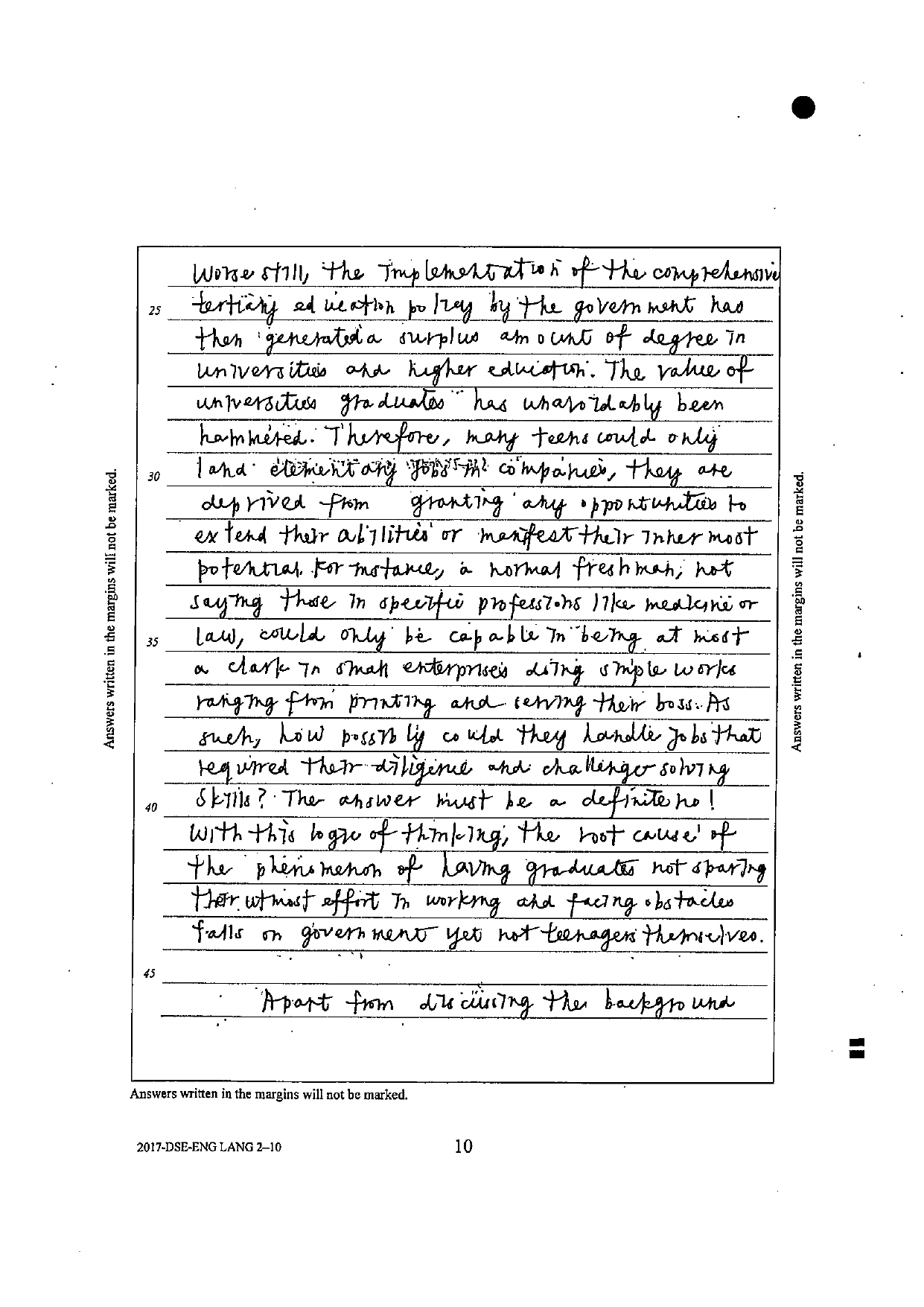
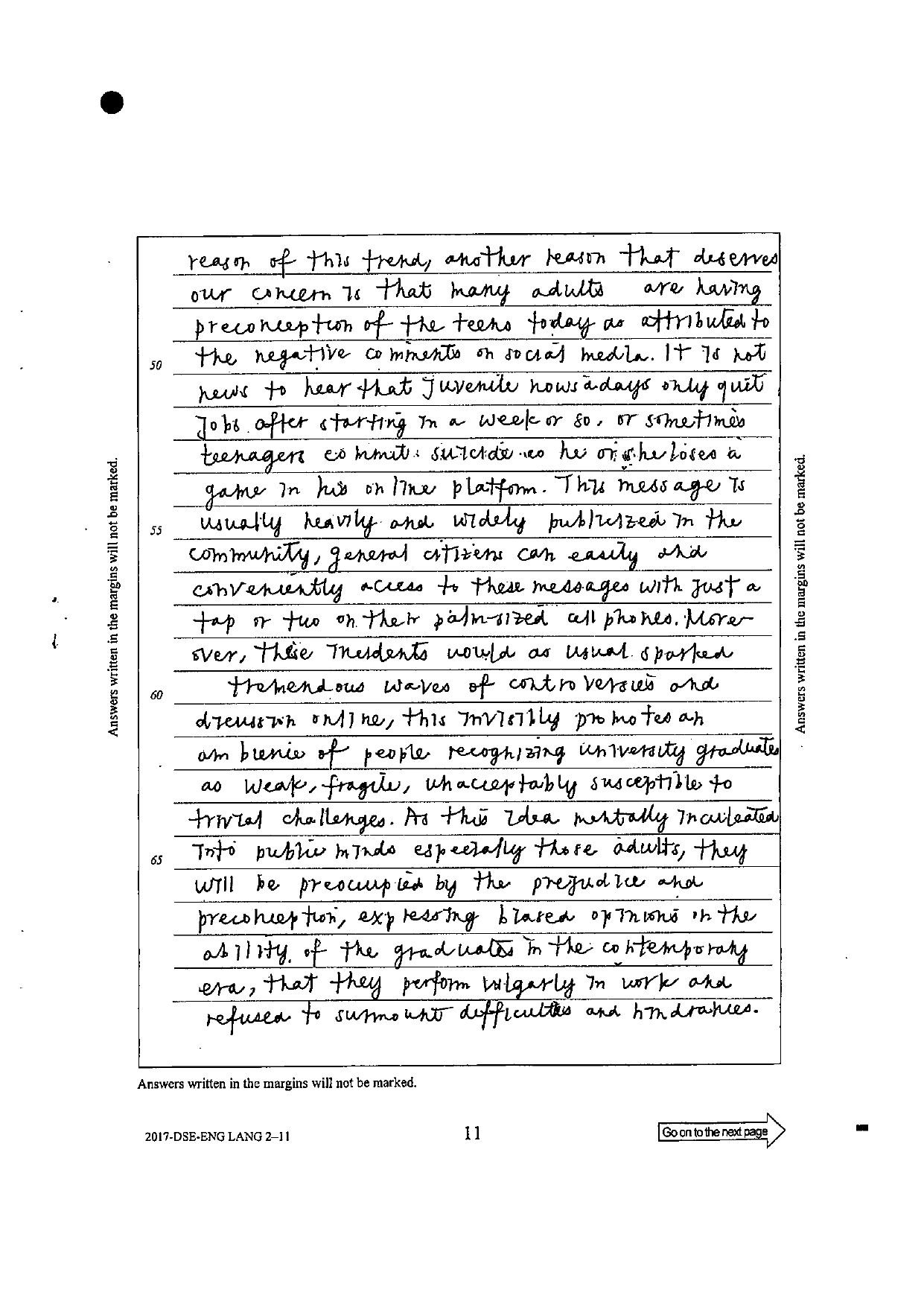

The writing, with corrections marked inline
Word count. Approximately 560 words against the 400-word brief — 40% over, which is normal for ambitious Q9 scripts. Length is not the issue; the structural collapse at the end is.
The structural failure at the close — what cost the band. The closing paragraph opens “In contradistinction to my belief, the advocates may deem…” which is the textbook signal that a rebuttal is about to be staged: the writer is going to lay out the opposing view in order to dismantle it. The candidate lays out the opposing view in full (permissive parenting since the 1990s has produced a generation that lacks resilience), and then runs out of paper before the rebuttal. The visible final sentence “Consequently, graduates are absolutely not diligent and unable to cope with adversities in life” reads as the candidate’s own conclusion — which is the structural opposite of the strongly disagree brief. A marker reading for argumentative coherence has to choose: either credit the opening of the paragraph (the writer was going to rebut, just ran out of time) or read the closing sentence as written (the writer has switched sides). The 5*/5** boundary is exactly where that choice gets registered.
What the script does well — the two-reason architecture before the collapse. The first reason (paucity of upward social mobility, with two named causes — economic saturation since the 1970s and the over-supply of degrees from tertiary expansion) is a real economic argument, not the standard graduates today are misunderstood opener most candidates reach for. The second reason (adults’ preconception is media-driven, fuelled by viral stories of quitting and online-gaming suicides) is an even more original move — the candidate has identified a specific transmission mechanism for the prejudice. These are 5*-level arguments; if the third paragraph had refuted rather than capitulated, the script would be at 5** of the band.
The verb “diligent” and the missing turn. The opening states clearly: “many teenagers are still very diligent and brave to embrace difficulties”. But the body of the letter never demonstrates the diligence — it explains why the perception is wrong (economic constraint; media prejudice) without ever showing a graduate being diligent. A reader looking for the positive case (here is a hard-working fresh graduate I can name) doesn’t find one. The argument is by exoneration, not by demonstration. Sister 2017-006 makes the same prompt land by naming a specific young entrepreneur; this candidate doesn’t. The missing positive case is the conceptual gap the marker registers.
Strengths to praise
“The foremost reason is that the major cause to this phenomenon is due to a paucity in upward social mobility for youngsters of this generation.” (lines 12–15) The candidate names a structural economic condition (the late-1970s job-creation boom from foreign investment is over; the vocational market is saturated; degree over-supply has devalued graduate credentials) as the explanation for what the older generation reads as laziness. This is a real diagnostic argument and the right one — the perception that graduates won’t take demanding work is partly about supply: there is less demanding work available. The argument lifts the letter above the conventional graduates work hard, you just don’t see it register.
Paragraph 2 (lines 12–23) sets up the economic background (Hong Kong’s growth has plateaued, vocational market saturated). Paragraph 3 (lines 24–44) adds the second step (the over-supply of degrees from tertiary expansion has devalued the qualification). The two paragraphs work as a causal chain — economic conditions plus policy decisions equal degraded job prospects, which equal apparent ‘reluctance’. The structure is sophisticated and the marker rewards it; the conceptual reach is at 5** even though the prose execution slips to 5*.
“A normal freshman, not to say those in specific professions like medicine or law, could only be capable of being at most a clerk in small enterprises doing simple work ranging from printing and serving their bosses.” (lines 33–37) The image (the law/medicine graduate exception, the freshman reduced to printing-and-coffee work in an SME) is specific in the right way: a Hong Kong reader recognises the type immediately. Printing and serving their bosses is the exact junior-clerk job description, the kind of texture that distinguishes a real claim from an abstract one.
Paragraph 4 (lines 46–74) doesn’t just say adults misjudge the young; it names the mechanism by which the misjudgement spreads (viral social-media stories about job-quitting and gaming-related suicides, accessed with “just a tap or two on their palm-sized cell phones”, fuelling waves of online controversy that “invisibly promote an ambience of people recognising university graduates as weak, fragile, unacceptably susceptible to trivial challenges”). This is sociological argument done at a high level — the writer is treating prejudice as a thing that propagates through specific channels with specific effects, not as a free-floating attitude. Sister Q9 letters (2017-005, 2017-004) don’t reach for this; the candidate’s instinct for media analysis is unusual.
“general citizens can easily and conveniently access these messages with just a tap or two on their palm-sized cell phones.” (lines 56–58) The phrase palm-sized cell phones is the writer reaching for the right physical detail (the smartphone is small enough to hold in one hand; the access is one or two taps). The compression of the modern-media phenomenon into a single sensory image is the kind of move that signals genuine writerly attention.
“As such, how possibly could they handle jobs that required their diligence and problem-solving skills? The answer must be a definite no!” (lines 37–40) The rhetorical question + immediate emphatic answer is the right rhetorical move for a letter-to-the-editor in a polemical register; the exclamation mark, normally a warning sign, is earned here because the writer has built the case for it. The audience is the “reasonable Hong Kong reader” the editor stands in for, and this is exactly the kind of confident move that audience expects.
The vocabulary range across the four pages: arousing concern, compelled, embrace difficulties, foremost reason, paucity, upward social mobility, surged exponentially, vocational market, saturated, comprehensive tertiary education policy, surplus, devalued, deprived of, manifest their innermost potential, surmount, hindrances, in contradistinction, advocates, deem, upsurge, overhaul, apprehensive, permissive parenting, adversity resilience, endurance, susceptible, inculcated, contemporary era. The candidate is operating two registers above the median Q9 script; the lexical instinct is the same one that earned the Part A near-perfect. This is what holds the Language score above the failure of the closing structure.
What the script doesn’t do — the structural and authenticity gaps
The drop from Part A’s 41/42 to this script’s 33/42 has three named causes, listed below. The grammar slips (the table further down) are real but mostly minor — the same kind of slip-rate as Part A, which scored at the top of the band. The real story is the genre fit and the time management.
The candidate opens paragraph 5 (line 75) with “In contradistinction to my belief, the advocates may deem…” — the standard signal that a rebuttal is about to be staged. The paragraph then lays out the opposing case in full (permissive parenting since families’ economic status improved; spoiled children grow up lacking resilience; a Chinese University graduate fails 200 job interviews as proof). The candidate runs out of paper before the rebuttal. The final sentence as written — “Consequently, graduates are absolutely not diligent and unable to cope with adversities in life” (lines 91–93) — affirms the opposing view, which is the structural opposite of the strongly disagree brief. The structural failure is what holds the band at 5* rather than 5**. The candidate evidently planned to refute and either ran out of time or ran out of room (booklet p.12 ends mid-thought); the rebuttal never gets onto the page.
The Q9 brief is support your view with three reasons and/or examples. The candidate’s ‘view’ (that graduates are diligent) is asserted in the opening but never demonstrated. The three reasons (economic constraint, media prejudice, and the abortive permissive-parenting rebuttal) all explain why the perception is wrong; none of them shows a graduate being diligent. A letter defending fresh graduates needs at least one named example of a graduate doing the work the older generation says they won’t. Sister 2017-006 reaches for the “young entrepreneur” case; sister 2017-005 reaches for the “long working hours, junior positions” testimony. This candidate doesn’t reach for either; the ‘diligence’ claim sits in the opener as a flag that is never returned to.
The brief asks for three reasons. Paragraph 2 + 3 = reason 1 (economic constraint, with two causal layers). Paragraph 4 = reason 2 (media-driven prejudice). Paragraph 5 = not a third reason at all but an opposing-view-and-rebuttal move (which the candidate then doesn’t complete). A reader counting reasons against the brief finds two real reasons and one paragraph that flips into a counter-argument. The same structural confusion appears in sister 2017-011’s Q6 speech (which also collapses reason and rebuttal in the final paragraph) — it is a recurring 2017 candidate pattern. A textbook 5** Q9 letter offers three structurally independent reasons (e.g. economic context, media perception, and an actual case of a diligent graduate) and handles the rebuttal as a separate fourth move.
Grammar notes
| Issue | Explanation |
|---|---|
(line 2) an arousing concerns → arousing concern / concerns |
Article-number mismatch. An requires a singular noun (an arousing concern); plural concerns takes no article (arousing concerns). The candidate has combined the singular article with the plural noun. Also, arousing in this context reads slightly off-register for the standalone “awakening” sense the candidate wants; a growing concern, mounting concern, increasing concern would be the more standard letter-to-editor opener. |
(lines 3–4) adolescents’ poor attitude in working and reluctant to encounter challenges → adolescents’ poor attitude to work and reluctance to face challenges |
Three slips. (i) Attitude in working — the preposition is to or towards (attitude to work, attitude towards challenges), not in. (ii) Working as a noun is unusual; the standard noun is work. (iii) Reluctant is an adjective; parallel with the noun attitude requires the noun form reluctance. The candidate’s sentence reads as if reluctant modifies adolescents directly, which doesn’t parse against the rest of the sentence. |
(lines 13–14) the major cause to this phenomenon → the major cause of this phenomenon |
Preposition. Cause of is standard; cause to means “reason to do something” (cause to celebrate, cause to worry). The candidate means the explanation for the phenomenon, which takes of. |
(lines 14–15) paucity in upward social mobilities → a paucity of upward social mobility |
Three slips. (i) Paucity is countable and takes the indefinite article (a paucity of). (ii) Paucity in reads as “rarity in” (a paucity in the data); paucity of reads as “shortage of” (a paucity of evidence). (iii) Mobilities is plural; social mobility is uncountable in this sense (the concept of movement between socioeconomic classes). The plural reads as if the writer means “multiple kinds of mobility”, which isn’t the standard usage. |
(lines 18–19) created a massive supply job opportunities → created a massive supply of job opportunities |
Missing preposition. Supply as a noun takes of + the thing being supplied (supply of goods, supply of labour, supply of opportunities). The candidate has dropped the preposition. |
(lines 20–21) the economic development of Hong Kong relieved → the economic development of Hong Kong has eased / has slowed |
Wrong verb. Relieve is transitive (to relieve someone of a burden) or means “to alleviate”; it doesn’t mean “to slow down” intransitively. The candidate means the pace of economic growth has slowed: has eased, has slowed, has plateaued. The verb slip is a real meaning slip (a reader could think the writer means Hong Kong has been relieved of economic development, which is the opposite). |
(line 21) vacational market → vocational market / job market |
Spelling slip producing a different word. Vacational isn’t standard English (the noun is vacation; the adjective is vacation-related). The candidate means vocational (relating to occupations and jobs); the two words differ by one letter (vocation vs vacation) and one means “job-related”, the other means “holiday-related”. A handwriting-pressure slip with real semantic cost: a reader could think the writer means “the holiday market”, which makes no sense in context. |
(lines 28–29) has unavoidably been hampered → has unavoidably been devalued |
Wrong verb for the sense. Hamper means to hinder progress (hampered by bad weather, hampered by lack of funds); the candidate means the value has gone down, which is devalued, eroded, diminished, lowered. The candidate’s sentence reads as if the value is being slowed down rather than reduced. |
(lines 31–32) deprived from granting any opportunities → deprived of opportunities to extend their abilities |
Two slips. (i) Deprive of, not deprive from (deprived of food, deprived of sleep, deprived of opportunities). (ii) Granting any opportunities reads as if the teens are doing the granting (granting is a transitive act with a giver); the candidate means the teens are not being granted opportunities. The cleanest fix recasts: they are deprived of opportunities, with opportunities to V following. |
(lines 33–34) not saying those in specific professions → not to say those in specific professions / let alone those in specific professions |
Fixed-phrase grammar. Not to say is the standard phrase for “and one could even say” or “not even mentioning”; not saying reads as the participial form, which means “while not saying”, which isn’t the candidate’s intent. The candidate means let alone (excluding the special cases of doctors and lawyers, who would be exceptions): “a normal freshman, let alone those in specific professions like medicine or law”. |
(line 35) could only be capable in being at most a clerk → could only be capable of being at most a clerk |
Preposition. Capable of + gerund (capable of working, capable of doing); the candidate writes capable in being, which is non-standard. The same preposition (of) appears earlier in the script — this is a recurring slot the candidate fills inconsistently. |
(lines 36–37) simple works ranging from printing and serving their boss → simple work ranging from printing to serving their bosses |
Three slips. (i) Work in the “tasks/labour” sense is uncountable; works in the plural refers to literary or artistic compositions (the complete works of Shakespeare) or to engineering installations (public works). (ii) Ranging from X and Y isn’t the standard construction; the fixed pattern is ranging from X to Y. (iii) Their boss (singular) where the context implies multiple junior clerks each with their own boss: their bosses. |
(lines 38–39) jobs that required their diligence → jobs that require their diligence |
Tense. The rhetorical question is in the present tense (how possibly could they handle), so the relative clause is also present (jobs that require). The candidate has slipped to past tense (required), which mismatches. |
(lines 41–42) the phenomenon of having graduates not sparing their utmost effort → the phenomenon of graduates not sparing their utmost effort |
Redundant having. The construction the phenomenon of X V-ing doesn’t need the auxiliary having; graduates not sparing is the gerundive subject and stands on its own. The extra having reads as a calque from Cantonese-influenced English. |
(line 44) falls on government yet not teenagers themselves → falls on the government, not on the teenagers themselves |
Three slips. (i) The government takes the definite article in this generic-policy sense. (ii) Yet not is non-standard for the contrastive sense; standard English uses but not, and not, rather than. (iii) The parallel needs the preposition repeated: on the government, not on the teenagers, so the comparison is parallel. |
(lines 48–50) having preconception of the teens today as attributed to → having a preconception of teens today which can be attributed to |
Two slips. (i) Preconception is countable and takes the indefinite article (a preconception). (ii) As attributed to reads as a free-standing participial phrase; the syntax needs the relative clause (which can be attributed to, which is attributable to) to connect the preconception with its cause. |
(line 51) Juvenile nowadays → juveniles nowadays |
Two slips. (i) Juvenile capitalised reads as a proper noun (a magazine? a film?); the common noun is lowercase. (ii) The candidate uses the singular form where the plural is needed (the claim is about juveniles in general, not one specific juvenile). The plural noun juveniles is also slightly clinical (suggests legal classification); young people, teenagers is the more natural register. |
(line 52) quit jobs after starting in a week or so → quit jobs a week or so after starting |
Word order. The candidate’s order (after starting in a week or so) reads as if the starting happened “in a week or so”, which doesn’t parse. The intended sense is that the quitting happens a week or so after starting, which the rewrite delivers by reordering. |
(lines 52–54) teenagers commit suicide as he or she loses a game → a teenager commits suicide because he or she loses a game / teenagers commit suicide because they lose a game |
Two slips. (i) Number agreement: teenagers (plural) doesn’t agree with he or she (singular). Either the subject becomes singular (a teenager) or the pronouns become plural (they). (ii) As as a causal conjunction is acceptable but slightly ambiguous (it can also mean “at the time when”); because is the clearer causal conjunction in this context. |
(lines 59–60) incidents would as usual sparked tremendous waves → incidents would as usual spark tremendous waves |
Modal-verb form. The modal would takes the bare infinitive (would spark, would create, would generate), not the past participle (would sparked). The candidate has used the past participle form, which doesn’t pair with the modal. |
(lines 64–65) this idea mentally inculcated into public minds → this idea is mentally inculcated into the public mind |
Two slips. (i) Missing copula: the sentence needs is before mentally inculcated (or the past tense was). Without the verb, the clause is a fragment. (ii) Public minds (plural) is unusual; the standard collective noun is the public mind (singular, treating the public as a single entity in this rhetorical sense). The plural reads as if there are multiple public minds, which isn’t the writer’s intent. |
(line 69) perform vulgarly in work → perform poorly at work |
Two slips. (i) Vulgarly means “crudely, in bad taste” (he laughed vulgarly, dressed vulgarly); the candidate means poorly, inadequately, sub-standardly. The wrong adverb is a real register slip because vulgar carries a moral charge the writer doesn’t intend. (ii) The standard preposition is at work, not in work (at work, at the office, on the job). |
(lines 91–93) graduates are absolutely not diligent and unable to cope → The closing sentence as written contradicts the letter’s thesis. |
The single most consequential issue in the script. The opening paragraph declares “many teenagers are still very diligent and brave to embrace difficulties” (lines 9–10); the closing sentence declares “graduates are absolutely not diligent and unable to cope with adversities in life”. The candidate has lost track of whose voice is speaking — the closing was meant to be the opponent’s conclusion (which the candidate would then refute) but reads as the writer’s own conclusion. The fix isn’t a wording change; the structural fix is to either insert “The advocates would conclude that…” as the framing of the sentence, or to add the rebuttal that was clearly planned (“But this conclusion is wrong, because…”). |
Style suggestions (where strong writing could become outstanding)
Professional rewrite — the closing paragraph (genre fit and structural completion)
For comparison only, not a correction. The student’s closing paragraph opens with the textbook rebuttal signal (“In contradistinction to my belief, the advocates may deem…”) and then runs out of paper before completing the move — the visible final sentence affirms the opposing view, which is the opposite of what the brief asks for. The rewrite below shows what the same content looks like when the rebuttal is given the space it needs: the opposing view is summarised more tightly, and the refutation is delivered in three short turns.
The student’s paragraph (lightly corrected)
Rewritten by a professional letter-writer
Read that example again. Two hundred interviews. A spoiled child does not sit through two hundred interviews. A spoiled child quits after the third. The 200-interview graduate is, by any reasonable definition, performing exactly the diligence the advocates accuse the generation of lacking.
The advocates have read the wrong story off the right data. The data say: graduates today are applying harder, longer, and against worse odds than their parents ever did. The story to tell is not that this generation is lazy. The story to tell is that we are working twice as hard for half the result — and being scolded for it by the people who set up the system that produced the result. I rest my case, and remain
Yours faithfully,
Chris Wong
- The opposing view is summarised, not re-stated in full. The student’s paragraph spends roughly 80 of its 130 words restating the permissive-parenting argument in detail; the rewrite compresses it to two sentences. Compression is the price of the rebuttal that has to follow — in a 130-word closing paragraph, you cannot give the opposition 80 words and yourself 50.
- The candidate’s own example is turned against the opposing view. The 200-interview Chinese University graduate is the candidate’s example, originally cited as proof of incapacity. The rewrite re-reads the example: 200 interviews is itself an act of diligence (a spoiled child wouldn’t sit through 10). The inversion of one’s opponent’s example is the strongest rhetorical move available in a short rebuttal — it shows the opposition is reading their own data wrong.
- The italicised emphasis lands the pivot. Two hundred interviews. The italicised re-statement of the number is the rhetorical move that asks the reader to dwell on the figure. In a letter-to-the-editor read aloud (which letters often are, in newsroom workshops), this is the line that gets the pause.
- The closing line is a generational verdict, not a personal complaint. “We are working twice as hard for half the result — and being scolded for it by the people who set up the system that produced the result.” The rewrite ends not on a personal lament but on a generational verdict that names the wider system. The line is the kind of close a real letter-to-the-editor reaches for: a punchy formulation the editor can pull as a quote-line.
- The sign-off is conventional and complete. The student’s draft has no sign-off (the writer ran out of paper before reaching it); the rewrite includes I rest my case, and remain / Yours faithfully, / Chris Wong. The closing salutation is part of the genre; without it, the letter reads as a fragment rather than a finished piece.
- Word count is similar. Student version ~130 words; rewrite ~190 words. The rewrite is slightly longer because it has to do something the student version never gets to (the rebuttal); the trade-off is a complete piece versus a piece that affirms the wrong side.
Vocabulary to notice
| Word | Definition | Usage notes | Synonyms / alternatives |
|---|---|---|---|
| compelled (to) | (adj./v.) forced or obliged to do something, often by inner moral pressure. | Pairs with feel, write, speak out, act, respond. Slightly literary; carries the sense of inner necessity rather than outer coercion. The candidate’s “I felt compelled to express my opposition” uses the standard letter-to-editor opener formula. | obliged, moved, driven, impelled, forced |
| paucity | (n.) the presence of something only in small or insufficient quantities; scarcity. | Pairs with evidence, data, information, opportunities, resources. Takes the indefinite article (a paucity of) and the preposition of, not in. Slightly literary / formal. The candidate’s “a paucity in upward social mobilities” uses the right register but the wrong preposition and a non-standard plural. | scarcity, dearth, shortage, lack, insufficiency |
| upward social mobility | (n. phrase) the ability of individuals or groups to move upward in social class or economic status across generations. | The standard sociological term for the conditions that determine whether a generation can do better than its parents. Pairs with opportunities for, paths to, decline in, blocked, increase, restore. The candidate uses it correctly to name the structural condition behind the lazy-graduates perception. | social mobility, intergenerational mobility, economic mobility |
| surge (exponentially) | (v.) to increase suddenly and powerfully, especially in volume or intensity. | Pairs with prices, demand, support, popularity, the economy, the river. The intensifier exponentially is mathematically specific (a quantity multiplying by a constant factor per unit time) but commonly used loosely to mean “very rapidly”. The candidate’s “the economy surged exponentially in the late 70s” uses the loose sense, which is acceptable in journalistic register. | soar, spike, jump, leap, escalate |
| saturated (market) | (adj.) (of a market) having reached the maximum level of consumption or supply such that further growth is impossible. | Pairs with market, demand, sector, industry, fully, completely, becoming. Standard business-section term. The candidate’s “the vocational market has gradually become saturated” uses the right metaphor for the right phenomenon (job market full, no more growth possible). | oversupplied, glutted, full, capped, at capacity |
| tertiary education | (n. phrase) post-secondary education (universities, polytechnics, colleges). | Pairs with expansion, reform, sector, institution, policy, comprehensive. The standard education-policy term in HK and BrE; the AmE equivalent is higher education. The candidate’s “the comprehensive tertiary education policy” uses the right register for an education-policy reference. | higher education, post-secondary education, university education |
| manifest (one’s potential) | (v.) to display, reveal, or show clearly. | Pairs with itself, talent, potential, ability, symptoms, properties. Slightly formal; carries the sense of an inner quality becoming visible. The candidate’s “extend their abilities or manifest their innermost potential” uses the verb in its “show forth” sense, paired correctly with potential. | display, reveal, show, demonstrate, exhibit |
| inculcated (into) | (v., participial) (of a belief or attitude) instilled in someone’s mind by persistent instruction. | Pairs with values, beliefs, ideas, principles, in the minds of, into the young. Slightly more formal than instilled; carries the sense of repetitive teaching. The candidate’s “this idea mentally inculcated into public minds” uses the right verb for the propagation of prejudice; the missing copula (is) is the slip, not the lexical choice. | instilled, ingrained, implanted, drilled in, indoctrinated |
| susceptible (to) | (adj.) likely or liable to be influenced or harmed by something; vulnerable. | Pairs with illness, attack, infection, criticism, pressure, influence, change. Takes the preposition to. The candidate’s “weak, fragile, unacceptably susceptible to trivial challenges” uses the adjective correctly in the sense the prejudicial view holds (graduates supposedly buckle under small pressures). | vulnerable, prone, liable, open, at risk |
| surmount | (v.) to overcome (a difficulty or obstacle). | Pairs with difficulty, obstacle, challenge, problem, the wall, the peak. Slightly literary / formal; the unmarked verb is overcome. The candidate’s “refuse to surmount difficulties and hindrances” uses the elevated verb appropriate for the formal register. | overcome, conquer, get past, prevail over, vanquish |
| hindrances | (n., plural) things that provide resistance, delay, or obstruction to something or someone. | Pairs with face, encounter, remove, overcome, despite, without. The candidate’s “surmount difficulties and hindrances” pairs the two nouns as near-synonyms; the standard policy collocation usually picks one (face hindrances, overcome difficulties) rather than doubling. | obstacles, impediments, obstructions, barriers, blocks |
| in contradistinction (to) | (prep. phrase) in distinction or contrast to (something else). | Pairs with belief, view, position, claim, expectation. Highly formal / scholarly register; the unmarked phrase is in contrast to. The candidate’s “In contradistinction to my belief” is the textbook signal that an opposing view is about to be presented — the rhetorical move the paragraph then fails to complete. | in contrast to, as opposed to, contrary to, unlike |
| advocates | (n., plural) people who publicly support or recommend a particular cause or policy. | Pairs with strong, leading, vocal, of, for, against. In rhetorical use, often refers to the opposing side in a debate (the advocates of this view). The candidate’s “the advocates may deem” uses the noun to name the opposing voices — correct register but the antecedent (advocates of what, specifically?) is left slightly vague. | proponents, supporters, champions, defenders |
| apprehensive (about) | (adj.) anxious or fearful that something bad or unpleasant will happen. | Pairs with about, of, that, future, prospects, results. Slightly more formal than worried; carries the sense of forward-looking anxiety. The candidate’s “many parents are apprehensive about their future” uses the right adjective for parental worry about a child’s prospects. | anxious, uneasy, worried, concerned, fearful |
| permissive (parenting) | (adj.) allowing or characterised by great or excessive freedom of behaviour. | Pairs with parenting, attitude, society, atmosphere, approach, mode. In child-rearing literature it names one of the four classical parenting styles (alongside authoritarian, authoritative, neglectful). The candidate’s “adopt a permissive parenting mode” uses the technical term correctly. | indulgent, lenient, lax, tolerant, easy-going |
| adversity resilience | (n. phrase) the capacity to recover from or adapt to difficult conditions. | A slightly compressed form; the standard noun phrases are resilience to adversity or resilience in the face of adversity. The candidate’s shortened form (adversity resilience) reads as if pulled from psychology textbook usage. Pairs with build, develop, lack, train, low, high. | resilience, fortitude, grit, mental toughness, endurance |
Leave a Reply