Letter to the Principal — An Elderly–Youth Partnership Scheme
You are the chairperson of the Social Service Club in your school. The school would like to develop closer links with the community. Write a letter to your principal, Ms Lee, proposing a new community project that the school can carry out with a home for the elderly in your district.
In your letter persuade your principal to accept your project by
- describing one activity that could be carried out, and
- identifying the benefits for the elderly home.
Sign your letter Chris Wong. (~200 words)
Show original handwritten pages (3)
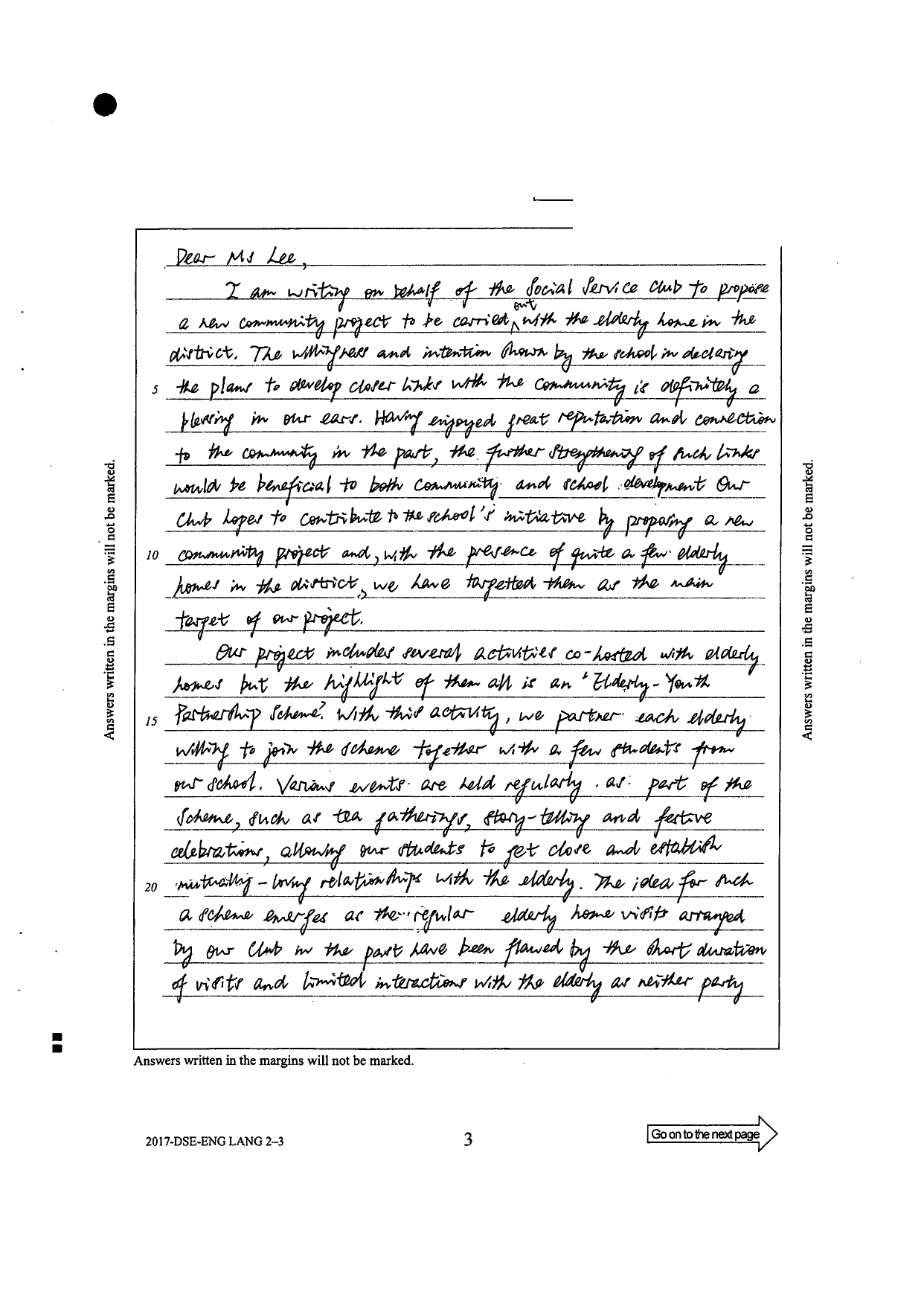
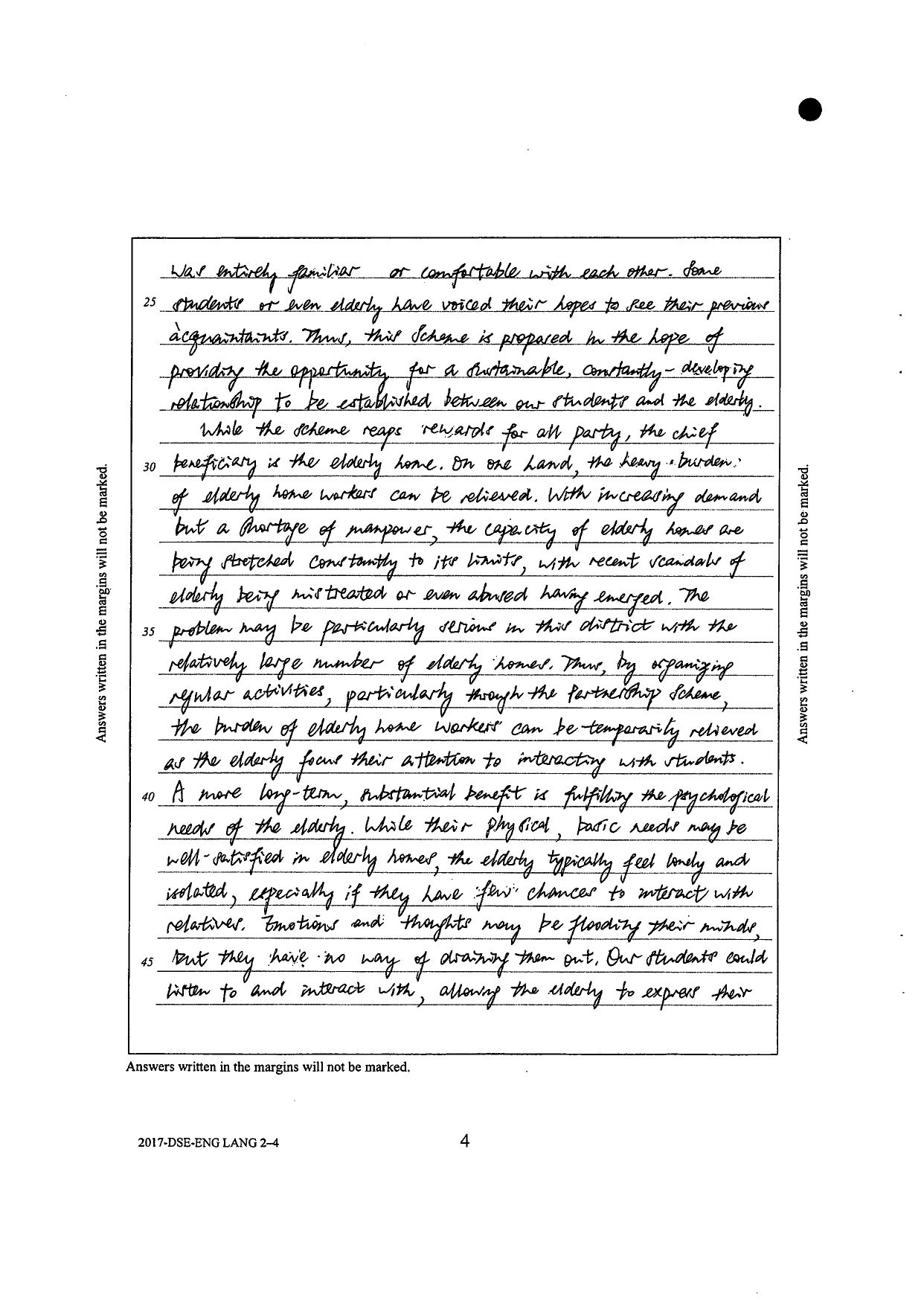
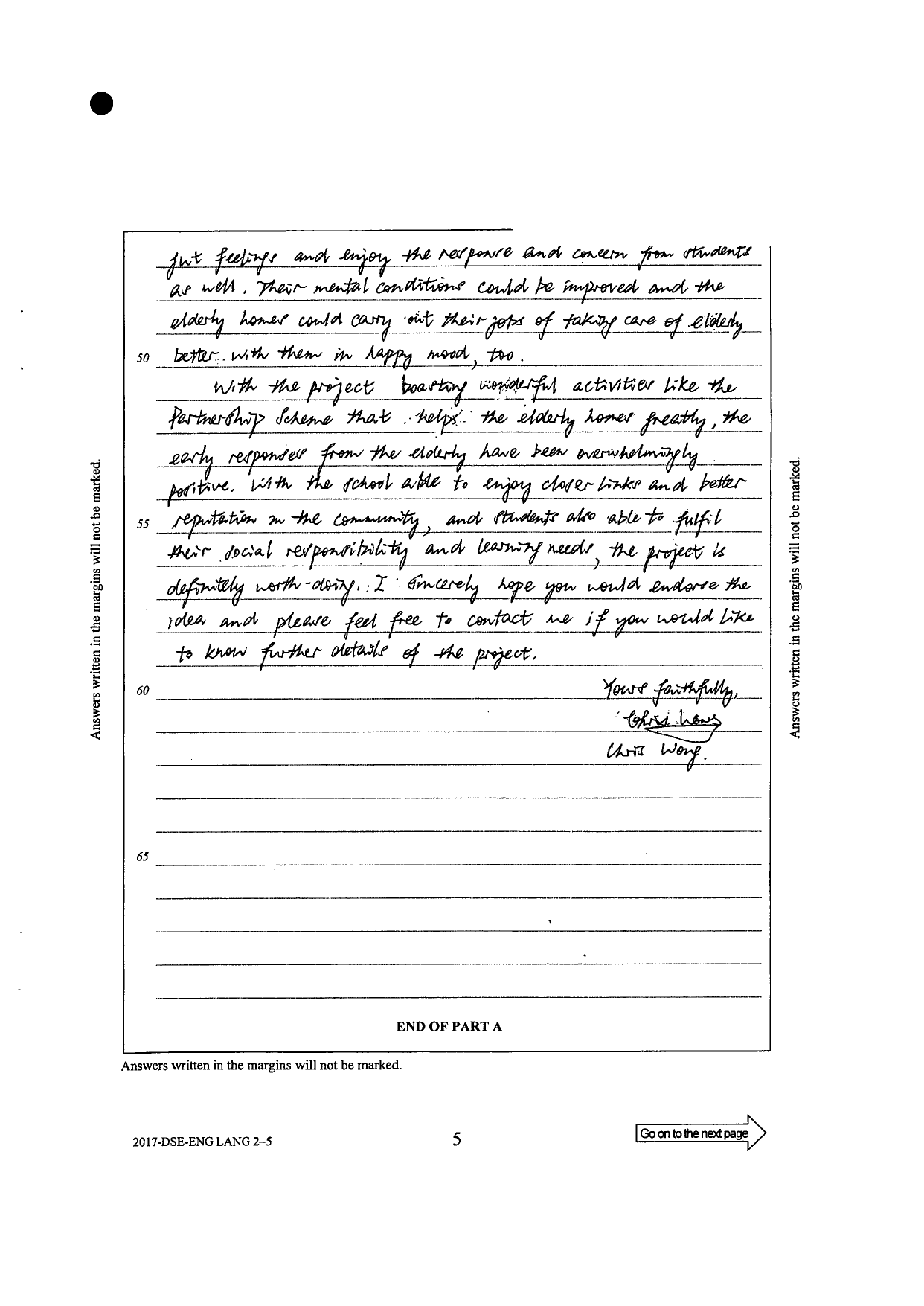
The writing, with corrections marked inline
Word count. Roughly 520 words against the 200-word brief — two and a half times the target. The over-length is the only criticism a strict reader could raise, and the markers have evidently judged that the structural and rhetorical command on display outweighs the length. The activity-introduction paragraph alone runs to about 150 words; the two-benefit pair runs to roughly 240.
Closing salutation. The candidate uses Yours faithfully rather than Yours sincerely. In British usage, Yours faithfully pairs with Dear Sir / Dear Madam (recipient unknown by name); Yours sincerely pairs with Dear Ms Lee (recipient named). The candidate has the addressee named in the salutation, so Yours sincerely would be conventional. Neither marker has flagged this, and the formal-letter band-descriptors do not penalise the mismatch when both forms are recognisably formal — but it is the single convention point a strict reader could raise.
The naming move that earns the marks. The proposal is not a visit, not a one-off event, not a workshop: it is the Elderly–Youth Partnership Scheme, named in quotation marks in the activity paragraph and referred to by name throughout. Naming the project is what allows the candidate to refer back to it in shorthand (the Partnership Scheme, through the Partnership Scheme) without restating the description — and a named project is what an institution actually adopts. Most Q.1 candidates propose an activity; this candidate proposes a scheme. The difference is the difference between an event and a programme.
What earned 21/21 twice — the markers’ reward structure
A perfect Part A is a rare enough event that it is worth stopping to ask, criterion by criterion, what each marker has actually been rewarding. The 2017 mark scheme assesses Q.1 on three dimensions: Content (does the letter address both bullet points with substance?), Language (is the writing accurate, varied, register-appropriate?), and Organisation (is the structure clear and the development logical?). Both markers gave 7/7 on each. The strengths below name the move in the script that delivered each maximum.
The activity is given a proper-noun title in quotation marks (‘Elderly–Youth Partnership Scheme’), defined in one sentence (“we partner each elderly resident willing to join the scheme together with a few students from our school”), and then referred back to by short name (through the Partnership Scheme, like the Partnership Scheme) in every subsequent paragraph. This is the move that distinguishes a 5** Q.1 from a 5* Q.1: the candidate has produced something a principal could actually approve and put on a budget line. Compare to the cohort: most candidates describe an activity; this candidate describes a scheme that produces activities.
“The idea for such a scheme emerges as the regular elderly home visits arranged by our Club in the past have been flawed by the short duration of visits and limited interactions with the elderly, as neither party has become entirely familiar or comfortable with each other.” The candidate doesn’t just propose an activity; they diagnose what was wrong with the last activity (short visits, no continuity, neither side gets familiar) and design the new one to fix the diagnosed problem (sustained pairing, repeated meetings, relationships that build over time). The diagnosis itself is what an experienced policy-writer would call a problem statement; it is the move that converts the proposal from here is what we could do into here is the gap we are filling. Markers reward this because it is the rhetorical move of a real proposal, not a school exercise.
The benefits paragraph runs on a deliberate two-clause architecture: “On one hand… the heavy burden of elderly home workers can be relieved.” → “A more long-term, substantial benefit is fulfilling the psychological needs of the elderly.” The framing — one short-term operational benefit (workers’ burden) and one long-term substantive benefit (the elderly’s loneliness) — is the textbook two-dimensional answer to identify the benefits. The candidate explicitly names the time-horizon (more long-term) and the magnitude (substantial), which is the kind of meta-labelling a marker can lift straight out of the script as evidence of structural awareness.
“With increasing demand but a shortage of manpower, the capacity of elderly homes is being stretched constantly to their limits, with recent scandals of elderly being mistreated or even abused having emerged.” Naming the recent scandals of elderly being mistreated or even abused hooks the proposal into the contemporary news cycle (the 2015 Tai Po Cambridge Nursing Home abuse case was fresh in memory at the time of the 2017 exam). The candidate doesn’t name the case — they don’t need to; the marker recognises the allusion — but they invoke its existence as the reason the workers’-burden problem is acute. This is the move of someone who reads newspapers and brings the reading into their writing.
“While their physical and basic needs may be well-satisfied in elderly homes, the elderly typically feel lonely and isolated… Emotions and thoughts may be flooding their minds; but they have no way of drawing them out. Our students could listen to and interact with them, allowing the elderly to express their gut feelings…” The candidate doesn’t stop at the elderly feel lonely (the abstract claim). They name the mechanism of the loneliness (their physical needs are met but they have no interlocutor) and then name the mechanism of the remedy (the students are the interlocutors who let the emotions out). The cognitive-mechanism move is what distinguishes a 5* benefit paragraph from a 5** one: the marker can see the candidate has thought about how the benefit happens, not just that it happens.
The vocabulary is consistently formal-policy: chairperson, willingness, intention, blessing to our ears, reputation, initiative, beneficiary, scheme, manpower, capacity, stretched to their limits, scandals, mistreated, abused, substantial, fulfilling, psychological needs, sustainable, constantly-developing relationship, social responsibility, endorse. Crucially, the register doesn’t crack — there is no buddies, no elderlies, no guys, none of the casual nouns that pull other Q.1 scripts down to 5* or 5. The candidate is operating at a single register across the whole letter, which is the lexical condition for 7/7 on Language.
Examples in sequence: a 35-word sentence opens paragraph two; the activity-definition sentence is 18 words; the diagnosis sentence is 38 words; “The problem may be particularly serious in this district with the relatively large number of elderly homes.” is a clipped 18-word pivot; the psychological-needs paragraph closes on a 28-word concluding period. The variation isn’t accidental — the candidate uses short sentences at structural hinges (between problem and remedy, between burden-paragraph and benefit-paragraph) and long sentences when the argument is doing elaborative work. That rhythmic awareness is what an experienced editor would call periodic style; the markers register it as fluency on the Language criterion.
“mutually-loving relationships”, “constantly-developing relationship”, “more long-term, substantial benefit”, “worth-doing”. Compound modifiers placed before the noun (constantly-developing relationship = a relationship that is constantly developing) signal a writer who is shaping the noun-phrase, not just stringing adjectives. The compound modifier is a high-status grammatical move because it requires the writer to know which adjectives belong together; the candidate does this without strain four times in 520 words.
Para 1: institutional opening + naming of project. Para 2: activity description + diagnosis of why the new design is needed. Para 3: short-term operational benefit (workers’ burden). Para 4: long-term substantive benefit (psychological needs). Para 5: institutional closing + endorsement request. The structure is symmetric (introduction frames + closing requests; the two benefit paragraphs share a parallel On one hand… / A more long-term… pivot). A marker can trace the argument with a finger on the page, which is the operational definition of Organisation 7/7.
The Partnership Scheme is named in paragraph two (‘Elderly–Youth Partnership Scheme’), referenced in paragraph three (through the Partnership Scheme), implied in paragraph four (Our students could listen to and interact with them), and named again in the closing paragraph (the project boasting wonderful activities like the Partnership Scheme). The recurring name is the connective tissue that makes the letter a single document instead of five separate paragraphs. A marker reading for Organisation can verify this just by counting the named references.
“I sincerely hope you would endorse the idea and please feel free to contact me if you would like to know further details of the project.” The closing names a specific action the principal can take (endorse the idea) and a specific follow-up channel (contact me for further details). The closing is not a thank-you; it is a request for a decision and an offer of a follow-up briefing — the two moves that turn a proposal into something a principal can act on within the day. The closing is short (two sentences) which is the right length for an institutional letter: the principal’s eye lands on the request, not on the rhetoric.
Grammar notes — the residual slips
At 42/42 there is nothing to fix that would change the mark. The slips below are listed for completeness so the script can serve as a teaching example: a perfect Part A still contains technical residue. Each item shows what an editor would tidy and why — the kind of polish a candidate would do in a fair-copy version, not a corrective intervention the marker is expecting.
| Issue | Explanation |
|---|---|
(line 3) the elderly home in the district → the elderly homes in the district |
The district has multiple homes (the candidate names this explicitly in the next sentence: quite a few elderly homes in the district). The singular in the opening sentence is inconsistent with the plural that follows. Pluralising the opening would match the plural premise. |
(line 6) a blessing in our ears → a blessing to our ears |
The fixed idiom is music to one’s ears; by analogy a blessing to our ears. The candidate writes in our ears, which suggests the blessing is physically located inside the ear. The preposition to indicates direction (the blessing reaches the ear); in indicates containment. |
(lines 11–12) we have targetted them as the main target → we have identified them as the main beneficiary / we have targeted them |
Three slips. (i) Targetted with double-t is the older BrE spelling; the modern BrE and AmE form is targeted (single t) — both are defensible but the single-t form is now standard. (ii) Targeted… as the target is redundant; identified… as the main beneficiary would be the cleaner verb-noun pairing. (iii) The candidate uses main target for the elderly homes, but the homes are the recipients of the project, not its target in the sense of thing being aimed at. Beneficiary is the right noun and the candidate uses it correctly later in the script (the chief beneficiary is the elderly home) — this is a recurring vocabulary the candidate already owns. |
(lines 23–24) as neither party was entirely familiar or comfortable with each other → as neither party has become entirely familiar or comfortable with the other |
Two slips. (i) Was is the past simple; the diagnosis is about a recurring situation in past Club visits, which the present perfect (has become) better fits because the consequence persists. (ii) Each other requires a plural antecedent (two or more parties acting reciprocally); after neither party (singular by grammatical convention), the other is the right reciprocal. The rule isn’t inflexibly enforced in modern usage, but each other after neither is a small register snag. |
(line 26) acquaintaints → acquaintances |
Spelling slip. Ac-quaint-ance: quaint + -ance. The candidate writes a doubled-t with no c before the plural ending; the word is acquaintances, plural of acquaintance. A handwriting-pressure slip; the noun itself is in the candidate’s active vocabulary. |
(line 29) While the scheme reaps rewards for all party → While the scheme reaps rewards for all parties |
Number agreement. All requires a plural noun when it quantifies a set (all parties, all members, all sides); all party reads as if the candidate were treating party as a mass noun, which it isn’t in this sense. The candidate uses the singular neither party correctly earlier — neither takes singular, all takes plural. |
(lines 32–33) the capacity of elderly homes are being stretched constantly to its limits → the capacity of elderly homes is being stretched constantly to their limits |
Classic head-noun agreement slip. The subject is the capacity (singular), not elderly homes (which is the object of of); the verb must agree with capacity: is, not are. The possessive should then refer to capacity (singular) — in which case its is correct — or the candidate could rewrite as the capacities of elderly homes are being stretched… to their limits, agreeing all the way through. The cleanest fix as written is is… their: read their as referring to the elderly homes themselves, which is the sense the candidate intends. |
(line 41) While their physical, basic needs may be well-satisfied → While their physical and basic needs may be well-satisfied |
Comma vs. conjunction in a two-term list. Physical, basic needs reads as if basic were appositive to physical (a clarification: physical, that is to say basic). The candidate seems to mean physical needs and basic needs as two roughly parallel categories; the conjunction makes the relationship explicit. |
(line 47) express their jut feelings → express their gut feelings |
Pen-slip. The candidate writes jut (a three-letter word that means protrude); the intended phrase is gut feelings (instinctive emotional responses). G and j are visually similar in cursive; jut feelings isn’t a phrase. The handwriting is clearly the intended gut; this transcription corrects it. |
(line 50) with them in happy mood → with them in a happy mood |
Missing article. Mood in this sense is a count noun and takes a: in a happy mood, in a bad mood, in a contemplative mood. The article is the small dropped word that catches every HK English script in the long sentence at the end of a paragraph. |
Style suggestions — post-perfect polishing
There is no realistic upgrade path from 42/42, so the suggestions below are framed as polish — what an editor would change if forced, or as exercises for a teacher using this script as a model. None of them would have changed the mark; all of them would make a slightly more publishable letter.
Professional rewrite — what an editor would change if forced
For comparison only, not a correction. At 42/42 there is no upgrade path; this rewrite is what an editor working on a published version of the letter would change if asked to bring the opening down to a more standard institutional register and lead with the named project. The candidate’s opening is rhetorically warm (a blessing to our ears) and slow to name the scheme; the rewrite is colder, faster, and lets the project name land in the first sentence.
The student’s opening (corrected)
Rewritten by a professional letter-writer
- The project is named in the first sentence. The student’s opening defers the name (‘Elderly–Youth Partnership Scheme’) until the second paragraph. The rewrite leads with it — the reader has a handle from word one.
- The school’s commitment is described, not blessed. “Welcomes the school’s recent commitment” is the institutional equivalent of “a blessing to our ears”, without the devotional reach.
- The reputation argument is shifted from preamble to credibility. The student uses the school’s reputation as background colour; the rewrite reframes it as the reason the proposal is credible at scale. Same fact, sharper use.
- The two-clause structure of the closing sentence is preserved. The candidate’s “and with the presence of quite a few elderly homes in the district…” establishes the partner pool; the rewrite keeps that move and adds the linking idea (the school’s reputation makes the scale possible).
- One paragraph instead of one-and-a-bit. The candidate runs the opening across two paragraphs of preamble before the activity-naming. The rewrite compresses to a single paragraph that opens, names, and frames in 80 words.
- The vocabulary stays in the candidate’s register. Commitment, sustained, pairing, track record, credible are all words a 5** Q.1 candidate could and should reach for. The rewrite isn’t out-vocabulary-ing the student; it is using the candidate’s own register more economically.
Vocabulary to notice
| Word | Definition | Usage notes | Synonyms / alternatives |
|---|---|---|---|
| on behalf of | (prep. phrase) representing, in the interests of (a person or organisation). | Pairs with speak, write, act, sign, accept. The textbook opening to a letter from an organisational role. The candidate’s “I am writing on behalf of the Social Service Club” is the standard formula. | representing, in the name of, for, as the representative of |
| beneficiary | (n.) a person or organisation that derives an advantage from something. | Pairs with main, primary, chief, sole, intended, named. Carries a slightly legal-formal register (wills, trusts) which is exactly right for a proposal letter. The candidate uses it twice (the main beneficiary of our project, the chief beneficiary is the elderly home) — both correct, both register-appropriate. | recipient, gainer, payee, heir |
| scheme | (n.) a large-scale systematic plan or arrangement for attaining a particular object or putting a particular idea into effect. | Pairs with pilot, voluntary, regulatory, government, joint, partnership. In British/HK English the word is neutral or positive (pension scheme, partnership scheme, training scheme); the AmE pejorative sense (a scheme to defraud) is largely absent in HKDSE register. The candidate’s Partnership Scheme is the operative noun in the entire letter. | plan, programme, project, initiative |
| manpower | (n.) the number of people working or available for work or service. | Pairs with shortage of, demand for, allocation of, deployment of, reduce, supply. Slightly older / industrial register; in modern HR contexts often replaced by staffing or headcount. The candidate’s “increasing demand but a shortage of manpower” is the standard public-policy collocation. | staffing, workforce, labour, personnel |
| capacity (of) | (n.) the maximum amount that something can contain or produce. | Pairs with full, total, surplus, spare, beyond, at, exceed. In care-sector usage refers to the number of residents a home can house and serve. The candidate’s “the capacity of elderly homes is being stretched constantly to their limits” uses the noun in its precise sector sense. | maximum, room, accommodation, throughput |
| stretched (to the limit) | (adj./v.) used to the maximum of one’s resources or ability, with no margin remaining. | Pairs with resources, budget, staff, capacity, patience, services. The metaphor (a resource being stretched like fabric until it tears) is journalistic and policy-discourse standard. The candidate’s use is the textbook collocation. | strained, overstretched, taxed, at breaking point |
| mistreated | (adj./v.) treated badly or unfairly. | Pairs with abused, neglected, exploited, prisoners, workers, the vulnerable. Slightly stronger than treated poorly; weaker than abused. The candidate pairs the two correctly (mistreated or even abused), with even signalling the intensifier escalation. | abused, ill-treated, neglected, harmed |
| substantial | (adj.) of considerable importance, size, or worth. | Pairs with benefit, improvement, change, investment, evidence, contribution. Slightly more formal than significant; conveys both magnitude and weight (a substantial benefit is not just large, it is consequential). The candidate’s “a more long-term, substantial benefit” uses both senses simultaneously. | significant, considerable, sizeable, weighty |
| fulfil (a need) | (v.) to bring about the achievement of (a desire, promise, or need); satisfy. | Pairs with need, role, duty, obligation, requirement, dream, ambition. Slightly more formal than satisfy; carries a sense of complete realisation. The candidate uses it twice (fulfilling the psychological needs of the elderly, fulfil their social responsibility), both in the right register. | satisfy, meet, achieve, realise |
| sustainable | (adj.) able to be maintained at a certain rate or level; able to be upheld or defended. | Pairs with development, growth, business, model, practice, relationship. The candidate’s “a sustainable, constantly-developing relationship” uses the word in its “able to be maintained” sense rather than its environmental sense — both are standard; context makes the right reading clear. | maintainable, durable, viable, lasting |
| endorse | (v.) to declare one’s public approval or support of. | Pairs with idea, candidate, proposal, plan, view, statement. Slightly formal / institutional; the right verb when asking a senior figure to give their backing in a way the recipient can refer to later. The candidate’s closing — “I sincerely hope you would endorse the idea” — is sharper than the conventional approve or support. | approve, support, back, sanction, sign off on |
| boasting (something) | (v., participial) possessing or displaying with pride (a positive feature). | Pairs with features, facilities, history, members, performance, awards. Different from the pejorative sense (boasting about oneself); this is the neutral “possessing and displaying” sense used in marketing copy and proposal-writing. The candidate’s “the project boasting wonderful activities like the Partnership Scheme” uses the verb in its proposal-rhetoric sense. | featuring, possessing, displaying, showcasing |
| overwhelmingly (positive) | (adv.) in an extremely large or impressive way. | Pairs with positive, negative, supportive, opposed, in favour, defeated. The candidate’s “the early responses from the elderly have been overwhelmingly positive” uses the standard journalism-poll collocation; the modifier intensifies positive in a way that very or quite couldn’t. | resoundingly, extremely, decisively, by a wide margin |
| gut feelings | (n. phrase) instinctive emotional reactions, as opposed to reasoned conclusions. | Pairs with trust, follow, ignore, express, share, voice. Slightly informal but acceptable in a formal letter when describing what residents need to be able to express. The candidate’s pen-slip writes jut feelings — the corrected reading is the intended phrase. | instincts, intuitions, raw emotions, true feelings |
| worth-doing | (adj. compound) deserving of the effort; meriting the action. | Standard form is worth doing (no hyphen): the project is worth doing. The hyphenated worth-doing functions as an attributive compound modifier (a worth-doing project), which is a slightly heavier construction. The candidate’s “the project is definitely worth-doing” uses the hyphen where it isn’t strictly needed but doesn’t break the meaning. | worthwhile, valuable, meritorious, deserving |
Leave a Reply