Debate Speech — “Watching TV Makes Us Smarter”
As captain of the debate team you have been asked to write a debate speech. The task is to argue that ‘Watching TV Makes Us Smarter’.
In your speech you should include three reasons to support the statement.
Write your speech. (~400 words)
Show original handwritten pages (4)
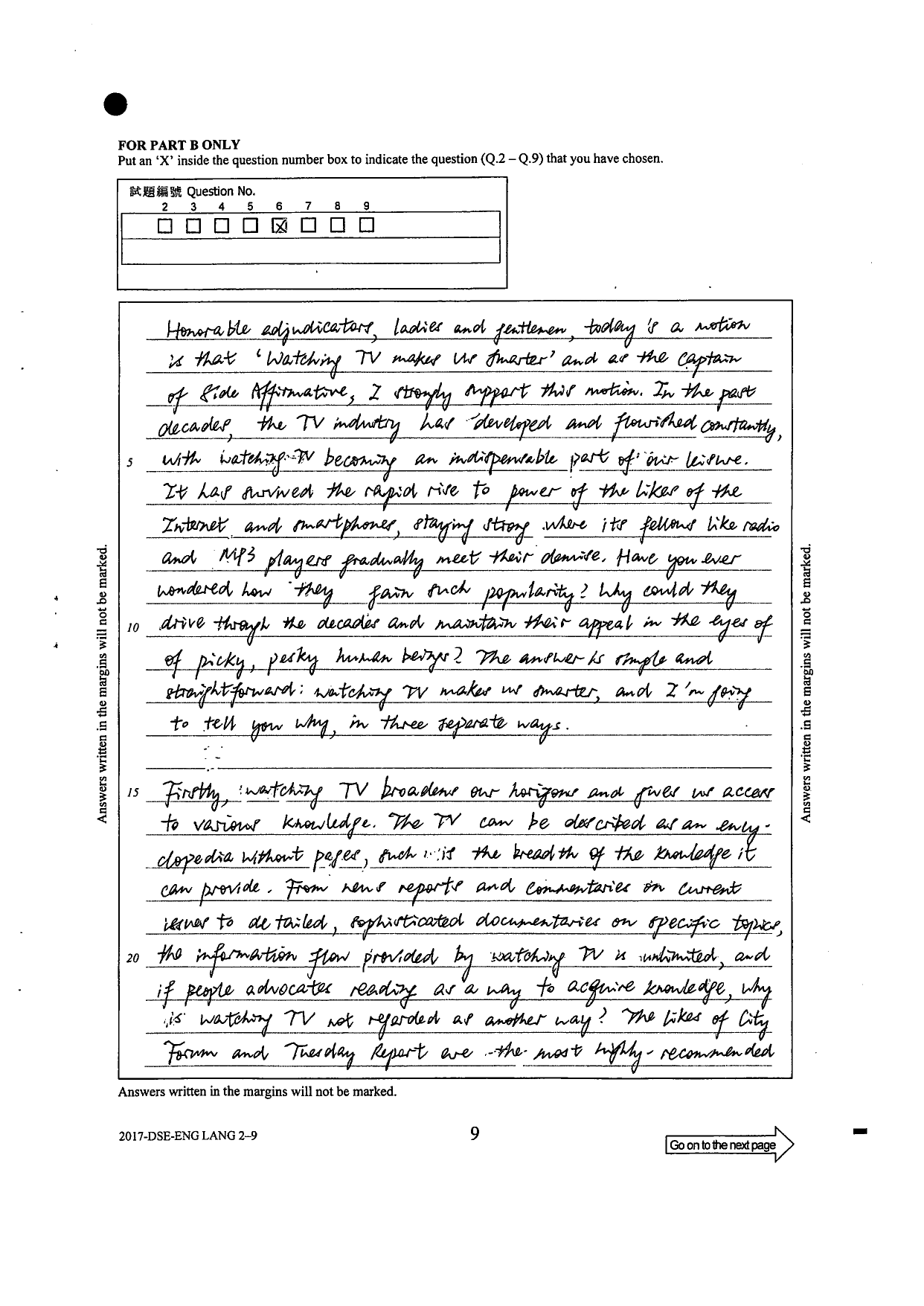

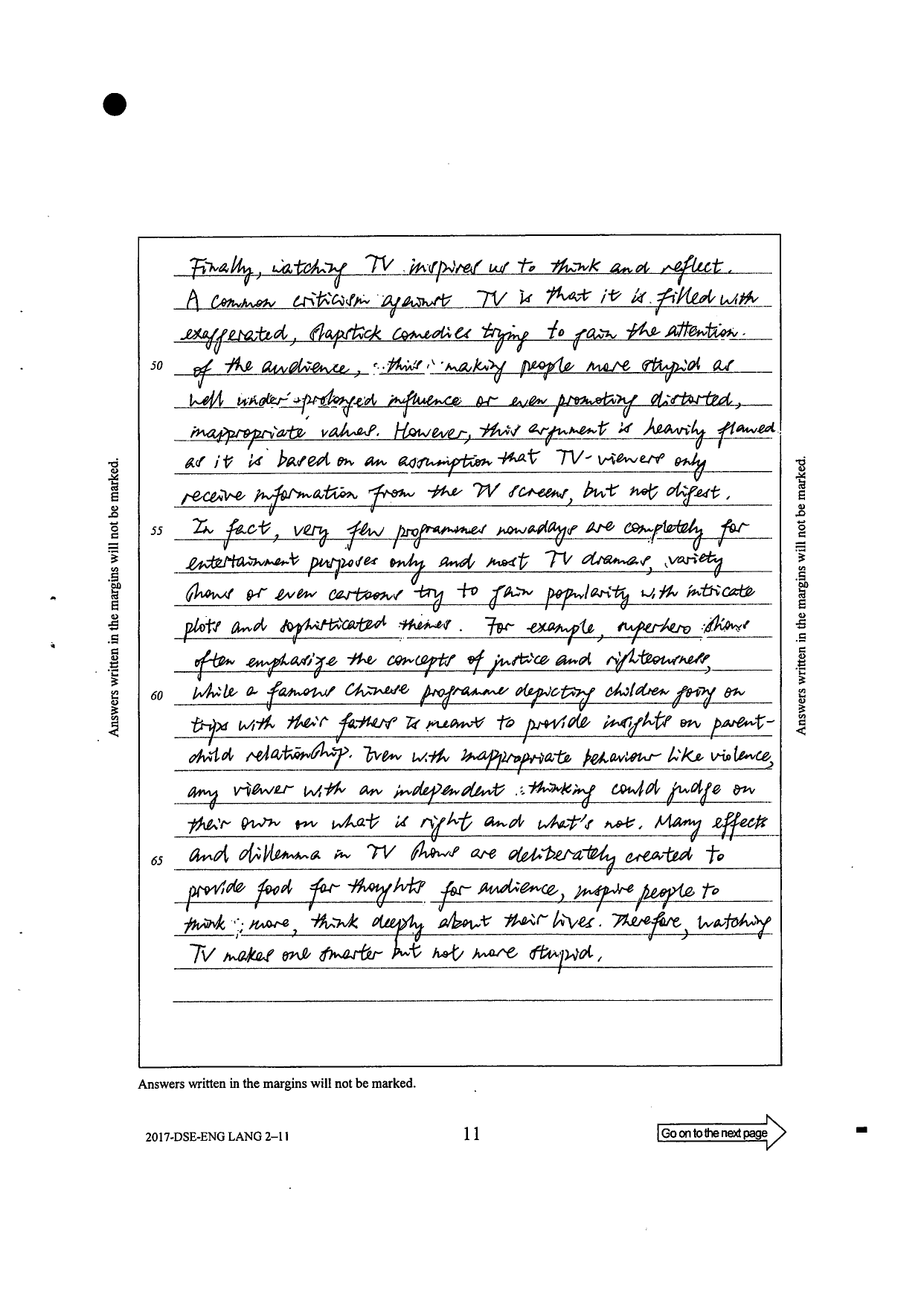

The writing, with corrections marked inline
Word count. The speech runs to roughly 450 words against the 400-word brief — just slightly over, which is the right length for a four-minute debate-room speech. Length is not the issue here; tightness of structure and authenticity of voice are.
What the structure misses. The three reasons are knowledge / interactivity / reflection — sensible, but they overlap. The second reason (TV is more interactive than books because of visuals + audio) effectively re-uses the first reason (TV is a source of knowledge); the third reason (TV inspires reflection) is doing the rebuttal work without being signposted as a rebuttal. A textbook 5** Q.6 speech uses three distinct reasons (e.g. knowledge / critical thinking / global awareness) and handles the opposition’s counter as a separate move. This script collapses reason and rebuttal in paragraph four without naming what it is doing — the kind of structural confusion that costs the speech its second mark.
The opening is a slight muddle. The opening sentence is grammatically scrambled: “today’s is a motion is that ‘Watching TV Makes Us Smarter’”. The candidate writes is a in the middle of today’s motion is that… and doesn’t strike it through. A debate-room opening is the highest-stakes sentence in the speech (the adjudicators decide their first impression in the first five seconds) and a syntactic stumble there is more costly than the same stumble in paragraph three.
The closing is the strongest moment. “If you support the opposing view, it’s definitely not a ‘smart’ choice — well, perhaps because you’ve not watched enough TV!” The closing flourish is genuinely witty (a self-referential joke that turns the motion against anyone disagreeing with it) and lands the right register for a debate close. If the rest of the speech operated at this level it would be at 5* — the closing shows the candidate has the rhetorical instinct, but the body of the speech hasn’t reached for it.
Strengths to praise
“Honourable adjudicators, ladies and gentlemen…” The opening names the panel (adjudicators) and the audience (ladies and gentlemen) in the conventional order. Most Q.6 candidates open with the generic “Good morning, ladies and gentlemen” (which is a speech salutation, not a debate one); this candidate uses the genre-specific opener. A small but immediate signal to the adjudicators that the candidate knows the room.
“A TV can be described as an encyclopedia without pages, such is the breadth of the knowledge it can provide.” The metaphor reframes the TV not as a screen (the lazy image) but as a reference book (the high-status image). The inversion is doing rhetorical work the candidate doesn’t need to explain: if the audience accepts the encyclopedia-comparison, they have implicitly accepted that TV is a knowledge instrument. The candidate has reached for a metaphor that converts the case before the case is argued.
Four named programmes appear in the first-reason paragraph, two of them HKDSE-classroom-relevant (City Forum and Tuesday Report are the standard examples Liberal Studies teachers use for current-affairs discussion), two of them globally recognisable (National Geographic, Discovery Channel). Naming the programmes makes the abstract claim (TV provides knowledge) verifiable in the audience’s own viewing experience. Most Q.6 candidates name one programme; this candidate names four. The specificity is the move that distinguishes the first-reason paragraph from the rest.
“The likes of City Forum and Tuesday Report are the most highly-recommended programmes used by Liberal Studies teachers…” Naming Liberal Studies (the HK secondary subject that explicitly uses TV current-affairs programmes as teaching material) is the rhetorical move of a student who knows the audience — the adjudicators are themselves Liberal Studies-aware teachers. The shared reference makes the example carry institutional weight rather than personal taste.
“National Geographic and Discovery Channel provide ‘great feasts’ to the minds of geography and history fanatics.” The food metaphor for intellectual content (a feast of knowledge, a banquet for the mind) is correctly deployed with quotation marks signalling the metaphorical use. The pairing of great feasts with fanatics (a word stronger than enthusiasts) makes the appetite for content the central image — viewers are hungry for the content these channels serve.
“A famous Chinese programme depicting children going on trips with their fathers is meant to provide insights on parent–child relationships.” The candidate is alluding to Where Are We Going, Dad? (爸爸去哪儿) — the Chinese reality show that ran from 2013 to 2016 and was enormously popular in Hong Kong. The reference signals media literacy beyond the English-language canon and addresses an audience that watches both. The choice doesn’t name the show explicitly (which is sensible under exam pressure — getting the romanised title wrong would cost more than the unnamed allusion gains), but the description is unmistakable to anyone who watched HK TV in 2013–2016.
“If you support the opposing view, it’s definitely not a ‘smart’ choice — well, perhaps because you’ve not watched enough TV!” The closing folds the motion back on itself: anyone disagreeing has, by the motion’s own logic, failed to watch enough of the thing under debate. The construction is a self-referential paradox played for laughs (the kind of move a debate audience will applaud) and the candidate signals the play with the scare quotes around smart. This is the wittiest moment in any of the 2017 Q.6 speeches; the marker has registered the closing as the speech’s peak.
What the speech doesn’t do — structural and authenticity gaps
The gap between Part A’s 42/42 and this script’s 31/42 is the story of this analysis. The strengths above identify what the speech does right; the suggestions in the next section name the moves a top-band debate speech makes that this one doesn’t. The grammar slips are real but mostly minor (and the candidate’s Part A has the same kind of slip-rate without it costing the marks) — the issue is genre fit. Three diagnoses:
Reason 1: TV provides knowledge. Reason 2: TV is more interactive than books (because of visuals + audio) and therefore acquires knowledge more easily. Reason 3: TV inspires reflection (and rebuts the “TV makes us stupid” counter). Reasons 1 and 2 are both about knowledge acquisition; the second reason is essentially reason 1 but with a delivery-mode argument. A debate brief asking for three reasons is asking for three structurally independent cases — e.g. knowledge / critical thinking / cultural exposure, where each can stand if the others fall. Two reasons that overlap will be heard as one-and-a-half reasons. This is the most structurally costly issue in the speech.
Paragraph 4 opens as “Finally, watching TV inspires us to think and reflect” — framed as the third reason. But the paragraph’s real argumentative work is rebutting the opposition’s expected counter (“TV makes people more stupid as well under prolonged influence”). The rebuttal is good (the candidate names the opposition’s assumption and shows it is wrong) but the framing is wrong: the audience is told they are getting a third reason and is instead given a rebuttal. The compare-and-contrast with sister 2017-010 is instructive — that candidate uses the same hybrid structure but names the move out loud (“This claim brings me to my third point”); this candidate just slides between reason and rebuttal without flagging the shift. A debate-trained reader expects the structural move to be visible.
The speech reads as if it had been written to be marked, not spoken. The sentences are long (the diagnostic sentence at the centre of paragraph 4 runs to 50 words); the transitions are textbook connectives (firstly, secondly, finally); the rhetorical questions are rare (only three in 450 words). A real debate speech uses short declarative sentences for pivots, switches to longer sentences for elaboration, and folds rhetorical questions into the rhythm at roughly one per paragraph. The candidate’s essay-prose register is the same register that earned 42/42 on Part A — but Part A is a letter, where essay-prose is right, and this is a speech, where it isn’t. The candidate’s Part A voice has been imported wholesale into a genre that requires a different one.
Grammar notes
| Issue | Explanation |
|---|---|
today’s is a motion is that → today’s motion is that |
Scrambled opening syntax. The candidate writes both today’s is a motion and motion is, producing the duplicated verb pattern is…is. The intended sentence is the clean today’s motion is that ‘Watching TV Makes Us Smarter’. The slip is high-cost because it is the first sentence the adjudicators read. |
Captain of Side Affirmative → Captain of the Affirmative side |
Word-order slip on a debate-vocabulary item. The standard order in HK school debating is the Affirmative side (head noun side with adjective Affirmative in attributive position); Side Affirmative reverses the order in a way that reads as French-style postposition. Some HK schools do use Side Affirmative / Side Negative, but it is a regional variation; the safer form for the marker is the Affirmative side. |
seperate → separate |
The classic ESL/EFL spelling slip on this word. The correct spelling has a in the middle syllable (sep-a-rate), not e. A teacher’s mnemonic: there’s a rat in sep-a-rate. |
gives us access to various knowledge → gives us access to various kinds of knowledge |
Knowledge is uncountable; various implies countability (different kinds). The fix is either various kinds of knowledge / various forms of knowledge (which preserves the countable framing), or a wide range of knowledge (which keeps knowledge uncountable). Without either, various knowledge reads ungrammatical. |
The TV can be described as an encyclopedia → A TV can be described as an encyclopedia / Television can be described as an encyclopedia |
Article slip on a generic statement. The TV with the definite article points to a specific TV set; the candidate means the medium in general. Two clean fixes: A TV (any TV, generic singular) or Television (the mass-noun form of the medium). The metaphor itself (encyclopedia without pages) is the line’s strength; the article is the line’s residual scrappiness. |
if people advocates reading → if people advocate reading |
Subject-verb agreement. People is plural and takes the bare verb (people advocate, people believe, people watch). The -s ending is for the third-person singular only. |
then go on to search further information on the topic → then going on to search for further information on the topic |
Two slips. (i) The verb in the parallel needs to be a participle (seeing… then going), not the bare infinitive. The candidate has likely to have the experience of seeing an interesting show on TV, then go on to search…; the parallel requires the gerund/participial form to match seeing. (ii) Search for X (where X is the thing being sought) requires the preposition for; search X means to examine the thing itself (search the room, search the database). The candidate is searching for information, not searching information. |
more effective in arousing our interests → more effective in rousing our interest |
Two slips. (i) Arouse in everyday English carries a slightly suggestive register (arouse desire, arouse suspicion); for the “awaken curiosity” sense, rouse is the neutral verb. (ii) Interest in this sense is uncountable: rouse our interest, not our interests. Interests (plural) refers to topics/hobbies one is interested in (her interests include music), which isn’t the meaning here. |
emphasize → emphasise |
Style consistency. The candidate writes emphasize with -z- (AmE) but earlier writes maximize-style verbs with -s- in other contexts. HKDSE conventions lean BrE: the -ise ending is the safer default. The split form (-ise in some places, -ize in others) signals inconsistency more than error; a script-wide convention is the polish move. |
any viewer with an independent thinking → any viewer with an independent thinking mind / any independent-thinking viewer |
The candidate has a noun-phrase shape mismatch. An independent thinking reads as if thinking were the head noun (which it can be as a gerund: independent thinking is rare), but the article an followed by the modifier independent thinking doesn’t parse to a complete head. The cleanest fix is to add the noun mind (an independent thinking mind) or to hyphenate as an attributive (an independent-thinking viewer). |
could judge on their own on what is right and what’s not → could judge for themselves what is right and what is not |
Two slips. (i) The fixed phrase is judge for oneself (not judge on one’s own), meaning to reach an independent conclusion. On one’s own means “without help” or “alone”, which is close but not the standard collocation with judge. (ii) Judge on what — the verb judge here takes a direct object (the matter being judged: what is right), not a preposition + indirect object. The doubled on in judge on their own on what is right reads awkwardly. |
Many effects and dillemma in TV shows → Many effects and dilemmas in TV shows |
Two slips. (i) Dillemma with double-l is a spelling slip; the correct spelling has single-l, double-m (di-lem-ma). (ii) Many requires a plural countable noun; dilemma is countable, so the plural dilemmas is required. |
food for thoughts → food for thought |
Fixed-phrase number. The idiom is food for thought (singular), meaning something to think about. The pluralised food for thoughts isn’t standard; thought in this idiom is uncountable. |
from the three reasons I’ve raised it’s clearly which side the motion favours → from the three reasons I’ve raised, it’s clear which side the motion favours |
Two slips. (i) Missing comma after the introductory adverbial phrase (from the three reasons I’ve raised,) — a small punctuation slip that costs little but is a polish point. (ii) Clearly is an adverb; the construction needs the predicate adjective clear (it’s clear, not it’s clearly). Clearly which side reads as in a clear way, which side, but the candidate means it is clear which side. |
watching TV makes one smarter but not more stupid → watching TV makes us smarter, not more stupid |
Pronoun consistency. The speech has been using us throughout (matching the motion Watching TV Makes Us Smarter); the closing line of paragraph 4 switches to the impersonal one. The pronoun shift in the rhetorical summary line is a small registerless moment — us is what the audience expects to hear because that’s what they’ve been hearing for four paragraphs and what the motion itself uses. |
Style suggestions (where strong writing could become outstanding)
Professional rewrite — the third-reason / rebuttal paragraph (genre fit)
For comparison only, not a correction. The student’s paragraph 4 collapses two different rhetorical moves (the third reason and the rebuttal of the opposition’s expected counter) into a single block of essay-prose. The rewrite below shows what the same content looks like split into the two moves it actually contains, with sentences sized for a spoken delivery and the rhetorical move named out loud.
The student’s paragraph (lightly corrected)
Rewritten by a professional debater
They will tell you that television is full of slapstick. Full of exaggeration. Full of distorted, inappropriate values. They are correct about the content. They are completely wrong about what it does to the viewer.
Here is the thing about a superhero show. The villain commits an injustice. The hero responds. The viewer — even a young viewer — sorts the two acts into right and wrong. That sorting is moral reasoning. Here is the thing about Where Are We Going, Dad?. A celebrity father loses his patience with a tired child. The viewer sees both sides and decides which one they would rather be. That seeing-both-sides is empathy.
The screen does not hand us our values. It hands us the dilemmas, and lets us do the sorting. That is the third reason watching TV makes us smarter. Not despite the slapstick. Because of it.
- The rebuttal is named as a rebuttal. The student version slides between reason and rebuttal without naming the shift; the rewrite tells the floor exactly what move is about to be made. Naming the move signals to the adjudicators that the speaker is operating on a meta-level — the rhetorical equivalent of showing your working.
- The opposition’s case is steel-manned in three short sentences. Three short anaphoric sentences make the opposition’s case sound stronger than the opposition will probably make it — which is the rhetorical condition for the rebuttal that follows to look unanswerable.
- The pivot is one short declarative. A 12-word sentence after the longer setup is the rhetorical hinge — in a debate room the speaker would pause here.
- The two examples are shown, not described. The student version describes the superhero show and the Chinese programme in the abstract; the rewrite shows the viewer’s actual cognitive sequence. Showing is harder than describing and a marker can register the difference.
- The closing inverts the opposition’s assumption. “Not despite the slapstick. Because of it.” Two fragments at the end of the paragraph — the kind of short-burst close that lands in a debate room because the speaker can pause between them.
Vocabulary to notice
| Word | Definition | Usage notes | Synonyms / alternatives |
|---|---|---|---|
| motion | (n.) the proposition being debated. | Pairs with propose, support, oppose, second, table, withdraw, stand, fall. Key phrases: today’s motion, the motion before us, the motion must stand. The candidate uses the term correctly in both opening (after the corrected syntax) and closing. | proposition, resolution, proposal, question |
| adjudicator | (n.) a judge or arbiter, especially in a debate or competition. | Always plural in school-debate salutations (a panel of three or five judges). Pairs with panel of, honourable, distinguished. The candidate’s opening “Honourable adjudicators” is the textbook genre-specific salutation. | judge, panel, arbiter, referee |
| indispensable | (adj.) absolutely necessary; that cannot be done without. | Pairs with tool, resource, part, member, aid, ally. Stronger than important; signals “without this, the system fails”. The candidate’s “watching TV becoming an indispensable part of our leisure” is the standard high-register collocation. | essential, vital, crucial, irreplaceable |
| demise | (n.) the end or failure of an enterprise, institution, or person’s career. | Pairs with imminent, sudden, premature, slow, untimely, professional. Slightly literary / journalistic. The candidate’s “its fellows like radio and MP3 players gradually meet their demise” uses the noun in its standard “technology obsolescence” sense; meet one’s demise is the fixed verb-noun collocation. | downfall, end, collapse, decline |
| encyclopedia (without pages) | (n., metaphorical) a comprehensive reference source. | The candidate’s metaphor reframes the TV not as a screen but as a reference book. The image is doing argumentative work — if the audience accepts TV = encyclopedia, they have implicitly accepted that TV is a knowledge instrument. This is one of the speech’s strongest single lines. | compendium, reference work, knowledge base |
| commentary (on) | (n.) an expression of opinions or explanations about an event or situation. | Pairs with running, expert, political, social, sports, news. The candidate’s “news reports and commentaries on current issues” is the standard journalism collocation. | analysis, explanation, expert opinion, op-ed |
| sophisticated | (adj.) developed to a high degree of complexity; cultured and worldly. | Pairs with analysis, audience, technology, theme, palate, equipment. The candidate’s “detailed, sophisticated documentaries” and later “intricate plots and sophisticated themes” both use the word in its “intellectually complex” sense. | complex, refined, advanced, nuanced |
| fanatic | (n.) a person filled with excessive and single-minded zeal, especially for an extreme religious or political cause; an enthusiast. | Two registers. (i) The strong sense (religious fanatic) carries negative connotations. (ii) The mild sense (football fanatic, geography fanatic) is enthusiastic, neutral-to-positive. The candidate’s “geography and history fanatics” uses the mild sense; readers will recognise the playful intensification. | enthusiast, devotee, buff, aficionado |
| feast (for the mind) | (n., metaphorical) an abundance of intellectual stimulation. | Pairs with visual, audio, sensory, intellectual. The candidate’s scare-quoted “great feasts to the minds of geography and history fanatics” uses the metaphor correctly — the quotation marks signal the figurative use. | banquet, abundance, smorgasbord, rich diet |
| prerequisite (to/for) | (n.) a thing required as a prior condition for something else to happen or exist. | Pairs with essential, key, basic, course, qualification. Takes for or to + noun/gerund. The candidate’s “being interested in the particular subject is the prerequisite to effective learning” uses the right preposition. | requirement, precondition, necessity, condition |
| trump (a competing claim) | (v.) to surpass or outdo (something else). | From card games (a trump card beats a card of any other suit). Pairs with everything, all, the lot, any consideration. The candidate’s “watching TV could even trump reading” is the standard rhetorical usage — one option decisively beating another. | beat, surpass, outdo, override |
| intricate (plot) | (adj.) very complicated or detailed. | Pairs with plot, design, pattern, machinery, network, web, scheme. The candidate’s “intricate plots and sophisticated themes” is a standard collocation in TV/film criticism. | complex, elaborate, complicated, multifaceted |
| slapstick | (adj./n.) comedy based on deliberately clumsy actions and humorously embarrassing events. | Pairs with comedy, humour, routine, film, gag. Originally from a paddle-like device used in farce to make slapping sound; now a register-marker for a particular kind of physical comedy. The candidate’s “exaggerated, slapstick comedies” uses both the adjective and the implicit noun (the slapstick genre). | physical comedy, farce, knockabout, broad comedy |
| distorted (values) | (adj.) misrepresented or twisted from a true or natural state. | Pairs with values, view, picture, account, perception, sense. Slightly stronger than incorrect or wrong; implies deliberate or systematic misrepresentation. The candidate’s “promoting distorted, inappropriate values” hits the right register for a debate critique. | twisted, warped, skewed, misrepresented |
| righteousness | (n.) the quality of being morally right or justifiable. | Pairs with self-, sense of, claim, defend, fight for. Slightly old-fashioned / Biblical register; works well as the abstract noun in a debate context. The candidate’s “superhero shows often emphasise the concepts of justice and righteousness” is the right pairing — justice as the systemic value, righteousness as the personal one. | morality, virtue, uprightness, rectitude |
| dilemma | (n.) a situation in which a difficult choice has to be made between two or more alternatives. | Pairs with face, pose, ethical, moral, real, false. The classic spelling slip-trap (single l, double m); the candidate writes dillemma with the doubling on the wrong letter. The intended use (many effects and dilemmas in TV shows are deliberately created) is the correct policy/literary register. | predicament, quandary, conundrum, hard choice |
| food for thought | (idiom) something that warrants serious thought or consideration. | Fixed phrase — thought always singular. Pairs with provide, give, offer, plenty of, real. The candidate’s use is right; the slip is the pluralisation (food for thoughts) which breaks the idiom. | something to think about, matter for reflection, considerations |
| elaborate (on) | (v.) to develop or present (a theory, policy, or system) in detail. | Pairs with further, in detail, on a point, on a theme, on an argument. The candidate’s closing “my fellow team members are going to further elaborate on how watching TV makes us smarter” is the standard debate-handoff formula — passing the argument to the next speaker on the team. | expand, develop, explain further, flesh out |
| motion must stand | (fixed phrase) the formal debating-room declaration that the proposition has been successfully argued and should be accepted. | Standard close to a proposing-side speech. Paired with the motion falls (the opposition’s equivalent close). The candidate’s “today’s motion must stand” is the textbook verdict request — the right phrase in the right place. | the motion carries, the proposition holds, vote in favour |
Leave a Reply