Short Story — “Wildlife” (The Lion in the Kitchen)
You are entering a short story competition on the topic of ‘Wildlife’. Your story should describe the events leading up to the image below.
Write your story. (~400 words)
Show original handwritten pages (5)
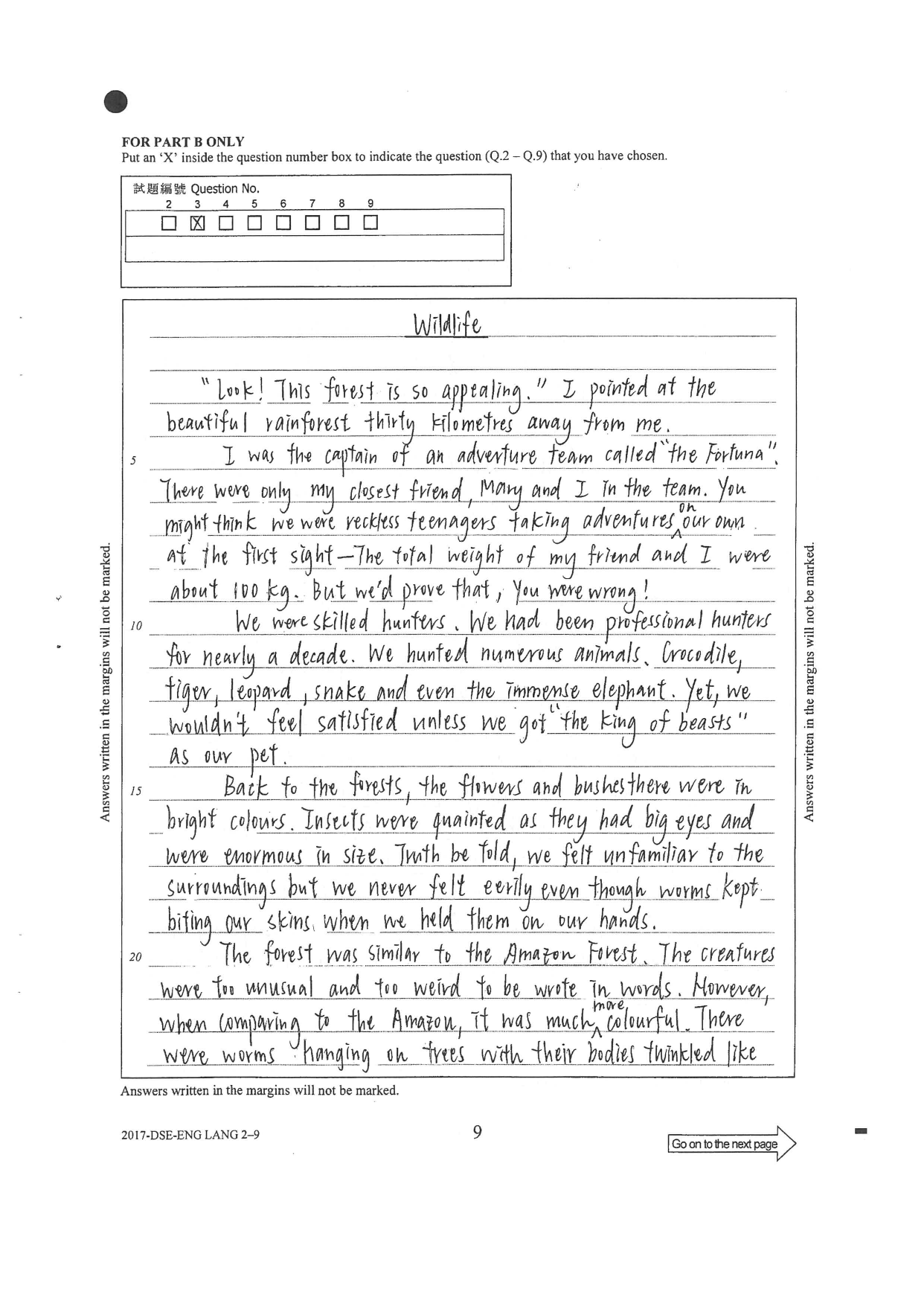
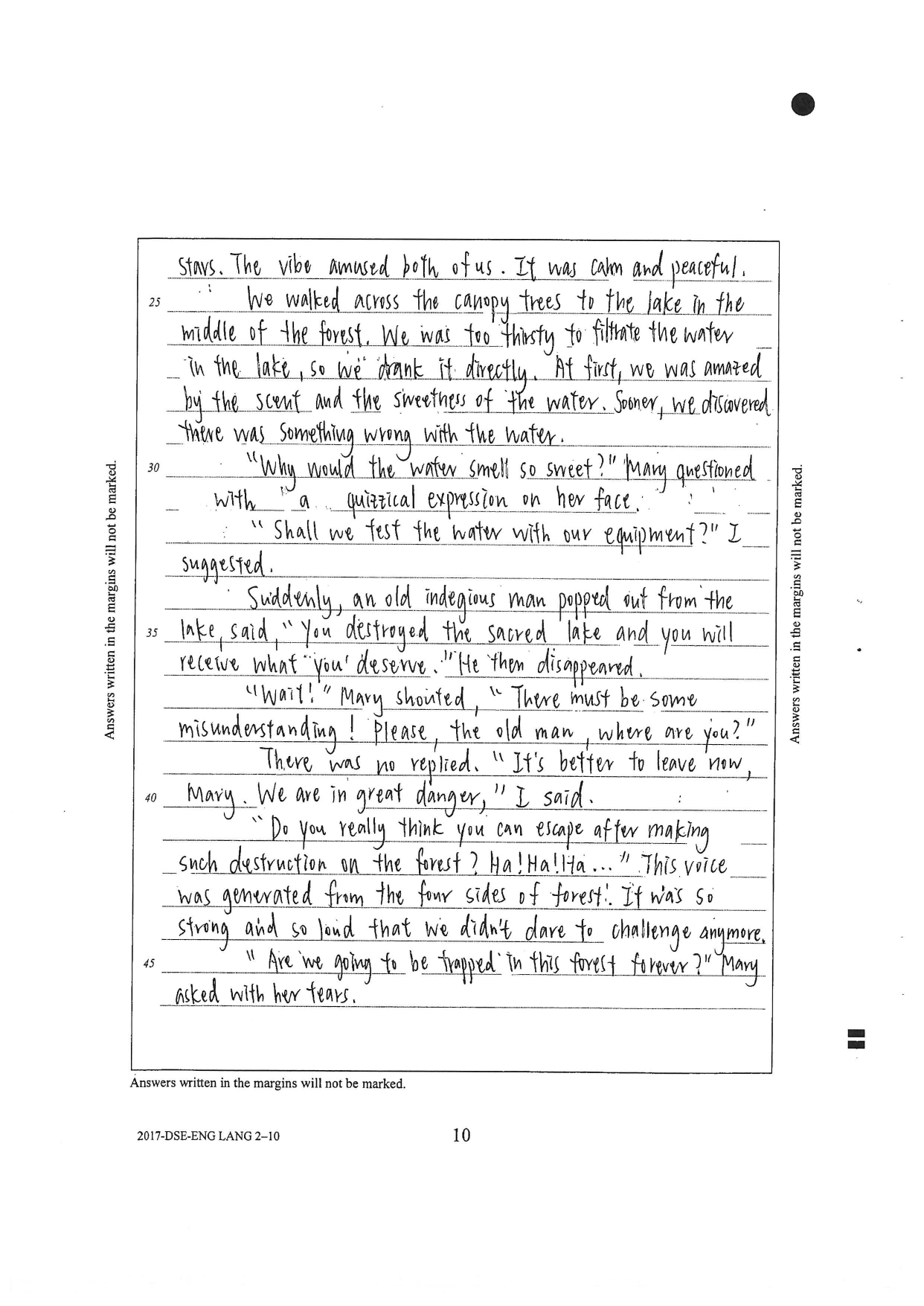
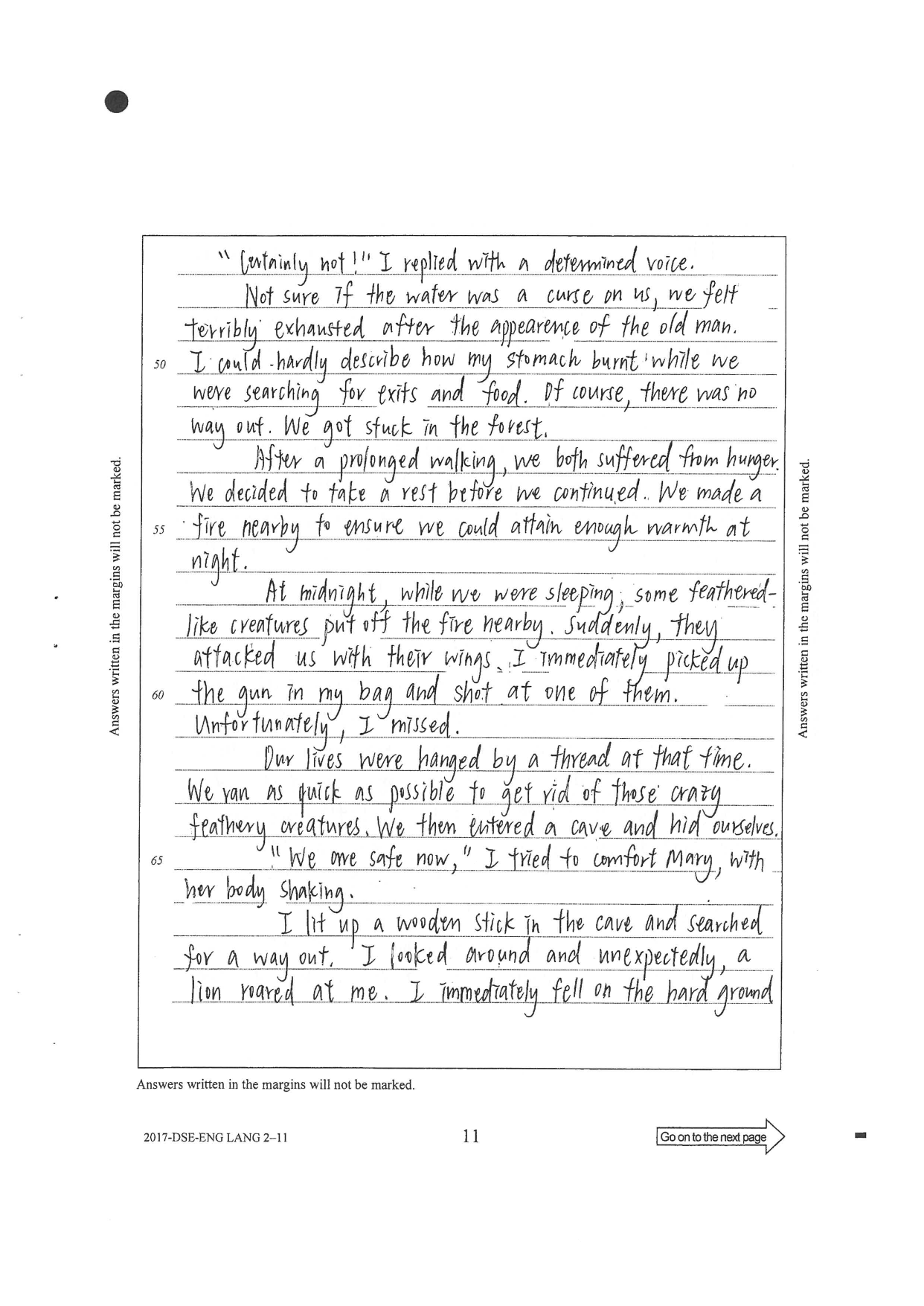
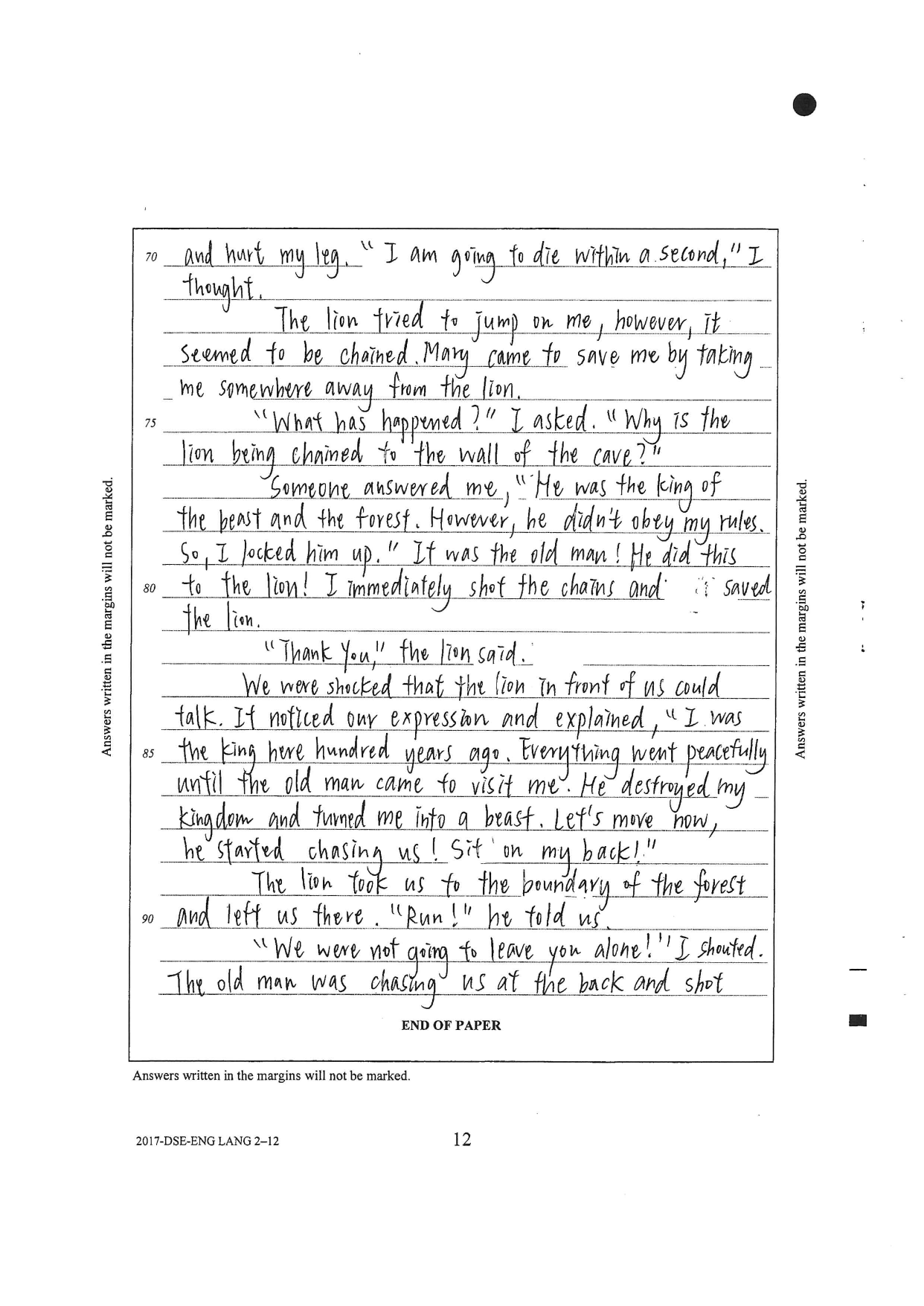

The writing, with corrections marked inline
Format and pacing. The story uses a clear three-act arc (set-up — hunter premise and the sweet lake; complication — the curse, the feathered creatures, the cave; resolution — the chained lion, the escape, the kitchen tableau). Direct speech is paragraphed correctly (each new speaker on a new line). The kitchen image from the prompt is the literal final sentence — the narrative lands exactly on the prescribed image without prolonged anti-climax.
The chosen genre — Q.3 short story. This is the first Q.3 short-story answer in the 2017 collection. Q.3 invariably runs hardest on Content (an inventive plot is rewarded heavily) and Language (the narrative-tense control + dialogue-formatting axis carries more weight than in essay-genre answers). The piece is strong on the Content axis and steady on Language, which is what the 37/42 score reflects.
Marks earned (^19 + ^18 = 37 / 42, closest-pair adjusted). A clean Band 5* per-piece score — tied with this candidate’s Part A, and a strong Q.3 result given how unforgiving the narrative genre is at HKDSE level. The 19/18 marker split is narrow; both markers see the same piece. Marks rewarded the inventive premise (skilled-hunter teenagers + curse-bearing indigenous spirit + chained shape-shifting lion), the consistent past-tense narration, the dialogue formatting, the descriptive set pieces (the sweet lake, the bright-coloured insects, the feathered creatures at midnight) and the satisfying landing on the prompt’s kitchen image. The cap below 21 reflects the cluster of past-tense slips around was/were, the spelling slips (indegious, distroyed, colorful, tooth/truth), the closing sentence’s mood-shift (so do we reads as historical present in a past-tense story), and the over-length.
Strengths to praise
The prompt asks for “the events leading up to the image below” — a lion in a kitchen, two front paws on the table. The story’s very last sentence is precisely that tableau: “The lion then went into the kitchen with his two front legs standing on the table. He smiled, so did we.” Most Q.3 candidates write a story that contains the image; this candidate writes a story whose final sentence is the image. The economy of the landing — one sentence does the rendering, the story is over — is the highest-yield Content move available on Q.3, and this writer executes it cleanly.
The plot turns on three substantive narrative inventions: (i) the protagonist-hunters reframe the genre — we expect the lion to be the threat, but the hunters are the threat; (ii) the curse mechanism (indigenous-spirit + sacred lake + voice-from-the-forest) gives the antagonist his power without an info-dump; (iii) the chained-lion reveal flips the antagonist twice — first we think it’s the lion, then we think it’s the old man, then the old man is the lion’s captor and the lion is the deposed king. Each of these is a real story-craft decision, not a stock-fantasy reach. Q.3 markers register inventiveness on the Content score; this story is unusually well-stocked on that axis.
The opening paragraph spends an entire paragraph establishing the protagonists as professional hunters — “We had been professional hunters for nearly a decade… we wouldn’t feel satisfied unless we got the King of Beasts as our pet.” The setup costs the writer about 80 words, but it earns those words back at the end: when the hunters help the deposed lion-king escape rather than capture him, the moral arc has somewhere to travel. A weaker version of the story would have skipped the hunter-premise and the ending would have lost its weight. The setup is doing structural work, not just colour.
The descriptive set pieces don’t reach for cliched fantasy vocabulary; they reach for specific weird detail. “Insects were painted, as they had big eyes and were enormous in size” — the insects are painted, an unusual verb that captures both bright colour and unreal quality. “Worms hanging on trees with their bodies trembling like snot” — the snot simile is grotesque in the right way for a forest under a curse. “Some feather-like creatures put out the fire nearby” — feather-like rather than bird-like keeps the creatures genuinely strange. Each image earns its place because each one is doing the work of making the forest feel wrong — the central atmospheric requirement of the story.
After the indigenous man disappears, the writer needs a way to keep the antagonist present without re-introducing him. The disembodied laughing voice (“Ha! Ha! Ha… This voice came from all four sides of the forest. It was so strong and so loud that we didn’t dare to challenge it anymore”) does exactly that — the antagonist is now everywhere, sound rather than figure, and the hunters cannot fight what they cannot see. This is the textbook horror-genre move (the antagonist scales up the moment he leaves the frame) and the writer reaches for it instinctively.
Each new speaker starts a new paragraph; reporting clauses (I asked, Mary shouted, he told us) attach to the right lines. Crucially, the dialogue is not decorative — it carries the plot. Mary’s “Why would the water smell so sweet?” (line 30) signals the curse; the old man’s “You destroyed the sacred lake…” (lines 34–35) delivers the consequence; the lion’s “Thank you” (line 81) pivots the entire moral arc on two words. The dialogue is functional and the function is plot-advancement — a 5* discipline in a 400-word brief.
The closing sentence (“The lion then went into the kitchen with his two front legs standing on the table. He smiled, so did we.”) is doing more than rendering the prompt’s picture. The lion is now a guest in a domestic space; the hunters who set out to capture the King of Beasts as a pet have ended up with him as a friend in their kitchen. The image is the prompt’s, but the meaning the image carries — the wild animal welcomed home, the moral arc completed — is the writer’s. The smile in the last line is what marks the inversion; the story has earned it.
Grammar notes
| Line(s) | Issue | Explanation |
|---|---|---|
| 6 | There were only my closest friend, Mary and I in the team → There was only my closest friend Mary and me in the team |
Two slips. (i) Subject-verb agreement: the head noun is friend (singular), modified by only; the verb agrees with friend, not with the conjoined-list interpretation. (Alternative valid form: There were two of us in the team — Mary, my closest friend, and me.) (ii) The pronoun in object position after and is me, not I: the whole noun phrase (my closest friend Mary and me) is the object of the locative in. Mnemonic: drop the other noun and re-read — There was… me in the team sounds right; There was… I in the team does not. |
| 8–9 | The total weight of my friend and I were about 160 kg → The total weight of my friend and me was about 160 kg |
Two slips. (i) Of my friend and me, not of my friend and I — same rule as the row above: object position after a preposition takes the object pronoun. (ii) The grammatical subject is weight (singular); the verb is was, not were. The plural pronouns inside the prepositional phrase don’t drive concord. |
| 11–12 | We hunted numerous animals (crocodile, tiger, leopard, snake and even the immense elephant). → We hunted numerous animals — crocodiles, tigers, leopards, snakes, and even the occasional elephant. |
Three nudges. (i) The animals in the list should be plural (crocodiles, tigers, leopards, snakes) — the writer is naming kinds of animal repeatedly hunted, not single specimens. (ii) The immense elephant reads as one particular elephant; the intended sense is elephants as a category, occasionally encountered. (iii) Round brackets are unnatural for a list inside narrative prose — a dash sets the list off more cleanly. |
| 13 | we wouldn’t feel satisfied unless we got the King of beasts → we wouldn’t feel satisfied unless we got the King of Beasts |
Capitalisation. King of Beasts is a fixed honorific (the title given to the lion in folklore); both nouns capitalise, parallel to King of Spain, Queen of England. With lower-case beasts, the phrase loses its title-status. |
| 17–18 | we felt unfamiliar to the surroundings → we felt unfamiliar with the surroundings |
Preposition. Unfamiliar takes with, not to: unfamiliar with the area, unfamiliar with the technology. (Unfamiliar to X would mean ‘not known by X’ — a passive sense the writer doesn’t want here.) |
| 17 | Tooth be told → Truth be told |
Spelling slip on the fixed idiom. Truth be told = ‘to tell the truth’; the subjunctive be survives in this archaic-flavoured discourse marker. Tooth be told is a near-homophone substitution under exam pressure. |
| 20–21 | The creatures were so unusual and so weird to be write in words. → The creatures were so unusual and so weird that it was hard to describe them in words. / too weird to be put into words |
Two slips. (i) The pattern too X to V takes a verb in V; so X to V isn’t a standard pattern at all. (ii) To be write needs the past participle (to be written), but the cleaner rewrite drops the passive: too weird to put into words. |
| 22 | when comparing to the Amazon, it was much colorful → when compared to the Amazon, it was much more colourful |
Three slips. (i) The participle is passive here (the forest is being compared, not doing the comparing) — when compared to, not when comparing to. (ii) BrE spelling colourful preferred in HKDSE (AmE colorful also acceptable). (iii) Much with an adjective in the positive degree (much colourful) is ungrammatical; the comparative is needed (much more colourful). |
| 22–24 | worms ‘hanging’ on trees with their bodies trembled like snots → worms hanging on trees, with their bodies trembling like snot |
Three small slips. (i) The scare-quotes around hanging are unmotivated (the worms really are hanging). (ii) The participle inside the absolute construction is active (the bodies are doing the trembling), so trembling, not trembled. (iii) Snot is uncountable in standard English — no plural snots. |
| 26–27 | We was too thirsty … we was amazed by the scent → We were too thirsty … we were amazed by the scent |
Two instances of past-tense subject-verb concord. We always takes were in the simple past (we were, never we was). The slip appears in two consecutive sentences, suggesting fatigue at the bottom of the page — worth flagging for the candidate as a re-read priority. |
| 33–34 | an old indegious man popped out from the lake, said, “You distroyed the sacred lake…” → an old indigenous man popped out of the lake and said, “You destroyed the sacred lake…” |
Four small slips. (i) Indigenous, not indegious (spelling). (ii) Destroyed, not distroyed (spelling). (iii) Out of, not out from — out from implies a covered source (out from under a bush); for emerging from water the standard preposition is out of. (iv) The participial gap after lake needs an explicit and before said; without it, the sentence reads as a misplaced reporting clause attached to nothing. |
| 41–42 | This voice was generated from the four sides of forest → This voice came from all four sides of the forest |
Three slips. (i) Was generated is engineering-register (signals come from a generator); for a voice in a forest, came from is the right collocation. (ii) All four sides is the natural quantifier; bare the four sides reads as if the forest’s four sides are previously specified, which they aren’t. (iii) Article: the forest, not forest (the specific forest the story is set in). |
| 44–45 | Mary asked with her tears → Mary asked through her tears |
Preposition. With X would mean Mary used her tears as an instrument; through X captures the right sense — the tears are the medium the question is being asked through. Standard collocation: speak through tears, ask through tears, smile through tears. |
| 61 | Our lives were hanged by a thread → Our lives were hanging by a thread |
Verb form. Hang has two past forms: hung (for objects suspended) and hanged (only for people executed by hanging). For the idiom about precarious survival the verb is hang in the progressive (were hanging by a thread), not the passive past participle hanged. |
| 56–57 | some featherlike creatures put off the fire nearby → some feather-like creatures put out the fire nearby |
Two: (i) Feather-like takes a hyphen when used attributively (modifying a noun) — standard for the X-like pattern (bird-like, child-like, dream-like). (ii) The phrasal verb for extinguishing a fire is put out, not put off. Put off means to postpone (put off a meeting) or to deter (the smell put me off) — both wrong senses here. |
| 83–84 | I was the king have hundred years ago → I was the king here a few hundred years ago |
Three slips. (i) The handwriting reads as have but the meaning needs here (a locative, not the auxiliary verb). (ii) A few hundred years ago, not bare hundred years ago — the quantifier needs the article. (iii) The reported speech is in the simple past throughout the rest of the story; this sentence keeps the tense consistent. |
| 99 | He smiled, so do we. → He smiled, and so did we. |
Two slips on the closing line. (i) Tense: the story is narrated in the simple past throughout; so do we shifts to historical present and breaks the tense pattern at the last moment. So did we restores it. (ii) The conjunction and is conventional before so + auxiliary inversion in this kind of clause; without it the closing reads as two run-on clauses joined by a comma. |
Style suggestions (where strong writing could become outstanding)
Professional rewrite — the opening paragraph
For comparison only, not a correction. The opening paragraph is doing important structural work — it establishes the hunter-premise that the rest of the story will subvert — but the prose tangles around the 160-kg joke and the “you cannot at first sight” aside, both of which the reader has to decode. The rewrite keeps every plot beat (forest spotted from a distance + hunter team + decade of experience + lion as ultimate target) and adds the foreshadowing detail that would pay off at the end.
The student’s opening (corrected)
I was the captain of an adventure team called ‘The Fortuna’. There was only my closest friend Mary and me in the team. You might think we were reckless teenagers seeking adventures — you cannot at the first sight. The total weight of my friend and me was about 160 kg, but we’d prove that you know wrong! We were skilled hunters. We had been professional hunters for nearly a decade. We hunted numerous animals — crocodiles, tigers, leopards, snakes, and even the immense elephant. Yet, we wouldn’t feel satisfied unless we got the King of Beasts as our pet.
Rewritten by a short-story craftsman
The rainforest sat thirty kilometres away, the canopy lit gold by the afternoon. Mary lowered her field-glasses and nodded once. We had been hunting together for nearly a decade — crocodile, tiger, leopard, snake, the occasional elephant when our buyer paid up front. At seventeen we were already the youngest licensed team in the trade, and we had a name picked out for our trophy already. The King of Beasts had outlived two generations of hunters; we did not intend to make it three.
- The opening line is a scene, not a label. “That’s the one” tells the reader the forest is the target, not the destination — we know within four words that something is going to be hunted. The original’s “This forest is so appealing” is generic; the rewrite’s version is loaded.
- The body-size joke is dropped. The 160-kg detail is removed entirely — the reader didn’t need it to register that the hunters are unlikely-looking. The replacement detail (the youngest licensed team in the trade) does the same ‘unexpected’ work without the decoded joke.
- The age is named. At seventeen tells the reader they are teenagers without using the word; HKDSE markers register the seventeen-year-old detail as more concrete than the abstract teenagers.
- The buyer line implies a market. The occasional elephant when our buyer paid up front tells the reader these hunters work for money, not sport — which sets up the moral arc more sharply than the original’s King of Beasts as our pet.
- The foreshadowing detail is planted. We had a name picked out for our trophy already is the re-read payoff line. On first read it’s arrogance; on second read it’s the moment the moral arc inverts — the lion they named will end up named differently, as a guest in their kitchen.
- The King of Beasts gets a backstory. Had outlived two generations of hunters tells the reader the lion is unusual in a specific way (long-lived enough that previous hunters failed) before the story reveals the lion is supernatural. The fact is the writer’s; the implication is the reader’s.
- Word count is similar. Original ~115 words, rewrite ~115 words. The opening does the same length of work but lays the structural foundations more concretely.
Vocabulary to notice
| Word | Definition | Usage notes | Synonyms / alternatives |
|---|---|---|---|
| appealing | (adj.) attractive or interesting; arousing liking or curiosity. | Pairs with idea, design, prospect, candidate, taste, smell. The student’s “This forest is so appealing” uses it correctly as a description of visual attractiveness, though it’s a slightly mild adjective for the rainforest the story will reveal (see the pro-rewrite for a stronger opening). | attractive, alluring, inviting, tempting, enticing |
| reckless | (adj.) acting without thinking about the consequences; careless in a way that risks harm. | Pairs with driving, behaviour, teenager, abandon, disregard, decision. The student’s “reckless teenagers seeking adventures” uses the standard collocation — reckless is the adjective for teenage risk-taking in English fiction. | rash, irresponsible, careless, headlong, foolhardy |
| immense | (adj.) extremely large or great in size, amount, or degree. | Pairs with building, ocean, fortune, pleasure, relief, difficulty. The student’s “the immense elephant” chooses a slightly literary adjective — immense is bigger than huge, more formal than massive. | huge, enormous, vast, colossal, gigantic |
| canopy | (n.) the uppermost layer of branches and leaves in a forest, forming a continuous covering. | Pairs with forest, rainforest, jungle, tree, tropical. The student’s “canopy trees” uses the rainforest-ecology word correctly. Note: the canopy is the layer; the trees that form it are canopy trees. | treetop layer, overstorey, leafy roof, cover |
| quizzical | (adj.) showing mild or amused puzzlement; questioning. | Pairs with expression, look, smile, glance, eyebrow. The student’s “a quizzical expression on her face” is a stock literary phrase — common enough that it borders on cliche, but absolutely correct. | puzzled, questioning, perplexed, bemused, enquiring |
| indigenous | (adj.) originating or occurring naturally in a particular place; native. | Pairs with people, population, culture, language, plant, species, knowledge. The student’s “an old indigenous man” uses the word respectfully and correctly. (The handwriting’s indegious is a spelling slip — the word has three vowels in the middle: in-di-ge-nous.) More formal and more respectful than native for describing peoples. | native, original, aboriginal, autochthonous |
| sacred | (adj.) regarded with great respect because of association with the divine; holy. | Pairs with place, site, ground, river, mountain, text, ritual, vow. The student’s “the sacred lake” deploys exactly the right adjective for the curse-bearing body of water — sacred is what makes the trespass count as a transgression worth a curse, where holy would have a more specifically religious feel. | holy, hallowed, consecrated, blessed, revered |
| prolonged | (adj.) continuing for a long time or longer than usual; lengthy. | Pairs with silence, period, exposure, applause, illness, walk, struggle. The student’s “after a prolonged walking” uses the right adjective but the wrong form of the second word (noun needed instead of gerund): after a prolonged walk. | extended, lengthy, drawn-out, protracted, sustained |
| attain | (v., formal) to succeed in achieving (something) by effort. | Pairs with goal, level, status, freedom, knowledge, perfection. The student’s “to ensure we could attain enough warmth at night” uses the word slightly loosely — attain usually denotes effortful achievement of something abstract; for physical warmth from a fire, have or get is more natural. | achieve, reach, accomplish, gain, secure |
| comfort (v.) | (v.) to soothe or console; to ease the grief or distress of (someone). | Pairs with child, friend, mother, the bereaved, the injured. The student’s “I tried to comfort Mary, with her body shaking” uses the verb in exactly the right register — comfort is the word for what one friend does for another in fear. | console, reassure, soothe, calm, hearten |
| determined | (adj.) having made a firm decision and being resolved not to change it. | Pairs with voice, look, effort, attempt, expression, resolve. The student’s “I replied with a determined voice” uses the right adjective for the heroine’s recovery of nerve after Mary’s tears. | resolute, firm, single-minded, unwavering, steadfast |
| enslave | (v.) to make (someone) a slave; to deprive of personal freedom. | Pairs with people, mind, soul, will, the body. The student’s “Someone enslaved me” is the loaded word the chained-lion needs — stronger than captured or imprisoned, with the moral charge the moment requires. | captivate, imprison, subjugate, subdue, dominate |
| peacefully | (adv.) in a way that is free from disturbance, conflict, or trouble. | Pairs with sleep, live, die, coexist, resolve, pass. The student’s “Everything went peacefully until the old man came to visit me” uses the standard idyll-before-the-fall collocation — everything went peacefully until X is a recognisable narrative move. | quietly, calmly, harmoniously, serenely, tranquilly |
| boundary | (n.) a line that marks the limit of an area; the edge. | Pairs with field, country, forest, property, garden, jurisdiction. The student’s “The lion took us to the boundary of the forest” uses the right word for the moral and spatial edge of the magical world — boundary carries both the ‘edge’ sense and the ‘limit of jurisdiction’ sense, which is exactly the dual weight the moment requires. | edge, border, perimeter, frontier, limit |
| magic stick | (noun phrase) a wand-like implement used for casting spells in fantasy fiction. | The student writes magic stick for what fantasy conventions would call a wand or a staff. Wand implies the small Harry-Potter implement; staff implies the full-length wizard’s rod (the indigenous-spirit antagonist would more typically carry a staff). Magic stick is descriptively clear but reads as a non-native phrasing for which English already has more specific words. | wand, staff, rod, sceptre |
Leave a Reply