Letter to the Principal — “Food Angels” (Tung Hua Home for the Elderly)
You are the chairperson of the Social Service Club in your school. The school would like to develop closer links with the community. Write a letter to your principal, Ms Lee, proposing a new community project that the school can carry out with a home for the elderly in your district.
In your letter persuade your principal to accept your project by
- describing one activity that could be carried out, and
- identifying the benefits for the elderly home.
Sign your letter Chris Wong. (~200 words)
Show original handwritten pages (3)
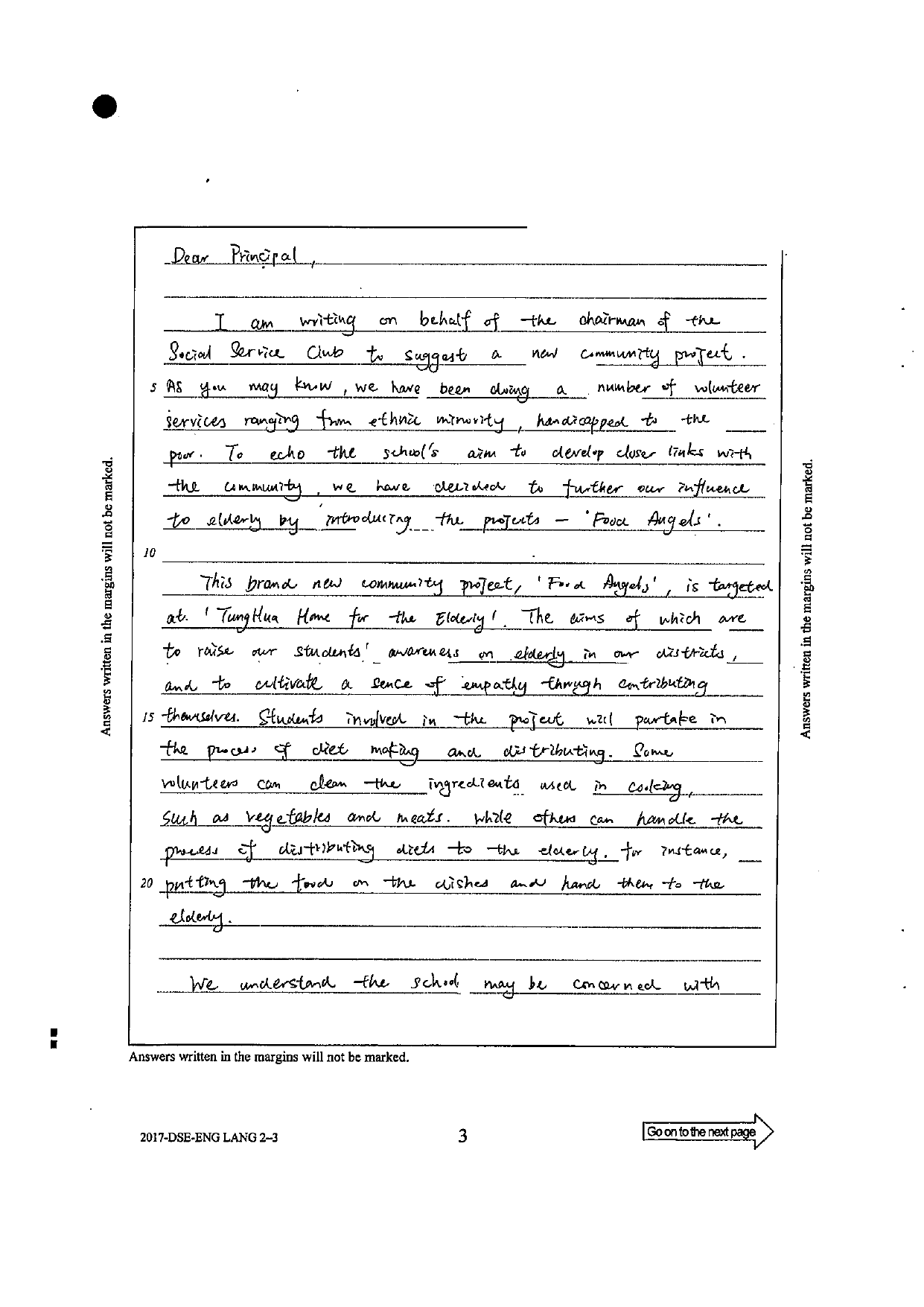
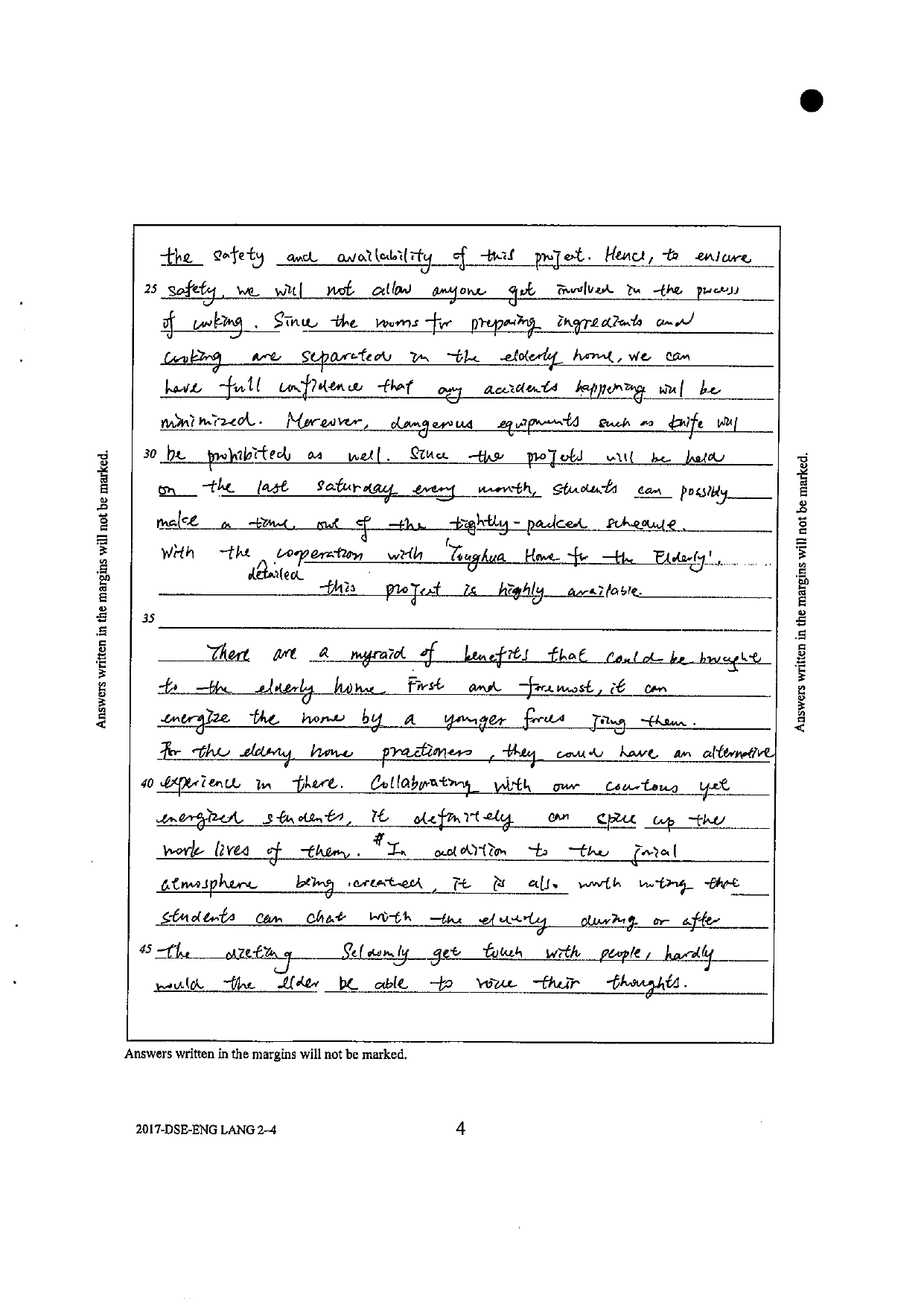

The writing, with corrections marked inline
Signature is written twice. The student signs Chris Wong, then writes the name a second time directly below in printed letters. The first version reads as a quick signature, the second as a name-block clarification — both kept here as transcribed.
Word count. The kept letter runs to roughly 440 words against the 200-word brief — more than double the target. The proposal is thorough but every section could be trimmed by a third.
Marks earned (^19 + ^18 = 37 / 42, closest-pair adjusted). A clean Band 5* per-piece score. Markers rewarded the vocabulary range (partake, myriad, courteous, jovial, foreseeable, gleeful, showered with warmth), the explicit safety-and-scheduling paragraph that pre-empts the principal’s most likely objections, and the two-sided benefits frame (residents and staff). The cap below 21 reflects the persona slip in lines 3–4, the over-length, and a cluster of word-choice slips (diet/diets, equipments, jovial in the wrong heat, Seldomly).
Strengths to praise
The project (‘Food Angels’) is named in line 9, and the partner home (Tung Hua Home for the Elderly) is named just two lines later. The principal is given a thing she can refer to in a reply (“your Food Angels proposal…”) before she has finished the first paragraph. Most Q.1 candidates leave one or both as generic placeholders (“an elderly home”); this candidate locks both in early.
The whole third paragraph (“the school may be concerned with the safety and availability of this project… we will not allow anyone to get involved in the process of cooking… dangerous equipment such as knives will be prohibited…”) anticipates the exact reason a principal would decline a cooking-themed proposal. Naming the foreseeable concern before the recipient raises it, and then defusing it, is the highest-yield persuasive move in proposal writing — and this is the only Part A in the 2017 collection that gives the move a full paragraph rather than a single sentence.
The benefits paragraph addresses (i) the residents — new younger company, a jovial atmosphere, the chance to voice thoughts they rarely share — and (ii) the elderly-home practitioners, the staff, who get an alternative experience and a spiced-up workday. The two beneficiaries don’t overlap and don’t blur. The staff-benefit move in particular is the one most candidates miss; this writer makes it explicit.
“Since the project will be held on the last Saturday of every month, students can possibly make time out of their tightly-packed schedule.” One sentence quietly handles the second-most-likely objection: “will this take students away from class?” By specifying both the frequency (monthly) and the day (Saturday), the writer signals the project has been planned, not just dreamt up — and that DSE-Form-6 academic pressure has been factored in.
In a 440-word letter, this candidate deploys: ethnic minorities, echo, cultivate a sense of empathy, partake in, a myriad of, first and foremost, energise, alternative experience, collaborating, courteous, spice up, jovial atmosphere, foreseeable, gleeful, showered with warmth, sincerely. Even where individual words are mis-pitched (see Style suggestions), the register is correctly formal-institutional throughout — a sustained achievement at this level.
Rather than saying “students will help cook” and stopping there, the writer breaks the activity into two named roles — cleaning ingredients (vegetables and meats) and distributing meals (putting food on dishes, handing them to the elderly). The role-split lets the principal see how 20-odd volunteers would actually be deployed on the day. This is the operational concreteness that lifts a competent Q.1 proposal toward 5*.
“Showered with warmth, we believe this project can bring positive impacts to the elderly home.” The benefits paragraph closes on a sensory image (a warm shower) that gathers the foregoing details (chatting, sharing inner thoughts, becoming gleeful) into a single feel. It is the writer’s most lyrical moment, and it is correctly placed at a section-end rather than mid-paragraph — which is what gives it room to land.
Grammar notes
| Issue | Explanation |
|---|---|
(lines 3–4) I am writing on behalf of the chairman of the Social Service Club → I am writing as the chairperson of the Social Service Club / on behalf of the Social Service Club |
Persona slip. The prompt makes Chris Wong the chairperson; you don’t write on behalf of yourself. The clean fixes are either as the chairperson (foregrounding the role) or on behalf of the Club (foregrounding the body, dropping the title). Also: the prompt’s word is chairperson, not chairman. |
(line 6) ranging from ethnic minority, handicapped to the poor → ranging from helping ethnic minorities and the handicapped to the poor |
Three issues. (i) Ethnic minority needs a plural (the group, not the abstraction): ethnic minorities. (ii) The handicapped needs the definite article (parallel with the poor). (iii) The list structure ranging from X, Y, to Z reads as broken; the standard pattern is ranging from X and Y to Z, listing two end-points with and. |
(line 12) The aims of which are to raise … → The aims of the project are to raise … |
Of which can only attach to an immediately preceding noun phrase as a relative pronoun, not start a new sentence on its own. Replacing which with the project turns it back into a normal independent sentence. |
(line 13) raise our students’ awareness on elderly in our districts → raise our students’ awareness of the elderly in our districts |
Two slips. (i) Awareness takes of, not on (awareness of climate change, awareness of the issue). (ii) The elderly needs the definite article when used as a collective noun (the elderly, the poor, the homeless). |
(lines 14–15) cultivate a sence of empathy through contributing themselves → cultivate a sense of empathy by contributing themselves |
Three: (i) sense, not sence (spelling). (ii) By is the standard preposition for cultivate X by [doing]. (iii) The sentence assumes students as the missing subject of contributing; in the original sentence that subject only arrives in the next clause, so the participle dangles. |
(line 16, also line 19) partake in the process of diet making and distributing → partake in the process of meal preparation and distribution / making and distributing meals |
Diet means a person’s habitual food intake (a low-salt diet, a diet rich in fibre), not an individual meal. For what the volunteers actually do — cooking and handing out food — the word is meal. (The same slip recurs in distributing diets to the elderly.) |
(lines 19–21) For instance, putting the food on the dishes and hand them to the elderly. → For instance, putting the food on the dishes and handing them to the elderly. |
Parallel structure. The first verb is the participle putting, so the second one needs to match: handing, not hand. (Standalone For instance, … + participles is also a sentence fragment — better folded into the previous sentence: …such as putting the food on dishes and handing them to the elderly.) |
(lines 25–26) we will not allow anyone get involved in the process of cooking → we will not allow anyone to get involved in cooking |
Allow takes a to-infinitive: allow X to do Y. The bare infinitive after allow is ungrammatical. (The process of cooking is also wordy — just cooking.) |
(line 29) dangerous equipments such as knife will be prohibited → dangerous equipment such as knives will be prohibited |
Two: (i) Equipment is uncountable in standard English — no plural equipments. (ii) Such as takes a representative example, which for a class of objects is typically plural: knives, not knife. |
(line 31) on the last saturday every month → on the last Saturday of every month |
Capitalisation of Saturday, and the structure is the last X of every month, not the last X every month (which omits the genitive link). |
(lines 31–32) students can possibly make a time out of the tightly-packed schedule → students can make time out of their tightly-packed schedule |
Two slips. (i) The idiom is make time (uncountable) — not make a time. (ii) The schedule is wrong scope; whose schedule? Their. (Also: can possibly doubles the modality — pick one. Can alone is cleaner.) |
(line 34) this project is highly available → this project is highly feasible / highly workable |
The writer wants feasible (= practically possible to carry out). Available means obtainable, accessible — the wrong concept here. |
(line 36) There are a myriad of benefits → There is a myriad of benefits / There are myriad benefits |
Two valid forms: (i) a myriad of + plural noun takes a singular verb because the head noun is myriad (singular). (ii) The bare adjective myriad + plural noun (myriad benefits) takes the plural verb. The student’s middle option is the one that doesn’t parse. |
(line 38) energize the home by a younger force joining them → energise the home with a younger force that joins them |
Two issues. (i) BrE spelling preferred in HKDSE: energise. (ii) By + noun + participle reads as broken; the subject of the participle (force) needs an explicit verb tie (that joins them) or the whole thing needs restructuring (by introducing a younger force into the home). |
(lines 41–42) it definitely can spice up the work lives of them → it can definitely spice up their work lives |
Two: (i) Adverb order — can definitely, not definitely can (modal first, adverb second). (ii) The work lives of them is over-formal and reads as translated; the natural possessive is their work lives. |
(lines 45–46) Seldomly get touch with people, hardly would the elder be able to voice their thoughts. → Since they seldom get in touch with people, the elderly are rarely able to voice their thoughts. |
Four slips packed into one sentence. (i) Seldomly isn’t a word — the adverb is seldom. (ii) The idiom is get in touch with, not get touch with. (iii) The dangling participle (subject of seldom getting is left unspecified) needs an explicit subject. (iv) The elder as a noun for old people is non-standard; use the elderly. The hardly + inverted modal construction (hardly would the elder be able) is grammatically valid but lands as over-literary; the rewrite tones it down. |
(lines 56–57) May you have any inquiries, please do not hesitate and contact me. → Should you have any inquiries, please do not hesitate to contact me. |
Two: (i) The conditional inversion is should, not may. May you have any inquiries reads as a wish or a benediction (May you have a happy birthday), which is the wrong illocution here. (ii) Do not hesitate takes to + infinitive: do not hesitate to contact me. The and reads as a clause-coordinator misfire. |
Style suggestions (where strong writing could become outstanding)
Professional rewrite — the opening paragraph (the persona slip)
For comparison only, not a correction. The opening paragraph is the only place in the letter where the Content score takes a real hit — the persona slip (“on behalf of the chairman”) puts the writer in the wrong relation to the Club, and the project name + partner home are held back until paragraph two. The body of the letter (safety, scheduling, two-sided benefits) is at-band 5* work; this rewrite shows what the opening would look like if the same care were given to it.
The student’s opening (corrected)
Rewritten by a professional letter-writer
- The persona is fixed in the first four words. “As chairperson of the Social Service Club” puts the writer in the right relation to the Club — they hold the role, not represent its holder. This is the persona the prompt asks for.
- The project name and partner home arrive in sentence one. The principal sees the proposal’s name (Food Angels) and counterparty (Tung Hua Home for the Elderly) before she finishes the opening line. The student delivers both, but separates them across two paragraphs.
- The proximity to school is foregrounded. “A short walk from our school gate” is an operational fact the principal will weigh heavily; it removes a transport-and-supervision concern before that concern can form.
- The existing programmes are listed with consistent wording. The original’s “ranging from ethnic minority, handicapped to the poor” reads as a broken list. The rewrite gives three parallel noun phrases (ethnic minorities, the disabled, the homeless) — cleaner grammar and a stronger picture of the Club’s breadth.
- The proposal is framed as a natural extension. “Extending that work to the elderly is the natural next step” positions the new project as continuous with proven work, not as a leap into unknown territory. Principals approve continuity more easily than novelty.
- The school’s aim is acknowledged second, not first. The student opens with the school’s aim (to echo the school’s aim…); the rewrite earns the aim by first listing the Club’s track record, then claiming the new project as the next instalment in that record. Same content, more persuasive order.
- Word count is similar. Original ~80 words, rewrite ~80 words. The opening does the same length of work, but four different jobs done well rather than four jobs half-done.
Vocabulary to notice
| Word | Definition | Usage notes | Synonyms / alternatives |
|---|---|---|---|
| on behalf of | (prep. phrase) as a representative of. | Formal. Used when the writer is not the named individual but is speaking for them. Here the student uses it where as would have been correct — they are the chairperson, not their deputy. See Grammar row 1. | representing, for, in the name of |
| echo | (v.) to repeat or reinforce (an idea, sentiment, theme). | Pairs with aim, sentiment, view, words, call. The student’s “to echo the school’s aim” is a clean idiom — the verb conveys both repetition and approval. | reflect, reinforce, mirror, support |
| cultivate | (v.) to develop or improve (a quality, skill, or sentiment) by careful attention over time. | Pairs with habit, skill, taste, sense, friendship, talent. The student’s cultivate a sense of empathy is exactly the right collocation. | develop, nurture, foster, build |
| partake (in) | (v., formal) to participate or take part in (an activity). | Always with in. Slightly literary register; common in formal proposals and reports. Also: partake of = to consume (food or drink), a different idiom. | participate in, take part in, engage in |
| a myriad of | (quantifier, formal) a great number of. | Takes a plural noun but a singular verb when used with a/the: a myriad of benefits is…. The bare adjective myriad (no article) takes a plural verb: myriad benefits are…. See Grammar row 12. | countless, a great many, innumerable |
| first and foremost | (adv. phrase) most importantly; before anything else. | Functions as a discourse marker introducing the first and most important point in a series. Followed by a comma. Slightly formal. | above all, primarily, in the first place |
| energise / energize | (v.) to give energy or enthusiasm to (a person, place, or activity). | BrE energise, AmE energize. Pairs with team, crowd, movement, debate, space, room. The student’s energi[s]e the home is a strong metaphor — treating the home as something that can be re-charged. | invigorate, enliven, animate, revitalise |
| collaborate (with) | (v.) to work jointly with someone on a project or activity. | Pairs with with (the partner) and on (the project): collaborate with X on Y. The student’s collaborating with our courteous yet energised students uses the verb cleanly. | cooperate, work together, partner, team up |
| courteous | (adj.) polite, respectful, and considerate in manner. | Pairs with service, staff, treatment, reply, manner, host. Stronger and warmer than polite; suggests the politeness comes from genuine consideration. A good word for describing student volunteers in a customer-facing role. | polite, civil, well-mannered, gracious |
| spice (something) up | (phrasal v., informal) to make something more exciting or interesting. | Originally about adding spices to food; metaphor for any kind of liveliness lift. The student’s spice up the work lives is in the right register for a friendly aside to the principal but slightly informal for the surrounding letter. | liven up, brighten, add interest to, perk up |
| jovial | (adj.) cheerful and friendly in an outgoing, hearty way. | Connotes loud, back-slapping cheer (a jovial host, a jovial uncle). For elderly residents the temperature overshoots; warm, lively, brighter, friendly sits better. See Style suggestion 5. | cheerful, hearty, merry, convivial |
| foreseeable | (adj.) able to be foreseen or predicted. | Pairs with future, outcome, consequence, risk. Common policy and report vocabulary. The student’s it is foreseeable that they can share their inner thoughts uses it correctly as a predictive frame. | predictable, expected, anticipated |
| gleeful | (adj.) showing happiness and excitement, especially at one’s own good fortune or another’s misfortune. | Two senses, one neutral (a gleeful child), one slightly malicious (gleeful at their rival’s failure). Used here in the neutral sense for elderly residents who become happier after a visit. The word lands well, though brighter or cheerful would be safer. | joyful, delighted, jubilant, elated |
| shower (someone) with | (phrasal v.) to give (a person) a great quantity of (something) in a generous, sudden way. | Pairs with praise, gifts, attention, affection, compliments, warmth. The student’s showered with warmth is the letter’s most evocative idiom — the verb does the rhetorical work of overflowing kindness. | lavish on, heap on, drench in, bestow on |
| inquiry (also: enquiry) | (n.) an act of asking for information; a formal investigation. | BrE prefers enquiry for the asking-for-information sense and inquiry for a formal investigation; AmE uses inquiry for both. HKDSE accepts either. The student’s should you have any inquiries is a standard closing for formal correspondence. | question, query, request, enquiry |
Leave a Reply