Report on Hong Kong’s NEETs
You are working on a project entitled ‘Hong Kong’s NEETs’. NEETs are young people who are not in education, employment or training. Many of these young people spend their time at home playing video games or surfing the Internet.
Write a report to explain why the number of NEETs in Hong Kong is rising and suggest what can be done to help these youths. Give reasons to support your suggestions.
(~400 words)
Show original handwritten pages (4)


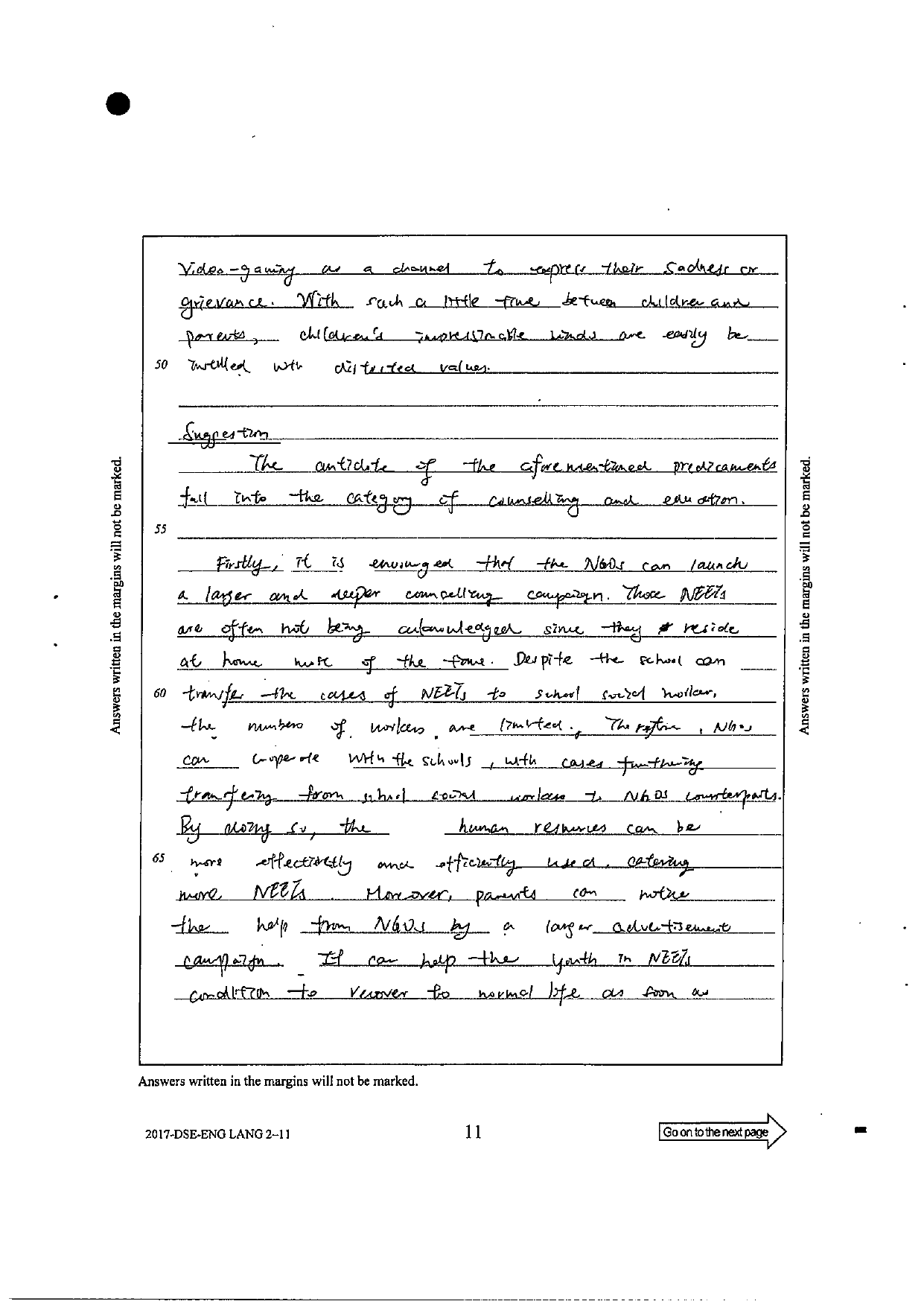

The writing, with corrections marked inline
Conclusion is missing. The report ends mid-list with the “vocational education” recommendation; there is no Conclusion section to close it. The candidate is one short paragraph away from a complete report-structure. See Style suggestion 9.
Format observance. Centred underlined title; Introduction, Reasons and Suggestion[s] headings; a tidy two-and-two preview line (academic pressure and lack of guidance) that pairs the causes with the solutions. The format is right; the conclusion gap is the one thing keeping it below the “textbook structure” ceiling.
Marks earned (^18 + ^15 = 33 / 42, closest-pair adjusted). A Band 5 per-piece score. The first marker (18) credits the formal-report skeleton, the strong NEET-specific lexis (soaring, ascribed to, inferiority, indispensable, instrumental) and the explicit cause-to-solution pairing; the second marker (15) pulls down for the larger volume of grammar slips (subject-verb disagreement, lack of mis-fitted as adjective, let done for let alone, missing articles, missing conclusion). The 3-mark spread between the two markers is what triggered the closest-pair adjustment recorded on the cover.
Strengths to praise
Centred underlined title; explicit Introduction, Reasons and Suggestions headings; a clear preview sentence (“The reasons … can be ascribed to two aspects — academic pressure and lack of guidance”) that tells the reader what is coming and in what order. This is exactly the architectural move Q.7 markers reward on the Organisation criterion.
Reason 1 (academic pressure / sense of inferiority) is answered by Suggestion 1 (NGO counselling campaigns + vocational-education advisories). Reason 2 (lack of parental guidance) is answered by Suggestion 2 (parents investing in family time + schools collaborating with parents). The symmetry is signposted at the start of each section — the writer designed the report before writing it.
The report names the HK-specific drivers throughout: TSA in primary stage, DSE in secondary stage, exam-oriented culture, knowledge-based economy, the 1st city with the longest working hours, over 50 hours every week, cosmopolitan city. The 50-hour working-week claim is the report’s most concrete data point and the kind of HK-specific framing that lifts the Content score.
“More and more teenagers are prompted to view themselves as losers based on academic results, getting a sense of inferiority. In order to seek satisfaction in life, they often do so by video-gaming. And it leads to a habit and obsession as time goes by.” Three steps — academic judgement → inferiority → compensatory gaming → addiction — in three short sentences. The mechanism is named, not just gestured at; this is the report’s strongest analytical moment.
“Despite that the school can transfer the cases of NEETs to school social workers, the number of workers is limited. The NGOs can co-operate with the schools, with cases further transferring from school social workers to NGOs’ counterparts.” Naming the existing channel (school → social worker), identifying its bottleneck (limited workers), and proposing the extension (social worker → NGO counterpart) is policy-grade reasoning. Most candidates stop at “more counselling should be provided”; this one specifies the referral pathway.
In a 540-word report this writer deploys: soaring, ascribed to, exam-oriented, knowledge-based economy, sense of inferiority, metropolis, at the expense of life, impressionable minds, distorted values, antidote, aforementioned, predicaments, NGOs, counterparts, catering to, advisable, instrumental, vocational education, prospects. The register is consistently formal-report; the lexical reach is wide; almost every word lands in the right collocation.
“With such a little time between children and parents, children’s impressionable minds can easily be swayed with distorted values.” The sentence closes the parents-section by naming the second-order risk (not just unsupervised time, but actively-warped values), and uses impressionable as the load-bearing adjective — exactly the right word for adolescents whose worldview is still being formed. The most rhetorically ambitious sentence in the report, and it lands.
Grammar notes
| Issue | Explanation |
|---|---|
(lines 3–5) NEETs … has been a phenomenon worldwide → NEETs … have been a phenomenon worldwide |
Subject-verb agreement. The subject NEETs is plural; the verb must agree. (Strictly the predicate a phenomenon is singular, but that’s a separate observation — the writer means NEETs are a worldwide phenomenon, where are agrees with the plural subject.) |
(lines 7–9) in the following sessions, we would like to examine the reasons → in the following sections, we will examine the reasons |
Two slips. (i) Sessions means time-bounded meetings (a counselling session, a parliamentary session); for parts of a written document the word is sections. (ii) Would like to is conversational politeness; a formal report uses the plain future (we will). |
(lines 12–13) can be ascribed in two aspects → can be ascribed to two factors |
Two slips. (i) Ascribe takes to, not in: ascribed to X. (ii) Aspects means sides or facets of one thing; what the writer is listing are factors or causes — two separate drivers, not two angles on one thing. |
(line 15) the increasingly academic and employment pressure → the increasing academic and employment pressure |
Adverb vs. adjective. Increasingly is an adverb (modifies a verb or adjective: increasingly difficult). To modify the noun pressure directly, you need the adjective increasing. |
(line 17) Hong Kong has been well-known of its heavy academic stress → Hong Kong has been well known for its heavy academic stress |
Two slips. (i) The preposition after well known is for (well known for X), not of. (ii) Well known is usually unhyphenated when used predicatively (after the verb); hyphenated only when attributive (a well-known author). |
(lines 19–21) Parents and schools are forcing them to pass exams with flying colours through massive drilling. → Parents and schools push them to pass exams with flying colours through relentless drilling. |
Two style nudges. (i) Forcing is the dramatic verb; pushing is the accurate one. (ii) Massive drilling reads as Chinglish (大量操練); relentless, endless or round-the-clock drilling sits more naturally in English. |
(lines 21–22) While the society is telling them academic results determine everything. → Meanwhile, society tells them that academic results determine everything. |
Three slips. (i) Standalone While … with no main clause is a sentence fragment — the subordinator while needs a main clause attached. (ii) Society in this general sense takes no article (society tells, not the society tells). (iii) Telling them + that-clause reads more cleanly with an explicit that. |
(lines 23–24) it comes as no surprise that the number of NEETs in Hong Kong are soaring → … the number of NEETs in Hong Kong is soaring |
Subject-verb agreement. The grammatical subject is the number (singular), not NEETs. The verb agrees with the head noun, not with the noun inside the prepositional phrase. (Compare: a number of NEETs are soaring — different head noun, different agreement.) |
(line 35) parents are lack of time in leisure activities → parents lack time for leisure activities |
Two slips. (i) Lack of is a noun phrase (the lack of X); to use it as a predicate you need lack as a verb (parents lack time) or have a lack of (parents have a lack of time). (ii) Preposition: time for X, not time in X. |
(line 36) let done providing guidance → let alone providing guidance |
The fixed expression is let alone (= not to mention, much less): they have no time for leisure, let alone providing guidance. Let done isn’t a phrase — this looks like a mishearing of the idiom. |
(lines 37–41) Some teenagers are persuaded by their friends to adopt such a living style as surfing Internet all the time, which can easily lead to addiction without the ability or time controlling and self-discipline moulded by their parents. → Some teenagers are persuaded by their friends to adopt a lifestyle of surfing the Internet all day, which can easily lead to addiction in children who lack the self-discipline normally instilled by their parents. |
A single very long sentence with four issues. (i) Such a living style as is awkward; a lifestyle of is the natural collocation. (ii) Surfing Internet needs the definite article: the Internet. (iii) The phrase without the ability or time controlling tries to coordinate ability, time, and controlling across mismatched syntactic slots; the cleanest fix is to recast the clause around the missing self-discipline. (iv) Moulded is a fine verb for character-formation in formal prose, but instilled is the standard collocation with self-discipline. |
(lines 41–43) While since faces challenges and obstacles in lives, but not having their parents to hear their dissatisfaction. → Facing challenges and obstacles in life but without their parents to hear their dissatisfaction, … |
The sentence as written has no subject and double subordinators (While since … but). The intended structure is a participle phrase (Facing … but without …) attached to the main clause in the following line (they can only hold their sorrow back). Also lives → life (the abstract noun is uncountable here). |
(lines 47–48) children’s impressionable minds are easily be swelled with distorted values → children’s impressionable minds can easily be swayed by distorted values |
Three issues. (i) Two finite-verb forms (are … be) collide; the correct modal pattern is can easily be. (ii) Swelled means inflated in size; for the influence-on-thinking sense the verb is swayed. (iii) By is the standard preposition with swayed (swayed by an argument, by an emotion). |
(line 57) Despite the school can transfer the cases → Although the school can transfer the cases / Despite the school’s ability to transfer the cases |
Despite is a preposition; it must be followed by a noun phrase or a gerund, not by a finite clause. To take a finite clause you need the conjunction although. Alternative: nominalise the clause (despite the school’s ability to transfer). |
(line 59) the numbers of workers are limited → the number of workers is limited |
Two slips. (i) Singular noun: the number, not numbers, for “the count”. (ii) Singular verb agrees with number: is limited. (Same pattern as the earlier number of NEETs is soaring.) |
(line 75) they should not overlooked the importance → they should not overlook the importance |
After a modal (should) you need the bare infinitive (overlook), not the past tense or past participle (overlooked). A common slip when writing at speed. |
Style suggestions (where strong writing could become outstanding)
Professional rewrite — the parental-guidance reason (weak moment)
For comparison only, not a correction. This is the weakest paragraph in the report on two counts at once. It carries the heaviest concentration of language friction in the piece — work is always attained at the expense of life, parents are lack of time in leisure activities, let [alone] providing guidance, the subjectless fragment While since … but not having their parents to [hear] their dissatisfaction, and minds swelled with distorted values — and the analysis itself thins: after the strong 50-hour-week data point it drifts into a chain of emotional consequences (hold their sorrow and tears back, sadness or grievance) that asserts feeling rather than tracing cause. The rewrite keeps every link the candidate built — long hours → no guidance → peer-driven habit → no self-discipline → distorted values — but states each one cleanly, at roughly the same length.
The candidate’s paragraph (corrected)
Rewritten by a professional
- The 50-hour figure is repositioned as the engine of the argument, not a stray statistic. The candidate states the working-hours data and the lack of guidance as two adjacent facts; the rewrite makes the hours cause the guidance gap (that shortage is built into the working day), so the strongest evidence in the paragraph actually does work.
- The subjectless fragment is repaired into a full sentence. “Facing challenges and obstacles in lives, but not having their parents to hear their dissatisfaction” had no main clause. The rewrite gives it a subject and a verb (A child … has nowhere to take it) so the thought completes.
- Emotive listing becomes a named mechanism. The candidate’s hold their sorrow and tears back … sadness or grievance piles up feeling; the rewrite keeps the emotional content but routes it through a stated cause-and-effect (nowhere to take it → video-gaming as the only available outlet), which is what report analysis rewards.
- “Vacuum” carries the peer-pressure turn. Into that vacuum step a teenager’s peers links the absent parent and the influential friend in one image, where the candidate left them as separate sentences.
- The candidate’s best phrase is preserved and sharpened. Impressionable mind and distorted values — the strongest words in the original — are kept, but swayed with becomes shaped by, and the second-order risk (values with no one to question) is named explicitly to give the paragraph its close.
Vocabulary to notice
| Word | Definition | Usage notes | Synonyms / alternatives |
|---|---|---|---|
| NEET | (n., acronym) Not in Education, Employment, or Training. | British policy acronym, now widely used in HK and East Asia. Plural NEETs. Always all caps. The student wisely defines the term in the introduction before using it. | idle youth, disengaged youth, drop-outs |
| phenomenon | (n.) a fact or situation that is observed to exist or happen. | Plural phenomena (Greek -on / -a). Pairs with social, natural, global, observed, rare, widespread. The student’s a phenomenon worldwide is the right register. | occurrence, trend, development, manifestation |
| soar | (v.) to rise rapidly to a high level. | Pairs with number, prices, rates, sales, temperature. Slightly journalistic; gives the impression of a sudden vertical climb. The student’s the number of NEETs is soaring is a clean idiom. | surge, skyrocket, climb, rise sharply |
| ascribe (to) | (v., formal) to attribute (a cause, quality, or event) to a particular thing. | Always with to: ascribe X to Y, never ascribe X in Y. Common in formal analysis and policy writing. See Grammar row 3. | attribute, credit, assign, put down to |
| exam-oriented | (adj.) (of a curriculum or culture) focused primarily on success in examinations. | Hyphenated. Pairs with culture, system, education, society, mindset. A standard HK educational-discourse term; the student uses it correctly. | test-focused, examination-driven |
| knowledge-based economy | (n. phrase) an economy in which the production, distribution and use of knowledge is the main driver of growth. | Hyphenated knowledge-based. Common in HK policy discourse since the early 2000s. The student deploys it as economic context for the NEET problem — a clean upgrade from generic modern economy. | information economy, post-industrial economy |
| inferiority | (n.) the condition of being lower in rank, status, or quality. | Pairs with sense of, feelings of, complex. A sense of inferiority is a standard mental-health-adjacent collocation; the student’s use is exactly on-register for the NEET-causation argument. | inadequacy, lowliness, subordination |
| metropolis | (n.) a very large and busy city. | Slightly literary register. Pairs with bustling, sprawling, modern, cosmopolitan, global. The student’s a metropolis such as Hong Kong is a clean noun choice for the city-stress framing. | megacity, urban centre, conurbation, city |
| at the expense of | (prep. phrase) with the loss or sacrifice of (something else). | Pairs with health, family, friendship, freedom, accuracy. The student’s work is always attained at the expense of life is the right idiom for the work-life trade-off. | at the cost of, to the detriment of, sacrificing |
| impressionable | (adj.) easily influenced because of a lack of critical ability. | Pairs with young, mind, age, children, teenager. The impressionable years is a fixed phrase. The student’s impressionable minds is the load-bearing adjective in the report’s strongest sentence. | susceptible, suggestible, malleable, vulnerable |
| distorted | (adj.) twisted out of true shape or meaning. | Pairs with view, perception, image, account, values, picture. Strong negative charge. The student’s distorted values is exactly the right collocation for value-corruption in adolescents. | warped, skewed, twisted, misrepresented |
| antidote | (n.) something that counteracts or solves a bad situation. | Original sense (medicine that neutralises a poison) gives the word its rhetorical force when applied to social problems. Pairs with to + noun: an antidote to despair, to apathy. A high-impact opener for a Suggestions section. | remedy, solution, counter, cure |
| aforementioned | (adj.) referred to previously. | Formal. Pairs with issue, problem, point, predicament, individual, fact. Strong report and policy vocabulary; the student uses it correctly to refer back to the two causes section. | previously mentioned, above, just discussed |
| predicament | (n.) a difficult, unpleasant, or embarrassing situation. | Slightly formal. Pairs with find oneself in, escape from, address, resolve. The student’s the aforementioned predicaments is a clean noun upgrade from the more generic problems. | dilemma, difficulty, plight, quandary |
| counterpart | (n.) a person or thing that holds an equivalent position elsewhere. | Pairs with foreign, regional, professional, local, civilian. The student’s NGOs’ counterparts means the NGOs’ equivalent staff — a precise word for the cross-organisation handoff being described. | equivalent, opposite number, peer |
| cater (to / for) | (v.) to provide what is needed or wanted by (someone). | BrE prefers cater for (= serve), AmE prefers cater to (= pander to). Both are accepted in HKDSE. The student’s catering to more NEETs is the AmE pattern but a clean idiom. | serve, provide for, accommodate, meet the needs of |
| let alone | (idiom) used after a negative statement to emphasise that the second possibility is even less likely. | Always after a negative: he can’t walk, let alone run. The student writes let done, which isn’t a phrase — almost certainly a mishearing of let alone. See Grammar row 10. | much less, never mind, to say nothing of |
| instrumental | (adj.) serving as a means of pursuing an aim. | Pairs with in + gerund: instrumental in shaping, in achieving, in bringing about. The student’s This is instrumental when teenagers begin to grow uses the word slightly loosely; the standard collocation is X is instrumental in Y-ing. | vital, crucial, key, important |
| vocational education | (n. phrase) education that prepares people to work in a specific trade or craft. | Pairs with training, programme, qualification, pathway, college. Standard HK policy term, contrasted with academic education. The student’s recommendation to expand vocational guidance addresses the root cause Reason 1 named — exactly the right pedagogical pivot. | technical training, trade education, professional training |
| prospects | (n., usually plural) the possibility or likelihood of future success or achievement. | Pairs with good, poor, bright, career, employment, future, marriage. The student’s more information and prospects uses the noun cleanly as “future possibilities”. | opportunities, possibilities, future, outlook |
Leave a Reply