Letter to the Principal — A Community Project for the Elderly Home
You are the chairperson of the Social Service Club at your school. The school would like to develop closer ties with the community. Write a letter to your principal, Mr Lee, proposing a new community project that the school can carry out with a home for the elderly in your district.
In your letter persuade your principal to accept your project by
- describing one activity that could be carried out, and
- identifying the benefits for the elderly home.
Sign your letter Chris Wong. (~200 words)
Show original handwritten pages (4)

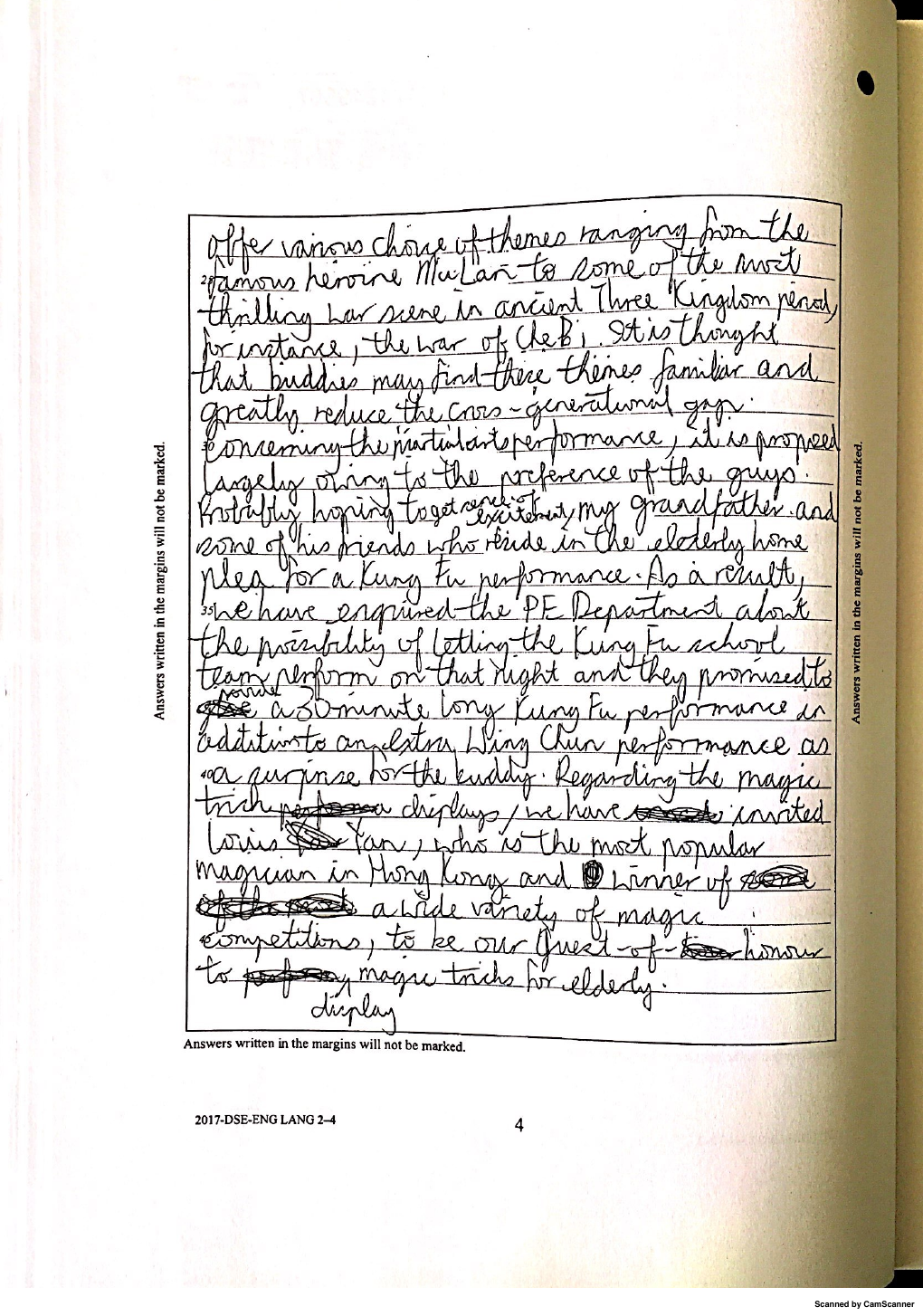


The writing, with corrections marked inline
Recipient name slip caught on the page. The prompt addresses the principal as Mr Lee; the student opens with “Dear Principal Miss Lee” and corrects it inline to Mr. Worth flagging because accurate recipient details are a content marker examiners check — but here the self-correction is part of the page.
Continuation onto a supplementary sheet. The student ran out of space at the end of booklet page 5 and finished the letter on Supplementary Answer Sheet B (S2). The Question No. box on the supplementary sheet correctly shows Q1 ticked. The transcript above stitches the two together.
Length note (informational, not a deduction). The full letter (main answer book + supplementary sheet) runs to roughly 470 words against a 200-word brief. At this grade band, the markers clearly judged the extra length to be earned by content density rather than padding — every paragraph carries new specifics (named clubs, named acts, named magician, survey, PE Department, post-exam slot). For a candidate aiming lower, that ratio would be a risk; for this one, it isn’t.
Strengths to praise
The student establishes the chairperson voice in the first sentence (“I am Chris Wong, the chairperson of the Social Service Club”) and immediately grounds the proposal in real data (“the latest percentage of elderly in the 18 districts. With Kwun Tong being the highest…”). The persuasive ground is set before the proposal arrives — a structural choice that separates 5** scripts from 5* ones.
The proposal names three specific acts (Cantonese opera, martial arts, magic tricks), three specific clubs (Drama, Melody, Chess), specific themes (Mulan, Three Kingdoms), and even a named magician (Louis Lam). Specificity is the most persuasive ingredient in a proposal; this letter is rich with it.
The student references a pre-visit survey, contact with the PE Department, and negotiations with Louis Lam. This shows the project isn’t just a wish — it has already been scoped. Principals approve proposals when the legwork is visibly done; the student gives the principal three pieces of evidence that it is.
The benefits section addresses two audiences: the elderly (mood, less depression, reduced resistance towards staff) and the elderly home as an institution (improved working environment, cost reduction through fewer external entertainment fees). This double-audience awareness, in a 200-word brief, is what the rubric’s top band is looking for.
Words like prevalence, broad spectrum, drafted, rendered, myriad, cross-generational, post-exam period, with regard to, in light of, guest of honour, on a regular basis, incurred are deployed in their proper collocations, not just sprinkled. Particularly notable: “in light of the prevalence of elderly homes” as a sophisticated transitional opener, and the “cross-generational gap” framing that ties the activity choice to the social rationale.
The closing paragraph reframes the project from being about elderly welfare to being about the school’s reputation and the school motto. This is exactly the move that persuades a principal — tie your proposal to the institution’s interests, not just the worthy cause. The student executes the pivot in one paragraph without sounding cynical.
Grammar notes
| Issue | Explanation |
|---|---|
(line 1) Dear Principal Miss Lee → Dear Principal Mr Lee |
The prompt names the principal as Mr Lee. The student opens with Miss Lee and self-corrects inline. Beyond the grammar, accurate recipient details are a content marker examiners check. |
(line 3) chairperson of Social Service Club → of the Social Service Club |
Named clubs and societies typically take the definite article (the Drama Club, the Social Service Club). |
(line 10) the prevalence of elderly home in Kwun Tong → of elderly homes |
Talking about more than one institution — needs the plural. |
(line 12) a variety show being the highlight → a variety show will be the highlight |
Being as a participial floating after a comma doesn’t connect to a finite verb. Rephrase to a prepositional phrase (with X as the highlight) or a full clause. |
(lines 15–16) to entertain elderly with various interest → to entertain the elderly with various interests |
Two fixes: elderly as a noun for the group takes the (the elderly, the young, the homeless); and interests in the sense of “things one is interested in” is countable and plural. |
(lines 52–53) Researches show → Research shows |
Research in the sense of investigation/findings is uncountable in modern English — no plural form, takes a singular verb. (Researches survives in older or very formal contexts but is best avoided.) |
(lines 53–54) stressed elderly may experience rebellion as do the adolescents → resistance much like adolescents do |
Two issues. Rebellion is too strong for the behaviour described (resistance, push-back, irritability); and as do the adolescents is an awkward formal inversion. Much like adolescents do reads naturally. |
(line 60) in order to bear our responsibilities can the elderly → responsibilities to the elderly |
Can is almost certainly a slip of the pen for to. The construction is responsibilities to X, not responsibilities can X. |
(line 62) investigating into the possibility to make → investigating the possibility of holding |
Investigate is transitive — no into. And the possibility is followed by of + gerund (the possibility of doing X), not to + infinitive. |
(lines 70–71) the school image can be definitely improved → the school’s reputation can definitely be improved |
Three small fixes: add the possessive (school’s); use reputation rather than the slightly corporate image; and put the adverb after the auxiliary (can definitely be). |
(lines 29, 42) Register: buddies → the elderly / our elderly friends |
The letter is a formal proposal to the school principal. Buddies is too casual for this register. The elderly, our elderly friends, residents of the elderly home all work. |
Style suggestions (what an editor would change if forced to find something)
Strong moment worth teaching from
This stretch (lines 22–46) is the single most teachable section in the letter. Worth quoting in class as a model of how a proposal makes an idea feel real — three named acts, each tied to a specific club or contact, each justified against the audience’s tastes.
Why this section is strong
- Three named acts, each justified. Cantonese opera is tied to the Melody Club; martial arts is tied to a personal anecdote (the writer’s grandfather and his friends made the request); magic tricks is tied to a celebrity booking (Louis Lam). The variety is not a guess — it is the result of a stated process.
- The personal-anecdote pivot. Mentioning my grandfather and some of his friends who reside in the elderly home drops the letter into authentic personal territory in exactly one sentence. It signals that the writer knows this audience, not just that they researched it. Markers respond to this kind of grounded specificity.
- The audience-segmentation move. The student notes that the martial arts segment is proposed largely owing to the preference of the elderly gentlemen — a sub-audience inside the elderly audience. That granularity (different acts for different sub-groups) is what turns a list of activities into a programme.
- Named themes inside the named acts. Not just “Cantonese opera” but Mulan, Three Kingdoms, war scenes. Specific titles double the persuasive density without doubling the word count.
Professional rewrite — the benefits paragraph (the closest thing to a weak moment)
For comparison only, not a correction. The student’s argument is strong, and this script scored 42/42 — but the benefits paragraph (lines 47–58) is where the letter slows down most: the rebellion line trips the reader, and the working-environment claim lands as an afterthought. The rewrite shows what a tighter, more confident version of the same case looks like in roughly the same word count.
The student’s benefits paragraph (corrected)
Rewritten by a professional letter-writer
- Two-audience structure stated up front. “The benefits would be felt on both sides of the visit” tells the reader exactly what is coming. The student’s version makes the reader assemble this.
- “Television” earns its place. The student introduces televisions much later (in the cost paragraph); pulling it forward here makes the contrast vivid (“in a way that television cannot”).
- The research claim becomes specific. “Prolonged stress in elderly residents leads to withdrawal and resistance toward care staff” — the rewrite names the behaviours, which makes the citation feel real rather than gestural.
- Staff working conditions get the closing emphasis. The student’s version mentions working environment almost as an afterthought. Moving it to the last clause, and adding the staff who do this difficult work every day, gives the institutional appeal more emotional weight.
- One paragraph, not two. The student’s case is split between this paragraph and the next (cost); folding the cost point in here lets the proposal move faster — useful if the writer were forced to hit the 200-word brief.
Vocabulary to notice
| Word | Definition | Usage notes | Synonyms / alternatives |
|---|---|---|---|
| prevalence | (n.) the fact or condition of being widespread. | Formal. Common in social-policy writing: the prevalence of obesity, of poverty, of dementia. Pairs with increasing, declining, growing. | commonness, frequency, ubiquity, incidence |
| utmost | (adj.) most extreme; greatest. | Pairs with abstract nouns: utmost importance, utmost care, utmost responsibility, utmost respect. More formal than greatest. | greatest, supreme, paramount, highest |
| broad spectrum | (n. phrase) a wide range or variety of something. | Originally scientific (light, antibiotics); now common metaphorically for variety. Pairs with of + plural noun: a broad spectrum of opinions, of clubs, of products. | wide range, full variety, diverse array |
| draft | (v.) to prepare a preliminary version of something. | Used for plans, letters, contracts, speeches. “It is drafted that…” is awkward (see Style suggestion 3); active forms are better. | plan, outline, sketch out, prepare |
| render | (v.) cause to be or become; (also: provide, give). | Multiple senses. Here: it is rendered that… = “the result is that…”. A more natural alternative: this leads us to conclude that. | make, cause, deliver, present |
| myriad | (n. / adj.) a countless or extremely great number. | Used both as a noun (a myriad of benefits) and as an adjective (myriad benefits). The adjective form is slightly more elegant. | countless, innumerable, multitude, plethora |
| cross-generational | (adj.) involving or affecting more than one generation. | Hyphenated. Common in education, social work, family studies. Cross-generational gap, cross-generational dialogue. | intergenerational, age-spanning |
| rebellion | (n.) an act of armed or open resistance; refusal to obey. | Strong. Used of political uprisings, adolescent defiance, teenage rule-breaking. Best avoided for elderly resistance to care — see Style suggestion 5. | resistance, defiance, uprising, mutiny |
| in light of | (prep. phrase) taking something into consideration; in view of. | Formal. Pairs with recent developments, the evidence, your decision, the prevalence of X. A more elegant way to say because of. | given, in view of, considering, owing to |
| post-exam (period) | (adj. phrase) the period after examinations. | Hyphenated when used attributively. Common in HK school contexts. Compare with pre-exam, mid-exam. | after exams, after-exam, end-of-term |
| heroine | (n.) a woman admired for her courage or noble qualities; the principal female character in a story. | Note the spelling distinction: heroine (the woman) vs heroin (the drug). Plural: heroines. | female protagonist, leading lady, legend |
| enquire (with) | (v.) to ask for information. | British spelling. American: inquire. Enquire about X with Y, or simply enquire about X. | ask, query, request information, find out |
| guest of honour | (n. phrase) the most important guest at a formal event. | British: honour; American: honor. Always with definite article the: the guest of honour, our guest of honour. | VIP, principal guest, special guest |
| energize / energise | (v.) give vitality or enthusiasm to. | British energise, American energize. Pairs with audience, crowd, team, room. Stronger than excite. | invigorate, animate, stimulate, enliven |
| on a regular basis | (adv. phrase) regularly; at regular intervals. | Slightly formal. Common in business and policy writing. Compare with regularly (simpler) or routinely (more institutional). | regularly, routinely, periodically, frequently |
| incurred | (v., past) become subject to (something undesirable, especially costs or debts). | Almost always paired with cost, expense, debt, penalty, fine, loss. Slightly formal. | sustained, run up, accumulated, brought upon |
| motto | (n.) a short sentence chosen as expressing a guiding principle. | Always singular when referring to a single phrase. Plural: mottoes (preferred) or mottos. Schools, clubs, families all have mottos. | slogan, maxim, watchword, dictum |
Leave a Reply