Letter to the Editor — Young Entrepreneur Defends Fresh Graduates
It has recently been claimed that in the workplace many Hong Kong fresh university graduates are less hard-working and less willing to face challenges compared to those in the past. You strongly disagree with this opinion. Write a letter to the editor of the Hong Kong Daily disagreeing with this opinion. Support your view with three reasons and/or examples. (~400 words)
Show original handwritten pages (4)
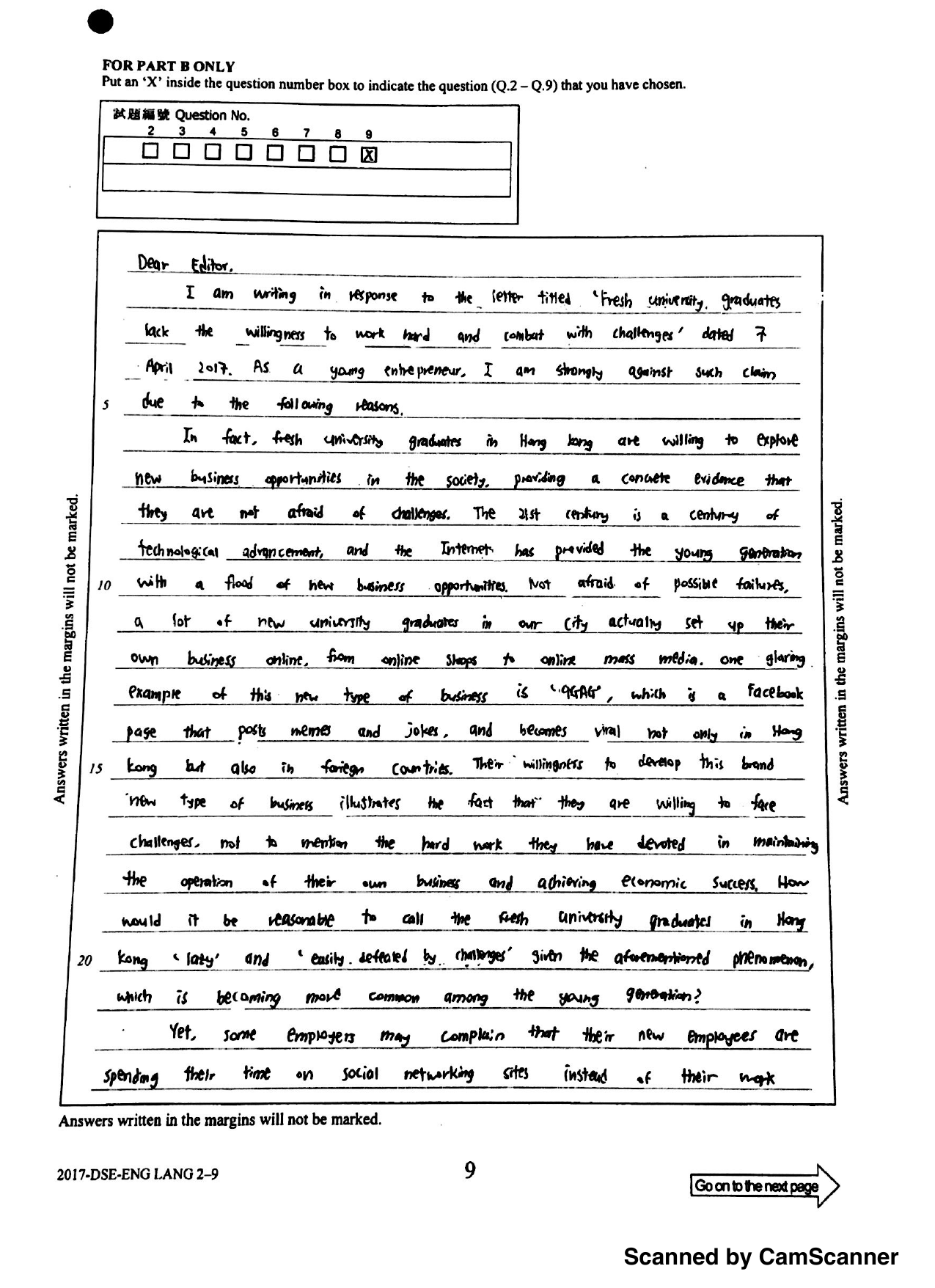

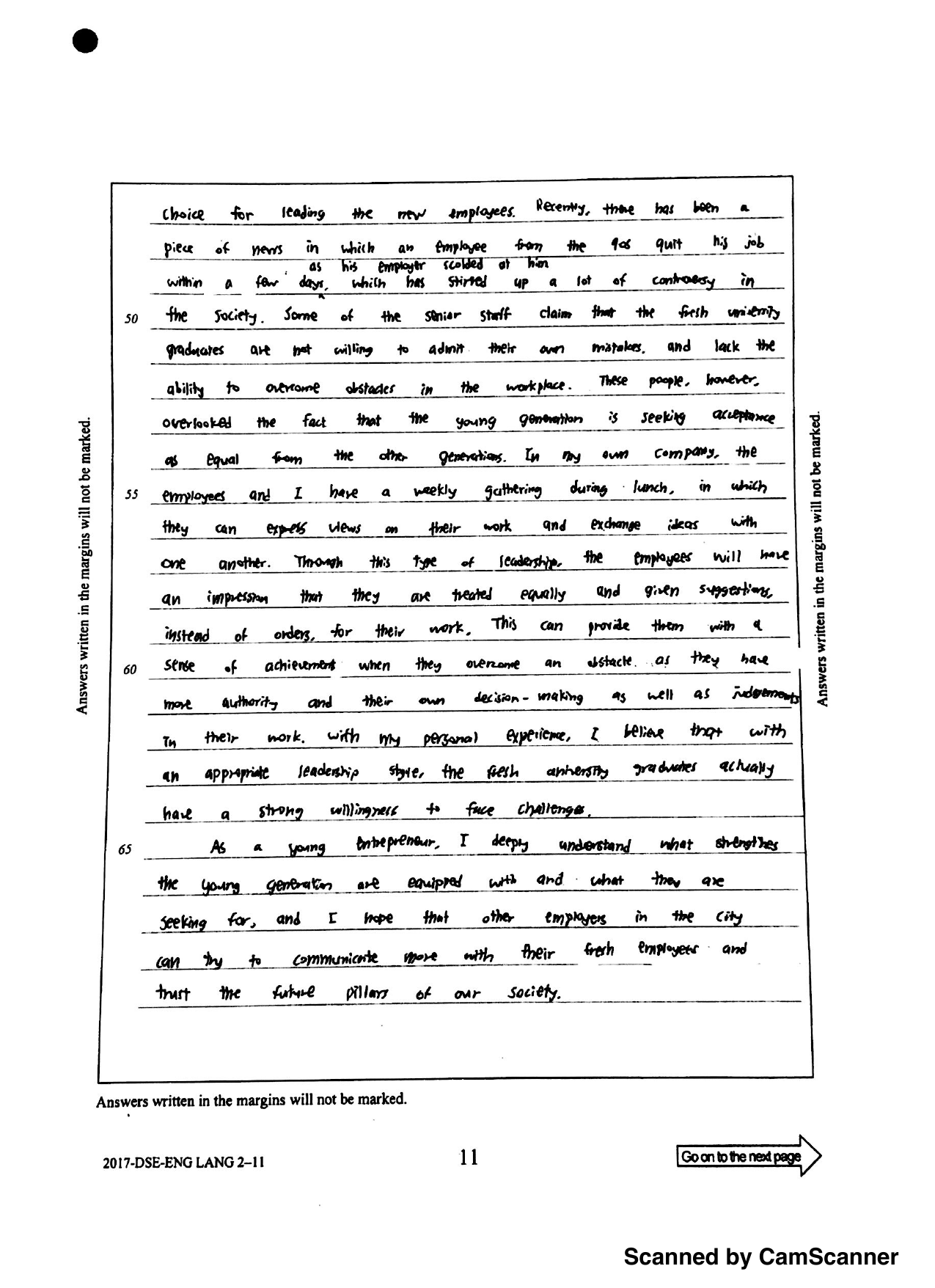
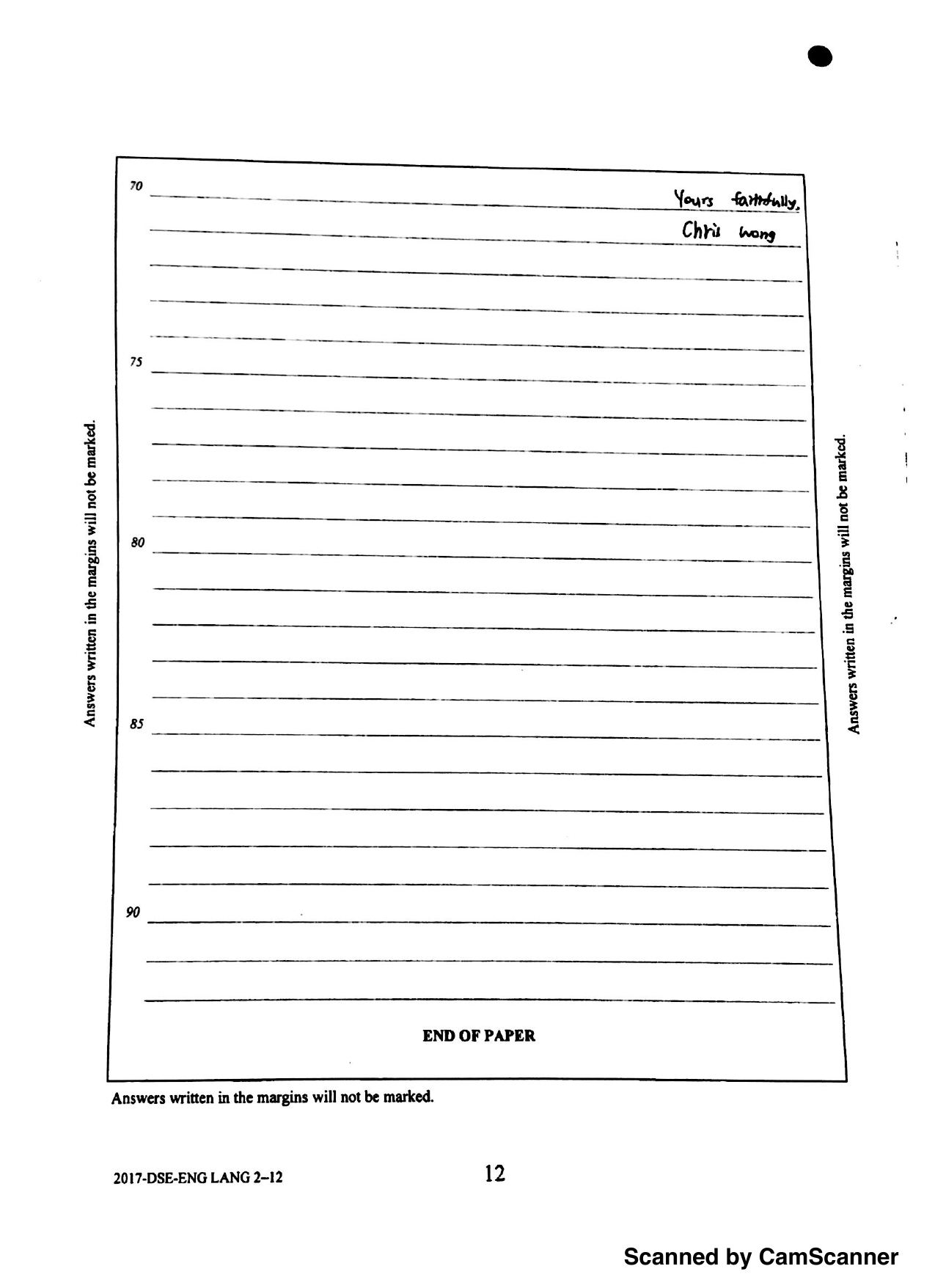
The writing, with corrections marked inline
The young-entrepreneur persona is the letter’s strongest asset. Identifying as a young entrepreneur (rather than the standard “millennial”) gives the letter a more specific, harder-to-dismiss voice. The 9GAG example, however dated, anchors the argument in something Hong Kong readers recognise. Two paragraphs — the Google paragraph and the closing paragraph — tangle in the prose, which holds the letter back from its argumentative ceiling.
Strengths to praise
Positioning the speaker as a working entrepreneur recasts the argument as testimony rather than self-pity — harder for the addressee to dismiss than the standard millennial-defends-millennials letter.
Citing a real Hong Kong-origin Facebook-driven media outlet as evidence of HK graduates building globally-recognised businesses gives the argument a verifiable anchor. Most candidates argue in the abstract; this one names a brand.
Setting Hong Kong’s rigid work culture against Google’s deliberate work-play integration reframes “graduates on phones” as a symptom of HK’s workplace conservatism, not graduate laziness. Sophisticated structural move.
The third argument identifies problematic leadership — not employee character — as the cause of disengagement, anchored in a real news case (mass firing without procedure). Locating the failure in management is the analytical move that earns the top band.
Entrepreneurship, sociological (work culture), institutional (management). The three angles don’t overlap and they build on each other — a clean argumentative scaffold.
In response to, concrete evidence, technological advancement, flood of new business opportunities, glaring example, paying full attention, integrate entertainment, problematic leadership, controversy, motivate workers, future leaders — the lexis is appropriately formal-public throughout.
Grammar notes
| Issue | Explanation |
|---|---|
(line 4) combat with challenges → combat challenges |
Combat as a verb is transitive — no preposition needed. |
(line 5) against such claim → against such a claim |
Indefinite article required: such a claim, such an idea, such an event. |
(line 9) providing a concrete evidence → providing concrete evidence |
Evidence is uncountable — takes no article. |
(line 12) not afraid of possible failures → needs a subject |
The clause hangs as a dangling participle. Either give it a subject (they are not afraid…) or fold it into the previous clause as a relative phrase. |
(line 14) Even online stores to online music media → From online stores to online media platforms |
The construction is from X to Y, not even X to Y. Music media also reads off — media platforms is the more general phrase. |
(line 20) How would it be reasonable to call the fresh university graduates ‘lazy’ |
Call takes a direct object + complement, no as: call them lazy, not call them as lazy. (The student avoids as here but the rhetorical question still reads stiff.) |
(lines 27–28) trying to understand entertainment in their work → trying to integrate entertainment into the workplace |
The verb understand doesn’t fit; the writer means integrate / introduce / build in. |
(line 31) too political and traditional → rigid and traditional / excessively hierarchical |
Political doesn’t describe a work culture in this sense (politics = power dynamics, not formality). The writer likely means rigid, formal, hierarchical. |
(lines 39–40) One has been a piece of news in which → There was recently a news report in which |
The original construction doesn’t resolve grammatically. The corrected version introduces a real event cleanly. |
(line 41) turned the fired ten of his employees → fired ten of his employees |
Turned the fired appears to be a slip — possibly conflating turned around and fired. The cleanest correction is to remove turned the. |
(lines 41–42) without proper standard or basic guideline → without due process or proper procedure |
Proper standard / basic guideline are off-register; the standard HR / journalism vocabulary is due process, proper procedure, justified cause. |
(line 47) seeking challenges and improvement from the future and the generation to my own community |
The original sentence collapses. The rewrite reconstructs the most likely intended meaning: seeking challenges and improvement both for themselves and for the wider community. |
(line 51) I strongly understand → I strongly believe |
The verb understand doesn’t take the intensifier strongly. The writer means believe, maintain, argue. |
(line 54) treat the future leaders → treat them as future leaders |
The construction treat X as Y — the as is missing. |
(line 70) Yours sincerely → Yours faithfully |
British convention: Yours faithfully when the addressee is not named (Dear Editor); Yours sincerely when the addressee is named. |
Style suggestions (where strong writing could become outstanding)
Professional rewrite — the 9GAG / entrepreneurship paragraph (strong moment)
The first argument has the letter’s strongest substance — a named HK example (9GAG) that real readers will recognise. But the prose buries the example in a half-finished construction. The rewrite leads with the name and the scale.
The student’s paragraph (corrected)
Rewritten by a professional opinion-writer
- Leads with the name. “Consider 9GAG” is the imperative-mood opening a professional opinion-writer would use.
- Anchors with year and origin. “Founded in 2008… HK university graduates” — verifiable facts replace the abstract claim.
- Names the scale. “Tens of millions worldwide” — a quantifier the reader can hold.
- Generalises beyond the named case. “A generation of HK-built apps, design studios and online-retail brands” — the rewrite admits that 9GAG is one example among many, which makes it more credible, not less.
- The closing kicker. “Not the work of a generation allergic to effort” — the rewrite’s last clause states the conclusion the paragraph has earned.
Professional rewrite — the Google / work-culture paragraph (weak moment)
The Google paragraph has a strong structural idea (HK’s rigid work culture, not graduates’ laziness, is the cause of the phone-scrolling employers complain about) but the prose collapses partway through. The rewrite delivers the same idea cleanly.
The student’s paragraph (heavily corrected)
Rewritten by a professional opinion-writer
- Concedes the visible behaviour. “It is partly true: many young employees do check Facebook” — conceding what the audience already believes is what earns the right to reframe it.
- Names the cultural import. “A country that has spent the last decade copying Silicon Valley” — the rewrite calls out the hypocrisy of demanding old-school discipline while importing new-school culture.
- Two specific places. “Causeway Bay open-plan office” vs “Mountain View” — the comparison gets geographical anchors.
- Names the structural cause. “A management culture that hasn’t caught up with the work it is asking her to do” — the rewrite locates the failure where the original argues it lies (management, not graduates).
- The pronoun is specific. Switching to she in the closing turns the abstract graduate into a person.
Leave a Reply