Welcome Speech to New Students — 41/42 (5** high end)
You are the President of the Students’ Union at your school. You are preparing a speech to welcome new students on the first day of school. In order to help new students achieve success and have an enjoyable school life, you want to talk about the following in your speech:
- importance of following school rules; and
- importance of interpersonal relationships.
The first part of the speech has been written for you. Finish the speech. (~200 words)
Show original handwritten pages (3)
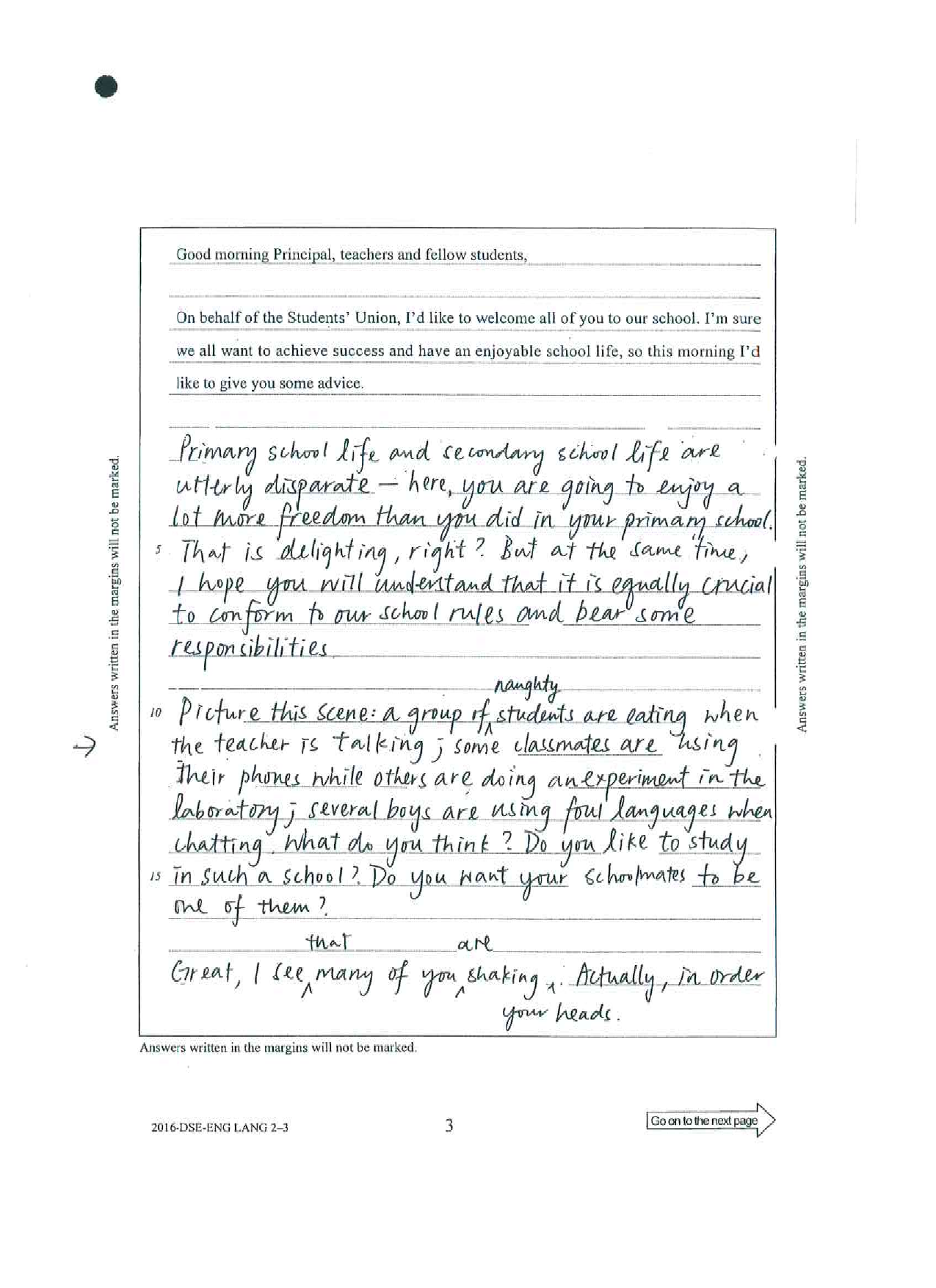


The writing, with corrections marked inline
On behalf of the Students’ Union, I’d like to welcome all of you to our school. I’m sure we all want to achieve success and have an enjoyable school life, so this morning I’d like to give you some advice.
The line about the school being “not a theme park… nor a prison…” (lines 22–23) has marginal additions floating around it (neither, into, chat loudly, whenever, But don’t be afraid!, it is) which look like an abandoned earlier draft. Stitched together, the intended sentence is most plausibly:
“Our school is neither a theme park where you can chat loudly whenever you please, nor a prison where you merely follow orders and instructions. But don’t be afraid — it is a place where you can grow, learn and thrive.”
Word count. Roughly 490 words against the ~200-word target. A long-form Part A by 5** standards. Length has not been penalised because every paragraph is doing different work — the candidate is not padding, they are sustaining a register.
Unclear handwriting. The main spot is the ‘theme park / prison’ sentence with the marginal additions (see callout above). Elsewhere, handwriting is consistently legible.
Spelling note. The candidate writes “cozy” (American spelling) twice. Corrected to “cosy” (British spelling) to fit HK conventions, though “cozy” would not have been penalised in the marking.
Title-style note. The candidate does not label the address with a heading; correct for a spoken speech.
What makes this a 5** (high-end) piece — the structural unpacking
A 5** Part A on a welcome-speech prompt has to deliver three things at once: a credible spoken voice, a clear handling of both bullets, and lexical control without showing-off. This piece does all three. Below are the moves that earned the score — each named to a concrete sentence so the same moves can be taught.
Driver 1 · The opening immediately frames the rules paragraph as a contrast, not a sermon.
Rather than start the rules paragraph with ‘rules are important,’ the candidate opens with the audience’s expected pleasure (freedom) and uses But at the same time as the hinge. The structure is concession-first, claim-second — the move every persuasive speech-writer reaches for. It also signals at the door that the speaker has thought about how the audience is feeling, not just about what the prompt asks.
Driver 2 · The cinematic scene-list is the heart of the rules section.
This is the single most identifiable 5**-defining move in the piece. Instead of asserting ‘students should behave,’ the candidate stages four parallel mini-scenes, semicolon-separated, building accumulating chaos. The verb Picture this scene instructs the listener to visualise — a speech-craft beat that essay writing never makes. Show, don’t tell in argumentative prose is rare in candidates; here it lands inside the second paragraph.
Driver 3 · The audience-physical-observation move (“I see many of you shaking your heads”).
The speaker reports a physical observation from the room. This single sentence does what no essay-register can do: it places the speaker on a stage looking out at the audience. The pivot from rhetorical questions in paragraph 2 to a reported reaction in paragraph 3 simulates real time. Markers rewarding text-type fit pick up on exactly this move.
Driver 4 · The ‘theme park / prison’ antithesis (despite its messy execution).
A textbook not X, nor Y antithesis. The candidate defines the school by what it isn’t, which makes the positive vision (oasis of fun and harmony) land harder. The execution is muddled on the page itself — this is almost certainly where the single lost mark sits — but the structural ambition is what the marker has registered.
Driver 5 · A memorable metaphor at the close of the rules section.
Two heavyweight nouns in one phrase: alma mater (Latinate, ‘nourishing mother’) and oasis (an image of refuge in a desert). Either alone would be a strong choice; together they elevate the rules-paragraph close from logistical (‘follow the rules’) to aspirational (‘build a refuge together’). The image also pre-empts the second bullet: relationships are what an oasis is made of.
Driver 6 · The pivot to the second bullet is conversational, not academic.
Not Secondly, not Moreover, not In addition. The candidate frames the second bullet as a continuation of a conversation (I would also like to share with you) — speaker-to-audience, not essayist-to-rubric. A small marker-noticed beat.
Driver 7 · The ‘mass game / no one invites you’ image gives the relationships paragraph stakes.
The same show, don’t tell move as Driver 2, redeployed for the second bullet. Most candidates argue at the level of friends are important; this candidate dramatises the cost of not having them, with a scene a Form 1 audience can picture immediately. The closing idiom (down in the dumps) is also pitched at the audience’s register.
Driver 8 · The ‘creeping up on them to frighten them’ line is the audience-register marker.
This is the candidate showing they have visualised the audience: 13-year-olds entering Form 1 actually do creep up on each other to frighten each other. Most candidates would pitch the example at a generic adult level (going out for lunch together); this candidate has pitched it at the actual age of the listeners. Marker tick.
Driver 9 · The closing ‘younger brothers and sisters’ address.
The closing line of any speech carries disproportionate weight. The candidate has chosen to address the audience as younger brothers and sisters — a phrase that earns its keep because it places the speaker (the SU President) inside a family relationship with the newcomers, not above them. Cosy home at the end echoes oasis of fun and harmony from the rules paragraph, so the speech closes on a sustained image rather than a recap.
Strengths to praise
Rhetorical questions land in every paragraph (right?, What do you think?, Would you want to study in such a school?, shall we?, doesn’t it?), combined with the physical-observation beat (I see many of you shaking your heads). The text-type mark is earned across the whole speech, not concentrated in one spot.
Rules are dramatised through the four-image misbehaviour sequence (eating while the teacher talks, phones, unsupervised experiments, foul language). Relationships are dramatised through the PE-lesson scene (no one invites you to their groups). Each bullet gets its own image, and the image carries the argument.
Alma mater in the rules paragraph, my younger brothers and sisters in the close, cosy home as the last image. The school-as-family frame appears in both rules and relationships paragraphs — what makes the speech feel composed rather than two paragraphs glued together.
Mass game in PE, creeping up on classmates to frighten them, experiments in the laboratory, phones in lessons — every example is something a Form 1 newcomer would actually do or see. The candidate has not reached for generic adult examples; they have pitched the level at the actual audience.
The closing image of the rules paragraph is the strongest single phrase in the piece. It earns its keep because oasis is the right metaphor for a school surrounded by exam pressure, and the noun pair (fun and harmony) bridges to the second bullet without the candidate having to flag the bridge.
One pass yields: utterly disparate, conform to, abide by, self-discipline, conducive to, alma mater, oasis, intrinsic part, rapport, perplexed, peer learning, mutual encouragement, confidants, faithful and genuine, solitary, scores of friends, down in the dumps. Each word is in a slot where it naturally collocates; the candidate is not stacking rare words for show.
The candidate has inserted naughty, also, undoubtedly, rolled back that are, recast congenial as warm, and changed be worried to worry. These edits show a writer reviewing as the piece develops — an unusual maturity at this length.
Grammar notes — the small handful of fixes the candidate just missed
A 5**-band piece has very few live grammar errors. The table below collects the ones present in this script — almost all small, several already half-corrected by the candidate themselves in the manuscript. The marker has reached the high-band conclusion despite (not because of) these.
| Issue | Explanation |
|---|---|
(line 4) That is delighting → That is delightful |
Delighting is the present participle of delight (the verb); the adjective is delightful. The candidate slipped into the participle ending and corrected (or the corrector should). That is delightful, right? matches the conversational tag. |
(line 12) foul languages → foul language |
Language in the sense of vulgar speech is uncountable — no plural. Languages (countable) refers to systems like English, French, Cantonese. |
(line 13) Do you like to study → Would you want to study |
In a rhetorical question about an unreal scenario (a chaotic school), the conditional would you want to is more apt than the present do you like to. The candidate self-corrected. |
(line 17) I see many of you that are shaking → I see many of you shaking |
After a verb of perception (see, hear, watch) + object, English uses the bare participle (see them shaking) rather than a relative clause. The candidate crossed out that are mid-sentence. |
(line 24) everyone of us follows → every one of us follows |
Everyone (one word) is a pronoun meaning ‘everybody’ and does not take of. The two-word form every one is an adjective + pronoun and does take of: every one of us, every one of the students. |
(line 33) don't be worried → don't worry |
The natural spoken imperative is don’t worry, not the awkward passive don’t be worried. The candidate self-corrected. |
(line 38) part of the school life → part of school life |
In the general / abstract sense, school life takes no article (compare family life, city life, country life). The article was crossed out. |
(lines 39–40) Imagine if you have no…, when whenever → Imagine if you have no…. Whenever |
The candidate started a comma-spliced run-on (…genuine friends, when whenever there is a mass game…) and stopped it mid-flow. Cleanest version: full stop, capital Whenever. |
(line 41) no one invites you to this groups → no one invites you to their groups |
This is a singular demonstrative; with the plural groups and a generic antecedent, their is the right possessive. The candidate self-corrected. |
(line 45) share your glee and sorrow → share your joys and sorrows |
Glee is uncountable and slightly archaic for a 17-year-old register; the natural plural-noun pair for this idiom is joys and sorrows. The candidate self-corrected. |
(line 52) vitally important and they will help you → vitally important and they will undoubtedly help you |
The candidate inserted undoubtedly — a useful intensifier in a section that needs rhetorical reinforcement. Kept above. |
(line 55) wear a congenial smile → wear a warm smile |
Congenial means ‘agreeable in disposition’ (a congenial host, congenial company); it doesn’t collocate with smile. The natural collocation is a warm smile. The candidate self-corrected. |
(line 61) everyone of you will make → every one of you will make |
Same every one / everyone distinction as above. The two-word form takes of. |
(line 64) cozy (American) → cosy (British) |
Used twice. Either form is acceptable in HKDSE marking, but cosy follows the British conventions of the syllabus. |
Style suggestions (where a 5** piece could become a 5**-with-margin-tick)
None of these were marked down. They are offered as polish — the kind of micro-improvements that turn a 41 into a 42 and earn a marginal “exceptional” from the marker.
Professional rewrite — the peer-learning sentence (weak moment)
For comparison only, not a correction. The peer-learning sentence is where the relationships paragraph briefly tips out of the speech voice and into a textbook list of nouns. The rewrite stages the same idea through three concrete classroom moments — the kind of pictures a Form 1 audience can actually see — without lengthening the sentence.
The student’s peer-learning sentence (corrected)
Rewritten by a professional speech-writer
- Three concrete moments replace three abstract nouns. Mutual encouragement · exchanges of ideas · constructive comments become a whisper before the bell · an idea completed at lunch · an honest comment on an essay draft. The audience can picture each one.
- The opening hinge is conversational, not academic. Also, you may also benefit from peer learning doubles up the connective and uses the term-of-art peer learning. And then there is the kind of learning no teacher can give you opens with a beat of spoken rhythm and frames the move as a contrast.
- A time horizon makes the promise concrete. Within a fortnight turns an abstract claim (peer learning will happen) into a specific prediction (it will happen soon, and to you specifically). Speech-craft markers reward exactly this kind of audience-facing concreteness.
- The exclamation mark goes. The original closes with academic studies!, which lands as essay-enthusiasm. The rewrite trusts the picture to do the persuading.
Vocabulary to notice
| Word / phrase | Definition | Usage notes | Synonyms / alternatives |
|---|---|---|---|
| disparate | (adj.) essentially different in kind; unlike. | Formal. Pairs with worlds, experiences, sources, groups. Utterly disparate is a fixed intensifier collocation. | different, dissimilar, distinct, unlike |
| conform (to) | (v.) to comply with rules, standards, or laws. | Intransitive; takes to. Pairs with rules, standards, expectations, norms. Compare with comply with (more legal) and follow (more everyday). | comply with, abide by, adhere to, follow |
| conducive (to) | (adj.) making something likely or possible; favourable to. | Always followed by to + noun or gerund: conducive to growth, conducive to learning, conducive to dialogue. Common in education writing. | favourable to, helpful to, supportive of |
| abide by | (phrasal v.) to accept and act according to (a rule, decision, or recommendation). | More formal than follow. Pairs with rules, laws, agreement, decision. Past tense: abided by. | obey, observe, comply with, adhere to |
| self-discipline | (n.) the ability to control one’s feelings and overcome one’s weaknesses. | Hyphenated. Often used in education and personal-development contexts. Pairs with develop, cultivate, exercise, lack. | self-control, willpower, restraint, self-mastery |
| alma mater | (n., Latin) a school, college, or university that one has attended; literally ‘nourishing mother’. | Slightly formal; common in graduation and reunion contexts. Always italicised in some style guides. Pairs with my, his, her, our. | old school, former school, one’s school |
| oasis | (n.) a fertile spot in a desert; figuratively, a place of refuge or relief. | Plural: oases. Figurative use is common (an oasis of calm, an oasis of harmony, an oasis in the city). | refuge, sanctuary, haven, retreat |
| intrinsic | (adj.) belonging naturally; essential. | Pairs with part, value, worth, quality, motivation. Compare with essential (more emphatic) and inherent (synonym). | essential, inherent, fundamental, integral |
| solitary | (adj.) done or existing alone; isolated. | Can describe people (a solitary person) or activities (a solitary walk). Slightly more elevated than lonely; carries less emotional weight. | alone, isolated, lonely, secluded |
| rapport | (n.) a close and harmonious relationship in which the people understand each other’s feelings. | Pairs with build, develop, establish, have, lose. Followed by with: have a good rapport with. Pronounced “ra-PORE” (silent t). | connection, bond, understanding, relationship |
| perplexed | (adj.) completely baffled; very puzzled. | Stronger than confused; suggests intellectual rather than emotional puzzlement. Pairs with look, feel, become. | puzzled, baffled, bewildered, mystified |
| creep up on | (phrasal v.) to approach quietly so as to take by surprise. | Informal and physical. Can also be metaphorical (old age creeps up on you). Pairs with someone, something, suddenly. | sneak up on, steal up on, approach stealthily |
| peer learning | (n. phrase) educational practice in which students learn from and with each other. | Common in pedagogy and education-policy contexts. Compare with peer mentoring, peer review, peer tutoring. | collaborative learning, mutual learning, peer-to-peer learning |
| confidant | (n.) a person with whom one shares secrets or private matters. | Feminine form: confidante. Pairs with close, trusted, lifelong. Compare with friend (more general) and ally (more strategic). | close friend, trusted friend, intimate, ally |
| down in the dumps | (idiom) in a state of low spirits; depressed. | Informal; speech register. Pairs with feel, look, be. Compare with feeling blue, down in the mouth. | depressed, dejected, low, gloomy |
| scores of | (quantifier) very many; large numbers of. | Originally ‘a score’ = 20; figurative use means ‘many’. Pairs with countable nouns: scores of friends, scores of people, scores of complaints. | lots of, many, plenty of, numerous |
| mass game | (n. phrase) a large team-based physical activity, especially in schools and PE lessons. | British / HK English. Common in school PE contexts. Compare with group activity, team game. | team game, group activity, large-group activity |
| cosy / cozy | (adj.) giving a feeling of comfort, warmth, and relaxation. | British cosy, American cozy. Pairs with home, atmosphere, chat, corner, evening. Both forms accepted in HKDSE marking. | warm, snug, comfortable, homely |
Leave a Reply