Letter to the Editor — Defending Fresh University Graduates
It has recently been claimed that in the workplace many Hong Kong fresh university graduates are less hard-working and less willing to face challenges compared to those in the past.
You strongly disagree with this opinion. Write a letter to the editor of the Hong Kong Daily disagreeing with this opinion. Support your view with three reasons and/or examples.
(~400 words)
Show original handwritten pages (4)
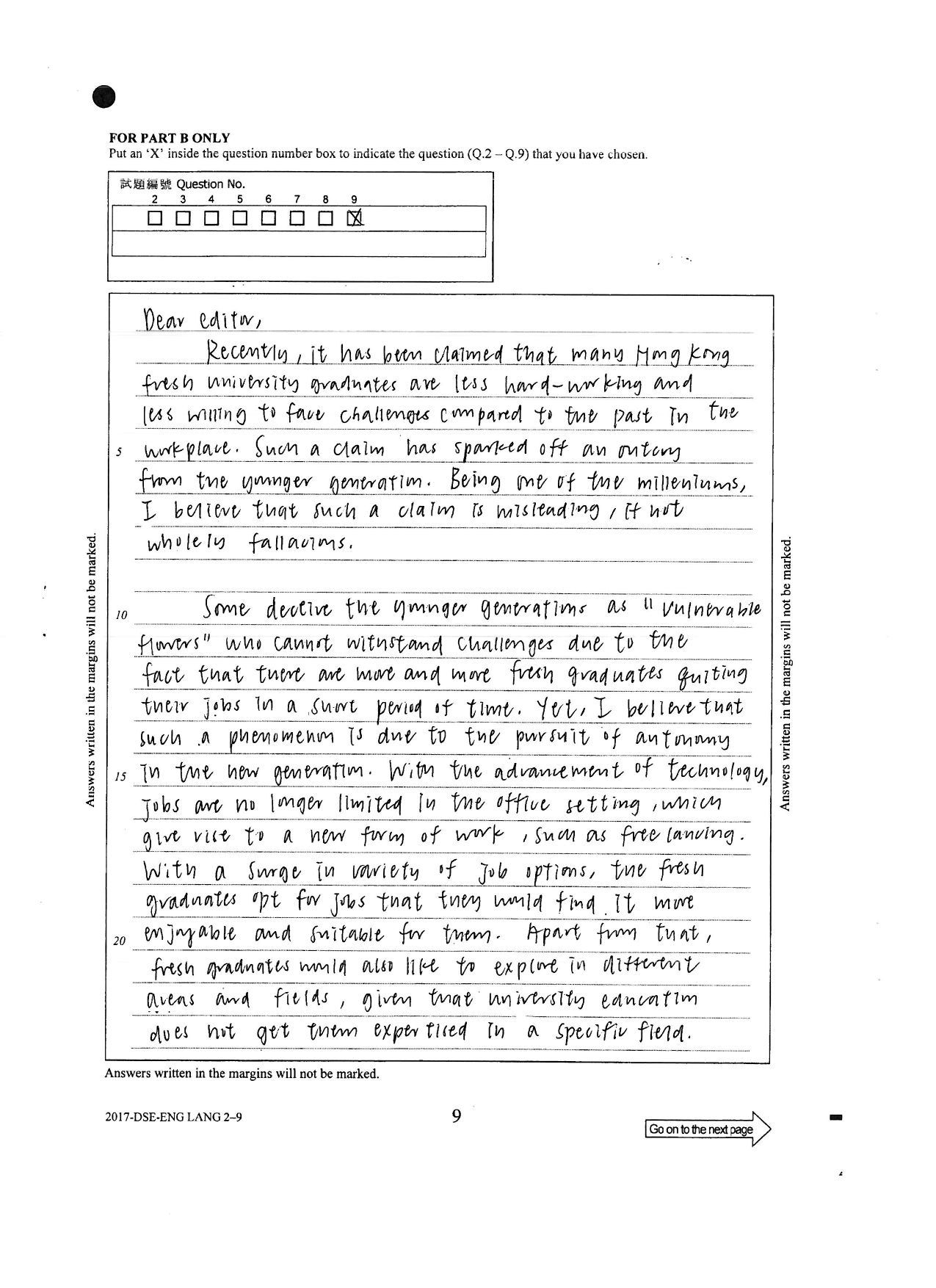

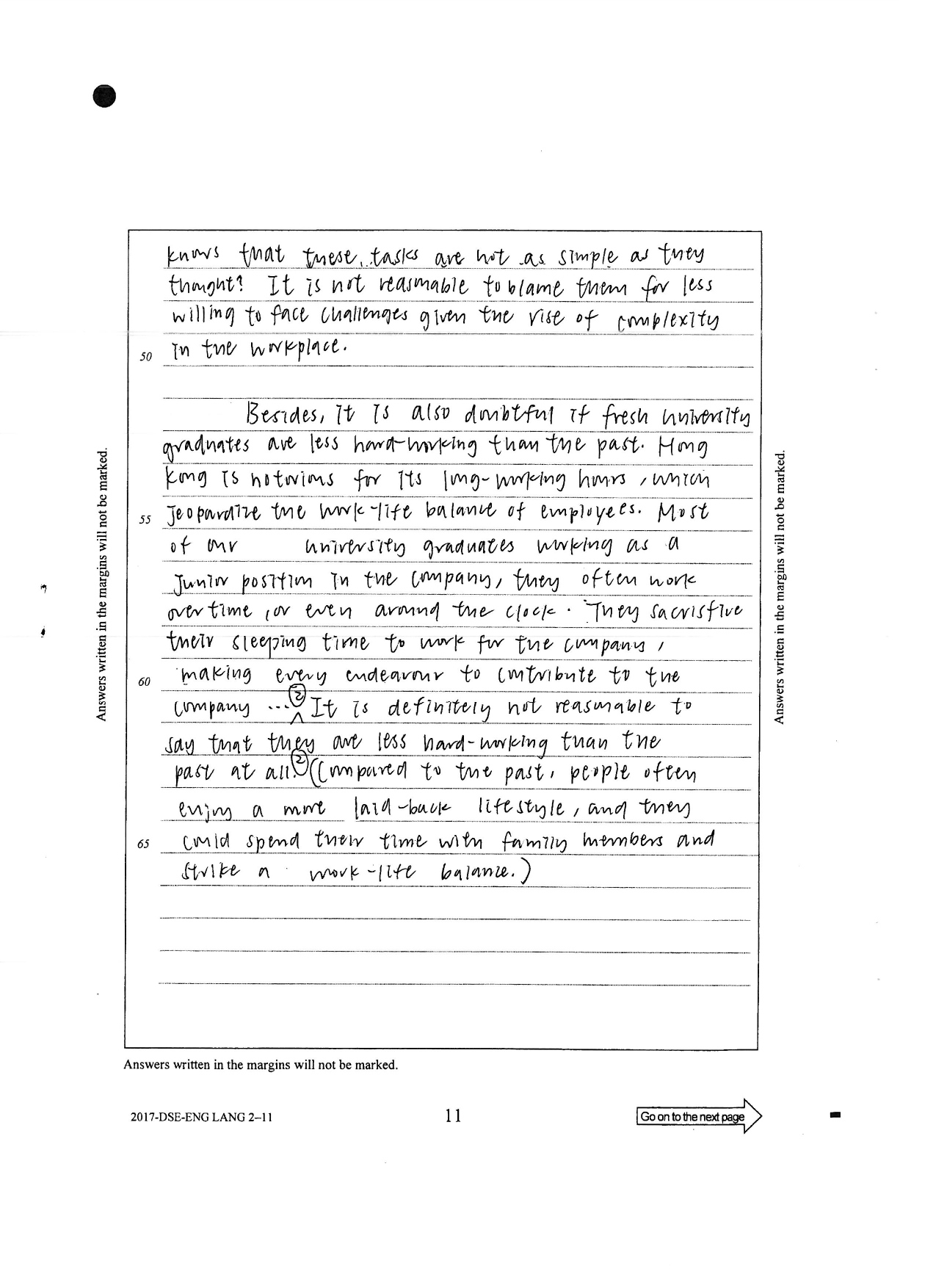

The writing, with corrections marked inline
Three sentences that collapse. Three places in this letter break grammatically and would slow any marker down: (i) “Some doubts the younger generation as it inheres a flavour” (lines 10–12); (ii) “The tasks and minds complain in the past required the younger generations are required to have…” (lines 36–37); (iii) “fresh university graduates are ‘seemingly’ as willing to face challenges” (line 30 — seemingly as means the opposite of the writer’s intended sense). These three slips alone probably account for the drop from 7/7 to 5/7 on Language.
Strengths to praise
Despite the prose tangles, the architecture is clear: argument 1 (graduates pursue autonomy / freelancing, not idleness); argument 2 (today’s workplace is more complex than the past’s); argument 3 (HK’s long-hours culture itself proves graduates aren’t lazy). Each paragraph has a thesis, support, and a closing turn. The marker can find the case.
“Such a phenomenon is due to the pursuit of autonomy in the new generation. With the advancement of technology, jobs are no longer limited to the office setting…” The writer correctly identifies that what older readers see as “quitting” is, for the new generation, a deliberate choice of work-form. This is the strongest move in the letter; if the prose were cleaner, this paragraph alone would lift the Content score.
“Hong Kong is notorious for its long working hours, which jeopardise the work-life balance of employees.” The candidate names a specific HK phenomenon (long-hours culture) that the audience recognises and that directly refutes the lazy-graduates claim. The audience-recognition move is the heart of letter-to-editor writing.
“The reason behind the claim… is the different perception of the generations.” The writer correctly identifies the underlying problem (it’s a perception gap, not a behavioural change) and closes with a call for the older generation to update its view. This is the right diagnosis and the right closing gesture.
Wholly fallacious, withstand, pursuit of autonomy, advancement of technology, opt for, cope with adversity, complexity of the workplace, subjected to, sophisticated tasks, problem-solving skills, notorious for, jeopardise, work-life balance, sacrifice, endeavour, irresponsible claim. The register is consistently formal-public and the lexis is well above average for a candidate at this band.
Grammar notes
| Issue | Explanation |
|---|---|
(line 6) Such a claim has sparked off an outrage → has sparked outrage | Two issues. Spark off is redundant (spark already means “cause to start”). Outrage as the emotion is uncountable (spark outrage, cause outrage); the article an appears only with the countable sense (an outrage = a shocking event). |
(lines 10–12) Some doubts the younger generation as it inheres a flavour → Some critics doubt the younger generation, pointing to… | This sentence doesn’t resolve grammatically. Inheres means “is an inherent quality of”; it doesn’t take a direct object like a flavour. The rewrite reads as a salvage. |
(line 16) which give rise to a new form of work → which has given rise to a new form of work | Subject is singular (the advancement of technology); verb needs the present perfect for the continuing effect. |
(line 19) opt for the type they would like to most enjoyable and suitable → opt for the type they find most enjoyable and suitable | The verb like to needs an infinitive after it (like to do); the sentence wants the verb find. |
(line 21) explore in different areas → explore different areas | Explore is transitive — takes a direct object with no preposition. |
(line 22) does not get them experiences → does not give them experience | Two issues. The verb is give, not get. And experience in this sense (knowledge gained through practice) is uncountable. |
(line 25) the young adults ability → the young adults’ ability | Plural possessive: apostrophe after the s. |
(line 27) their new age of workplace → their new stage of workplace life / this new chapter of working life | Age reads as a long historical period; stage reads as a personal life-phase, which is what the writer means. |
(line 30) are ‘seemingly’ as willing → are seemingly less willing | The original means the opposite of what the writer is arguing. The marker likely had to re-read this sentence twice. |
(line 31) the complexity of the community itself → the complexity of the workplace itself | The paragraph is about workplaces, not communities. Word-substitution slip. |
(lines 36–37) The tasks and minds complain in the past required… → The tasks of today require the younger generation to have… | The original sentence is mid-collapse. The corrected version above reconstructs what the writer almost certainly meant. |
(line 40) blamed for less willing to cope → blamed for being less willing to cope | After blamed for, the construction is for + gerund/noun phrase. For less willing to cope needs being. |
(line 44) the size of complexity → the scale of complexity | Complexity has scale, depth, degree, not size. |
(line 46) doubtful of fresh university graduates are less hard-working → doubtful that fresh university graduates are less hard-working | The clause needs the conjunction that, not the preposition of. |
(line 50) Most of our university graduates working as a junior position → Most of our university graduates work as juniors | Two issues. (i) Main verb missing (working isn’t a finite verb on its own — needs work). (ii) Work in a position, not as a position; or simply work as juniors. |
(line 68) misunderstandings towards the fresh graduates → misunderstandings of the fresh graduates | Misunderstanding of X is the standard preposition. |
Style suggestions
Professional rewrite — the autonomy / freelance argument (strong moment)
The autonomy/freelance argument is the strongest move in the letter — correctly reframing what older readers see as quitting. The original buries the move in a paragraph that opens with a collapsed sentence.
The student’s paragraph (corrected)
Rewritten by a professional opinion-writer
- The critics’ case is named. “Fresh graduates leave their first jobs faster than they used to” — one sentence states what the older readers see.
- The reframe is named explicitly. “From outside… / From inside…” tells the reader the move the paragraph is making.
- Three concrete examples replace one abstract noun. The student says freelancers; the rewrite names three plausible cases.
- The closing reframes ambition itself. “Ambition reshaped by what the internet now permits” is the line that wins the paragraph.
Professional rewrite — the collapsed complexity paragraph (weak moment)
The middle of paragraph 3 collapses syntactically (“The tasks and minds complain in the past required the younger generations are required to have…”). The argument under the broken prose is good; the rewrite reconstructs it.
The student’s paragraph (corrected)
Rewritten by a professional opinion-writer
- Specific comparator. “A junior role in 2017 is not the junior role of 1997” — the generational comparison is named with years.
- Three concrete demands. “Fluency in three software tools, write for an international audience, manage a brief over Slack” — the abstract sophisticated tasks becomes three things a 2017 reader has seen.
- Names the misreading. “The older generation reads it as a failure of grit. Read more carefully…” — the rewrite explicitly contrasts the wrong reading with the right one.
- Closes on the structural unfairness. “A harder job at the same starting salary” — the rewrite ends on the economic argument that the student gestures at but doesn’t state.
Leave a Reply