In Defence of Fresh Graduates [working title — the student’s actual letter has no headline]
It has recently been claimed that in the workplace many Hong Kong fresh university graduates are less hard-working and less willing to face challenges compared to those in the past. You strongly disagree with this opinion.
Write a letter to the editor of the Hong Kong Daily disagreeing with this opinion. Support your view with three reasons and/or examples. (~400 words)
Show original handwritten pages (5)

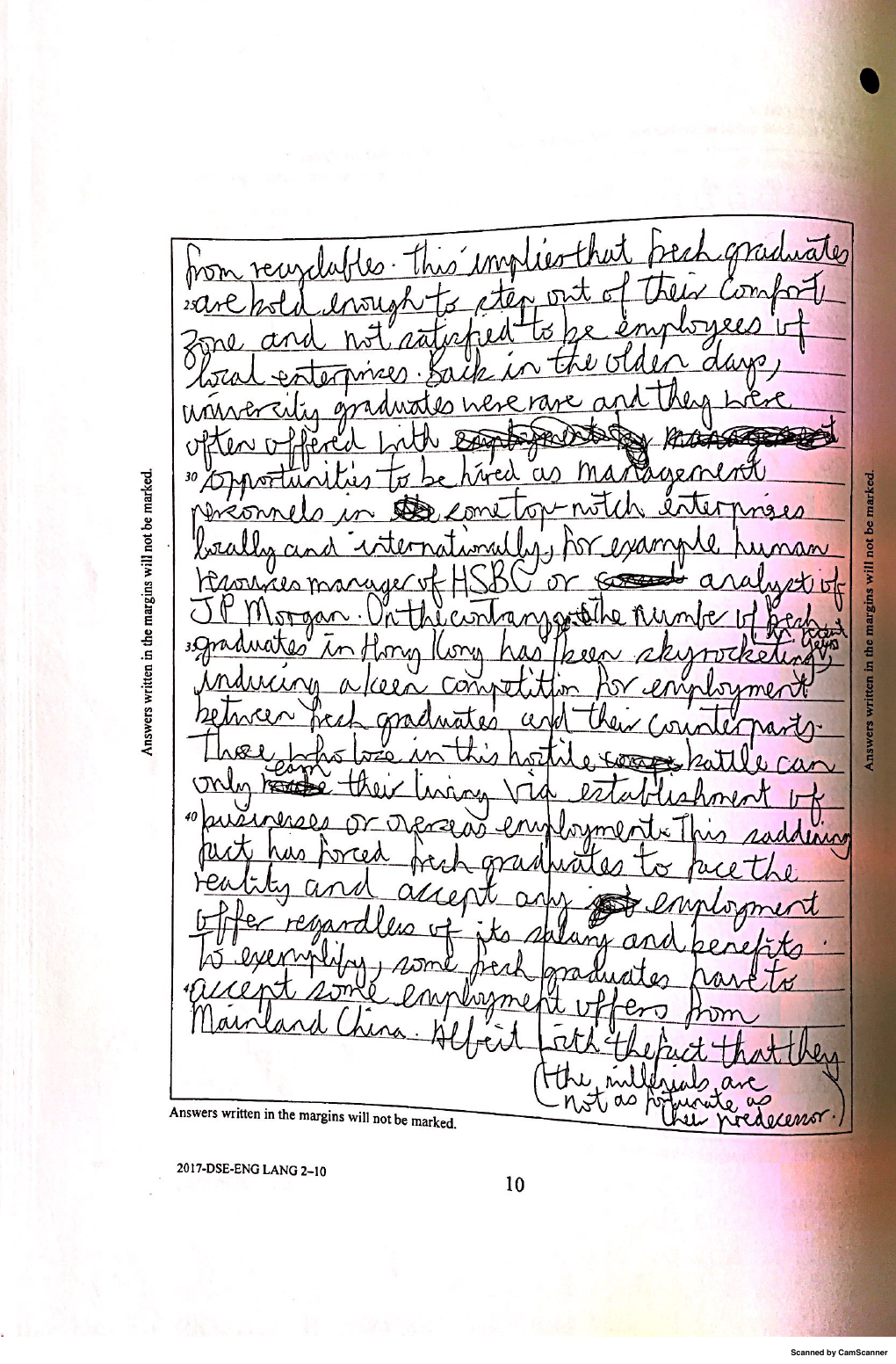
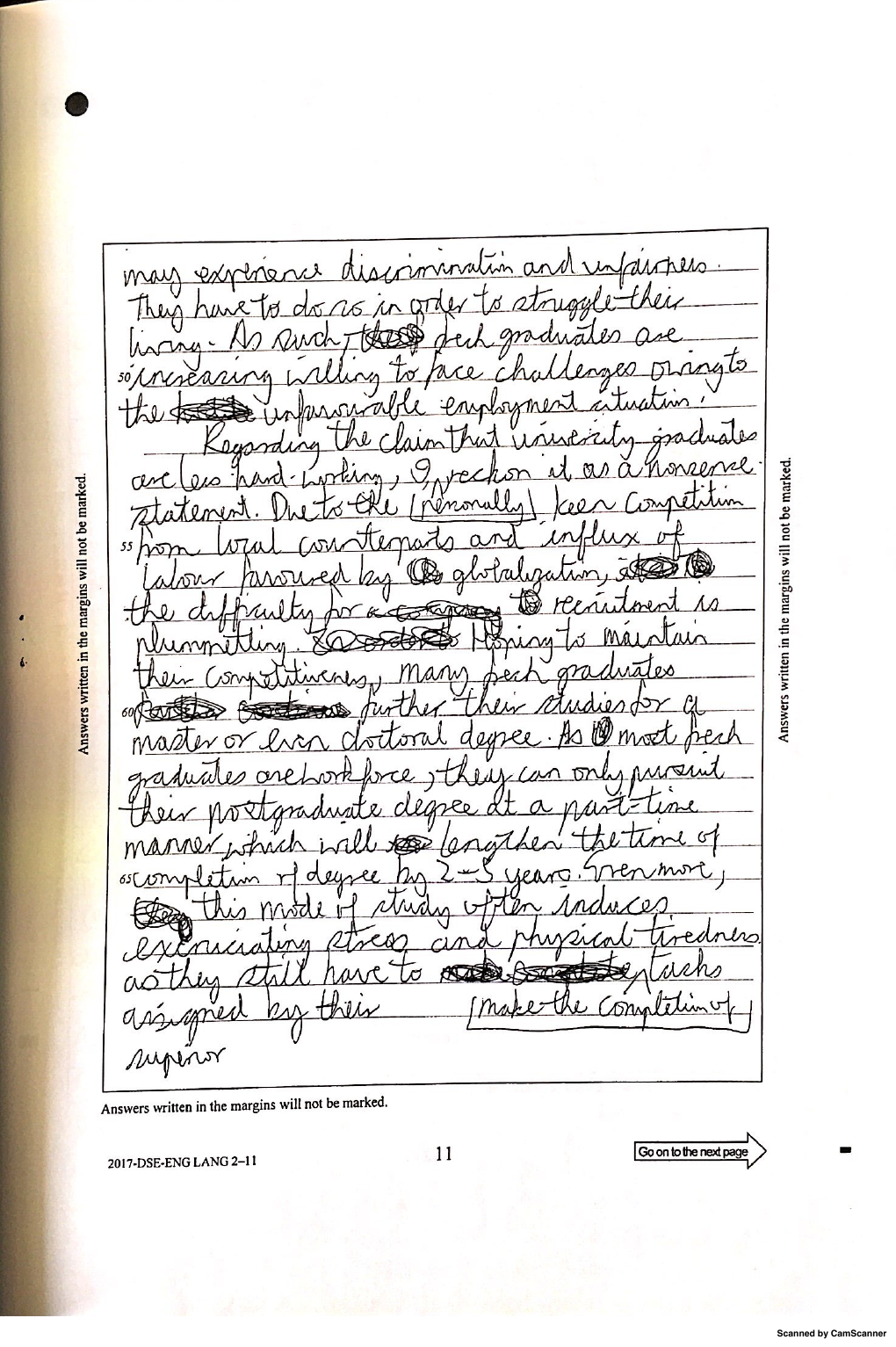
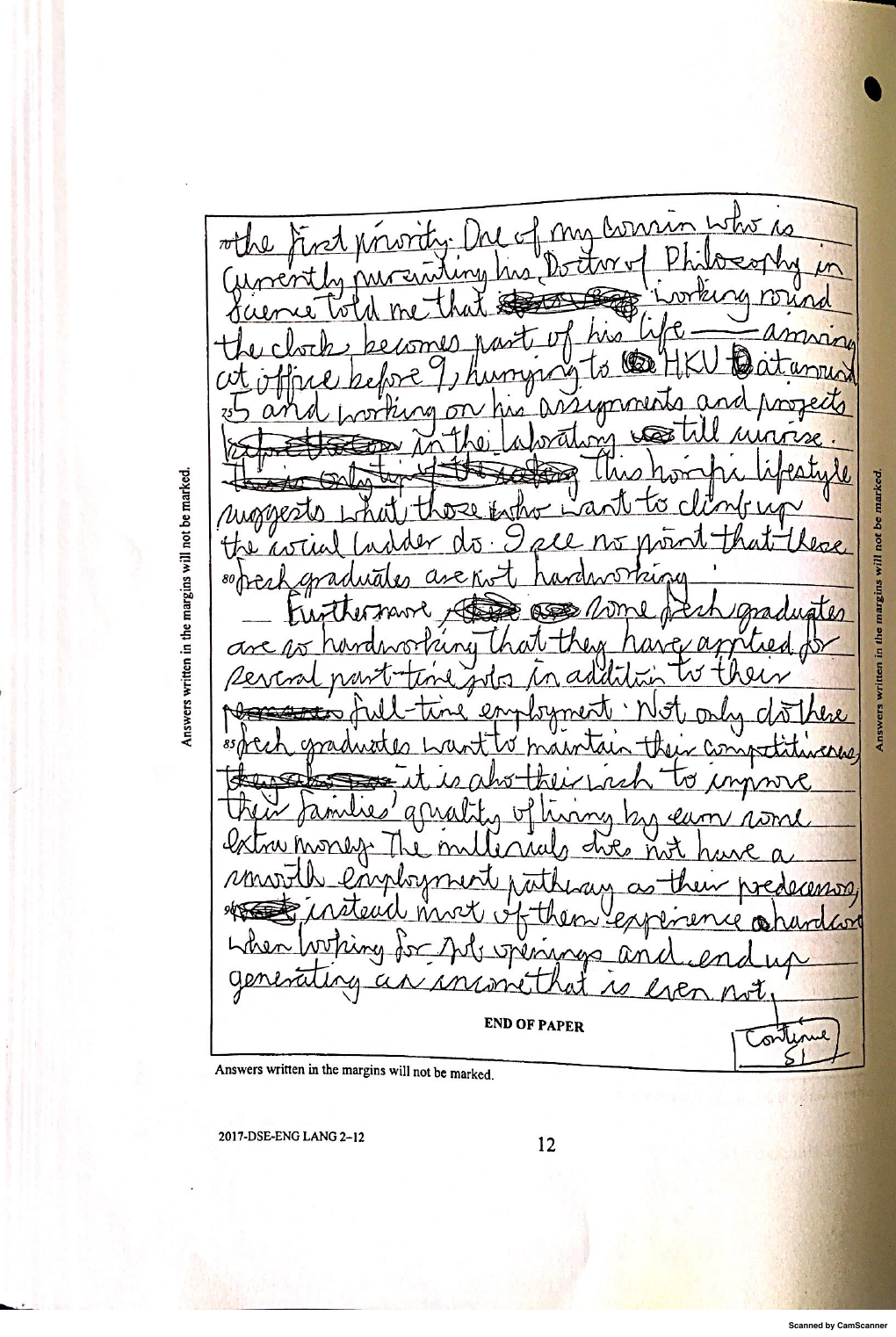
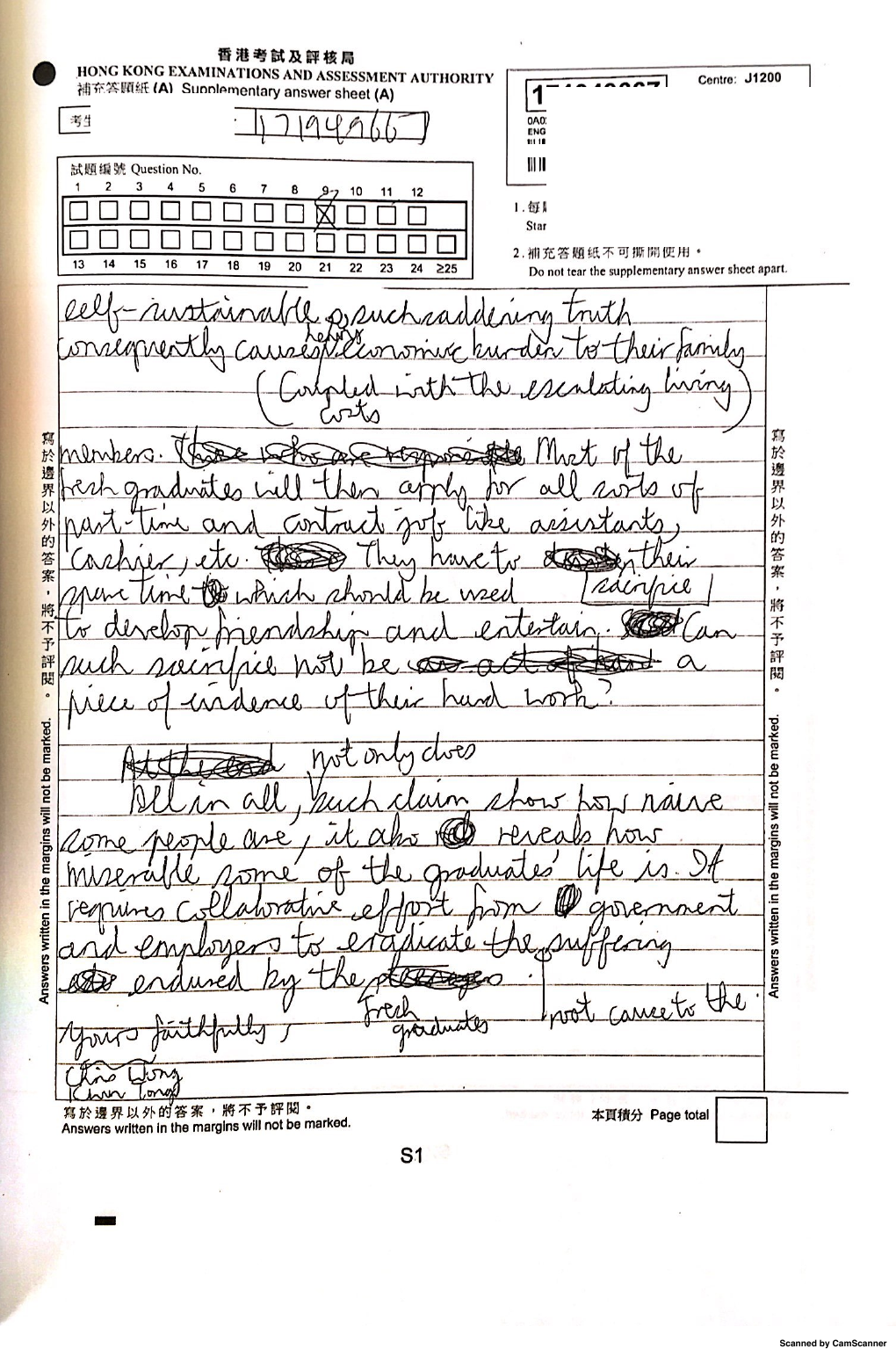
The writing, with corrections marked inline
The closing fragment “not cause to the [unclear]” on line 107 is illegible in the handwriting, but from context the sentence is reaching for “…to eradicate the suffering endured by fresh graduates, not deepen it” or similar — a closing reminder that the editor’s claim worsens, rather than helps, the situation. A clean completion:
“It requires collaborative effort from the government and employers to eradicate the suffering endured by fresh graduates — not to add to it with claims that have no basis in their daily reality.”
Continuation onto a supplementary sheet. The student ran out of space at the bottom of booklet page 12 (PDF page 63) and continued the final paragraph + conclusion on Supplementary Answer Sheet A (S1, PDF page 64). The Question No. box on the supplementary sheet correctly shows Q9 ticked.
Word count note: the full letter (main answer book + supplementary sheet) runs to roughly 650 words — well over the 400-word target. The argument is full and well-developed; a tightening pass would bring it on target without losing the substance.
Several lines have student crossings-out and insertions. The transcription above preserves the student’s intended reading where the edits are clear, and marks unclear spots in yellow.
Strengths to praise
The student doesn’t hedge. The opening sets up the case quickly (“the socio-economic situation of Hong Kong has changed drastically in the past few decades”) and frames the editor’s claim as built on outdated standards. This is exactly the rhetorical move a strong opinion-piece writer makes: reframe before refuting.
The piece references the Labour Department‘s 10,000 applications, the government’s small-business subsidy programme, named employers (HSBC, JP Morgan), a named destination (Mainland China), and a named institution (HKU). The student also brings in a personal anecdote (the PhD cousin). Specificity beats abstraction in argumentative writing.
The letter has three clear claims: (1) graduates are more willing to face challenges (entrepreneurship, overseas work); (2) graduates are pursuing higher degrees while working; (3) graduates are taking on multiple jobs to support their families. Each gets its own paragraph and its own examples. The triadic structure is textbook persuasive writing.
The contrast “back in the older days” vs the current era runs through the piece and gives it coherence: graduates used to be rare and welcomed; now they are common and squeezed. This historical framing transforms a defensive argument into an analytical one.
Words like conclusive evidence, escalating, novel, top-notch, skyrocketing, hostile battle, low-tier, inhospitable, mounting, excruciating, millennials, self-sustainable, eradicate, endured are all deployed in the right collocations. The student reaches high without often falling.
The final paragraphs add an emotional register the earlier paragraphs lack — “such a claim shows how naive some people are; it also reveals how miserable some of the graduates’ lives are”. Pairing data (10,000 applications, 2–3 extra years for a part-time PhD) with feeling (the PhD cousin’s exhaustion, the cashier shift) is the textbook recipe for a persuasive op-ed.
Grammar notes
| Issue | Explanation |
|---|---|
(lines 3–4) the recent claim of many [that] → insert that |
Reported speech needs the conjunction: the claim that, the suggestion that, the belief that. |
(lines 4–5) are less hard-working and willing to face challenges → less hard-working and less willing |
Without the second less, the sentence reads as “less hard-working AND willing” — which would mean graduates ARE willing. Inserting the second less binds the comparison correctly. |
(line 29) both opportunities to be hired → opportunities to be hired |
Both only works when two things are paired (both opportunities and obligations). Here it doesn’t refer to a pair, so drop it. |
(line 33) With the contagion → With time / Over the years |
Contagion means the spread of disease (or, by extension, the spread of an emotion or behaviour). It doesn’t fit the time-passing meaning the student wants. Most likely a memory slip for another word; over the years is the natural choice. |
(line 39) oversees employment → overseas employment |
Homophone slip. Oversee is a verb (to supervise). Overseas is the adjective for “abroad.” |
(lines 45–46) the cultural difference is not as familiar as their predecessor |
The comparison wobbles between two ideas. Cleaner: “the cultural difference is starker than it was for their predecessors” or “the culture is less familiar to them than it was to their predecessors”. |
(line 54) I reckon it as a nonsense statement → I find this claim absurd / I regard this as nonsense |
Two issues. Reckon is conversational, slightly slangy — off-register in a formal letter. And the construction is I reckon X (is) Y, not I reckon X as Y. I regard X as Y works grammatically. |
(lines 60–61) or matter or even doctoral degree → a master's or even a doctoral degree |
Matter is almost certainly a slip for master’s. Articles needed: a master’s degree, a doctoral degree. |
(lines 63–64) at a part-time manner → on a part-time basis |
Idiom: in a [adjective] manner (in a polite manner) or on a part-time basis. At is the wrong preposition for both. |
(line 67) compromise all tasks → complete all tasks |
Compromise means to undermine or to settle by mutual concession; neither fits the context. The student almost certainly means complete or carry out. |
(line 88) The millennials are not have a smooth employment pathway → The millennials do not have a smooth employment pathway |
Two auxiliaries collide. Use one or the other — almost always do not have in this construction. |
(line 92) generating an income that is even not self-sustainable → that is not even self-sustainable |
Word order. Not even is a fixed phrase; even not jars. |
(lines 97–98) say assistants, cashier, etc. → such as assistants, cashiers, etc. |
Say for “such as” is borderline acceptable in very informal English but unusual in a formal letter. Such as, like, including are safer. |
(line 103) such claim → such a claim |
Countable singular nouns need an article after such: such a claim, such a person, such an idea. |
(lines 104–105) how miserable some of the graduates' life is → some of the graduates' lives are |
Subject-verb agreement: the subject is some of the graduates’ lives, which is plural. |
Style suggestions (where strong writing could become outstanding)
For comparison only, not a correction. The student’s argument across pages 60–63 is full and well-evidenced, but the closing paragraph on the supplementary sheet falters — the final clause breaks off into illegible handwriting (“not cause to the [unclear]”, line 107) and the call to action is buried. I picked the closing paragraph because it’s the weakest stretch of an otherwise strong piece, and because letters to the editor live or die by their landing.
The student’s closing paragraph (corrected, with the unclear fragment kept)
Rewritten by a professional opinion-page editor
What we need from all of you is collaboration: training schemes that lead to real careers, housing policies that do not consume our first salaries whole, and reporting that distinguishes exhaustion from indolence. Until then, please credit us with the same effort our parents were credited with — even when our salaries do not yet match what our parents earned at our age.
- Names the indictment in one short sentence. “The claim that my generation has grown lazy is not just wrong — it is cruel.” Op-ed conclusions need a single line the reader will take away.
- Distributes blame specifically. Instead of vague “the government and employers”, the rewrite enumerates: the government, employers, and yes, the press — with the last item aimed directly at the letter’s recipient (the editor).
- Three concrete asks instead of one abstract one. Training schemes, housing policies, distinguishing exhaustion from indolence. The rule of three again, but each item is the kind of policy a reader can imagine being implemented.
- A closing line that turns the rhetorical screw. “…even when our salaries do not yet match what our parents earned at our age.” Letters to editors benefit from a single quotable last line; this one indicts both the editor and the wider system.
- The “we” is explicit. My generation, what we need, our parents. The student’s letter argues for a group; the rewrite places the writer firmly inside that group.
Vocabulary to notice
| Word | Definition | Usage notes | Synonyms / alternatives |
|---|---|---|---|
| socio-economic | (adj.) relating to or concerned with the interaction of social and economic factors. | Hyphenated. Pairs with situation, conditions, status, background, factors. Standard term in policy writing. | socioeconomic, social and economic |
| drastically | (adv.) extremely; severely. | Carries a sense of urgency or unwelcome change. Pairs with change, reduce, decline, increase. | severely, radically, dramatically, sharply |
| conclusive (evidence) | (adj.) serving to settle or prove something; definitive. | Strong word for evidence: conclusive proof, conclusive evidence, conclusive findings. Compare with compelling (persuasive but not necessarily final). | definitive, decisive, irrefutable, incontestable |
| escalating | (adj./v.) increasing or developing rapidly. | Often negative (escalating costs, escalating tensions), but can be neutral or positive in argumentative writing (escalating willingness, escalating demand). | rising, growing, mounting, soaring |
| novel (idea) | (adj.) new or unusual in an interesting way. | Used of ideas, approaches, solutions. Distinct from novel the noun. Compare with innovative (more positive). | new, original, fresh, innovative |
| top-notch | (adj., informal) of the highest quality; excellent. | Colloquial but accepted in opinion writing. Pairs with service, talent, company, school. Hyphenated. | first-rate, world-class, premier, elite |
| skyrocketing | (v., participle) increasing very steeply or rapidly. | Often negative for prices and costs; can be positive for popularity or sales. More vivid than rising. | soaring, spiking, surging, ballooning |
| induce | (v.) to bring about or give rise to. | Often used of effects, conditions, behaviours: induce sleep, induce competition, induce vomiting. Slightly formal. | cause, produce, trigger, engender |
| counterpart | (n.) a person or thing that corresponds to or has the same function as another. | Common in journalism and policy writing: their counterparts overseas, their British counterparts. Always implies a parallel. | equivalent, opposite number, peer, parallel |
| hostile | (adj.) unfriendly; antagonistic. | Strong. Used figuratively here for a competitive environment (hostile battle, hostile market, hostile takeover). Compare with tough (less charged). | aggressive, antagonistic, adversarial, unwelcoming |
| low-tier | (adj.) of a lower rank or category. | Hyphenated when attributive. Common in employment writing: low-tier jobs, low-tier roles. Compare with entry-level. | lower-grade, junior, entry-level |
| albeit | (conj.) although; even though. | Formal. Used to introduce a contrasting clause without starting a new sentence. “He won, albeit narrowly.” | although, even though, though, despite the fact that |
| inhospitable | (adj.) (of an environment) harsh and difficult to live in; (of a person) unfriendly. | Used both literally (climates, terrains) and figuratively (markets, working conditions). Strong negative. | harsh, hostile, unfavourable, unwelcoming |
| influx | (n.) an arrival or entry of large numbers of people or things. | Strong word for population movement: an influx of migrants, of capital, of tourists, of labour. Pairs with massive, sudden, unexpected. | inflow, arrival, surge, wave |
| mounting | (adj.) increasing or accumulating, often in an unwelcome way. | Pairs with pressure, tension, debt, evidence, concern, difficulty. Slightly negative. | growing, increasing, accumulating, building |
| excruciating | (adj.) intensely painful; (also: tediously boring). | Strong. Used both physically (excruciating pain) and figuratively (excruciating stress, excruciating detail). | agonizing, unbearable, intense, severe |
| millennials | (n., plural) people born between (roughly) the early 1980s and mid-1990s. | Common in social and economic writing. Often discussed in contrast to Gen X or Gen Z. Definite article often dropped: millennials, not the millennials. | Generation Y, the millennial generation |
| self-sustainable | (adj.) able to be maintained without external support. | Common in economics and environmental writing. Hyphenated. Compare with self-sufficient (similar but more about needs being met internally). | self-sufficient, self-supporting, viable |
| eradicate | (v.) destroy completely; put an end to. | Strong. Pairs with poverty, disease, hunger, corruption, suffering. Sounds more activist than reduce. | eliminate, wipe out, root out, abolish |
| endure | (v.) to suffer through or undergo (something difficult) with patience. | Carries a sense of admirable resilience. Pairs with hardship, suffering, pain, criticism. | suffer, bear, withstand, weather |
Leave a Reply