Letter to the Principal — “Love the Elderly” (Happy Nursing Home)
You are the chairperson of the Social Service Club in your school. The school would like to develop closer links with the community. Write a letter to your principal, Ms Lee, proposing a new community project that the school can carry out with a home for the elderly in your district.
In your letter persuade your principal to accept your project by
- describing one activity that could be carried out, and
- identifying the benefits for the elderly home.
Sign your letter Chris Wong. (~200 words)
Show original handwritten pages (2)
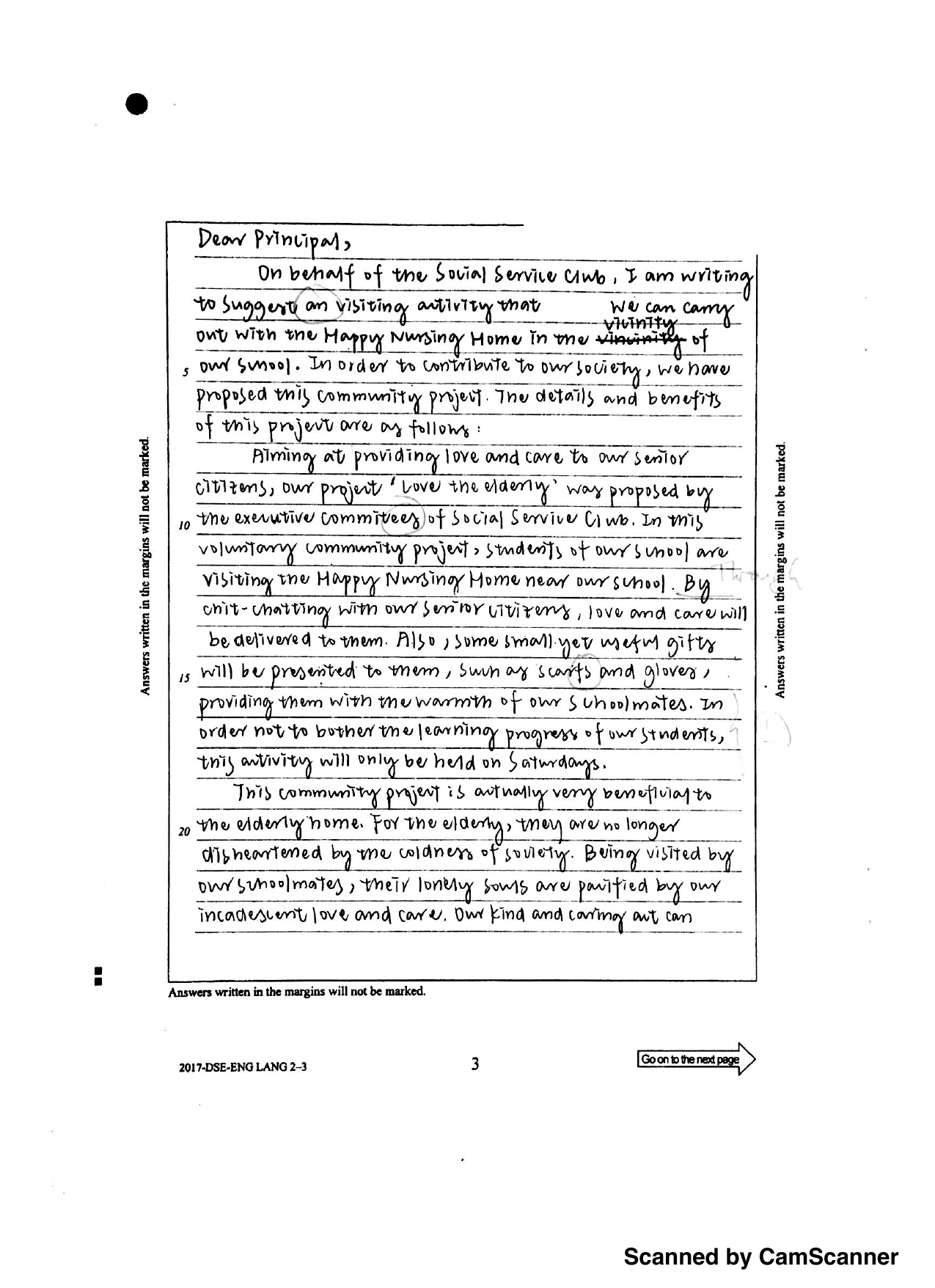
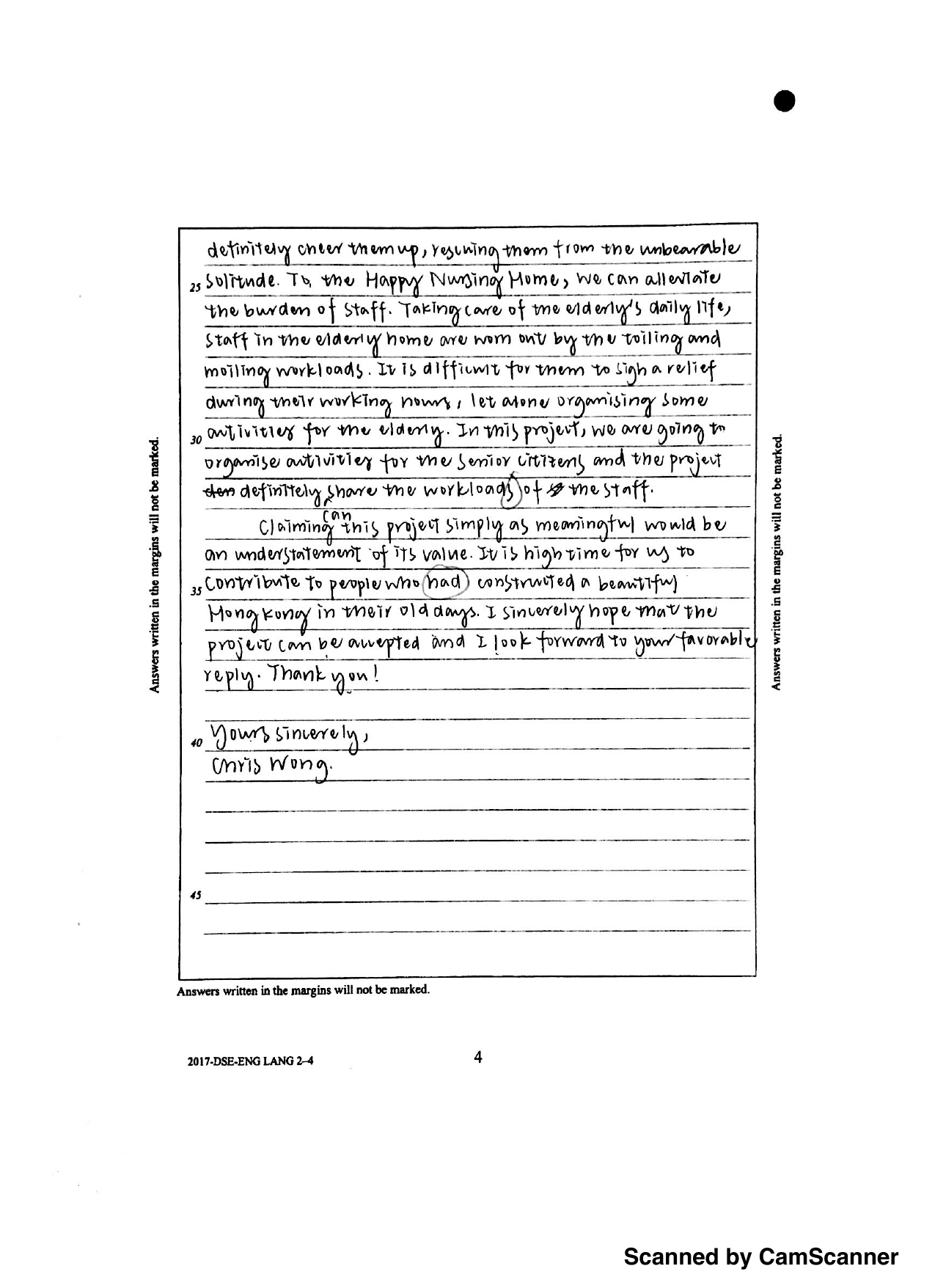
The writing, with corrections marked inline
Strengths to praise
The project (‘Love the Elderly’) is named, and the partner home (Happy Nursing Home) is named. Many candidates leave one or both as generic placeholders. Naming both turns the proposal into a thing that could be referred to in a follow-up reply — the most basic test-craft move in proposal writing, executed cleanly.
“In order not to disrupt the learning progress of our students, this activity will only be held on Saturdays.” One sentence quietly answers a foreseeable objection the principal would have raised in any reply (will this take students away from class?). Acknowledging the foreseeable concern before the recipient raises it is the highest-yield persuasive move in proposal writing.
The benefits paragraph addresses (i) the residents — relief from solitude, warmth from young visitors, the “cheering them up” line — and (ii) the staff — alleviation of workload, a moment’s relief from worn-out routines. The two audiences don’t overlap and don’t blur. The student even names the staff explicitly, where weaker letters keep the institutional benefit abstract.
In a 330-word letter, this candidate deploys: vicinity, voluntary, chit-chatting, provide them with the warmth, beneficial, disheartened, pacified, alleviate, worn out, sigh a relief, organising, understatement, favourable reply. The range is wide and almost every word lands in the right collocation. This is what 19/21 on the Language criterion looks like.
“It is high time for us to contribute to people who have built up a beautiful Hong Kong in their old days.” The closing reframes the elderly not as recipients of charity but as the generation that built the city the writer lives in. This is the rhetorical move that lifts a competent proposal into a memorable one; it gives the principal a reason to care that goes beyond “the right thing to do”.
“Our project ‘Love the Elderly’ was proposed by the executive committee of the Social Service Club.” One small phrase signals that the writer didn’t dream this up alone — it’s come through the club’s formal process. Principals respond to proposals that already have institutional backing; the executive-committee mention is a quiet but well-placed credibility marker.
Grammar notes
| Issue | Explanation |
|---|---|
(lines 3–4) an exciting activity that … we can carry out → an exciting activity that we can carry out |
After the strike-out the relative clause doesn’t fully reconnect to activity. The simplest fix is to drop the struck fragment entirely and let that we can carry out with the Happy Nursing Home attach cleanly to activity. |
(line 10) proposed by the executive committee of Social Service Club → of the Social Service Club |
Named clubs and societies typically take the definite article (the Drama Club, the Social Service Club, the executive committee of the United Nations). |
(lines 11–12) students of our school are visiting the Happy Nursing Home → students of our school will visit the Happy Nursing Home |
Tense issue: the activity is a future plan, not a present routine. The continuous are visiting reads as if the visits are already happening. |
(line 15) Such big stunts and lively [activities] → Such events and lively activities |
Stunts means daring physical feats (parkour, motorbike jumps) or attention-seeking tricks. The student means events, activities, occasions. The companion adjective lively is correct; the noun beside it is illegible in the manuscript (marked unclear above). |
(lines 20–21) they are no longer disheartened by the loneliness of society → by the loneliness of life in the home |
The phrase the loneliness of society is the wrong scope — the loneliness the residents feel is the loneliness of their day-to-day at the home, not of society in the abstract. |
(lines 22–23) their lonely souls are pacified by our incandescent love and care → their lonely souls are eased by our warm love and care |
Two issues. (i) Pacified suggests calming an agitation or anger; lonely residents aren’t typically agitated. (ii) Incandescent means “glowing white-hot” or “burning with anger”; for affection toward elderly residents it’s the wrong heat. Warm, gentle, steady all fit. |
(line 24) saving them from the unbearable solitude → relieving them of / from the unbearable solitude |
Save someone from implies rescuing from imminent danger; relieve someone of / from is the right verb for lifting a burden. |
(lines 27–28) the tiring and tasking workloads → the tiring and taxing workloads |
Tasking isn’t an adjective in modern English. The student is reaching for taxing (= demanding, exhausting) — a near-twin that does the job. |
(lines 28–29) to sigh a relief during their working hours → to find a moment’s relief / to draw breath |
The idiom is sigh with relief (= express relief by sighing), not sigh a relief. And the sense the writer wants is closer to catch a break, draw breath, get a moment’s peace — find a moment’s relief is the cleanest fix. |
(lines 29–31) By organising some activities …, and the project also definitely shares → By organising activities …, the project also shares |
Two issues. (i) The and after the introductory by-clause is one connector too many — cut it. (ii) Drop definitely; intensifiers like this thin the prose when overused. |
(line 32) Claiming this project as meaningful → To call this project merely meaningful / Claiming this project simply as meaningful |
The student writes “Claiming this project as meaningful would be an understatement”. The construction works but the rhetoric wants the word merely / simply to land the understatement move. The corrected version inserts simply. |
(line 33) Its high time for us → It is high time for us |
Pen slip — the apostrophe is missing. It’s = it is; its = the possessive. A common slip but a costly one in formal letters. |
(lines 34–35) people who constituted a beautiful Hong Kong in their old days → people who have built up a beautiful Hong Kong in their old days |
Constitute = “make up” a thing (the committee constitutes seven members); it doesn’t mean “build” or “establish”. The writer wants built up, established, made. |
Style suggestions (where strong writing could become outstanding)
Professional rewrite — the closing line (strong moment)
For comparison only, not a correction. The closing line of this letter is the most rhetorically ambitious moment in the whole piece — the move that reframes the elderly residents not as recipients of charity but as the generation who built the city the student lives in. The original lands the move but buries it inside a paragraph of generic close-of-letter language. The rewrite gives the move its own sentence, anchors it in a specific operational cadence (one Saturday afternoon a fortnight), and turns the closing’s rhetorical posture from request to humility — which is harder to decline.
The student’s closing (corrected)
Rewritten by a professional letter-writer
- The rhetorical move is named explicitly. The original implies that the residents built Hong Kong; the rewrite says it (“the generation that built the Hong Kong we live in”). Making the claim direct rather than gestural is what gives the line its weight.
- The cadence is specified. “One Saturday afternoon a fortnight” replaces the abstract contribute. A principal can imagine the schedule; she could not imagine contribute.
- The rhetorical posture flips from request to humility. “The smallest version of saying thank you” repositions the entire proposal — it is now framed as the writer being modest about an inadequate gesture, not as the writer asking for permission to do something generous. This is the version that is harder to decline.
- The closing ask is specific. The original hopes for a favourable reply. The rewrite asks for a meeting and names what the writer would bring to it (consent and supervision plans). Specificity is what converts a closing from polite filler into something the principal can act on.
- “Thank you!” is cut. An exclamation-marked thanks reads as informal in a formal letter to a principal. A professional close would either omit the thanks (the closing sentence already implies gratitude) or fold it in (“I look forward to discussing this with you”).
- The understatement line is dropped. The original’s “Claiming this project simply as meaningful would be an understatement” is rhetorically ambitious but lands awkwardly — the construction strains. Cutting it leaves room for the much stronger “generation that built Hong Kong” line to breathe.
Vocabulary to notice
| Word | Definition | Usage notes | Synonyms / alternatives |
|---|---|---|---|
| on behalf of | (prep. phrase) as a representative of. | Formal. Pairs with letters, speeches: on behalf of the committee, on behalf of the club. | representing, for, in the name of |
| vicinity | (n.) the area near or surrounding a particular place. | Pairs with in the / in close vicinity of. Slightly more formal than nearby; common in journalism and policy writing. | nearby area, neighbourhood, surroundings |
| voluntary | (adj.) done willingly and without obligation or payment. | Pairs with work, contribution, service, organisation, basis. The student’s voluntary community project is the right register. | unpaid, optional, willing, freely given |
| chit-chat | (n. / v., informal) light, casual conversation. | Hyphenated. Slightly informal — reads as a half-register lighter than the surrounding formal letter. See Style suggestion 3. | small talk, casual conversation, banter |
| disheartened | (adj.) having lost determination or confidence; dispirited. | Pairs with by, at, to find. Stronger than disappointed; suggests the will to continue has been damaged. | discouraged, demoralised, dispirited, deflated |
| pacify | (v.) to calm or appease (someone who is angry or upset). | Implies the target is agitated. For loneliness or sadness, ease, soothe, comfort read better. See Style suggestion 6. | calm, soothe, appease, mollify |
| incandescent | (adj.) emitting light as a result of being heated; burning with strong emotion (esp. anger). | Two senses, neither quite right for warm affection. Most idiomatic in modern English: incandescent with rage / fury. Best avoided for kindness. | radiant, glowing, blazing; (for affection) warm, tender |
| solitude | (n.) the state or situation of being alone. | Neutral or even positive in some contexts (welcome solitude, the solitude of a long walk). For an elderly resident, the student’s unbearable solitude uses the modifier well to mark it as the negative kind. | loneliness, isolation, seclusion, aloneness |
| alleviate | (v.) to make (suffering, deficiency, or a problem) less severe. | Pairs with pain, suffering, burden, stress, poverty, workload. Slightly formal; common in policy and journalism. The student’s alleviate the burden of staff is exactly right. | relieve, ease, mitigate, lessen, lighten |
| worn out | (adj. / past part.) exhausted; very tired. | Two-word phrasal adjective. Worn-out (hyphenated) when used attributively (a worn-out machine); two words after a verb (he is worn out). The student’s use is correct. | exhausted, drained, depleted, knackered (BrE informal) |
| taxing | (adj.) physically or mentally demanding. | Pairs with job, schedule, week, climb, exam. Distinct from taxable (subject to tax). The student writes tasking, which isn’t a standard adjective. | demanding, exhausting, gruelling, draining |
| organise / organize | (v.) to arrange systematically; to bring people or things together for a particular purpose. | BrE organise, AmE organize. Pairs with event, meeting, trip, committee, protest. The student is consistent with the British spelling. | arrange, set up, coordinate, plan |
| workload | (n.) the amount of work to be done. | One word, no hyphen. Pairs with heavy, light, manageable, reduce, share. | burden of work, work demands, allocation |
| understatement | (n.) the presentation of something as being smaller, worse, or less important than it actually is. | The student uses the move “calling X simply [adj] would be an understatement” — a classic English rhetorical lift. Pairs naturally with massive, gross, complete, gentle. | downplay, modesty, restraint |
| high time | (idiom) used to say that something should have happened earlier and there is no more time to wait. | Followed by for + noun or by a past-subjunctive clause (it is high time we left). Note the perfect-tense feel even in the present (high time we left not high time we leave). | about time, overdue, long overdue |
| favourable | (adj.) expressing approval; advantageous. | BrE favourable, AmE favorable. Pairs with reply, response, conditions, terms, review. A favourable reply is a fixed phrase in formal correspondence. | positive, approving, encouraging, supportive |
Leave a Reply