Letter to the Editor — Egg Tarts & Mahjong as Cultural Heritage
Recently the Hong Kong Government published a list of intangible cultural heritage items that the city should protect. The following were on the list: Traditional egg tarts and Mahjong.
Write a letter to the editor of the Hong Kong Daily supporting the Government’s choice of these two features of Hong Kong culture, suggesting why they are worth protecting and how they can be protected.
(~400 words)
Show original handwritten pages (5)
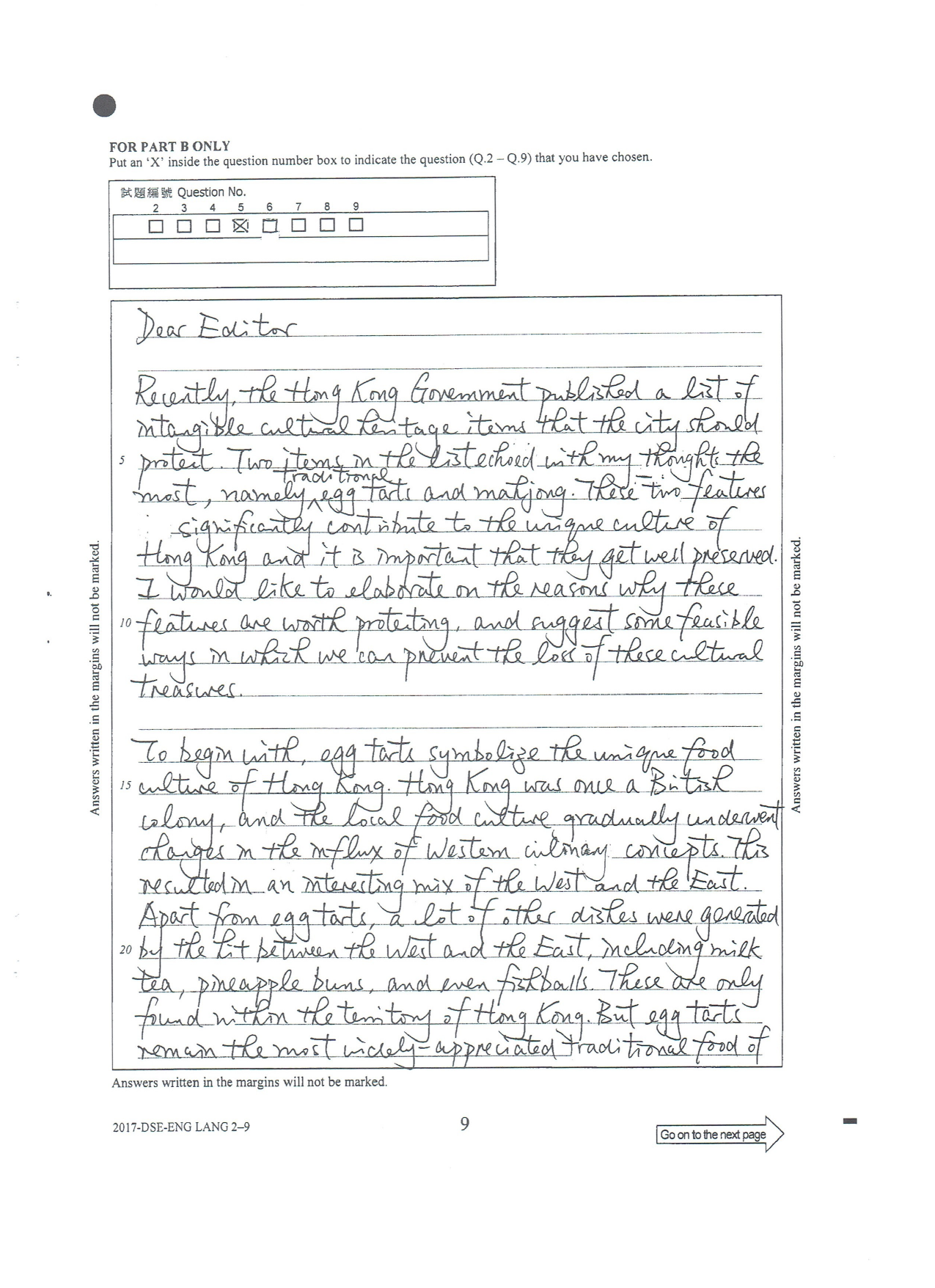
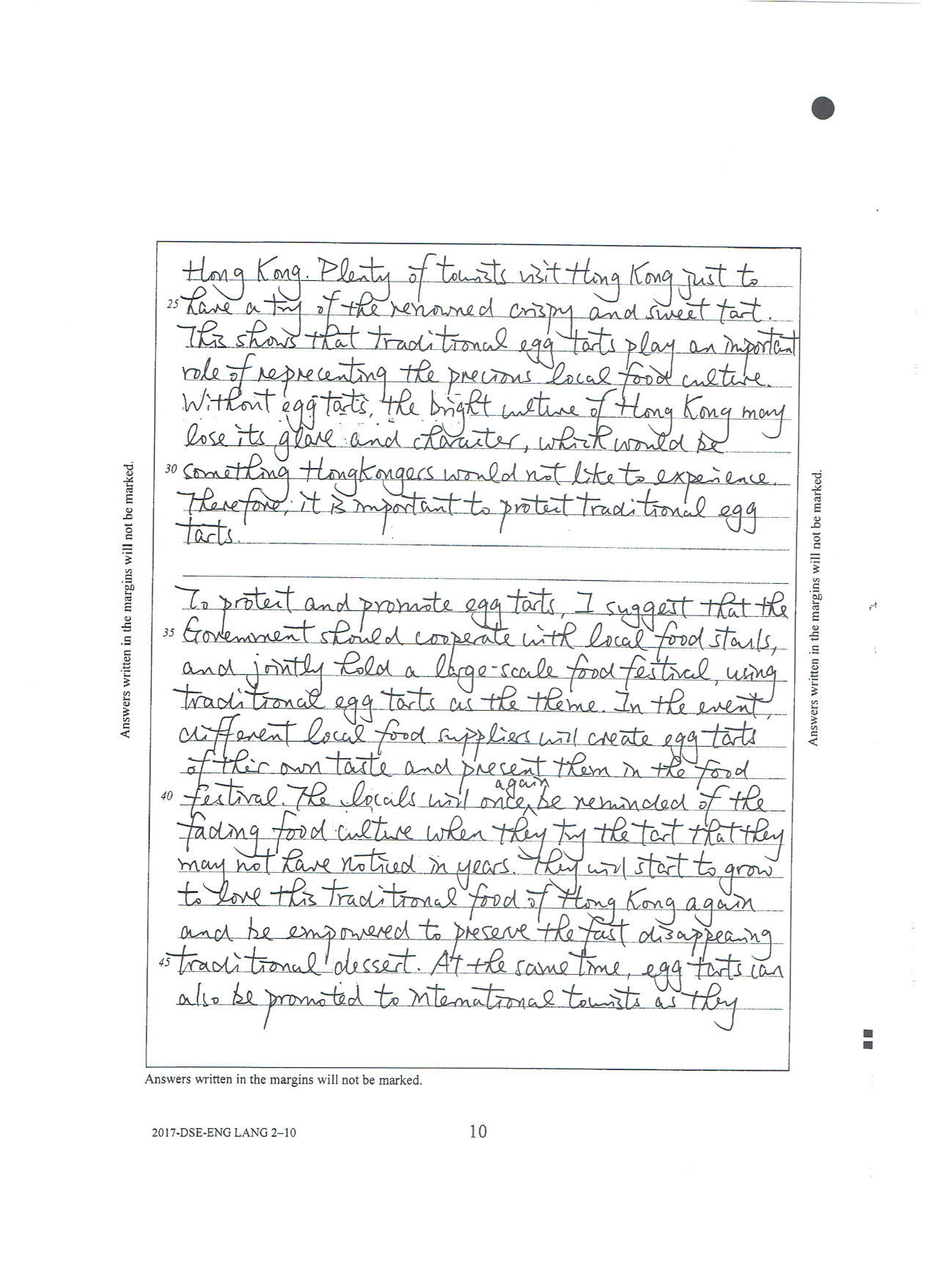


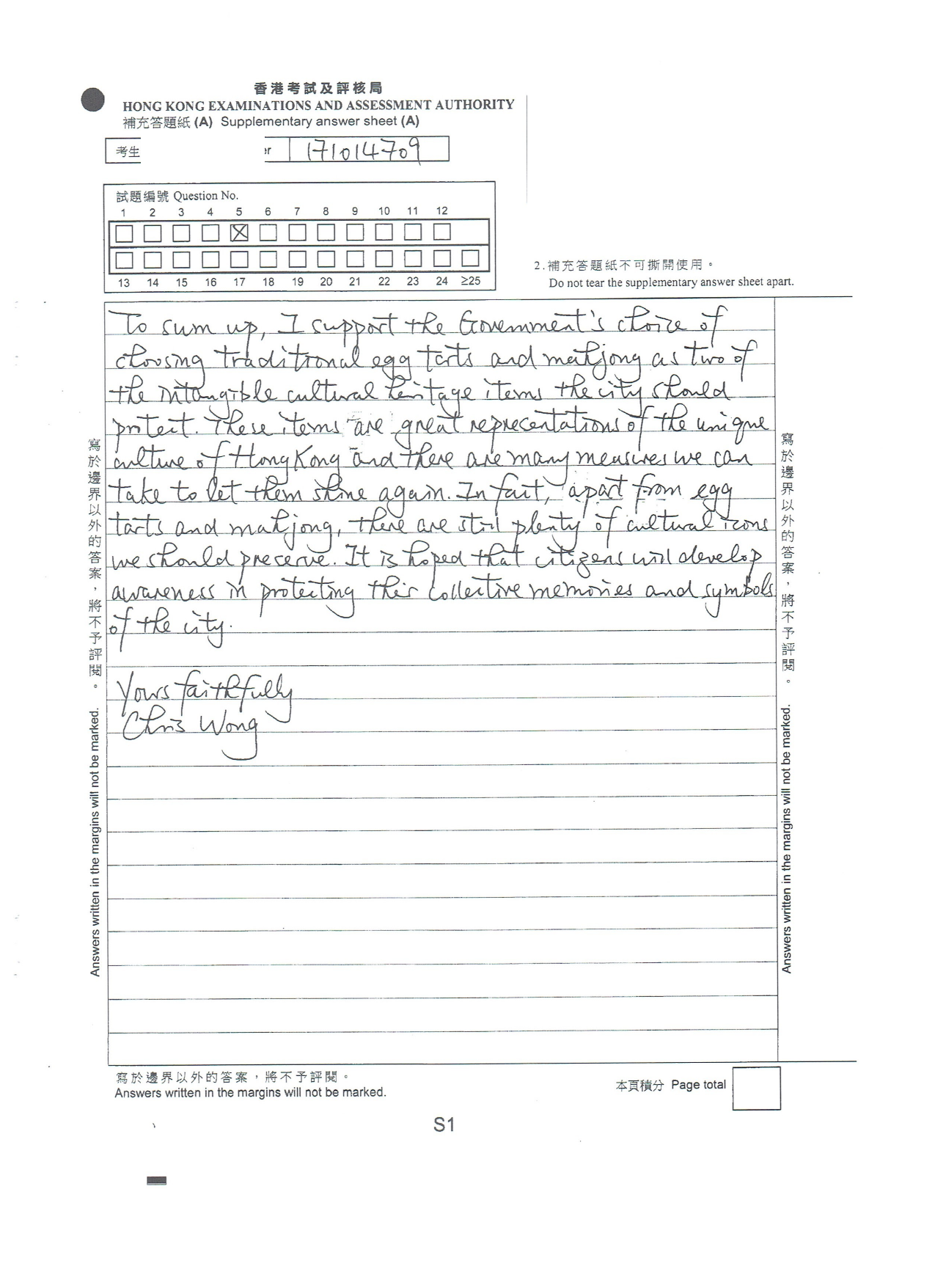
The writing, with corrections marked inline
Length. The letter runs to roughly 650 words against a 400-word brief — over 60% above target. The architecture is genuinely impressive (four sub-tasks — two features × two sub-questions per feature — all addressed) but the prose has not been compressed; some paragraphs read as first-draft thinking.
Two paragraphs where the syntax collapses. (i) The food festival paragraph (lines 34–47) contains the run-on “traditional egg tarts at the most authentic local food suppliers will create egg tarts of their own taste… when they try the tart that the event makes had retired in years”. (ii) The mahjong-competition paragraph (lines 67–86) similarly tangles: “the fading popularity of mahjong is the size of entertainment which today’s locals more often resorting to. They are seeking matching as too time-consuming…” These are the two moments where the marker’s pen most likely came out.
One culturally unclear reference. “In the hotels, a long-winded of Japanese mob makes mahjong as the main theme, where they recall friends and so on” (lines 57–58) — this appears to be a confused reference to long-running Japanese dramas or anime that feature mahjong (e.g., Akagi, Mahjong Hourouki). Marked unclear; the corrected version above proposes a clean replacement.
Sign-off. Yours faithfully is the correct close for a letter to the editor where the addressee is “Dear Editor” rather than a named person. The student gets this right.
Strengths to praise
Q5 has a hidden four-part structure: (a) which two features, (b) why each is worth protecting, (c) how each can be protected, plus (d) a frame for both. Many candidates handle one feature properly and pad the other. This letter handles both features in symmetrical depth — egg tarts get a cultural-fusion reason and a food-festival method; mahjong gets a collective-memory reason and a ten-week competition method. The symmetry is what 19/21 looks like.
Rather than just saying “egg tarts are tasty”, the writer frames the dish as evidence of Hong Kong’s colonial-era culinary fusion: “Hong Kong was once a British colony, and the local food culture has gradually absorbed changes through the influx of Western culinary influences. The result is a meaningful mix of the West and the East.” (lines 15–18). The writer then strengthens the case by listing parallel hybrid foods (milk tea, pineapple buns, fishballs). This is graduate-level cultural framing for a 17-year-old.
The letter doesn’t just use the prompt’s phrase as a label. The writer treats the items as practices (a way of eating, a way of socialising) rather than as objects, and the protection methods reflect that — you protect a practice by reviving its use, not by putting it in a museum. The food festival and the open competition both invite participation, which is what UNESCO-style intangible heritage protection actually looks like.
The letter doesn’t stop at “we should protect them”. It proposes concrete operations: a large-scale food festival with local food stalls cooperating to display authentic recipes, and a ten-week mahjong competition open to citizens including teenagers, structured so that gambling is excluded. Specificity is what separates a 5* opinion piece from a 5** policy letter.
The competition idea isn’t just a competition — the writer names why it would work: “since the competition does not involve gambling, younger citizens and even teenagers can participate. They will get the opportunity to learn the rules and skills of mahjong, and the tradition can therefore be passed to newer generations.” (lines 81–85). Naming the mechanism (no gambling → legal for minors → intergenerational transmission) is real argumentative work.
Intangible cultural heritage, renowned, persona, facets, resonated, influx, culinary influences, collective memory, recreational life, alienated, undoubtedly recognised, fading popularity, motivated to take part, passed to newer generations, cultural icons, develop awareness — all used in their proper habitat. The register is steadily formal throughout.
“In fact, apart from egg tarts and mahjong, there are still plenty of cultural icons we should preserve. It is hoped that citizens will develop awareness in protecting the collective memories and symbols of the city.” (lines 93–96). The letter closes by inviting the reader to think beyond the two named items — turning a specific case for two items into a general call to action. This is exactly what an op-ed-style letter to the editor should do at its close.
Grammar notes
| Issue | Explanation |
|---|---|
(line 5) Two items on the list echoed with me strongly → resonated with me strongly |
Echo describes a sound bouncing back; the verb the writer wants is resonate, which is the standard idiom for ideas or images that strike a chord. Resonate with is the fixed phrase. |
(lines 16–17) the local food culture eventually undergone changes in the influx of Western culinary contacts → has gradually absorbed changes through the influx of Western culinary influences |
Three issues. (i) Eventually undergone is missing an auxiliary — needs has eventually undergone, or rephrase. (ii) In the influx → through or during the influx. (iii) Culinary contacts is the wrong noun — the writer means influences, traditions, techniques. |
(lines 17–18) The resultant of a meaningful mix → The result is a meaningful mix |
The resultant is an adjective used attributively (the resultant force, the resultant decision). It cannot stand as a noun on its own here. The writer wants the noun result. |
(line 19) a lot of other dishes were quite distinct of the link between the West and the East → also reflect the link between the West and the East |
The original phrasing doesn’t resolve. Distinct of isn’t an English collocation (one is distinct from). The simplest fix is to replace the whole clause: the writer means these dishes are further examples of the East-West fusion. |
(line 21) These took only found within the territory of Hong Kong → These can only be found within the territory of Hong Kong |
Tense/auxiliary slip — took appears to be a pen slip for can. The sentence needs the passive can be found. |
(line 25) tourists visit Hong Kong just to have a try of the renowned cuisine → just to taste the renowned cuisine / just to try the renowned cuisine |
Have a try of is not idiomatic English. Either use the verb taste / try directly, or the noun phrase have a taste of. |
(line 27) play an important role of representing → play an important role in representing |
The collocation is play a role in X, never play a role of X. Reliable pattern: play a role in shaping, in promoting, in representing, in determining. |
(lines 49–50) mahjong is an entertainment device that have enjoyed for centuries → an entertainment tradition that has been enjoyed for centuries |
Three issues. (i) Entertainment device describes hardware (a TV, a console); mahjong is a tradition / pastime / game. (ii) Subject-verb agreement — the antecedent is singular. (iii) The verb needs the passive (has been enjoyed), since mahjong is the object of enjoyment, not the enjoyer. |
(lines 51–53) Thrived in Hong Kong in the last century, a lot of exercises played mahjong → Thriving in Hong Kong in the last century, many elders played mahjong |
Thrived as a participle should be thriving. Exercises is clearly a pen slip for elders (or elderly people, the elderly) — exercise means a workout or a task, not a person. |
(line 63) its popularity is shaking → its popularity is waning |
Shaking describes physical tremor; the writer wants waning, declining, fading, dropping off. Waning is the most idiomatic for declining popularity. |
(line 68) a tennis-week mahjong competition → a ten-week mahjong competition |
Pen slip — tennis for ten. The hyphenated ten-week is the standard form for duration adjectives. |
(line 74) technologic gadgets → technological gadgets |
Technologic is a non-standard form — modern English uses technological (adj.) almost exclusively. |
(line 75) technological gadgets which last less time → which take less time |
Last here means “endure / continue to exist”; that is the opposite of what the writer means. Take less time describes how long an activity lasts, which is the intended sense. |
(line 84) the pleasant can therefore be passed to newer generations → the tradition can therefore be passed to newer generations |
Pleasant is an adjective, not a noun. The writer wants the tradition, the practice, the game, the love of the game. |
(lines 89–90) two of the most remarkable cultural heritage items → two of the most recognisable cultural heritage items |
Remarkable means “worthy of remark”, which is true but vague. Recognisable is the precise word — egg tarts and mahjong are heritage items every Hong Konger would identify on sight. |
Style suggestions (where strong writing could become outstanding)
Professional rewrite — the food festival paragraph (weak moment)
For comparison only, not a correction. The food festival paragraph carries the letter’s most important policy idea — concrete protection through revival of authentic recipes — but the syntax breaks in three places and the paragraph tries to do five things in one sentence. The rewrite splits the paragraph into the operation, the locals’ benefit, and the tourists’ benefit, each given its own clause, and grounds the abstract “fading food culture” in three specific lost variations of the egg tart.
The student’s festival paragraph (corrected)
Rewritten by a professional opinion-writer
- The festival has a name and a place. “An annual Egg Tart Festival in the heart of Central” is something a reader can picture. The original’s “large-scale food festival” stays abstract.
- The partners are named in HK-specific terms. “The city’s remaining traditional bakeries and cha chaan teng” rather than the generic “local food stalls”. Mentioning that the partners are remaining also quietly reinforces the heritage-at-risk argument.
- The “fading culture” claim becomes concrete. The student says traditions are fading. The rewrite names three lost variations — the Macanese flaky version, the firmer Cantonese custard, the cocktail-bun crust. Specificity turns a general lament into something the reader can grieve.
- The two audiences are separated cleanly. The original tangles locals and tourists in one sentence; the rewrite gives each its own clause with its own benefit. The locals get flavours most of us have not encountered in years; the tourists get a food story told by the people who still make the food.
- The locals’ benefit is phrased in the first person plural. “Most of us have not encountered in years… which version we grew up with” — in a letter to a HK newspaper, writing as a Hong Konger to other Hong Kongers is what makes the appeal land. The original keeps the locals at arm’s length (“the locals will…”) as if from outside.
- The tourists’ benefit is reframed as authenticity, not awareness. The original promises tourists will “learn more about” the food culture. The rewrite promises “a food story told by the people who still make the food” — which is what a tourist actually values, and which only a real festival can provide.
- A genuine transmission mechanism is added at the close. “Each participating shop should be invited to publish its recipe at the end of the festival — which would seed the next generation of bakers.” The original ends the festival idea with attraction-marketing language. The rewrite ends it with the heritage-protection mechanism the paragraph has been promising: a way for a recipe that lives in one bakery’s head to outlive that bakery.
Vocabulary to notice
| Word | Definition | Usage notes | Synonyms / alternatives |
|---|---|---|---|
| intangible cultural heritage | (n. phrase) traditions, oral histories, social practices, and craft skills that cultures recognise as part of their heritage. | A UNESCO term, adopted into HK policy language. Distinct from tangible heritage (buildings, objects). Pairs with protect, preserve, safeguard, register, transmit. | living heritage, cultural tradition, ICH (abbreviation) |
| resonate (with) | (v.) to evoke or suggest images, memories, or emotions; to have particular significance for someone. | Pairs with strongly, deeply, particularly. The fixed phrase resonate with is the right idiom for “strike a chord with”. The student uses echo; resonate is what is meant. | strike a chord with, mean a lot to, register with |
| renowned | (adj.) known and admired by many people. | Pairs with chef, restaurant, dish, building, scholar. Slightly more formal than famous; carries a positive evaluative charge that famous doesn’t. | famous, celebrated, well-known, acclaimed |
| facet | (n.) one side of something many-sided; one aspect of a topic or character. | Originally jewellery (the flat faces of a cut gemstone), now general. Pairs with important, complex, hidden, unexpected. The student’s facets of Hong Kong culture is exactly right. | aspect, dimension, side, feature, element |
| colony | (n.) a country or area under the political control of another country, usually a distant one. | Historical and political vocabulary. HK was a British colony from 1842 to 1997. Pairs with former, British, French, settler. Important counterpart: colonialism, colonial period. | territory, possession, dependency |
| influx | (n.) an arrival or entry of large numbers of people or things. | Pairs with of: an influx of tourists, of capital, of refugees, of culinary influences. The student’s influx of Western culinary influences is the right collocation (with the right preposition fix). | inflow, arrival, surge, wave |
| culinary | (adj.) relating to cooking or the kitchen. | Pairs with tradition, skill, art, history, school. Slightly formal — common in food journalism and culture writing. | cooking, gastronomic, food-related |
| cuisine | (n.) a style or method of cooking, especially as characteristic of a particular country, region, or establishment. | Pairs with local, regional, French, Cantonese, fusion, authentic. Singular even when discussing a broad tradition (Hong Kong cuisine, not cuisines). | cooking, food, fare, gastronomy |
| collective memory | (n. phrase) the shared memory of a group of people, often passed from one generation to the next. | A sociological / cultural-studies term. Pairs with preserve, lose, evoke, build, fade, transmit. Common in heritage and post-colonial writing about HK. | shared memory, cultural memory, public memory |
| recreational | (adj.) relating to or denoting activity done for enjoyment when one is not working. | Pairs with activity, drug, sport, vehicle, life, time. The student’s recreational life of Hong Kong people is a clean collocation. | leisure, free-time, pastime |
| wane | (v.) to decrease in vigour, power, or extent. | Originally the moon — the waning moon. Now common for popularity, influence, interest, enthusiasm: waning popularity, waning support. The student uses shaking where waning is needed. | decline, fade, diminish, dwindle |
| revive | (v.) to restore to life, consciousness, or use; to renew interest in something. | Pairs with tradition, interest, custom, language, fortunes. Revive a custom is a perfectly idiomatic phrase in heritage writing. | resurrect, renew, restore, bring back, resuscitate |
| icon | (n.) a person or thing regarded as a representative symbol of something. | Originally religious painting; broadened to cultural symbol. Pairs with cultural, national, fashion, pop. The student’s cultural icons is well used. | symbol, emblem, representation, totem |
| depict | (v.) to represent by drawing, painting, or other artistic means; to describe in detail. | Pairs with scene, character, life, event, theme. The student’s the importance of mahjong is also depicted in other ways stretches the verb slightly — shown, demonstrated, reflected would fit better, since “importance” isn’t typically depicted. | portray, show, illustrate, represent |
| authentic | (adj.) of undisputed origin; genuine. | Pairs with experience, recipe, tradition, voice, story. Heavily used in food writing — an authentic egg tart, an authentic Cantonese restaurant. | genuine, real, true, unfiltered, original |
| empower | (v.) to give someone the authority or power to do something; to make stronger and more confident. | Slightly buzz-wordy in modern English; use sparingly. Pairs with communities, women, workers, citizens, generations. The student’s empowered to protect this kind of culture is on-register for the heritage context. | enable, equip, authorise, embolden |
| generations to come | (n. phrase) future generations. | Set phrase. The student’s passed to newer generations is similar but slightly off — the more natural idiom is passed on to future generations or passed down to the next generation. | future generations, posterity, those who come after |
| awareness | (n.) knowledge or perception of a situation or fact. | Pairs with raise, develop, increase, public, growing, lack of. The student’s develop awareness works but the more common collocation in policy writing is raise awareness. | consciousness, knowledge, recognition, understanding |
Leave a Reply