Welcome Speech to New Students — 39/42 (5*, closest-pair with D3)
You are the President of the Students’ Union at your school. You are preparing a speech to welcome new students on the first day of school. In order to help new students achieve success and have an enjoyable school life, you want to talk about the following in your speech:
- importance of following school rules; and
- importance of interpersonal relationships.
The first part of the speech has been written for you. Finish the speech. (~200 words)
Show original handwritten pages (2 of 3 — booklet p.3 missing from scan)
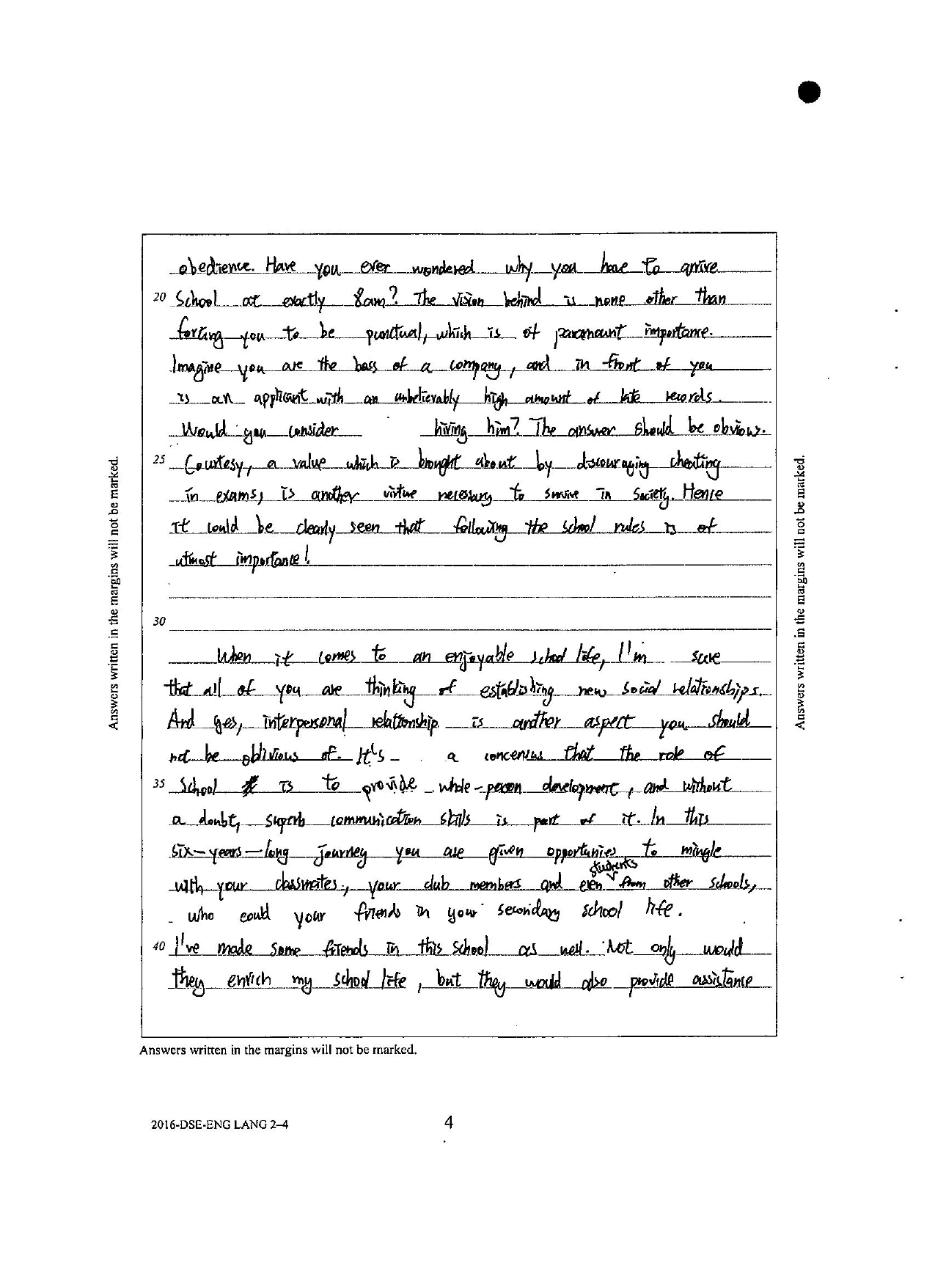

The writing, with corrections marked inline
On behalf of the Students’ Union, I’d like to welcome all of you to our school. I’m sure we all want to achieve success and have an enjoyable school life, so this morning I’d like to give you some advice.
Word count. Roughly 380–420 words of visible writing (lines 20–69). The booklet-p.3 portion (lines 1–19) adds approximately another 200 words, bringing the full piece to around 580–620 words against the ~200-word target. Like most band-5** Part A scripts in this collection, the candidate goes well over length; the marker has not docked because every paragraph earns its weight.
Unclear handwriting. Four short stretches are difficult to read: “obedience” at the top of line 20 (the page break may have eaten the head of the word; transcribed from context); the participle pair “demonstrating, chatting” in paragraph 2 (could also be demonstrating, sharing or demonstrating, caring); the noun “authorities” in paragraph 3 (clearly a slip for adversities, kept here as a visible candidate self-error then corrected); and the verb “shouted each other” in paragraph 3 (almost certainly intended as supported each other — the corrected version makes the sentence read sensibly, since the candidate then continues “with support”).
Title-style note. The candidate does not label the address with a heading; correct for a speech delivered orally to a known audience.
Strengths to praise
Rather than listing rules abstractly, the candidate frames the entire punctuality sub-point as a hiring scenario: “Imagine you are the boss of a company, and in front of you is an applicant with an excessively high amount of bad morals. Would you consider hiring him? The answer should be obvious.” This is the textbook 5**-band move: drop the audience into a future-self scene where the rules matter, rather than telling them the rules matter. The rhetorical question “Would you consider hiring him?” forces the answer the speaker wants, which is what rhetorical questions exist to do.
Rules (visible from line 20 onward, with the punctuality scenario and the courtesy sub-point) → relationships (from the “When it comes to an enjoyable school life…” opener). The pivot uses the second key word from the pre-printed opening (enjoyable school life) to launch the relationships paragraph — a small but real callback that the marker rewards.
“I’ve made some friends in this school as well. Not only would they enrich my school life, but they would also provide assistance whenever I encounter adversities in life. We have gone through a lot, played a lot and supported each other with support.” The President of the Students’ Union steps out of the abstract case and into a one-sentence memory. This is the move that converts a generic welcome speech into this President’s welcome speech — the marker can hear a specific person behind the words.
“For example, if you were asked to work on a project which requires the filming of a video, you should find someone in your group who is good at using the camera.” A concrete classroom scenario (the video project) anchors the abstract claim (interpersonal relationships are an asset). Candidates who reach the 5** band almost always have at least one fully worked-out scenario per body paragraph; this candidate has two (the hiring scenario in paragraph 2, the video-project scenario in paragraph 5).
The text remembers it is a speech, not an essay: “Have you ever wondered why…?” (rhetorical question, line 20); “Imagine you are the boss…” (direct address with imperative); “Would you consider hiring him?” (second rhetorical question); “And yes…” (a spoken-register beat that no essay writer would use); “I’ve made some friends in this school as well.” (personal aside); “Wish you all the best, and thank you!” (oral sign-off). Together these earn the text-type mark.
Across the visible portion of the speech: paramount importance, oblivious of, whole-person development, prevalence, extensive interpersonal relationship, mingle, endeavour, adversities, fruitful, asset. Each appears once, in its natural slot — the difference between vocabulary deployed and vocabulary displayed. The marker has seen the range.
The closing sentence — “your obedience and endeavour, I’m sure that all of you would achieve success and have a joyful school life” — lifts success and (a synonym for) enjoyable school life straight from the pre-printed opening. The candidate is closing the loop deliberately: the speech ends where the pre-printed opening began, only now with the two bullets earned by the body paragraphs. This is the single most reliable Part A move on prompts with a given opening.
Grammar notes
For a 5** Part A in this collection the live error count is small — mostly subject-verb agreement slips on compound noun phrases, plus a couple of word choices where the candidate reached for a near-miss. The table below catches the items a careful re-read would have fixed, and explains the rule behind each.
| Issue | Explanation |
|---|---|
(line 25) an exclusively high amount of bad morals → an excessively high amount of bad morals |
The intended sense is “to a great extent / very high”, which is excessively. Exclusively means “to the exclusion of other things” and does not modify high. A one-letter / one-prefix slip; the marker has read past it because the meaning is recoverable. |
(line 36) interpersonal relationship is another aspect → interpersonal relationships are another aspect |
The candidate writes relationship (singular) several times in the script where the plural is wanted (you have relationships with many people, not a relationship with the school). When the noun is plural the verb agrees: relationships are, not relationship is. |
(line 40) sound communication skills is part of it → sound communication skills are part of it |
Subject-verb agreement. Skills is plural; communication is the modifier, not the head noun. A classic “nearest-noun” trap. |
(lines 40–41) Six-years-long journey → six-year-long journey |
When a number-noun phrase becomes a compound adjective in front of another noun, the noun is singular: a six-year-long journey, a three-hour-long meeting, a two-week trip. Also note: lower-case six (no need to capitalise inside a sentence). |
(line 59) someone in your group who are good at → someone in your group who is good at |
The relative pronoun who takes the verb of its antecedent someone, which is singular. In your group is a prepositional phrase that does not affect agreement. |
(line 63) interpersonal relationship is surely an important asset → interpersonal relationships are surely an important asset |
Same pluralisation note as above. (The candidate makes this slip consistently; a single read-through could have fixed all four instances together.) |
(line 38) the role of School at it is → the role of the school |
A pen slip where the candidate started a phrase, abandoned it, and did not strike through cleanly. The intended sentence is “It’s a necessity that the role of the school is to provide whole-person development”. |
(lines 42–43) even other schools, who could your friends → even students from other schools, who could be your friends |
Two small repairs in one phrase. Schools cannot themselves be friends — what becomes a friend is a person from another school, so add students from. And the relative clause needs the verb be: who could be your friends, not who could your friends. |
(line 49) shouted each other with support → supported each other |
The phrase as written is incoherent (you don’t shout someone with support). The intended verb is almost certainly supported — which the candidate then repeats as the noun support in the same clause. A pen slip that should have been caught at re-read. |
(line 53) a key to succeed in school → a key to succeeding in school |
After key to, English uses a gerund (-ing form), not a bare infinitive: the key to winning, a key to learning, a key to succeeding. (The same rule applies to secret to, route to, path to, approach to.) The candidate makes this slip; a key to succeed is a common Hong Kong-English form. |
(lines 60–61) It is to be better if you had known him beforehand → It would be even better if you had known him beforehand |
The third-conditional needs would have or would be, not is to be. The candidate’s “had known him” is correct; the main clause needs the matching “would be / would have been”. |
(line 66) That would conclude my speech. Listen, your obedience… → …Given your obedience… |
The opening word of the closing sentence is unclear in the handwriting but as written reads Listen, which is an imperative addressed to the audience and does not connect grammatically to the noun phrase that follows. The intended word is almost certainly Given (i.e., “Given your obedience and endeavour, I’m sure…”), which is a preposition that does take a noun phrase. A single misread word at the start of the closing sentence costs the candidate a tidy final pivot. |
Style suggestions (where 5** could become 5**+)
Professional rewrite — the courtesy sentence (weak moment)
For comparison only, not a correction. The courtesy sentence is where the rules paragraph briefly loses its footing: the noun (courtesy) is introduced before it has been named, the participial list (demonstrating, chatting) does not quite parse, and the parenthetical (in essence) hangs awkwardly off the end. The rewrite restores the sentence to the same speech-register as the rest of the rules paragraph — noun first, mechanism second, payoff third — in roughly the same word count.
The student’s courtesy sentence (corrected)
Rewritten by a professional speech-writer
- The noun comes first. And then there is courtesy introduces the value before describing it. The student’s version names the value mid-sentence, after a long subordinate clause, which is why the sentence loses cohesion.
- The mechanism becomes three concrete pictures. The senior who holds a door · the teacher who waits for the bell · the classmate who hears you out replaces the abstract participles demonstrating, chatting. The audience can see each one.
- The payoff is stated directly, not signposted. The student writes Hence it could be clearly seen that… — a textbook essay connective that flattens the speech voice. The rewrite makes the same argument (rules build the habits a working society needs) without naming the move.
- The rules-paragraph close reframes the bullet. Not to limit you, but to build the habits a working society needs answers the question every new Form-1 student secretly asks (why are there rules?) with a one-line case the audience can take away.
- The exclamation mark goes. …is of utmost importance! lands as essay-enthusiasm. The rewrite trusts the picture to do the persuading.
Vocabulary to notice
| Word / phrase | Definition | Usage notes | Synonyms / alternatives |
|---|---|---|---|
| punctual | (adj.) happening or doing something at the agreed or proper time. | Pairs with be, become, remain. Adverb punctually; noun punctuality. The candidate uses both punctual and punctuality in the same sentence — a small lexical flourish. | on time, prompt, timely |
| paramount importance | (n. phrase) the highest degree of importance. | Pairs with of: of paramount importance. No article. Compare with of utmost importance, of vital importance. The candidate uses both paramount and utmost in adjacent paragraphs. | of supreme importance, of the highest importance, critical, crucial |
| excessively | (adv.) to a degree that is too great; more than is necessary, normal, or desirable. | Pairs with high, expensive, complicated, harsh, polite. Carries a faintly negative tone (the thing being modified is more than it should be). Compare extremely (neutral) and exceedingly (formal, positive or neutral). | excessively, overly, too, unduly, immoderately |
| morals | (n. pl.) standards of behaviour; principles of right and wrong. | Almost always plural (poor morals, good morals, lax morals). Compare with morale (n., uncountable: confidence and enthusiasm). The candidate uses morals correctly in plural. | ethics, values, principles, scruples |
| courtesy | (n.) polite behaviour that shows respect for other people. | Pairs with show, extend, treat with. Common courtesy is the everyday fixed phrase. By courtesy of X = thanks to X (e.g., on photo credits). | politeness, civility, manners, respect |
| oblivious of / to | (adj.) not aware of or not concerned about what is happening. | Both prepositions work; oblivious to is slightly more common in modern English. Pairs with oblivious to the danger, to the noise, to one’s surroundings. | unaware of, unmindful of, heedless of, ignorant of |
| whole-person development | (n. phrase) the development of intellectual, physical, social, emotional and ethical dimensions of a person together. | A formal phrase common in Hong Kong educational discourse (the Education Bureau curriculum framework uses it). Hyphenated. Pairs with promote, foster, achieve, pursue. | all-round development, holistic education, well-rounded growth |
| mingle | (v.) to mix or move freely among people in a social gathering. | Often intransitive: mingle with the guests, mingle freely. Pairs with welcome party, reception, crowd. A natural verb for the “new students meeting people” context. | mix, socialise, circulate, fraternise |
| adversities | (n. pl.) difficulties or misfortunes encountered in life. | Often plural in this sense (face many adversities, overcome adversities). Singular adversity is also common (in times of adversity). The candidate’s manuscript reads authorities, which is a near-miss for adversities. | hardships, difficulties, misfortunes, setbacks |
| fruitful | (adj.) producing good or useful results; productive. | Pairs with discussion, meeting, year, partnership, school life. The opposite is fruitless (without results). Originally agricultural; now mostly figurative. | productive, rewarding, profitable, beneficial |
| extensive | (adj.) covering or affecting a large area; wide in range or scope. | Pairs with knowledge, experience, network, damage, range. Slightly more formal than wide or large. The candidate uses extensive interpersonal relationship — the noun should be plural (relationships). | wide-ranging, broad, comprehensive, far-reaching |
| prevalence | (n.) the fact or condition of being widespread or common. | Formal. Pairs with the prevalence of, increase in, decline in. Common in sociology and public-health writing (prevalence of diabetes, of smoking). | commonness, widespread occurrence, frequency, ubiquity |
| asset | (n.) a useful or valuable thing or person; (also: an item of property owned). | Pairs with major, valuable, important, real, prized. An asset to the team / company / community. The candidate’s “an important asset in your school life” is a natural collocation. | resource, advantage, strength, benefit |
| endeavour | (n. / v.) an attempt to achieve something / to try hard to do something. | British spelling; American endeavor. As a noun: a worthy endeavour, scientific endeavour. As a verb: endeavour to do something. The candidate uses the noun form in the closing — correct register for a speech. | effort, attempt, exertion, striving |
| joyful | (adj.) feeling, expressing, or causing great pleasure and happiness. | Pairs with occasion, moment, news, celebration, life. Slightly warmer than happy; carries a small ceremonial quality that fits a welcome speech. | happy, joyous, cheerful, delighted |
Leave a Reply