Working in Other Asian Cities — 39/42 (5**)
Many Hong Kong graduates complain about the lack of employment opportunities in the city. It has been suggested that the graduates who fail to find a job in Hong Kong could look for opportunities in other cities in Asia. Do you support this suggestion?
Write an article for the Young Post explaining your views. Provide an appropriate title for your article. (~400 words)
Show original handwritten pages (3 of 4 — booklet p.9 missing from this scan)
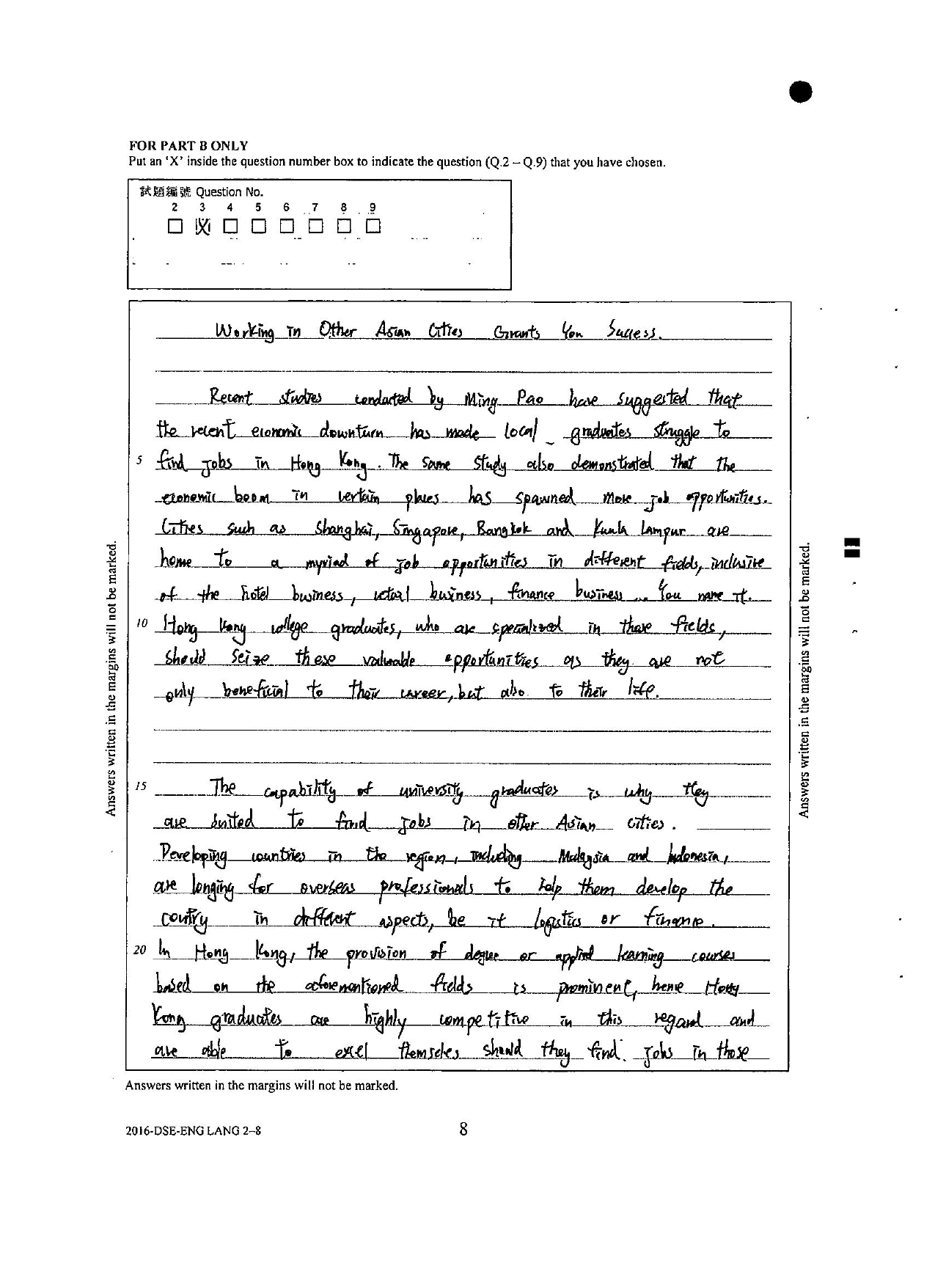


The writing, with corrections marked inline
Title provided. Unlike candidate 2016-002 (who left the title slot empty), this candidate writes a centred title at the top of the first writing page: “Working in Other Asian Cities — Concerns You Should Know” (the second half is partially unclear — could also be “Concerns You Should Have” or “Concerns You Shouldn’t Have”). The title alone secures the “title is provided” content mark.
Word count. Roughly 620–660 words against the ~400-word target. The article stays in the main answer book throughout (no supplementary sheet needed) and reaches END OF PAPER at line 87 of booklet p.11.
Unclear handwriting. Three places need flagging: “Concerns You Should Know” in the title (the last word could be Know, Have or another short noun); “conducted by Ming Pao” in paragraph 1 (the source name; Ming Pao is the most plausible reading); and “is therefore recommended” in paragraph 3 (the manuscript reads as surrounded, which is incoherent in context; recommended is the corrected reading and fits the surrounding logic).
Strengths to praise
The title “Working in Other Asian Cities — Concerns You Should Know” does the work the prompt asks of it: it names the topic, signals the audience-facing register (You Should Know), and uses an em-dash subtitle structure that is genuinely common in Young Post headlines. Compare with candidate 2016-002 on the same prompt, who left the title slot empty — a small but real content deduction.
Reason 1: capability of university graduates (training in international fields + bilingual proficiency). Reason 2: security of employment (growing economies, more jobs, better pay). Reason 3: cultural exposure (foreign cultures, festivals, cuisine, languages). Each reason gets its own paragraph with its own concrete examples. The conclusion then loops back to the prompt’s framing word (unemployment) before the call-to-action close.
Paragraph 1 names Shanghai, Singapore, Bangkok, Kuala Lumpur. Paragraph 2 names Malaysia, Indonesia, Singapore, Beijing, Guangzhou. Paragraph 3 names South East Asia as a region. Paragraph 4 names Malay as a sample language and Taiwan as the “even close cultures are different” example. The specificity rate is unusually high for a 17-year-old timed essay and is what gives the article its weight.
The opening paragraph names a source (Ming Pao) and a finding (the economic downturn has made graduates struggle locally; the boom has spawned opportunities elsewhere). Whether the citation is exact or not, it gives the argument empirical weight before the opinion arrives — the standard opinion-piece structure of data → problem → thesis.
Strong collocations land throughout: economic downturn, economic boom, a myriad of job opportunities, gives rise to, broaden their horizons, a multitude of advantages, the best bet, lives greatly enriched, value-added industries, high value-added, the production industry, security of employment, materialistic incentives, global vision, hampered. None of these are decorative — each does its argumentative work in its slot.
The fourth body paragraph is structured around four specific things a graduate would do abroad: participate in local festivals, deepen understanding of regional culture, learn and master foreign languages, enjoy local cuisines. This is the textbook 5** move — the argument is not asserted but enacted through a list of imaginable activities. The marker can picture the graduate doing each one.
The single rhetorical question — “Who would not want to work daily while earning a lot?” — lands at the end of the wages sub-section in paragraph 3. The candidate uses it sparingly (just once, not three times), and at the moment in the argument where the audience is most likely to agree. Sparing use is what makes a rhetorical question feel like rhetoric rather than a tic.
Grammar notes
| Issue | Explanation |
|---|---|
(line 11) graduates who are spawned in these fields → graduates who are trained in these fields |
Spawn is used either of fish laying eggs or of a thing producing things in large numbers (as the candidate uses it correctly two lines earlier: “has spawned more job opportunities”). It does not collocate with graduates being educated in a subject. The wanted verb is trained, educated, schooled, prepared. |
(lines 12–13) are not only beneficial to their career, but also to their life |
The construction not only X but also Y is correct, but for balance both halves want the same preposition phrase form: beneficial to their career but also to their life is acceptable; tightening to beneficial both to their career and to their life is sharper. |
(line 24, post-missing-page) excel themselves |
The intended idiom is excel themselves (= surpass their own previous performance), which is correct British usage. Distinguish from excel at X (= be very good at X). The candidate uses excel themselves in the sense of do very well — arguably the wanted phrase is excel (intransitive: they will excel in these fields). A subtle near-miss; the marker has accepted it. |
(line 28) which is recognised into the ESL curriculum → which is incorporated into the ESL curriculum |
Recognise means to identify or acknowledge; you don’t recognise a language into a curriculum. The wanted verb is incorporate, include, build into, embed in. A near-miss; the marker has read past it. |
(line 30) convenient; demonstrating the communication barriers → convenient, lowering the communication barriers |
The participle demonstrating is the wrong verb — the candidate means the convenience removes the barriers, not that it demonstrates them. The fix is to swap the verb (lowering, reducing, dismantling) and to use a comma rather than a semicolon (the second half is a participial phrase, not an independent clause). |
(line 31) between the three places |
The candidate has so far named only two places (Hong Kong and Singapore); the three places has no antecedent. Either name a third place or change to between the two places. |
(line 32) English proficiency is reached high → English proficiency is high |
The verb reach in passive voice (is reached) does not fit. The simplest fix: drop reached and say English proficiency is high. Alternative: where English proficiency has reached a high level. |
(line 34) cities which are heavily growing → cities which are booming |
Heavily is the wrong intensifier with growing; the natural collocation is growing rapidly, growing quickly, growing fast. The single-word verb booming says the same thing more naturally and matches the economic register. |
(line 43) Asian cities as it are → Asian cities as they are |
The pronoun must agree with its antecedent Asian cities (plural) — so they, not it. A pen slip; the candidate writes they correctly two lines later. |
(line 44) Whilst in Hong Kong, the number is so saturated → Whereas in Hong Kong, the number is so saturated |
Both whilst and whereas can signal contrast, but whilst normally introduces a clause with a subject and verb (whilst graduates are searching…). To open with a prepositional phrase (in Hong Kong) and then a main clause, whereas is the natural contrast marker. |
(line 45) hardly could one find a job |
Correct subject-verb inversion after the negative adverb hardly — one of the harder 5** sentence forms to produce on the fly. The candidate gets it right (hardly could one find…, not hardly one could find…). |
(line 46) The vast amount of jobs above Hong Kong graduates to find a job easily → The vast amount of jobs allows Hong Kong graduates to find a job easily |
The handwriting reads above, which is incoherent in this clause. The intended verb is almost certainly allows (or enables) — a one-letter slip that costs the sentence its main verb until you fix it. |
(lines 51–52) steadily increasing and is bound to increase |
The sentence repeats the verb increase in successive clauses. Tighten by varying the second: steadily increasing and is bound to keep climbing or and shows no sign of slowing. |
(line 54) is therefore surrounded for Hong Kong graduates → is therefore recommended for Hong Kong graduates |
As written the sentence is incoherent (you don’t surround a course of action for someone). The intended verb is almost certainly recommended; the sentence then reads sensibly as “Working in other Asian cities is therefore recommended for Hong Kong graduates, especially when they have the abilities.” |
(line 61) besides those exist in Hong Kong → besides those that exist in Hong Kong |
A relative clause needs its relative pronoun. Those exist is two finite verb phrases bumped together; those that exist embeds the second properly. |
(line 68) deepen their understanding on that region’s culture → deepen their understanding of that region’s culture |
Wrong preposition. Understanding of X is the standard collocation (the noun understanding takes of). On X would be acceptable only with a different noun like perspective on or research on. |
(line 76) cultures which is utterly distinct → cultures which are utterly distinct |
Subject-verb agreement. Cultures is plural; which takes the verb of its antecedent. |
(lines 76–77) utterly distinct from that in Hong Kong → utterly distinct from those in Hong Kong |
The pronoun that / those must agree in number with what it refers back to (cultures, plural). So those in Hong Kong, not that in Hong Kong. |
(line 79) far more beneficial than it is in Hong Kong → far more beneficial than working is in Hong Kong |
The comparative than X needs a subject for its verb. The candidate’s it has no clear antecedent (working is the obvious referent but is several clauses back); naming it explicitly closes the loop. |
(lines 81–82) Unemployment is certainly the last thing we want to after graduating → Unemployment is certainly the last thing we want after graduating |
The infinitive marker to is a leftover from the deleted earlier draft (“Being unemployed is certainly the last thing we want to [be] after graduating”). Once the candidate rewrites the subject as Unemployment (a noun), the infinitive needs to come out too. |
(lines 85–86) I am sure that they would have their lives greatly enriched |
Causative have + past participle construction (have something done) used correctly: they would have their lives enriched. One of the trickier 5** sentence forms to produce; this candidate produces it cleanly. |
Style suggestions (where 5** could become 5**+)
Professional rewrite — the conclusion (weakest stretch)
For comparison only, not a correction. The candidate’s three body paragraphs are strong; the conclusion is the only stretch where the article visibly tires. The original conclusion is two sentences, both correct but neither memorable. The rewrite shows what a paid columnist would do with the same two ideas (recap + call to action) in roughly the same word count.
The student’s conclusion (corrected for grammar)
Rewritten by a professional columnist
Pack the suitcase. The graduates who go will come home richer — in experience, in language, in confidence — than the graduates who stayed.
- An opening image instead of an opening abstract claim. “The worst homecoming gift the city can give” personifies Hong Kong and gives unemployment a felt weight. The student’s “the last thing we want” is correct but lifeless.
- Repetition as rhetoric. “Shanghai is hiring. Singapore is hiring. Jakarta, Bangkok and Kuala Lumpur are hiring.” — the same verb three times across four named cities. The student’s article names these cities individually in paragraph 1 but never gathers them into a chorus. Opinion-piece conclusions love a chorus.
- The “return ticket” image. “A return ticket that lets you come home a bigger person than the one who left.” This carries the whole article’s argument (the graduate returns, having grown) in one concrete picture. The student’s article makes the same point in paragraph 4 (broaden their horizons) but doesn’t bring it back to the conclusion.
- A two-sentence final beat. “Pack the suitcase. The graduates who go will come home richer…” — an imperative followed by a forecast. Short final paragraph; lands.
- The three-noun list at the very end. “In experience, in language, in confidence.” The rule of three, in three short prepositional phrases. The student instinct is right (greatly enriched) but the rewrite names the three things they are enriched in, so the reader can hold the article’s argument in their head when they put the paper down.
Vocabulary to notice
| Word / phrase | Definition | Usage notes | Synonyms / alternatives |
|---|---|---|---|
| economic downturn | (n. phrase) a period of decline in economic activity. | The natural opposite of economic boom / upturn. Pairs with recent, sharp, prolonged, current. Common in business journalism. The candidate uses both downturn and boom in the same paragraph — deliberate pairing. | recession, slump, contraction, slowdown |
| spawn (v.) | (v.) to give rise to; to produce or generate (especially in large numbers). | Originally of fish laying eggs. Now mostly figurative: spawned a wave of imitators, spawned a new genre, spawned more opportunities. Pairs with abstract nouns. Don’t use of people being educated — that’s where the candidate’s second use slips. | generate, produce, give rise to, create |
| a myriad of | (n. phrase, idiomatic) a great number of. | Myriad can be either a noun (a myriad of options) or an adjective (myriad options). Both are accepted in modern English; the adjective form is slightly more elegant in writing. | countless, innumerable, a host of, a wealth of |
| inclusive of | (prep. phrase) including; with the inclusion of. | Slightly more formal than including. Common in legal and contractual writing (the price is inclusive of VAT). The candidate uses it correctly to introduce a list. | including, encompassing, comprising, with |
| prominent | (adj.) important; famous; standing out; noticeable. | Pairs with role, figure, position, feature. Slightly more formal than important or noticeable. The candidate’s “the provision… is prominent” uses the “noticeable / well-developed” sense. | notable, eminent, conspicuous, leading |
| gives rise to | (v. phrase) causes; brings about; is the source of. | Formal. Pairs with abstract nouns: gives rise to concerns, to questions, to competitiveness, to misunderstandings. Compare with leads to (more neutral). | causes, brings about, leads to, results in |
| eases | (v.) makes easier; reduces the difficulty of. | Pairs with communication, tension, congestion, the burden, the pain. The candidate’s “eases communication” is a natural collocation. | facilitates, smooths, lightens, simplifies |
| saturated | (adj.) holding as much as can be absorbed; (of a market) fully supplied to the point that no more can be added profitably. | Economic and chemistry senses both common. Pairs with market, the airwaves, with information, with advertisements. The candidate’s “the number is so saturated” is awkward (numbers aren’t saturated; markets are) — the wanted formulation is “the job market is so saturated”. | full, overloaded, glutted, overflowing |
| value-added | (adj.) (of industries, services, products) involving a process that adds value to a raw material or basic service. | Hyphenated. Common in economics and trade-policy writing (high value-added manufacturing, value-added services, value-added tax). The candidate’s “high value-added industries” is the standard collocation. | higher-margin, premium, processed, finished |
| materialistic incentives | (n. phrase) rewards or motivators that are about money or material possessions. | Used in management and motivational psychology. The opposite is intrinsic motivation (the work itself). The candidate uses the phrase to pivot from the wages paragraph to the cultural-exposure paragraph — a clean structural marker. | financial incentives, monetary rewards, pay-based motivators |
| devoid of | (adj. phrase) entirely lacking; without (something). | Formal. Pairs with abstract nouns: devoid of meaning, of emotion, of life, of opportunities. Always followed by of. Slightly bookish — would not appear in casual speech. | without, lacking, bereft of, empty of |
| global vision | (n. phrase) a broad perspective shaped by familiarity with people and ideas from many parts of the world. | Common in education and corporate-leadership writing. Compare with international outlook, global perspective, world view. The candidate uses it to mark the cultural-exposure argument’s stakes. | international outlook, global perspective, world view, broad horizons |
| hampered | (v., past) hindered; obstructed; impeded. | Pairs with progress, development, growth, efforts, vision. Slightly stronger than slowed; carries the image of being tied up. | hindered, impeded, obstructed, constrained |
| broaden one’s horizons | (idiom) to extend the range of one’s knowledge, experience or interests. | Fixed idiom; horizons is plural. Pairs with travel, study, working abroad, reading widely. Slightly clichéd but acceptable in opinion writing about exposure to the wider world. | expand one’s outlook, widen one’s experience, open one’s eyes |
| utterly distinct | (adj. phrase) completely different; entirely separate. | Utterly is a strong adverb pairing with negative-or-extreme adjectives (utterly different, utterly impossible, utterly devastating). With a positive adjective it sounds odd (utterly happy — no). The candidate’s “utterly distinct” is the standard collocation. | completely different, entirely separate, fundamentally distinct |
| a multitude of | (n. phrase) a large number of. | Formal alternative to many or lots of. Pairs with both countable (a multitude of voices) and uncountable (a multitude of advice) following nouns. The candidate uses it to introduce the conclusion — appropriate register. | many, numerous, a host of, a wealth of, a wide range of |
| the best bet | (idiom) the most likely or wisest course of action. | Slightly informal. Pairs with your best bet, the best bet for X, your safest bet. Common in spoken English and conversational opinion writing. | the best option, the wisest choice, the safest course |
| enriched | (v., past participle) made richer in some quality; improved by the addition of something valuable. | Can be material (enriched uranium) or figurative (enriched my life, an enriched experience). Pairs with greatly, significantly, immeasurably. The candidate’s “have their lives greatly enriched” is a natural collocation. | improved, enhanced, augmented, deepened |
Leave a Reply