Study Local, Work Local — 32/42 (5)
Many Hong Kong graduates complain about the lack of employment opportunities in the city. It has been suggested that the graduates who fail to find a job in Hong Kong could look for opportunities in other cities in Asia. Do you support this suggestion?
Write an article for your school magazine expressing your views. Give three reasons to support your views. Provide an appropriate title for your article. (~400 words)
Show original handwritten pages (3)

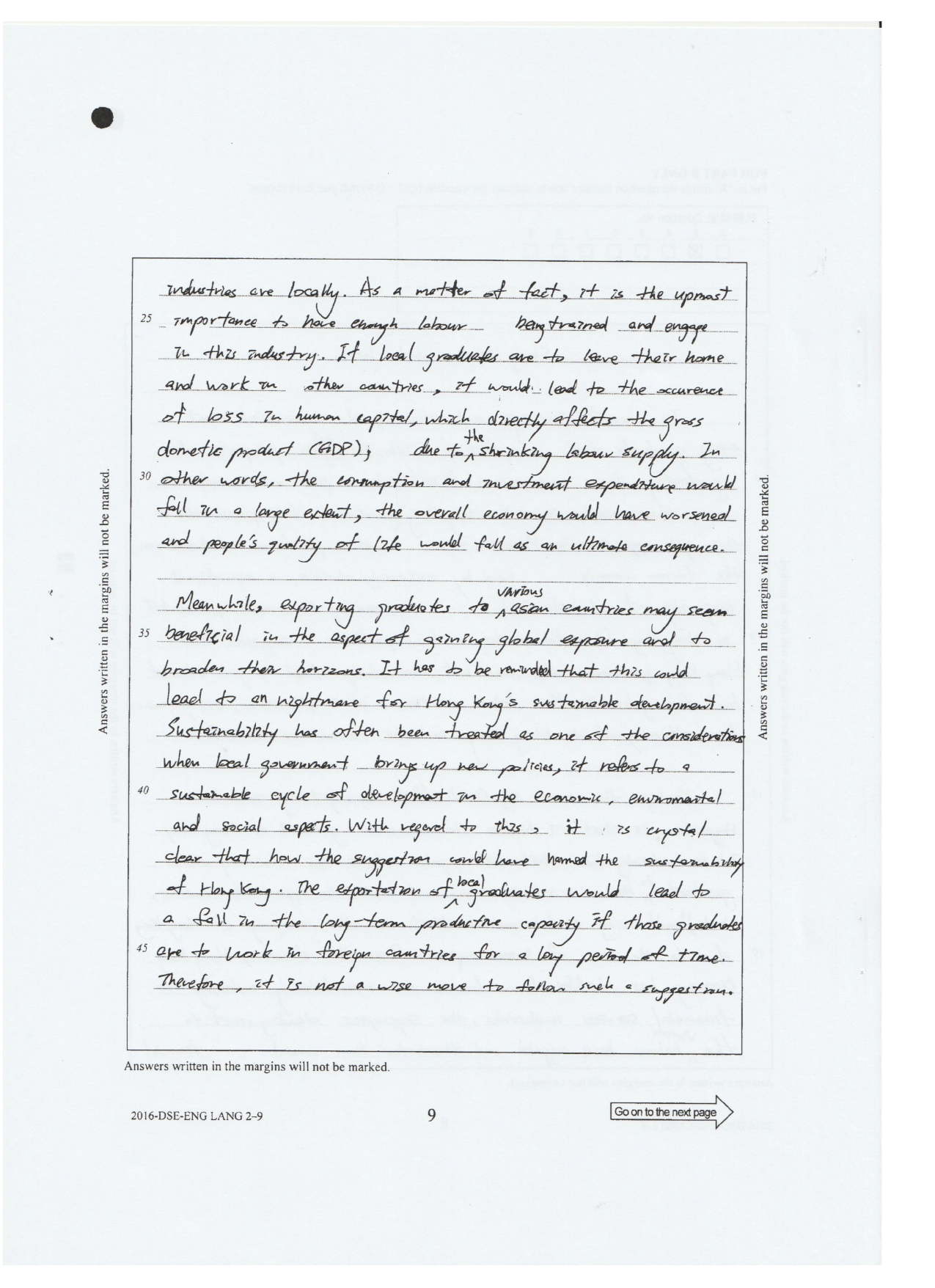

The writing, with corrections marked inline
Title. The candidate provides one: “Study local, Work local.” A clean two-clause slogan that previews the argument (against working abroad). Capitalisation is unconventional — Local should be capitalised in a title (Study Local, Work Local) — but the marker has not penalised this.
Position. The candidate argues against the suggestion — the more interesting position on this prompt, since most candidates agree. The three reasons are: (1) damage to Hong Kong’s economic growth, (2) damage to sustainable development, and (3) damage to diplomatic relationships with other Asian countries.
Word count. Roughly 520 words against the 400-word target — on the long side but well-controlled; each paragraph carries one full argument.
Handwriting. Clean and legible. One word in paragraph 2 is slightly hard to read (Harbour, in “the Victoria Harbour”) but the reading is unambiguous from context. No supplementary answer sheet used — the writing fits within the standard answer book.
Strengths to praise
“Study local, Work local.” Four words, two parallel imperatives. The title tells the reader the candidate’s position before the article begins — a magazine convention most candidates miss. The cadence (X local, Y local) is also memorable.
The candidate cites both a poll on the internet (“more than 90% felt pessimistic”) and a named forum (unistudent.com). Two sources hit harder than one; the named platform makes the evidence feel specific even if invented. Real opinion-piece craft.
The final sentence of paragraph 1 (“the reasons are three-fold”) tells the reader exactly what the article is about to do. The candidate then delivers three distinct reasons — economic growth, sustainable development, diplomatic relationships — each in its own paragraph. Road-map set and followed.
Human capital, GDP, shrinking labour supply, consumption and investment expenditure, productive capacity, sustainable cycle of development. Each term appears in the right paragraph and in correct collocation — the candidate has internalised the macroeconomic register, not just sprinkled it on.
Paragraph 2 concedes (stable income…) before rebutting (but it would bring a detrimental effect…). Paragraph 3 concedes (may seem beneficial…) before rebutting (this could lead to a nightmare). Concede-then-rebut is the signature shape of mature argumentative writing.
“Think about how you would feel if a vast number of graduates from Mainland China competed for a work placement with you…” The candidate flips the prompt — making the reader feel what it would be like to be on the receiving end. The kind of rhetorical move that distinguishes a 5 from a 5*.
The conclusion does not stop at don’t do this. It proposes two alternatives: developing scientific industries or subsidizing further studies and research. Articles arguing against a proposal are stronger when they offer a replacement; this candidate does.
Grammar notes
| Issue | Explanation |
|---|---|
(line 4) more than ninety per cent Hong Kong graduates → more than ninety per cent of Hong Kong graduates |
Percentage phrases need of before the noun (90% of graduates, 50% of voters, two-thirds of students). |
(line 4) felt pessimistic on their job opportunities → felt pessimistic about |
The adjective pessimistic takes the preposition about, not on: pessimistic about the economy, pessimistic about her chances. |
(lines 2–7) graduates felt unsatisfied · students felt depressed · graduates felt pessimistic |
The opening paragraph uses past tense for all three feelings (felt) even though the surveys are still current. Present tense or present perfect (feel pessimistic, have felt unsatisfied) would match the rest of the article’s present-tense framing. |
(line 18) Hong Kong economy → Hong Kong’s economy |
Genitive needed: the economy of Hong Kong / Hong Kong’s economy. The bare noun-noun compound (Hong Kong economy) reads as journalese in a school-magazine article. |
(line 19) shifted from focuses on manufacturing industry → shifted from a focus on manufacturing industries |
Two slips. (a) Focuses as a plural noun would mean ‘centres of attention’; the singular a focus matches the meaning. (b) Manufacturing covers many industries — the plural matches the parallel financial services industries in the same sentence. |
(line 21) standing next to the Victoria harbour → standing next to Victoria Harbour |
Proper noun — no article, and Harbour takes a capital H as part of the name. |
(lines 22–23) upmost importance → of utmost importance / of the utmost importance |
The fixed idiom is of utmost importance. Upmost means ‘closest to the top’ (a different word). The candidate writes a phonetic near-miss. |
(lines 23–24) have enough labour being trained and engage → train enough labour and have them engaged |
The original mixes a passive participle (being trained) and a bare infinitive (engage) under have, which doesn’t parse. The cleaner causative is have + object + past participle (have them engaged). |
(line 26) occurence → occurrence |
Spelling: double-r, double-c — oc-cur-rence. |
(line 26) loss in human capital → a loss in human capital |
The noun loss (countable in this sense) needs an article: a loss of revenue, a loss in capacity. |
(line 29) would fall in a large extent → fall to a large extent |
The fixed phrase is to a large extent, not in. (Compare to some extent, to a great extent, to what extent….) |
(line 29) the overall economy would have worsened → would worsen |
The candidate uses the perfect conditional (would have worsened) where the simple conditional (would worsen) is wanted — the consequence is hypothetical-future, not hypothetical-past. |
(line 34) It has to be reminded that → It should be remembered that / It is worth remembering that |
Remind takes a person as object (I remind you); it has to be reminded is structurally impossible because there is no person to remind. The natural impersonal form is It should be remembered that…. |
(line 35) an nightmare → a nightmare |
Nightmare begins with a consonant sound /n/ — a nightmare. The candidate writes an from spelling instinct. |
(line 37) local government brings new policies → brings in new policies / introduces new policies |
To enact policies, the collocation is bring in, introduce, roll out. Plain bring doesn’t carry the legislative sense. |
(lines 39–40) it is crystal clear that how the suggestion could have harmed → crystal clear how the suggestion could harm |
Two slips. (a) Embedded wh-clauses don’t take that before how / why / when. (b) The perfect could have harmed implies the harm is already in the past; the simple could harm matches the hypothetical-future frame. |
(line 46) the invasion of Hong Kong graduates to other Asian countries → the influx of Hong Kong graduates into… |
Invasion implies hostile military action — far too strong for a labour-migration argument. Influx is the right noun and pairs with into. |
(line 48) Think about how would you feel → Think about how you would feel |
In an embedded question after Think about…, English uses statement word order (how you would feel), not question word order (how would you feel). |
(lines 48–49) a vast amount of graduates → a vast number of graduates |
Amount is for uncountable nouns (amount of water); number is for countable nouns (number of graduates). |
(line 49) compete a work placement with you → compete for a work placement with you |
Compete needs the preposition for before the prize. The candidate omits it. |
(line 52) incur furious oppositions → provoke fierce opposition |
Three slips. (a) Incur collocates with costs, fines, penalties, debts, not opposition. (b) Furious describes anger in people, not abstract opposition; fierce is the natural intensifier. (c) Opposition in this sense is uncountable — no plural. |
(line 54) obtain a job as easy as before → obtain a job as easily as before |
Comparison of an adverb modifying the verb obtain — the adverb form easily, not the adjective easy. |
(line 55) between Hong Kong government and the governments of other countries → between Hong Kong’s government… |
The same genitive missing as in paragraph 2 (Hong Kong’s, not Hong Kong). |
(lines 57–58) cancellation of various trades agreements and future cooperations are hindered → cancellation of various trade agreements; future cooperation would be hindered |
Three slips. (a) Trade agreements, not trades agreements (the noun is used attributively, no plural). (b) Cooperation is uncountable in this sense (no plural). (c) The sentence sprawls into a clause-fragment; a semicolon and a finite verb (would be hindered) cleans it. |
(line 62) take such an action → take such a risky action / take such action |
Either the article disappears (take such action, indefinite) or it stays with an intervening adjective (take such a risky action). Such an action by itself reads incomplete. |
(lines 63–64) suggesting local graduates to find a job → suggesting that local graduates find a job |
Suggest does not take the to-infinitive (*suggest someone to do something). Use suggest that someone do something (bare subjunctive) or suggest doing something. |
(line 64) continentally |
The adverb exists (relating to a continent) but is rare and slightly awkward in this slot. Elsewhere in Asia or overseas lands more naturally. |
(line 66) subsidizing further studies and researches → subsidizing further studies and research |
Research in the academic / scientific sense is uncountable — no plural. (Plural researches exists in literary or older usage but is no longer standard.) |
(line 67) in the forthcoming future → in the near future / in the years to come |
Forthcoming future is a tautology — forthcoming already means ‘about to come’. Near future or years to come is the standard collocation. |
Style suggestions (where strong writing could become outstanding)
For comparison only, not a correction. Paragraph 4 (lines 46–59) contains the article’s most original rhetorical move (the reverse-perspective question) but is also the paragraph where the candidate’s grammar most often slips. The rewrite shows how a magazine sub-editor would land the same three ideas in roughly the same length, keeping the candidate’s flip-perspective hook.
The candidate’s paragraph (corrected for grammar)
Rewritten by a professional sub-editor
A sudden influx is rarely welcomed quietly. Local workers would push back, and the governments hosting them would feel the pressure. The damage would not stop at the labour market: trade pacts could be reopened, cooperation agreements stalled, and the reputation Hong Kong has spent decades building — as a city you negotiate with, not a city that sends its problems overseas — would be the first thing to fall.
- A four-word paragraph opener. “Then there is the diplomacy.” — one short sentence as a signal that a new argument is starting. The candidate’s “Speaking of diplomatic relationships” is functional but generic.
- The reverse-perspective move is given room to breathe. Three short sentences (Imagine… / How would that feel? / Now flip it) instead of one long question. Each sentence gives the reader a single beat to absorb.
- Specific cities, not ‘other Asian countries’. Hanoi, Bangkok, Manila — three concrete destinations that the reader can picture. Specificity is what makes the argument feel argued rather than asserted.
- The diplomatic consequence is broken into three pieces. Trade pacts reopened, cooperation stalled, reputation fallen. The candidate’s version stacks all three in one sprawling clause; splitting them into a tricolon gives each one weight.
- Final image is concrete. “A city you negotiate with, not a city that sends its problems overseas” — an antithesis (X, not Y) that crystallises Hong Kong’s stake in one image. “Notorious for it” in the original is too vague to land.
Vocabulary to notice
| Word / phrase | Definition | Usage notes | Synonyms / alternatives |
|---|---|---|---|
| pessimistic | (adj.) tending to see the worst aspect of things or to believe the worst will happen. | Pairs with about, not on or to: pessimistic about the future, about her chances. Opposite: optimistic. | gloomy, cynical, defeatist, downbeat |
| prospects | (n., often plural) the possibility or likelihood of future success. | In the sense of ‘future possibilities’, almost always plural: career prospects, job prospects, marriage prospects, bright prospects. | chances, outlook, possibilities, opportunities |
| three-fold | (adj. / adv.) having three parts, sides, or aspects; consisting of three. | Used both as adjective (a three-fold problem) and as adverb (increased three-fold). Compare two-fold, four-fold. | threefold, triple, tripartite, three-pronged |
| hinder | (v.) to create difficulties for, resulting in delay or obstruction; to hold back. | Pairs with progress, growth, development, efforts. Stronger than slow, weaker than block. | impede, obstruct, hamper, hold back |
| detrimental | (adj.) tending to cause harm. | Formal. Pairs with effect, impact, consequence, influence + on / to. Compare harmful, damaging. | harmful, damaging, deleterious, injurious |
| human capital | (n.) the skills, knowledge, and experience possessed by an individual or population, viewed in economic terms. | Macroeconomic register. Pairs with invest in, build, deplete, lose, develop. | workforce skills, talent base, intellectual capital, manpower |
| gross domestic product (GDP) | (n.) the total monetary value of all finished goods and services produced within a country’s borders in a specific time period. | Capitalised acronym (GDP). Common in news and economic writing. Compare with GNI, GNP. | national output, economic output, total economy |
| labour supply | (n. phrase) the total amount of labour available in an economy or region. | Economic term. Pairs with shrinking, ageing, expanding, abundant. Compare labour force, workforce. | workforce, manpower, labour pool, employment base |
| consumption and investment expenditure | (n. phrase, economics) the total of household spending plus business spending on capital goods. | From national accounts — the C and I in GDP = C + I + G + (X − M). Slightly textbook in register. | aggregate demand, total spending, private spending |
| broaden one’s horizons | (idiom) to increase the range of one’s knowledge, experience, or understanding. | Common with travel, study, work abroad. Fixed phrase: don’t say widen horizons in this collocation. | expand one’s outlook, gain perspective, widen one’s experience |
| sustainable development | (n. phrase) economic development conducted without depleting natural resources or harming future generations’ ability to meet their needs. | Brundtland Commission definition (1987). Pairs with promote, achieve, pursue, threaten, undermine. Standard policy register. | green growth, balanced development, long-term development |
| productive capacity | (n. phrase, economics) the maximum amount of output an economy can produce given existing resources. | Pairs with expand, build up, lose, erode. Economic / industrial register. | output capacity, production potential, industrial capacity |
| diplomatic relationships | (n. phrase) formal relations between governments or states. | Pairs with establish, strengthen, sever, damage, strain. Compare with bilateral relations, foreign relations. | bilateral ties, foreign relations, international relations |
| influx | (n.) an arrival or entry of large numbers of people or things. | Takes of + group, and into + place: an influx of tourists into the city. Neutral or mildly negative connotation; not as hostile as invasion. | flood, surge, wave, inrush |
| work placement | (n. phrase) a temporary period of work undertaken as part of training or study. | Common in HR and education contexts. Compare with internship, attachment, work experience. | internship, attachment, traineeship, work experience |
| notorious | (adj.) famous or well-known, typically for a bad quality or deed. | Always negative. Pairs with for: notorious for corruption, for crime, for bad weather. Compare famous (positive or neutral), infamous (close synonym). | infamous, ill-famed, disreputable, scandalous |
| subsidize / subsidise | (v.) to support an activity or organization financially by paying part of the cost. | Pairs with industries, research, agriculture, housing, education. British -ise, American -ize. | fund, finance, underwrite, support |
| crystal clear | (adj. idiom) absolutely clear; unmistakable. | Pairs with it is crystal clear that…. Slightly clichéd but acceptable in argumentative writing. | unmistakable, transparent, unambiguous, plain |
| exportation | (n.) the action of sending goods or services abroad for sale. | Usually used of goods; applied to people (exportation of graduates) it carries a faint commodity connotation. Compare export as a noun. | export, outflow, sending abroad |
| incur | (v.) to become subject to (something unwelcome or unpleasant) as a result of one’s own behaviour or actions. | Collocates with costs, debts, fines, penalties, damages, expenses, criticism, wrath. Not with opposition (the candidate’s slip). | attract, bring on, suffer, sustain |
| cooperation | (n., uncountable) the action of working together to the same end. | Uncountable — no plural in this sense. British also co-operation. | collaboration, partnership, joint action, teamwork |
| foreseeable | (adj.) able to be foreseen or predicted. | Common with future (in the foreseeable future), consequence, problem, benefit, risk. | predictable, expected, anticipated, likely |
| implement | (v.) to put a decision, plan, or law into effect. | Pairs with policies, reforms, decisions, strategies, recommendations. The noun implementation appears in policy writing. | carry out, enact, execute, put into practice |
| utmost | (adj.) most extreme; greatest. | The idiom is of utmost importance or of the utmost importance. Not upmost, which means ‘highest up’. | greatest, paramount, supreme, maximum |
Leave a Reply