Welcome Speech to New Students
You are the President of the Students’ Union at your school. You are preparing a speech to welcome new students on the first day of school. In order to help new students achieve success and have an enjoyable school life, you want to talk about the following in your speech:
- importance of following school rules; and
- importance of interpersonal relationships.
The first part of the speech has been written for you. Finish the speech. (~200 words)
Show original handwritten pages (2)

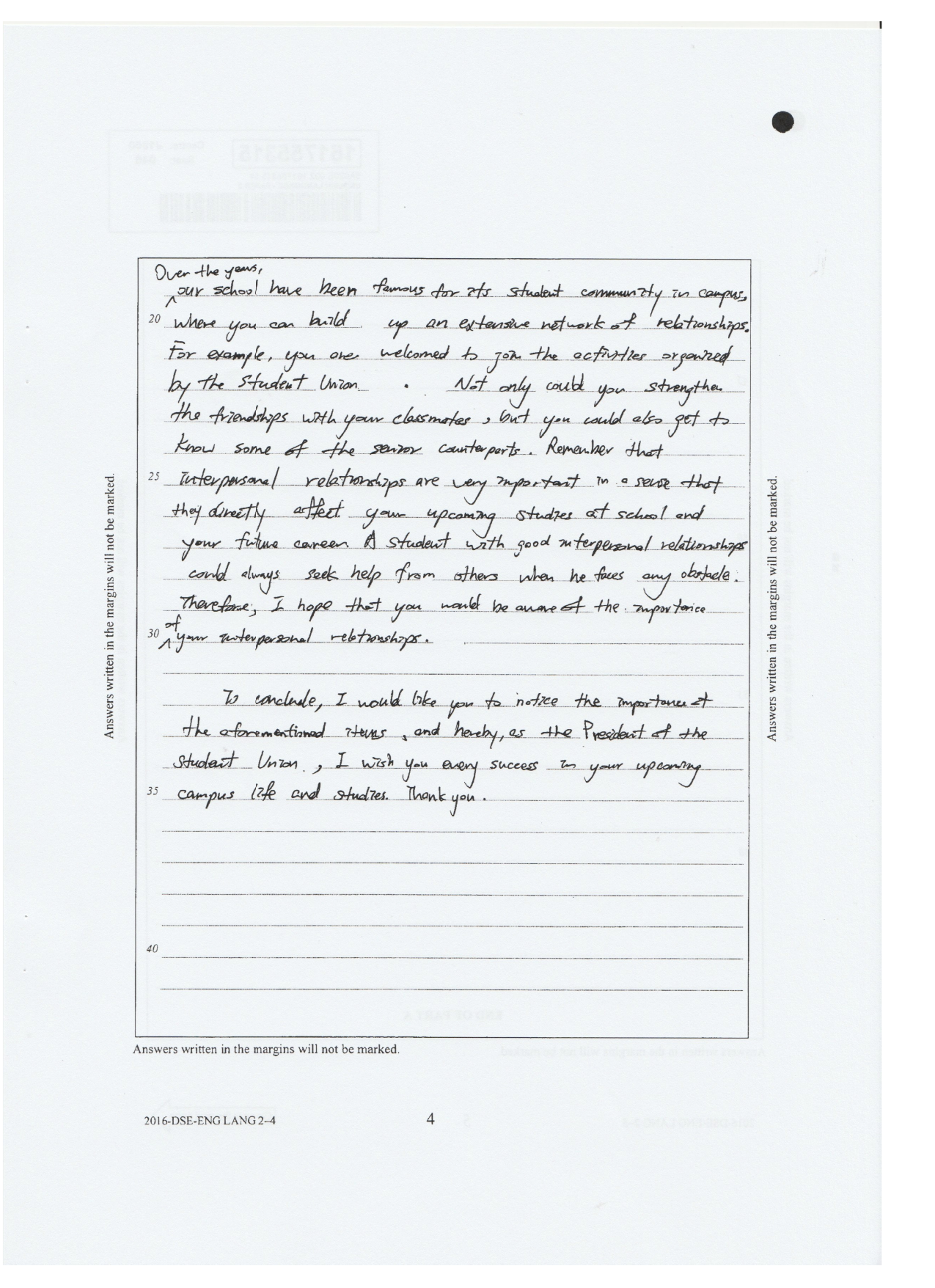
The writing, with corrections marked inline
On behalf of the Students’ Union, I’d like to welcome all of you to our school. I’m sure we all want to achieve success and have an enjoyable school life, so this morning I’d like to give you some advice.
Word count. Roughly 280 words against the ~200-word target — on the long side for a 5-band Part A but well within the marker’s tolerance.
Handwriting. Clean, legible cursive throughout. Two small carat-style insertions visible above the lines (read and in paragraph 1 line 1; Over the years opener at the start of paragraph 3) have been folded into the corrected transcript above. No words have been flagged as unclear.
Bullet coverage. Both bullets are addressed at roughly equal length, with an explicit one-line bridge (“What follows is some advice for your interpersonal relationships.”) marking the pivot.
Strengths to praise
The candidate names the role twice — “as the President of the Students’ Union, I urge you to read the school rules carefully” at the end of paragraph 1, and “as the President of the Students’ Union, I wish you every success” in the close. The persona is not just claimed in the pre-printed opening and then forgotten; it bookends both halves of the speech.
“What follows is some advice for your interpersonal relationships.” — a one-line bridge that signals the bullet change without using the conventional Now let me move on to…. The hinge is given its own paragraph, which gives the audience a small breath between the two halves of the speech.
The rules paragraph specifies uniform neat and clean and the inner pages of your student handbooks as a concrete anchor; the relationships paragraph specifies activities organized by the Students’ Union and some of your seniors. The candidate avoids the common 5-band trap of arguing only in generalities.
“First and foremost…”, “For example…”, “Remember that…”, “Therefore, as the President…”, “To conclude…”. The candidate sequences these discourse markers in roughly the order an audience would expect to hear them, which gives the speech a satisfying shape even before the content is weighed.
“Not only could you strengthen friendships with your classmates, but you could also get to know some of your seniors.” A correctly-inverted not only construction with the modal could in both clauses. This is the sort of structural sentence-form that distinguishes a low-5 from a high-5.
“A student with good interpersonal relationships could always seek help from others when he runs into any obstacle.” The sentence converts the abstract claim (relationships are important) into the practical pay-off (you can ask for help when something goes wrong). That is the argument the marker wants to see at this band.
The opening “First and foremost, you are strongly advised…” and the close “I wish you every success in your upcoming campus life and studies. Thank you.” are calibrated for a speech delivered orally. The final Thank you is the right ceremonial sign-off; the speech does not end mid-thought the way essay-trained candidates often end.
Grammar notes
| Issue | Explanation |
|---|---|
(line 2) the school rules at our school → the school rules of our school |
The collocation is the rules of X (genitive) — rules belong to the school. At works locatively (students at our school) but not possessively. |
(line 5) the rules clearly stated what kind of behaviours… → the rules clearly state… |
The handbooks are being distributed this morning in the speech’s present tense; the rules state, not stated. The candidate slips into the past for the verb that should anchor the present. |
(line 8) maintain a good self-discipline → maintain good self-discipline |
Self-discipline is uncountable — no article. Compare maintain good behaviour, maintain good hygiene, all without a. |
(line 8) in the campus → on the campus / on campus |
The preposition for campus is on: on campus, on the campus, life on campus. In the campus is a common Hong Kong-English slip. |
(line 9) act justly, it is a vital way → act justly; it is a vital way |
Comma splice between two independent clauses. A semicolon or full stop is what is needed here. The candidate uses commas for sentence breaks in three places across paragraph 1. |
(lines 12–13) act wisely and finally to uphold the fame → act wisely and finally uphold the good name |
Two issues. First, parallelism: obey…, act…, uphold… — the third verb should match the bare-infinitive pattern of the first two (drop to). Second, the fame of our school doesn’t quite work in English — fame implies celebrity / notoriety, whereas the candidate means reputation, good name. |
(line 14) President of the Student Union → President of the Students' Union |
The body’s name is the Students’ Union (apostrophe-s, the union of the students). The pre-printed opening uses the correct form; the candidate then drops the apostrophe-s for the rest of the speech. A small but visible inconsistency. |
(line 17) Following up are some advice → What follows is some advice / Here is some advice |
Two issues. (a) Following up are is a participial construction that doesn’t parse here; the natural opener is What follows is or Here is. (b) Advice is uncountable — takes singular is, not plural are. |
(line 18) our school have been famous → our school has been famous |
Subject-verb agreement. Our school is singular. (British English does allow plural agreement with collective nouns when emphasising the members — the team are arguing — but for school in this generic sense the singular is standard.) |
(line 19) in campus → on campus |
Same as above — the candidate makes the in/on campus slip twice. Worth a single fix-up in proofreading. |
(line 20) you are welcomed to join → you are welcome to join |
The fixed phrase is you are welcome to + verb (adjective welcome), not you are welcomed to (past participle, which would mean someone welcomes you in order to…). |
(line 23) some of the senior counterparts → some of your seniors |
Counterparts means people in the equivalent role elsewhere (e.g. the principal’s counterpart at another school). In a school-rank sense the natural word is simply seniors or older students. |
(line 24) important in a sense that they directly affect → important in the sense that… |
The fixed phrase is in the sense that (definite article). In a sense, X exists separately, but it doesn’t take a that-clause. |
(line 26) your future careers → your future career |
Each individual student has one future career, so the distributive singular is preferred. Your future careers would suggest each student will hold multiple careers. |
(line 27) when he faces any obstacle → when he runs into any obstacle |
Grammatical as written, but face an obstacle sounds slightly static. Run into is the natural collocation for unexpected difficulties. (Polish, not error.) |
(line 31) I would like you to notice the importance → I would like you to take note of the importance |
Notice is involuntary (one notices what one happens to see). To call attention to something deliberately, the verb is take note of or recognise. A small register slip in a closing line. |
(line 32) the aforementioned items → the aforementioned points |
Items belongs to lists or invoices, not to speech content. Points is the speech-register equivalent (I have made two main points today…). |
(line 32) and hereby, as the President…, I wish you → and here, as the President…, I wish you |
Hereby belongs in legal documents (I hereby resign, hereby certify). The candidate wants the simple here (now, in this speech). The slip is visible because it is in the closing sentence. |
Style suggestions (places where strong writing could become outstanding)
Professional rewrite — the closing paragraph (weak moment)
For comparison only, not a correction. The closing paragraph is where the speech tips most clearly out of the spoken voice and into the kind of phrasing that belongs on the bottom of an internal memo: take note of the importance of the aforementioned points, hereby, as the President, your upcoming campus life and studies. The student knows where to put the role-claim and the ceremonial Thank you; the rewrite keeps both, but ditches the legal-document vocabulary in between.
The student’s closing paragraph (corrected)
Rewritten by a professional speech-writer
- The two-take-aways compress the whole speech to a line. Read the rules. Build the friendships. Two five-word sentences a Form 1 student could repeat back at lunch. The student’s the importance of the aforementioned points obscures the actual content of the speech behind a label.
- The role-claim moves from hereby, as the President to On behalf of the Students’ Union. The latter echoes the pre-printed opening (On behalf of the Students’ Union, I’d like to welcome all of you), which gives the speech a satisfying frame — the same body that opened it is the body that closes it.
- The blessing gets specific. Every success in your upcoming campus life and studies is what you say to anyone, anywhere. Have a brilliant six years is what you say to thirteen-year-olds standing at the start of secondary school — six years is the actual time-horizon of their relationship with this school. Specificity is what audience-pitched writing does.
- The legal vocabulary goes. Aforementioned, hereby, take note of — three back-to-back words from solicitors’ letters. The rewrite swaps them for two things to take away, which is what a speaker actually says.
- Short sentences create speech rhythm. The student’s closing is one long sentence with three coordinated clauses. The rewrite is five short sentences, each landing a single beat. A speaker delivers short sentences; a writer delivers long ones.
Vocabulary to notice
| Word / phrase | Definition | Usage notes | Synonyms / alternatives |
|---|---|---|---|
| first and foremost | (idiom) above all else; before anything else. | Sentence-opening discourse marker. Comma after. Common in speeches, opinion pieces, and policy documents. | most importantly, above all, before all else, first of all |
| strongly advised | (v. phrase, passive) given firm advice to do something. | Formal. Pairs with strongly advised to + verb. Slightly impersonal — works in written instructions but a bit stiff in a welcome speech to teenagers. | urged, recommended, encouraged, told |
| under all circumstances | (idiom) no matter what the situation; without exception. | Pair with must / should / are expected to. Compare at all times, in any case, no matter what. | at all times, in every case, no matter what, without exception |
| self-discipline | (n., uncountable) the ability to control one’s behaviour, feelings, and impulses. | Uncountable — good self-discipline, not a good self-discipline. Pairs with maintain, develop, demonstrate, lack. | self-control, self-restraint, willpower, discipline |
| harmonious | (adj.) marked by agreement and accord; free from conflict. | Common with relationship, atmosphere, community, environment. Adverb: harmoniously. | peaceful, agreeable, congenial, cordial |
| uphold | (v.) to maintain or support (a tradition, principle, reputation, law). | Pairs with abstract nouns: uphold the law, uphold a decision, uphold a tradition, uphold the good name of… (not the fame of…). | maintain, defend, sustain, protect |
| decent manners | (n. phrase) socially acceptable, polite behaviour. | Decent here = morally acceptable, respectable. Slightly informal. Compare good manners (more standard), proper conduct (more formal). | good manners, proper conduct, polite behaviour |
| extensive | (adj.) covering a large area or range; very large in scope. | Pairs with network, knowledge, experience, damage, research. Slightly formal — in speech register, wide often works better. | wide, broad, far-reaching, comprehensive |
| welcome to (+ verb) | (adj. + infinitive) freely permitted or invited to do something. | The adjective form: you are welcome to ask, welcome to stay, welcome to join — not welcomed, which is the past participle of the verb. | free to, invited to, encouraged to, at liberty to |
| strengthen | (v.) to make stronger or more secure. | Pairs with friendships, bonds, relationships, ties, position. Useful when the noun is metaphorically a structure that can be reinforced. | reinforce, solidify, fortify, build up |
| counterpart | (n.) a person or thing with the same role or position as another, in a different setting. | The candidate uses this for seniors, which doesn’t quite work — counterparts are equals in a parallel place (the principal’s counterpart at the other school), not seniors in the same school. | equivalent, opposite number, parallel |
| in the sense that | (discourse marker) introducing a clarifying explanation of how a claim is meant. | Definite article (the), not a. Compare with in a sense (which stands alone and means ‘in one way’). | meaning that, in that, inasmuch as |
| obstacle | (n.) a thing that blocks one’s way or prevents progress. | Pairs with face, overcome, encounter, run into, remove. Both literal (an obstacle on the road) and metaphorical (an obstacle to progress). | hurdle, barrier, hindrance, impediment |
| aforementioned | (adj.) referred to or mentioned previously. | Formal, slightly legal. Common in essays and reports, less natural in spoken English. Compare the above, the points I have made, what I have just said. | above-mentioned, previously mentioned, the foregoing |
| hereby | (adv.) by this means; as a result of this statement. | Belongs in legal documents and formal proclamations (I hereby resign, hereby certify, hereby declare). Out of place in a school speech — use here or now instead. | by this, with these words, here, now |
| upcoming | (adj.) approaching; about to happen or arrive. | Pairs with events and time-periods: upcoming examination, upcoming year, upcoming campus life. American origin, now standard in British English too. | forthcoming, approaching, imminent, coming |
| community | (n.) a group of people living in the same place or having a particular characteristic in common. | Useful for talking about schools, neighbourhoods, faiths, professions. Pairs with build, foster, nurture, join, leave. | society, group, fellowship, body |
Leave a Reply