Letter to Parents on Choosing an Acting Career
You are a Form Six student considering educational opportunities after your HKDSE. You have selected the Hong Kong Academy for Performing Arts (HKAPA) as you want to take up an acting career. However, your parents would like you to pursue an academic subject at another institution. As the deadline for submitting the application is approaching, you decide to write an email to your parents (who are on an overseas trip) to convince them to support your choice.
Write the email. (~400 words)
Show original handwritten pages (3)
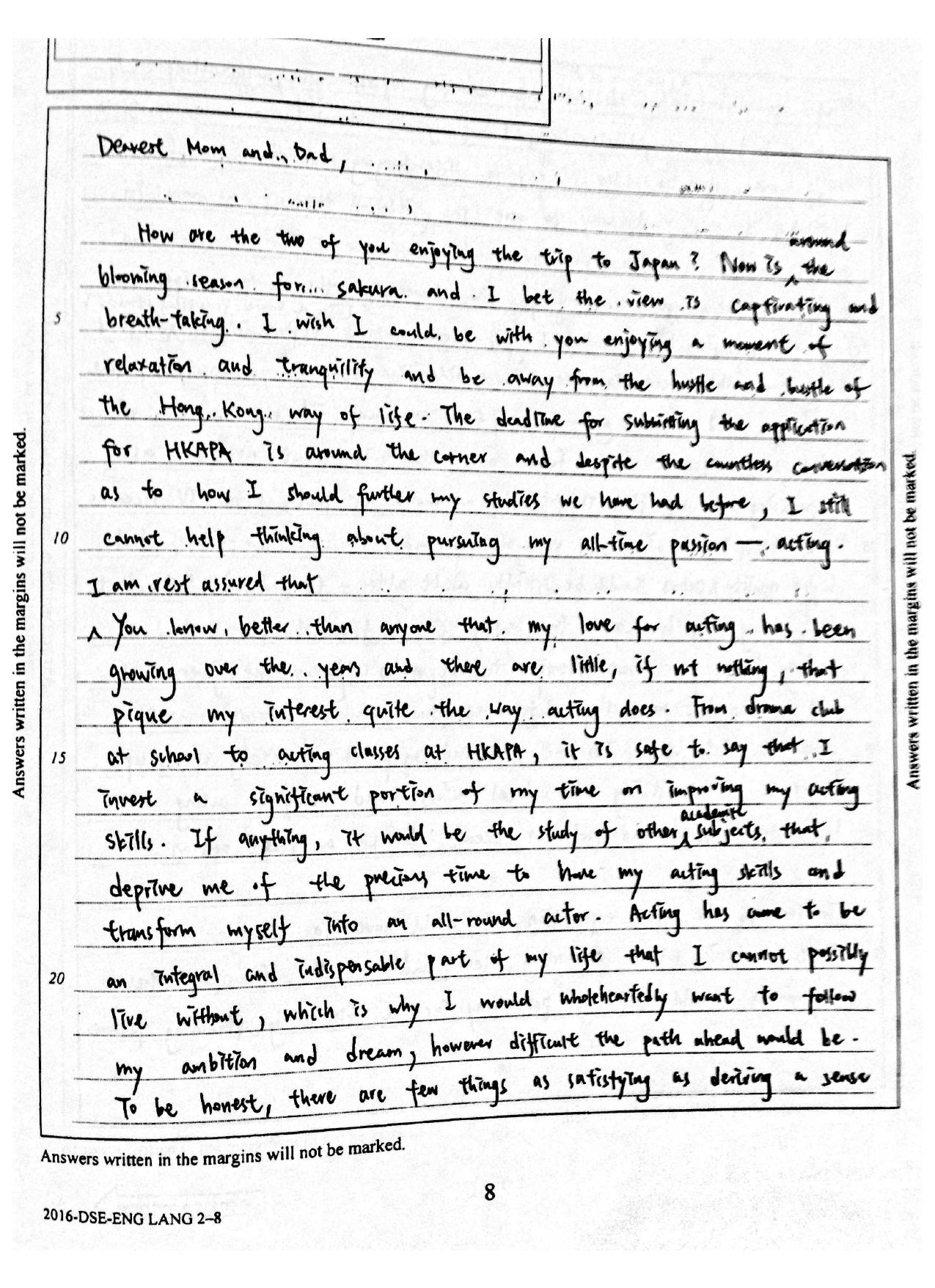

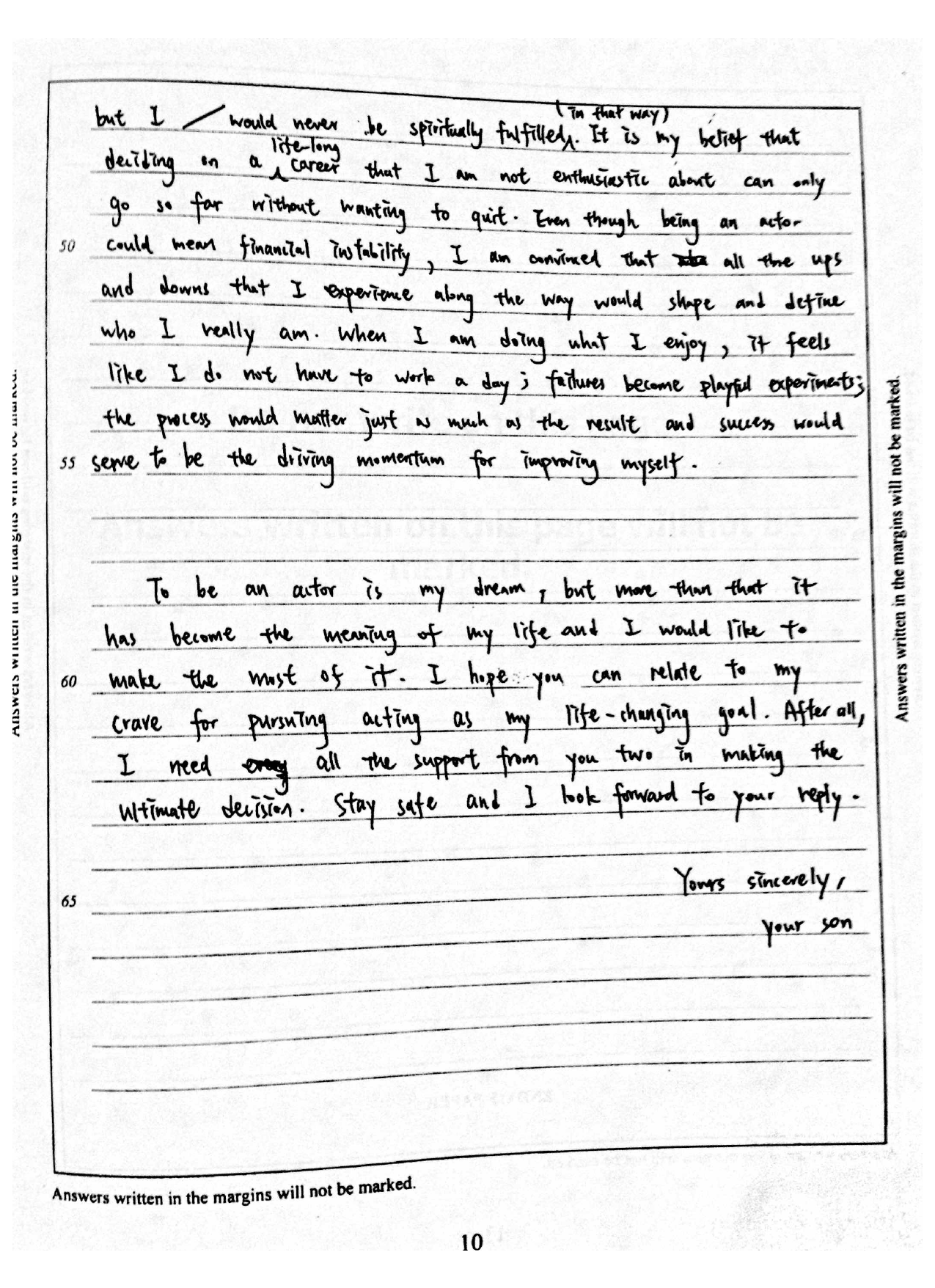
The writing, with corrections marked inline
The marker spread. M1 scored this 19/21; M2 scored 13/21. That is a six-point gap, which triggers a third marker (D3) under HKEAA double-marking rules. D3 scored 20/21, agreeing closely with M1, and the closest-pair adjustment (M1 + D3) gave the final 39/42. The mid-marker (M2) appears to have penalised the prose tangles in places where M1 and D3 saw the argument and the warmth as the dominant features.
Register slip in the sign-off. Yours sincerely is for formal letters (to teachers, employers, strangers). To parents, the convention is Love, With love, or Yours lovingly. The closing closes the wrong register, and a careful marker will notice.
One unclear interpolation: on page 7 a phrase reads “(In a more practical sense)” — it sits awkwardly between two clauses and the brackets are the candidate’s own. Kept above as a parenthetical, which is the best reading.
Strengths to praise
The letter opens with two sentences of family warmth (“How are the two of you enjoying the trip to Japan? Now is the blooming season for sakura, and I bet the view is captivating and breath-taking. I wish I could be with you…”) before pivoting to the application. Persuasive letters to family don’t open with the argument; they open with the relationship. The candidate knows this instinctively.
The career-prospects paragraph opens: “One of the biggest concerns you two have is the career prospect of an actor in terms of stability, income and opportunities. I fully understand the need to take into consideration the many aspects of the career and not my passion for it alone.” That is a textbook concession move — name the opponent’s argument fairly, signal that you’ve heard it, then introduce your evidence. Adults reading this letter would feel respected, not lectured.
Instead of insisting on the dream, the letter argues that the dream is also rational: “more TV licences will be issued in the near future… Hong Kong has gone from solely being a ‘financial centre’ to a society that pays more attention to art and culture, the government will surely be more determined than ever to allocate more resources to the TV and film industry.” That is a three-part argument (industry expansion + cultural shift + government policy) that a parent might actually find moving. Very mature rhetorical move for a 17-year-old.
“When I am doing what I enjoy, it feels like I do not have to work a day; failures become playful experiments; the process would matter just as much as the result…” — this is the heart of the letter and the candidate lets it run. The three short clauses (I do not have to work a day; failures become playful experiments; the process would matter just as much as the result) build to a triplet rhythm. A marker reading this paragraph believes the writer.
“From drama club at school to acting classes at HKAPA, it is safe to say that I invest a significant portion of my time on improving my acting skills… when I finally managed to interpret not only the outer but also inner emotions of a character who faces a life-changing dilemma.” Specifics (the drama club, the HKAPA classes, the language of “outer vs inner emotions”) prove the passion isn’t just a teenage whim. A general claim of love wouldn’t have done this work.
Sakura, captivating, breath-taking, tranquillity, hustle and bustle, all-time passion, pique my interest, hone, indispensable, wholeheartedly, dedicating and devoting, life-changing dilemma, in a more practical sense, sought after, allocate, viable option, spiritually fulfilled, financial instability, ups and downs, shape and define, playful experiments, driving momentum, ultimate decision. The lexis sits above average for the band and the collocations are mostly natural.
“After all, I need all the support from you two in making the ultimate decision.” The letter doesn’t say “I am going to HKAPA whether you like it or not.” It says I need your support to make the decision — subtly putting the parents back in the loop and inviting them to be part of the choice. This is the right strategic move for a persuasive letter to family.
Grammar notes
| Issue | Explanation |
|---|---|
(line 14) I am rest assured that… → Rest assured that… / I can assure you that… |
Rest assured is a fixed phrase used as a stand-alone clause: “Rest assured that we will reply soon.” It does not take I am in front of it. The student probably blended I am sure with rest assured. |
(line 17) there are little, if not nothing, that pique my interest → there is little, if not nothing, that piques my interest |
Two issues. (i) Little and nothing are both singular pronouns, so the verb is is, not are. (ii) The relative clause’s subject (the antecedent) is also singular, so that piques, not that pique. |
(line 21) I invest a significant portion of my time on improving → in improving |
Invest + time / money / effort takes in, not on: invest time in a project, invest money in shares. Spend takes on; invest takes in. |
(line 23) it would be the study of other academic subjects that deprive me → that deprives me |
The subject of the relative clause is the study (singular). The verb agrees: deprives. |
(line 47) it is little doubt that… → there is little doubt that… |
The fixed existential construction is there is little doubt…, not it is little doubt…. It is works only with predicate adjectives or noun phrases (It is doubtful that…); for the existential meaning (very little doubt exists), English uses there. |
(line 54) allocate more resources into the TV and film industry → allocate more resources to the TV and film industry |
Allocate X to Y is the fixed pattern (allocate funds to projects, allocate seats to students). Into is for direction of movement (pour money into a project) — not for assignment. |
(line 55) opens up all sorts of possibility → opens up all sorts of possibilities |
All sorts of introduces a plural noun: all sorts of options, all sorts of people, all sorts of possibilities. Possibility in the singular would need a determiner (a possibility). |
(line 60) To live up to your expectation → To live up to your expectations |
Expectations is almost always plural in this idiom. Meet expectations, exceed expectations, live up to expectations — in each case, the plural is the natural form. |
(line 63) pave way for a financially promising future → pave the way for a financially promising future |
Pave the way is a fixed idiom — the definite article the is part of the phrase. Pave way alone is non-standard. |
(lines 65–68) It is (in that way) my belief that deciding on a lifelong career…can only go so far → I believe that committing to a lifelong career…can only go so far |
The original is grammatically intact but the (in that way) is a marginal interpolation that the marker has to parse, and it is my belief that is essay-formula English. I believe is more direct, more honest in a personal letter, and shorter. |
(line 82) I hope you can relate to my crave for pursuing acting → my craving for pursuing acting |
Crave is a verb, not a noun. The noun is craving: a craving for chocolate, a craving for travel. (The student may have confused this with the noun crave in product-marketing English, which is rare and not standard.) |
(lines 88–89) Yours sincerely, your son |
Register slip. Yours sincerely belongs at the end of formal letters (to teachers, employers, strangers). To parents, the convention is Love, With love, Yours lovingly, or simply the writer’s name. The whole letter has been warm; the sign-off should be warm too. |
(lines 11–13) despite the countless conversations as to how I should further my studies we have had before |
The clause holds together but reads in a tangle — the head conversations is followed by as to…before, with the relative clause we have had before stranded at the end. Easier: “despite the many conversations we’ve had about my future studies”. |
(lines 67–68) can only go so far without wanting to quit |
The thought is right but the syntax is muddled: who is the subject of without wanting to quit? The candidate. The cleanest version makes that explicit: “…a lifelong career I’m not enthusiastic about — I’d burn out before long.” |
(lines 73–75) failures become playful experiments / the process would matter just as much as the result |
Tense mismatch inside the same triplet. The first half is simple present (failures become); the second half slides to conditional (would matter). Keep all three in simple present to land the rhythm: “failures become playful experiments; the process matters as much as the result; success becomes momentum.” |
Style suggestions (where strong writing could become outstanding)
For comparison only, not a correction. I picked the opening paragraph because (i) it is the longest stretch of unbroken text in the letter, (ii) it does several jobs at once (greeting, missing-you note, topic shift, the love-for-acting argument), and (iii) the second marker M2 scored Language 4/7 here — suggesting this is where the prose felt heaviest. The rewrite shows what a polished version of the same paragraph, with the same content, could read like in roughly the same word count.
The student’s opening paragraph (corrected for grammar)
How are the two of you enjoying the trip to Japan? Now is the blooming season for sakura, and I bet the view is captivating and breath-taking. I wish I could be with you enjoying a moment of relaxation and tranquillity and be away from the hustle and bustle of the Hong Kong way of life. The deadline for submitting the application for HKAPA is around the corner and despite the countless conversations as to how I should further my studies we have had before, I still cannot help thinking about pursuing my all-time passion — acting. Rest assured that you know better than anyone that my love for acting has been growing over the years, and there is little, if not nothing, that piques my interest quite the way acting does. From drama club at school to acting classes at HKAPA, it is safe to say that I invest a significant portion of my time in improving my acting skills. If anything, it would be the study of other academic subjects that deprives me of the precious time to hone my acting skills and transform myself into an all-round actor.
Rewritten by a professional letter-writer
How are you both enjoying Japan? The sakura must be in full bloom by now — I can almost see the view from here. Part of me wishes I were with you, an ocean and a working week away from Hong Kong.
But I’m writing because there is something I need to talk to you about while you’re away. The HKAPA application is due next Friday, and I know we’ve had this conversation before. I haven’t changed my mind. If anything, the closer the deadline gets, the surer I am.
You both know how long I’ve loved this. From the drama club at school to weekend classes at HKAPA, I’ve spent more hours on acting than on any subject in my timetable — and I’ve never regretted one of them. The truth is, the only thing that ever stops me improving as an actor is the rest of my homework.
- Splits one long paragraph into three shorter ones. Greeting / topic-shift / case — each gets its own paragraph. Family letters breathe better with white space.
- Names the swerve. “I’m writing because there is something I need to talk to you about while you’re away.” The original swerves from sakura to HKAPA without warning; the rewrite earns the turn with a single confiding sentence.
- Replaces “an all-time passion — acting” with a deeper move. I haven’t changed my mind. If anything, the closer the deadline gets, the surer I am. — speaks to the parents’ real fear (that the child might still wobble) and pre-empts it.
- Inverts the “academic subjects deprive me” line. The student’s version sounds aggrieved (“the study of other academic subjects deprives me of the precious time”). The rewrite’s version sounds confident and slightly funny (“the only thing that ever stops me improving as an actor is the rest of my homework”) — same idea, less complaint.
- Drops three stock phrases. The hustle and bustle of Hong Kong way of life, an all-time passion, an all-round actor, captivating and breath-taking — the rewrite uses none of these. They are not wrong, but they signal “student essay” rather than “real letter.” A polished version chooses fresher images even at the cost of vocabulary points.
Vocabulary to notice
| Word | Definition | Usage notes | Synonyms / alternatives |
|---|---|---|---|
| captivating | (adj.) capable of attracting and holding interest; charming, enchanting. | Often used of views, performances, smiles, stories. From the verb captivate. | enchanting, mesmerizing, riveting, spellbinding |
| breath-taking | (adj.) astonishing or awe-inspiring in quality, so as to take one’s breath away. | Pairs with view, beauty, scenery, performance, speed. Often hyphenated. | stunning, awe-inspiring, jaw-dropping, magnificent |
| tranquillity | (n.) the quality or state of being calm and peaceful. | British spelling tranquillity; American tranquility. Slightly literary; pairs with peace, calm, serenity. | peace, calm, serenity, stillness |
| hustle and bustle | (idiom) busy and noisy activity, especially in a city or workplace. | Fixed phrase — the two words are always paired in this order. Often the hustle and bustle of X (city life, the office, daily routine). | commotion, busyness, frenetic activity, rush |
| pique (one’s interest) | (v.) to stimulate (curiosity, interest); to arouse. | Almost always paired with interest, curiosity, attention. Pronounced “peek”. Not to be confused with peak (mountain) or peek (glance). | arouse, stir, awaken, kindle |
| hone | (v.) to refine or perfect (a skill) over time; to sharpen. | Originally of sharpening blades on a hone (whetstone). Now mostly figurative: hone one’s skills, hone one’s craft, hone an argument. | sharpen, refine, polish, perfect |
| all-round | (adj.) versatile; competent or skilled in many different areas. | Of people: an all-round athlete, an all-round actor. Adverb form: all-round (British) / all-around (American). | versatile, well-rounded, multi-skilled, accomplished |
| integral | (adj.) necessary to make a whole complete; essential. | Often pre-modifies part, role, member, component. Stronger than important. | essential, indispensable, fundamental, vital |
| indispensable | (adj.) absolutely necessary; impossible to do without. | Strong word; usually of people, tools, or roles. Often pairs with part, role, ally, ingredient. | essential, vital, crucial, irreplaceable |
| wholeheartedly | (adv.) with complete sincerity and commitment; without reservation. | Common with verbs of agreement and support: agree wholeheartedly, support wholeheartedly, embrace wholeheartedly. | completely, unreservedly, sincerely, fully |
| interpret (a role) | (v.) to bring out the meaning of a part by performance. | Theatre / film vocabulary: interpret a role, interpret Hamlet, interpret a piece of music. | perform, portray, render, embody |
| life-changing | (adj.) having such a profound effect as to alter the course of one’s life. | Pairs with experience, decision, moment, event, dilemma, opportunity. Hyphenated when used before a noun. | transformative, momentous, pivotal, defining |
| dilemma | (n.) a situation requiring a choice between two equally undesirable alternatives. | Strictly, a dilemma involves two options (di- = two); in loose usage, any difficult choice. Pairs with face, pose, resolve, horns of. | predicament, quandary, difficulty, conundrum |
| unpromising | (adj.) not giving expectations of good things to come. | The opposite of promising. Used of starts, prospects, situations, beginnings. | discouraging, unfavourable, inauspicious, bleak |
| sought after | (adj. phrase) much desired or in great demand. | Often hyphenated before a noun (a sought-after job). Common in jobs, products, properties, talents. | in demand, coveted, prized, desirable |
| allocate | (v.) to assign or distribute (resources, time, money) for a particular purpose. | Takes to: allocate funds to projects, allocate seats to students. Compare with budget for, set aside, earmark. | assign, distribute, apportion, set aside |
| viable | (adj.) capable of working successfully; feasible. | Often pairs with option, alternative, solution, plan, business. Stronger than possible. | workable, feasible, practical, realistic |
| live up to (expectations) | (phrasal v.) to fulfil or match (a standard, hope, or expectation). | The object is almost always expectations, promises, hype, name, reputation. Expectations is plural by convention. | meet, fulfil, satisfy, match |
| pave the way (for) | (idiom) to create the conditions in which something can happen; to make possible. | The definite article the is part of the idiom — not pave way. Pairs with reforms, change, success, future. | prepare for, open the door to, set the stage for |
| fulfilled | (adj.) satisfied or happy because of fully developing one’s abilities or character. | Of people: spiritually fulfilled, professionally fulfilled, personally fulfilled. Noun: fulfilment. | satisfied, content, gratified, complete |
| enthusiastic about | (adj. + prep.) having or showing intense and eager enjoyment, interest, or approval. | Always takes about (not for or to): enthusiastic about the plan, about the trip, about her work. | excited about, keen on, passionate about, eager |
| momentum | (n.) the impetus and driving force gained by the development of a process or course of events. | From physics, but mostly used figuratively now: gain momentum, lose momentum, build momentum, the campaign’s momentum. | impetus, drive, traction, forward motion |
| ultimate (decision) | (adj.) being or happening at the end of a process; final, decisive. | Pairs with decision, choice, goal, aim, authority, sacrifice. Compare with final, last, conclusive. | final, decisive, definitive, ultimate |
Leave a Reply