Welcome Speech to New Students — 39/42 (5**)
You are the President of the Students’ Union at your school. You are preparing a speech to welcome new students on the first day of school. In order to help new students achieve success and have an enjoyable school life, you want to talk about the following in your speech:
- importance of following school rules; and
- importance of interpersonal relationships.
The first part of the speech has been written for you. Finish the speech. (~200 words)
Show original handwritten pages (3)

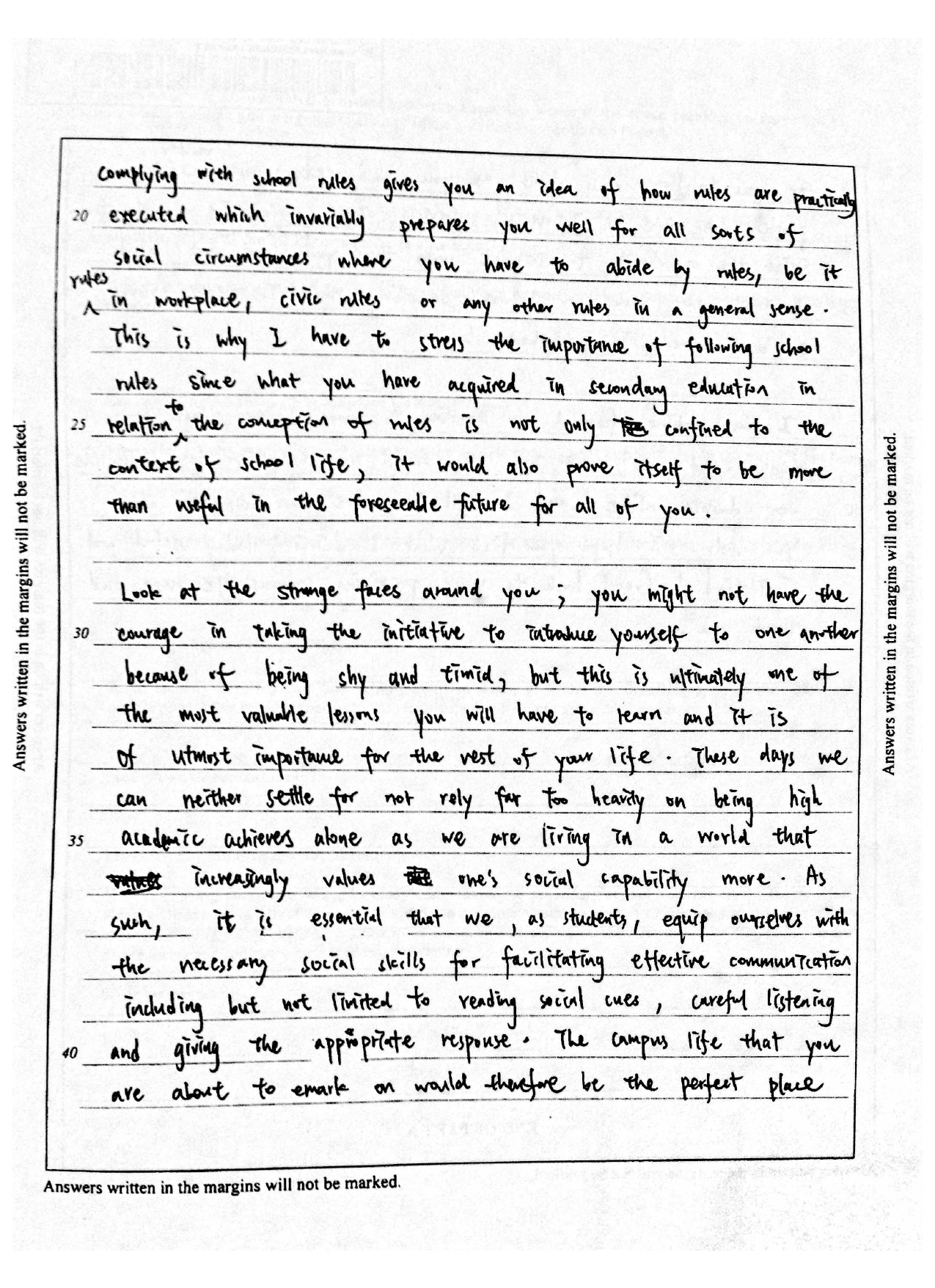

The writing, with corrections marked inline
On behalf of the Students’ Union, I’d like to welcome all of you to our school. I’m sure we all want to achieve success and have an enjoyable school life, so this morning I’d like to give you some advice.
Word count. Roughly 470 words against the ~200-word target — more than double the brief. The question asks the candidate to finish the speech after the pre-printed opening, so length isn’t penalised severely, but a tightening pass would help the speech land on time.
The final paragraph is one long run-on sentence. The student fuses a sign-off (“I am looking forward to getting to know you guys”), an open invitation (“do come to me should you encounter any difficulties”) and an offer of help into a single sentence held together by dashes. A speech audience won’t track punctuation; breaking this into three short sentences would land it cleanly — see Suggestion 9.
Strengths to praise
Instead of launching into the topic, the candidate names the audience’s likely feeling: “The first thing that strikes many of you as being intimidating would most probably be the school rules.” Then the speaker steps inside the audience’s head: “Seeing your anxious faces, it reminds me of how I was overthinking about the notion of school rules.” This is exactly how a real speaker opens — by anticipating and disarming the listener’s first reaction.
The speaker keeps positioning themselves as a senior student who has lived through what the newcomers are feeling: “I have been there and I can assure you…”, “I was overthinking…”, “I am looking forward to getting to know better about you guys…”. That persona makes the advice feel earned rather than preached — a sophisticated tonal choice for a welcome speech.
“Think of it as a set of standardized social norms that each and every one of you would follow on a day-to-day basis.” The metaphor reframes rules as something the audience already does outside school. Later this is extended (“rules in the workplace, civil rules, or any other rules in a general sense”) so school rules become rehearsal for adult life. Solid two-step argument: defuse the fear, then enlarge the stakes.
Intimidating, strictly, standardized, social norms, anxious, envisioned, restrict, unbearable, fundamental, punctuality, implementation, disrupt, complying, invariably, abide by, foreseeable, timid, settle for, capability, facilitating, social cues, embark on, hone, introverts, extroverts, insightful. These are deployed in the right collocations — the candidate has internalised them, not just memorised them.
The rules paragraph stays grounded with three named behaviours: “punctuality and politeness to the way we dress”, then “everyone is not attending classes on time or when we wear school uniform in whichever way that pleases us”. The relationships paragraph names “introverts, extroverts or a combination of the two” and three communication moves: “reading social cues, careful listening and giving the appropriate response.” Examples like these are the difference between a 5 and a 5**.
There is no “Now let’s move on to interpersonal relationships.” Instead, the rules paragraph closes on the foreseeable future (“more than useful in the foreseeable future for all of you”) and the next paragraph opens with a visual cue (“Look at the strange faces around you”) that pivots the audience’s attention from the abstract (rules) to the concrete (the people in the hall). Most candidates use a sign-posting phrase; this one uses staging instead — the bolder choice.
“Seize the opportunity to interact with those you dare not — and would otherwise not — I am sure you can learn something that is never going to be covered in textbooks!” The contrast between covered in textbooks and learning from strangers is the kind of takeaway a Form 1 might actually remember walking out of the hall. A solid pay-off for the relationships argument.
Grammar notes
| Issue | Explanation |
|---|---|
(line 1) The first thing that strike many of you → strikes |
Subject-verb agreement. The relative clause’s subject is that, standing in for the singular thing; the verb is strikes. |
(line 9) I can assure you of the fundamental purpose…is nothing → I can assure you that the fundamental purpose…is nothing |
Assure takes two patterns: assure someone of something (I assure you of my support) or assure someone that… followed by a clause. With a clause (the purpose is nothing…) the conjunction is that, not of. |
(line 13) Imagine what would it be like when… → Imagine what it would be like when… |
An indirect question (inside imagine…) keeps statement word order — subject before verb. Inversion is for direct questions only (What would it be like?) but not for embedded ones (Imagine what it would be like). |
(line 14) when we dress school uniform → when we wear school uniform |
Dress is intransitive in this sense (I dress smartly, dress up, dress down) or takes a person as object (dress the baby). The verb that takes uniform, jeans, a tie, etc. as object is wear. |
(line 17) neither teachers nor students would be benefited → would benefit |
Benefit in this sense is intransitive and active (teachers benefit, students benefit); the passive be benefited is non-standard. Compare with profit — we say they profit from this, not they are profited. |
(line 21) rules in workplace → rules in the workplace |
Workplace is a count noun and takes the definite article when referring to the workplace as a general concept: in the workplace, at the workplace. |
(line 24) in relation the conception of rules → in relation to the conception of rules |
In relation to X is the fixed prepositional phrase. The student dropped the to. |
(line 29) you might not have the courage in taking the initiative → the courage to take the initiative |
After the courage, English uses an infinitive (the courage to speak, to leave, to refuse), not a gerund with in. |
(line 33) we can neither settle for not rely too heavily → neither settle for… nor rely too heavily |
The neither…nor… pair is the standard correlative. The student wrote not in the second slot, which doesn’t pair with neither. Also the settle for needs an object (settle for less, settle for academic achievement) — the cleanest fix is to break the sentence: We can no longer settle for academic achievement alone, nor rely too heavily on it. |
(line 47) I am looking forward to getting to know better about you guys → getting to know you guys better |
Know here is transitive — the object is you guys, and the adverb better follows the object (or sits before know: getting to know you guys better). Know about is a different construction (used for facts/topics: know about astronomy), not for getting acquainted with people. |
(line 48) you guys and do come to me → you guys — do come to me… |
The student wrote and where a sentence break (or a dash) is needed. The clause that follows (do come to me) is a fresh imperative, not a continuation of the previous clause. |
(line 50) I hope you fid what I delivered today useful → find |
Simple typo — fid for find. The construction find X useful works (object + adjective complement). |
Style suggestions (where strong writing could become outstanding)
Professional rewrite — the closing paragraph (weak moment)
For comparison only, not a correction. The closing paragraph is the single spot where the candidate’s otherwise composed voice frays. Three ideas (sign-off, invitation, offer) are fused by and…and… into one breathless sentence; the final wishes pile two abstract adjectives (promising campus life) onto the last noun before the audience can settle. The rewrite separates the three beats and lets each one land, in roughly the same word count.
The student’s closing paragraph (corrected)
Rewritten by a professional speech-writer
- The three beats are unpicked into three sentences. Sign-off (looking forward to getting to know each one of you) · invitation (come and find me) · reason for the invitation (I would much rather hear about it early). A speech audience needs the breaks; the dashes in the original were doing structural work that punctuation can’t carry in spoken delivery.
- The invitation is specified. Should you encounter any difficulties or doubts alike is registered up high (legal / formal). The rewrite substitutes two concrete examples (a class you can’t keep up with, a friend you haven’t quite made) — the kinds of trouble a Form 1 student will actually have in the first month.
- The “I hope you found it useful” sentence is rescued. What I delivered today is post-mortem register; something I have said this morning sits inside the speech as it happens. Stays with you replaces useful and insightful (two soft adjectives) with a single behavioural promise.
- The exclamation marks go. The original closes with two exclamation marks in three lines (insightful! … thank you.). The rewrite trusts the rhythm of the short final line (Good luck — and welcome) to do the lifting.
- The closing echoes the pre-printed opening. The given opening said welcome all of you to our school. Ending on and welcome closes the loop — the speech began and ends with the same word, the strongest single move available in a speech of this length.
Vocabulary to notice
| Word | Definition | Usage notes | Synonyms / alternatives |
|---|---|---|---|
| intimidating | (adj.) frightening or threatening, especially because of size, complexity, or authority. | Used of people, places, situations, tasks. The verb is intimidate; the noun, intimidation. | daunting, frightening, formidable, off-putting |
| envisioned | (v., past) imagined as a future possibility; visualized. | Slightly formal. Often used for plans, futures, scenarios: envisioned a career, envisioned a different outcome. | imagined, foresaw, visualized, pictured |
| unbearable | (adj.) not able to be endured or tolerated. | Strong word; pairs with pain, heat, silence, pressure, extent, suffering. Adverb: unbearably. | intolerable, insufferable, unendurable, oppressive |
| fundamental | (adj.) forming a necessary base or core; of central importance. | Often pre-modifies purpose, principle, right, change, difference, question. Compare with basic (less elevated). | essential, central, core, foundational |
| punctuality | (n.) the quality of being on time. | Civic / professional virtue. Pairs with value, insist on, take pride in. Adjective: punctual. | timekeeping, promptness, being on time |
| complying with | (v. + prep.) acting in accordance with a rule, request, or order. | Formal. Common in legal and regulatory contexts: complying with the law, with regulations, with safety requirements. | obeying, abiding by, conforming to, observing |
| invariably | (adv.) in every case or on every occasion; always. | Slightly formal; useful in arguments about cause and effect: invariably leads to, invariably results in, invariably the case. | always, without exception, consistently, inevitably |
| abide by | (phrasal v.) to accept and act in accordance with a rule, decision or law. | Almost exclusively paired with rules, decisions, agreements. More formal than follow. | comply with, observe, adhere to, respect |
| foreseeable | (adj.) able to be predicted; likely to happen in the near future. | Fixed phrase: in / for the foreseeable future. Adverb: foreseeably. | predictable, expected, anticipated, on the horizon |
| timid | (adj.) showing a lack of courage or confidence; easily frightened. | Used of people, animals, gestures, voices. Compare with shy (less negative). | shy, hesitant, fearful, retiring |
| capability | (n.) the power or ability to do something. | Often plural in technical contexts: military capabilities, technical capabilities. Capacity is a near-synonym but emphasises potential more than skill. | ability, capacity, competence, skill |
| facilitating | (v., -ing) making (an action or process) easier; assisting. | Slightly formal / corporate; useful in policy and educational writing: facilitating dialogue, facilitating learning. Noun: facilitator. | enabling, easing, assisting, smoothing |
| social cues | (n. phrase) verbal or non-verbal signals that guide behaviour in social interactions. | Common in psychology and communication writing. Pair with read, pick up on, miss, respond to. | signals, hints, body language, non-verbal signs |
| embark on | (phrasal v.) to begin a new project, journey, or course of action. | Often pairs with journey, career, project, adventure, course. From the literal sense of boarding a ship. | begin, undertake, set out on, launch into |
| hone | (v.) to refine or improve (a skill, ability) over time; to sharpen. | Originally of sharpening blades on a hone (whetstone). Now figurative: hone one’s skills, hone an argument, hone one’s craft. | sharpen, refine, polish, perfect |
| introvert / extrovert | (n.) a person who is reserved and inward-looking / outgoing and sociable. | From Jungian psychology. The third type is ambivert (in between). Adjectives: introverted, extroverted. | (introvert) reserved person, loner; (extrovert) outgoing person, social butterfly |
| seize the opportunity | (idiom) to take advantage of a chance when it appears. | The verb seize implies decisiveness and speed. Pair with seize the moment, seize the day, seize control. | take the chance, grasp the opportunity, jump at it |
| insightful | (adj.) having or showing a deep and accurate understanding. | Often used of comments, analyses, books, lectures. The noun is insight. | perceptive, astute, illuminating, thought-provoking |
| promising | (adj.) showing signs of future success or excellence. | Used of people, careers, starts, futures. Compare with up-and-coming, budding. | auspicious, hopeful, encouraging, full of promise |
| implementation | (n.) the process of putting a decision or plan into effect. | Formal. Pair with policy, system, plan, programme, reform. Verb: implement. | execution, enactment, application, carrying out |
Leave a Reply