Letter to the Young Post — In Favour of Parental Monitoring Apps
It has recently been reported that some parents in Asian countries are installing apps on their children’s mobile phones that monitor their activities to ensure that they devote these devices to learning.
Write a letter to the Young Post stating whether you agree with these parents’ actions or not. Justify your position with three reasons.
About 400 words. Pages 8–11 of the booklet. The candidate has argued IN FAVOUR of the parents’ actions.
Show original handwritten pages (5)


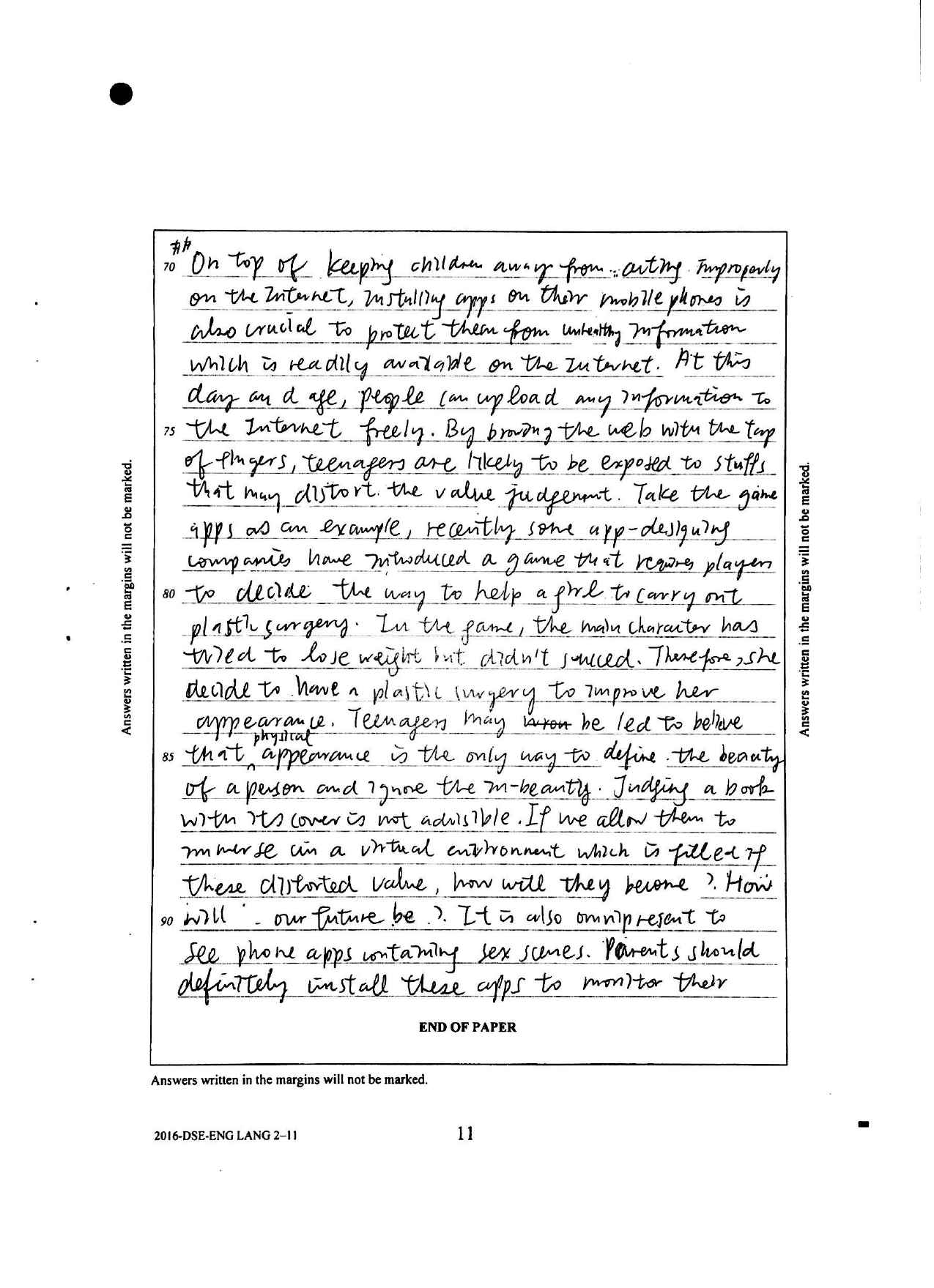

The writing, with corrections marked inline
Word count. Approximately 660 words across booklet pp.8–11 plus the supplementary sheet S1 — about 65% over the ~400-word brief. The piece runs out of stamina on S1, where the close knots up (this, in addition with two sides, three anchors you and ours in this issue is the wobbliest sentence in the piece). Within the normal envelope for Q4 letter responses.
Position taken. The candidate has argued IN FAVOUR of parents’ actions (committed in paragraph 1: “I am prone to support the idea that these parents’ actions are reasonable and responsible.”). Three reasons delivered in three body paragraphs: (1) preventing screen-time addiction, (2) preventing improper online conduct (cyber-bullying / vicious words), (3) protecting from distorted values (the plastic-surgery game, sexual content). The conclusion echoes the position and adds an aspirational close (young generation will use phones well and make full use of the benefits).
What gets a Q4 letter to 5**. Architecture, named evidence, and a committed rhetorical position — this piece delivers all three. The first paragraph stakes a clear pro-side claim and names the opposition (Yet, skeptics insist…). The three body paragraphs each deliver one substantive reason with one specific image or example (the MTR scenery image; cyber-bullying; the plastic-surgery game). The close commits the position again and offers a forward-looking vision. That five-paragraph spine (intro · 3 reasons · close) is what 5** Q4 letters look like.
The MTR-scenery image is the standout move. “Have you ever seen kids around stuck to their smart phones for the whole MTR trip without having a look at the beautiful scenery outside the train? I am sure everyone has experienced it before.” A Hong-Kong-specific everyday image, framed as a rhetorical question, that turns the abstract claim (teenagers lack self-restraint) into something the marker can visualise. No other 2016 collection piece on Q4 uses an HK-domestic image with this specificity.
The plastic-surgery-game example is the second standout move. “Recently some app-display companies have introduced a game that needs players to decide whether the main character has plastic surgery. In the game, the main character has tried to lose weight but didn’t succeed. Therefore, she decided to have plastic surgery to improve her appearance. Teenagers may be led to believe that ‘appearance’ is the only way to define the beauty of a person and ignore the inner self.” A specific game premise (likely a real reference to one of the Plastic Surgery Princess / Lady Make-Up genre of mobile games that went viral in 2014–15) used as a vehicle for the distorted-values argument. The marker can see the cultural critique through the named example.
Why this isn’t a perfect 42. The M2 = ^19 (two below perfect) almost certainly reflects sentence-level wobbles — the recurring some of disagreement comes from their parental disregard tangle in paragraph 1, the helps teenagers from being hesitated slip mid-paragraph 2, the likely to express to a parents who… mid-paragraph 3, and the S1 sentence (this, in addition with two sides, three anchors…) where the close knots. The argumentative substance is at the perfect-mark level; the surface execution loses two marks. The pro-rewrite below models the close as a fix-the-stamina-collapse stretch toward 42/42.
Strengths to praise
“I am prone to support the idea that these parents’ actions are reasonable and responsible.” — the candidate commits explicitly in the first paragraph, after a balanced two-sentence steel-man of the opposition (Advocates argue… Yet, skeptics insist…). Q4 letters that stake their flag in paragraph 1 give the marker something to track from the start. The standard structural move for 5** debate-genre responses.
“Have you ever seen kids around stuck to their smart phones for the whole MTR trip without having a look at the beautiful scenery outside the train? I am sure everyone has experienced it before.” The candidate doesn’t argue that teenagers are addicted — they invite the marker to remember something they’ve already seen. The rhetorical question + shared-experience appeal is a debating technique transposed into a letter; very effective. Localising the image to the MTR makes it HK-specific in a way a generic on the bus example wouldn’t.
Reason 1 (paragraph 2): screen-time / addiction prevention. Reason 2 (paragraph 3): preventing improper online conduct / cyber-bullying. Reason 3 (paragraph 4): protecting from distorted values / sexual content. Each paragraph carries one reason; no reason is repeated. The structural backbone is clean — exactly the ‘three reasons’ the prompt asks for, each given its own paragraph and its own specific example.
“Recently some app-display companies have introduced a game that needs players to decide whether the main character has plastic surgery… she decided to have plastic surgery to improve her appearance. Teenagers may be led to believe that ‘appearance’ is the only way to define the beauty of a person and ignore the inner self.” A specific game premise rather than a vague claim (games encourage bad values). The example almost certainly references a real category of mobile games (Plastic Surgery Princess-genre apps that went viral around 2014–15) — the candidate is engaging with actual contemporary digital culture. Q4 markers reward this kind of cultural specificity.
“Advocates argue that by doing so, parents can protect their children from using these gadgets unconstructively. Yet, skeptics insist that this is detrimental to teenagers. Some of the disagreement comes from young parents themselves, who may not have grown up with these devices…” The candidate gives the opposition a full sentence and even a sociological explanation (young parents not grown up with these devices) before refuting. The phrase skeptics insist dignifies the opposition rather than dismissing them — a 5*+ move that makes the candidate’s pro-position read as considered rather than reflexive.
“It is conducive to the teenager’s enjoyment and the future of our society.” The candidate scales the individual-level argument (one kid, one phone) up to the collective-level argument (the future of our society). This is the standard rhetorical pivot for 5*+ persuasive writing: the personal claim is grounded by a civic stake.
The opening (Dear Editor), the explicit position-taking (In this letter, I am writing to explain my views), and the sign-off (Yours faithfully, Chris Wong) all match the letter-to-editor convention. The marker doesn’t have to look for the format — it’s where it should be. A surprising number of Q4 letter responses skip the sign-off; this one doesn’t.
Grammar notes
| Issue | Explanation |
|---|---|
(lines 3–5) Asian parents are installing apps on their children’s smart phones with their activities in order to ensure… → …installing apps on their children’s smart phones to track their activities in order to ensure… |
The sentence is missing the verb that links the app to the monitoring. With their activities doesn’t parse — the intended sense is that track or to track. Without the verb, the syntax collapses. |
(lines 7–8) Advocates proclaim that parents can do this protect their children → Advocates argue that by doing so, parents can protect their children |
Two issues. (i) Proclaim takes a direct object or a finite clause, but the candidate has stacked do this + protect without a connector. (ii) By doing so is the cleaner connector for the means. |
(lines 10–12) Some of disagreement comes from their parental disregard, as parents who are very young, may not get used to it → Some of the disagreement comes from young parents themselves, who may not have grown up with these devices… |
Heavy recast required. Three issues. (i) Some of disagreement needs the article: some of the disagreement. (ii) Parental disregard means parents’ lack of concern, the opposite of the candidate’s intended sense. (iii) The dangling comma + clause (as parents who are very young, may not get used to it) is ungrammatical. The intended sense is young parents themselves are sometimes skeptical because they didn’t grow up with these devices. |
(line 16) actions are reasonable and inevitable → actions are reasonable and responsible |
Inevitable means unavoidable, certain to happen — doesn’t match the intended sense (the parents’ actions are justified, not unavoidable). Responsible, justified, well-founded all fit. |
(lines 20–21) none are as significant as the fact that it helps prevent children → none are as significant as the fact that they help prevent children |
The antecedent of it / they is the parents’ actions (plural). Subject-verb agreement: they help, not it helps. |
(line 24) the internet nowadays would be filled with attractive information → the internet nowadays is filled with attractive information |
The conditional would be doesn’t fit a present-time statement of fact. Present simple: is filled. |
(lines 25–26) addicts can be allowed to access their smart device → young users can be tempted to access their smart device at all hours |
Two issues. (i) Addicts presupposes the conclusion (the candidate is arguing about people who might become addicted, not people who already are). (ii) Allowed to access doesn’t match the context — nothing is permitting them; they want to. Tempted to matches the candidate’s argument. |
(line 27) kids around upon sticky to their smart phones → kids stuck to their smart phones |
The candidate is reaching for glued to / stuck to / fixated on. Upon sticky isn’t a phrase in English; the intended image is the kid whose eyes are physically attached to the screen. |
(lines 29–30) I am sure everyone experienced it before → I am sure everyone has experienced it before |
Present-perfect with before: have you ever / I am sure everyone has experienced. The past simple experienced needs has when the time-reference is indefinite. |
(lines 42–43) parents can outright their childrens’ exposure → parents can responsibly limit their children’s exposure |
Three issues. (i) Outright is an adverb / adjective, not a verb — can’t take an object. (ii) The plural possessive is children’s, not childrens’ (children is already plural). (iii) The intended verb is limit / control / monitor. |
(lines 39–40) It helps teenagers from being hesitated by the mobile phones → It helps teenagers to stop being held hostage by their mobile phones |
Word-choice scramble. Hesitated doesn’t fit (the candidate isn’t saying phones make teenagers hesitant) — the intended sense is held hostage / dominated / consumed by. Help X from -ing is also not a structure in English; help X to stop -ing or prevent X from -ing are the alternatives. |
(line 48) preventing children to be overrun by the cell-phone stalk → preventing children from being overrun by the lure of the cell phone |
Two issues. (i) Prevent takes from + -ing: prevent X from being Y, not prevent X to be Y. (ii) Cell-phone stalk isn’t a phrase; the intended sense is the pull / lure / grip of the cell phone. |
(line 61) spit out vicious words → let out / hurl vicious words |
Spit out works literally (spit out food) but reads oddly for words. Hurl insults, let out harsh words, throw vicious comments all match the register better. |
(lines 62–63) likely to express to a parents who, in this stage, may not gain a thorough understanding → likely to be exposed to a peer group who, at this stage, may not gain a thorough understanding |
Three issues. (i) Express to doesn’t mean encounter / face — possibly a slip for exposed to. (ii) A parents mixes the singular article with a plural noun. The intended sense from context is a peer group, not parents. (iii) In this stage → at this stage (the standard preposition for the stage idiom). |
(line 75) Per this day or so, people can upload any information → These days, people can upload any information |
Per this day or so isn’t a phrase in English. The intended sense is nowadays / these days / in the present day. |
(lines 80–81) a game that needs players to decide the main character has plastic surgery → a game that asks players to decide whether the main character has plastic surgery |
Two issues. (i) Needs players to doesn’t fit — requires / asks players to is the standard pattern. (ii) Missing whether: decide whether, not decide [that]. |
(lines 82–83) the main character has refused to have white → the main character has tried to lose weight (best reconstruction from context) |
Word-choice scramble or transcription unclarity. Refused to have white doesn’t parse against the surrounding context (but didn’t succeed… she decided to have plastic surgery). The intended sense from context is tried to lose weight or tried to look pretty in other ways — some prior attempt that failed and pushed her to surgery. |
(line 88) Justify a youth with the negative view is not advisable → Justifying such a distorted view to young people is not advisable |
Three issues. (i) Justify as a bare verb at sentence-start needs justifying (gerund) to be the subject. (ii) A youth with mismatches — the candidate means this view to young people, not a young person with this view. (iii) The negative view → such a distorted view for register. |
(line 96) conductive to the teenager’s enjoyment → conducive to the teenager’s enjoyment |
Wrong word. Conductive = able to conduct electricity. Conducive = making something likely; favourable. The candidate means conducive. Common HK English slip. |
(line 108) it is hoped that this, in addition with two sides, three anchors you and ours in this issue → I hope that, with this argument from both sides, you and your readers can reach a sound position on this issue |
This is the most tangled sentence in the piece — almost certainly written under time-pressure on the supplementary sheet. In addition with isn’t standard; two sides, three anchors doesn’t parse. The reading reconstructed from context is what the candidate seems to be reaching for. |
Style suggestions (where 5** could become perfect)
What would lift this from low-5** toward top-5**: the M2 = ^19 score reflects sentence-level wobbles — the recurring scrambles in paragraph 1 (the ‘some of disagreement’ sentence), the mid-paragraph slips (hesitated by phones, cell-phone stalk, likely to express to a parents), and the runs-out-of-stamina close on S1. The argumentative substance is at top-band level; the surface execution loses two marks.
The Part B is firmly 5** across pp.8–11; the writing collapses on the supplementary sheet where the stamina runs out and the close knots up. The rewrite below preserves the candidate’s structural moves (pro-position recap, civic stake, forward-looking close) and lands them in clean letter-genre register. This is the single biggest stretch toward 42/42.
The student’s close (S1, lightly corrected)
Rewritten as a Q4 5** letter close
The phone is not the enemy. Used well, it is the most powerful tool any teenager has ever had. The parents in your report are not trying to take it away — they are trying to teach their children how to hold it. I hope the readers of the Young Post will see the same when they next look at a parent with the monitoring-app icon on their own phone.
Yours faithfully,
Chris Wong
- Recaps the three reasons in one sentence. Phones are addictive… the screen muffles cruelty… the values on offer would horrify their parents. The student’s recap meanders through two long sentences; the pro version condenses the entire argument into a single tricolon-paragraph. Letter-genre convention: recap, don’t re-argue.
- The ‘hand on the shoulder’ metaphor. Frames monitoring as continuity with the parenting that every previous generation has done. This reframes the debate — the question stops being ‘should parents monitor?’ and becomes ‘why would this generation be the exception?’
- The aphoristic close. The phone is not the enemy. Used well, it is the most powerful tool any teenager has ever had. The parents in your report are not trying to take it away — they are trying to teach their children how to hold it. Three short sentences that land the position with parallelism. The candidate’s original closes with enjoy these advantages over the other users of the like — flat by comparison.
- Names the publication once more. I hope the readers of the Young Post will see the same…. Letter-genre convention: the close acknowledges the audience and the venue. The candidate’s original close says the young generation in the whole world — addresses no specific reader and lands no specific punch.
- Replaces the tangled ‘two sides, three anchors’ sentence entirely. Writing-fatigue collapse is the most fixable single thing about this piece. A pre-planned final paragraph — even just one sentence held in reserve — would have prevented the collapse and won the additional two marks.
Vocabulary to notice
| Word / phrase | Definition | Usage notes | Synonyms / alternatives |
|---|---|---|---|
| phenomenon | (n.) a fact or situation that is observed, especially one whose cause is in question. | Common Q4-letter opener (The phenomenon that… has aroused much concern). Plural: phenomena. So overused that it’s a marker tell — vary with trend, development, practice, debate. | occurrence, event, trend, development |
| aroused (much concern) | (v., passive) provoked, stirred up. | Pairs with concern, debate, suspicion, controversy, anger: aroused much debate, aroused public concern. Mid-formal register; standard letter-to-editor opener. | provoked, stirred up, sparked, triggered |
| unconstructively | (adv.) in a way that does not contribute to building something useful. | Pairs with spend, use, engage, behave: using these gadgets unconstructively. The candidate’s use is precise; uncommon but well-placed. | unproductively, wastefully, idly, pointlessly |
| detrimental (to) | (adj.) tending to cause harm. | Pairs with health, development, environment, education: detrimental to teenagers, detrimental to public health. Formal register; standard policy-essay vocabulary. | harmful, damaging, injurious, deleterious |
| prone to (support) | (adj. phrase) inclined to; likely to. | Two patterns: (i) prone to + noun (prone to error); (ii) prone to + verb (prone to support). The candidate uses pattern (ii); both work. | inclined to, disposed to, apt to, given to |
| self-restraint | (n.) control over one’s feelings or impulses. | Pairs with exercise, show, lack, develop: teenagers lack self-restraint, exercise self-restraint. Mid-formal register; standard debate-essay vocabulary for adolescent-behaviour arguments. | self-control, self-discipline, restraint, willpower |
| universally known | (adj. phrase) known by everyone. | Pairs with that, fact, truth: it is universally known that…. Slightly stronger than widely known; useful for asserting common ground. | widely known, commonly accepted, universally acknowledged |
| unacceptably (long) | (adv.) to a degree that cannot be accepted. | Pairs with long, high, low, slow, expensive: unacceptably long, unacceptably high. Mid-formal register; useful for setting a moral threshold. | excessively, intolerably, unreasonably |
| stuck to (something) | (adj. phrase) physically or figuratively attached and unable to move. | Figurative use is common with screens: stuck to their smart phones, stuck to the TV. Stronger versions: glued to, fixated on, transfixed by. | glued to, fixated on, transfixed by |
| cyber-bullying | (n.) bullying conducted through digital channels. | Modern compound; pairs with commit, fall victim to, suffer, perpetrate: fall victim to cyber-bullying. Standard Q4 / Q5 vocabulary for adolescent-digital-life prompts. | online harassment, digital abuse, internet bullying |
| vicious (words) | (adj.) cruel or malicious. | Pairs with attack, cycle, rumour, dog, words, comments: vicious comments, a vicious attack. Strong negative-evaluative. | cruel, malicious, spiteful, venomous |
| improperly | (adv.) in a way that is incorrect or unsuitable. | Pairs with use, behave, act, dressed: act improperly online, use a device improperly. Mid-formal register; standard policy-essay vocabulary. | incorrectly, unsuitably, inappropriately, wrongly |
| distorted (values) | (adj.) pulled out of true shape or meaning. | Pairs with view, value, image, perception, idea: a distorted view of beauty, distorted values. The candidate’s use in the plastic-surgery paragraph is precise. | warped, twisted, skewed, perverted |
| immerse (in) | (v.) to involve deeply in something. | Pairs with in, oneself, completely, fully: immerse them in a virtual environment, immerse oneself in study. Mid-formal register; precise for digital-environment arguments. | engross, absorb, plunge, submerge |
| virtual environment | (n. phrase) a simulated digital space or world. | Pairs with immerse in, navigate, create, explore: immerse in a virtual environment. Technology-policy vocabulary; standard for Q4 prompts about digital culture. | digital space, online world, cyber environment |
| conducive (to) | (adj.) making something likely or possible. | Pairs with to + noun: conducive to learning, conducive to growth, conducive to harmony. The candidate’s conductive needs correction to conducive — common HK English slip. | favourable to, beneficial to, helpful to, advantageous to |
| cyber world | (n. phrase) the digital realm; the online space. | Pairs with dangerous, navigate, enter, explore: the dangerous cyber world. Mid-formal register; standard digital-policy vocabulary. | cyberspace, the internet, the digital realm, the online world |
| on the premise that | (prep. phrase) on the basis that; assuming that. | Pairs with that-clause: on the premise that this can also separate…. Formal register; useful for connecting one claim to a prior assumption. | given that, assuming that, on the basis that, provided that |
| make full use of | (v. phrase) to take maximum advantage of. | Pairs with opportunities, benefits, resources, time: make full use of the benefits, make full use of these advantages. Standard solution-paragraph vocabulary. | take full advantage of, capitalise on, exploit, maximise |
| held hostage by | (idiom) figuratively, controlled or dominated by. | Pairs with by + noun: held hostage by their phones, held hostage by deadlines. Strong-evaluative metaphor; useful for arguing against addiction or over-dependence. | dominated by, controlled by, in thrall to, enslaved by |
| a hand on the shoulder | (metaphor) a gesture of guidance and presence. | Pairs with put, lay, feel, need: a hand on the shoulder. Useful for reframing what might look like control as care or guidance — the model move in the pro-rewrite’s steel-man. | guidance, presence, reassurance, supportive nudge |
Leave a Reply