Welcome Speech to New Students
You are the President of the Students’ Union at your school. You are preparing a speech to welcome new students on the first day of school. In order to help new students achieve success and have an enjoyable school life, you want to talk about the following in your speech:
- importance of following school rules; and
- importance of interpersonal relationships.
The first part of the speech has been written for you. Finish the speech. (~200 words)
Show original handwritten pages (4 writing pages + 1 brainstorm page)


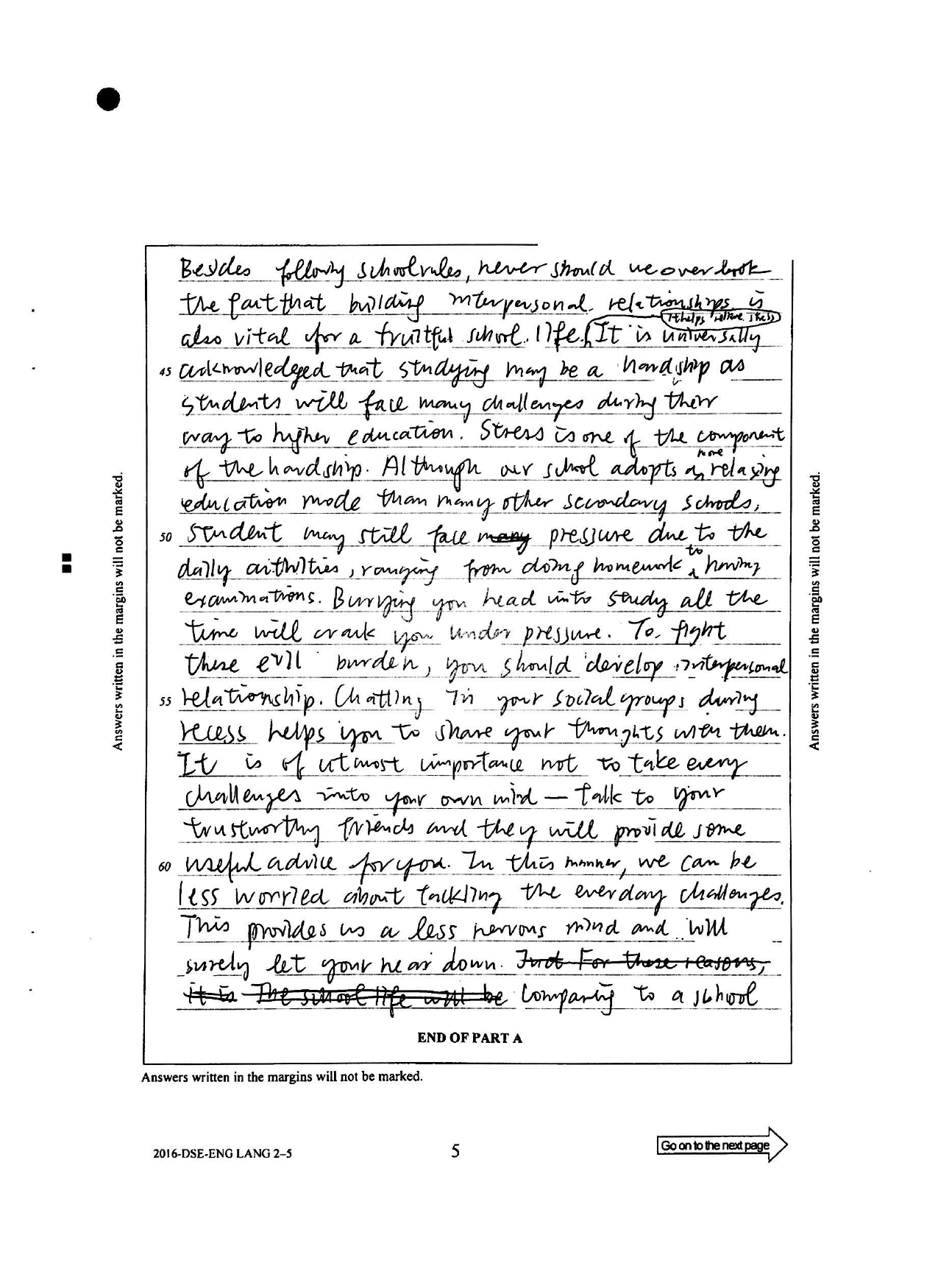

The writing, with corrections marked inline
On behalf of the Students’ Union, I’d like to welcome all of you to our school. I’m sure we all want to achieve success and have an enjoyable school life, so this morning I’d like to give you some advice.
Word count. Approximately 490 words against the ~200-word brief — about 2.5× over budget. The piece spills onto a supplementary sheet (S1) because the candidate didn’t close in the booklet. The length isn’t penalised harshly given the strength of the content, but a tighter version would land closer to 300 words.
Format slip. The candidate refers to the piece as ‘this short essay’ in the opener (line 5: I will demonstrate the power of these two crucial elements in achieving success in this short essay) — but the prompt is a speech, not an essay. This is the cleanest single fix available: this morning’s talk, the next few minutes, or my speech today would all match the text-type.
Unclear handwriting. Three phrases on booklet pp.4–5 and S1 can’t be confidently read — “maybe even tougher acts” (line 36) at the end of the penalties section, “head down” (line 61) in the friendship paragraph, and “another story” (line 64) on S1. The reading reconstructed from context is shown in the transcription above with yellow highlight.
Strengths to praise
“Have you ever imagined that following school rules and developing interpersonal relationships are the keys to an enjoyable school life?” — a single sentence that picks up both prompt bullets and frames them as keys. The marker can already see the architecture of the speech in line one. This kind of front-loaded signposting is a 5*+ move.
“Imagine this scenario — you are one of the staff here, and there are two students in front of you. One of them is a typical student who never breaks the school rules… He is a so-called ‘bad’ student who loves challenging the school by openly violating school rules. Which one will you prefer to teach?” — the candidate flips the audience’s perspective from student to teacher, making them imagine being on the other side of the rule. Sophisticated rhetorical move: the audience answers the question themselves rather than being told.
“Our school has a well-developed prefect association and discipline department. If you do something rebellious, never hold the belief that you can escape the prefects’ eyes!” — the candidate names actual school institutions (prefect association, discipline department) and grades the consequences (oral warning → bullying / cheating → even tougher). Concrete enforcement detail elevates the abstract claim.
“Stress is one of the components of the hardship… To fight these evil burdens, you should develop interpersonal relationships. Chatting in your social groups during recess helps you to share your thoughts with them. It is of utmost importance not to take every challenge into your own mind — talk to your trustworthy friends and they will provide some useful advice for you.” — the candidate doesn’t just claim friends are valuable; they articulate a specific mechanism (stress decompression through conversation). Mechanism-level reasoning is a 5** move.
Be the keys to, of paramount importance, well-polished impression, down to earth, prefect association, oral warning, the be-all and end-all, well-developed, undoubtedly, rebellious, take a glance, mock examinations, of utmost importance, trustworthy, fulfilling — all in the right collocations. The phrase be-all and end-all (close) and down to earth (penalties) are both idiomatic and well placed.
The piece uses you / your / yourself in almost every paragraph (You are one of the staff… Which one will you prefer… never hold the belief that you… behave yourself and follow the school rules… share your thoughts… find some friends in these six years). Speech-writing technique: the speaker keeps turning to face the audience.
“An amazing secondary school life is waiting for you!” — the final sentence is the one the audience will remember, and the candidate has chosen a forward-looking promise rather than a procedural close (Thank you for your attention). The exclamation mark matches the speech context.
Grammar notes
| Issue | Explanation |
|---|---|
(line 3) are the keys for an enjoyable school life → are the keys to an enjoyable school life |
Key to is the standard collocation, not key for: the key to success, the key to happiness, the keys to the kingdom. For doesn’t fit here. |
(line 5) I will demonstrate… in the short essay → in this short talk (text-type fix) |
Two issues stacked. (i) The article should be this, not the — the candidate is referring to the speech they’re currently giving. (ii) The piece is a speech, not an essay; short talk, my speech today, or the next few minutes all match the text-type. See Suggestion 1. |
(line 18) some of you may be as rebellious as the one who always break the school rules → …the one who always breaks the school rules |
Subject-verb agreement in the relative clause. The subject of break(s) is the one (third-person singular), so the verb is breaks. |
(line 21) be more yourself → be more thoughtful / be a better self |
Be more yourself means ‘be more authentic’ — the opposite of what the candidate intends here (the candidate is urging students to behave better, not to be more themselves). The reading reconstructed from context: be more thoughtful or be more conscientious. |
(line 23) be a perfect role for students → be a perfect role model for students |
The collocation is role model, not role on its own. A perfect role would suggest the student is acting in a play. |
(line 26) lets not forget → let's not forget |
Missing apostrophe. Let’s = contraction of let us; lets (no apostrophe) is the third-person singular of let (he lets the dog out). |
(lines 31–32) never hide the belief that you can be let off the prefects' eyes → never hold the belief that you can escape the prefects' eyes |
Three issues. (i) Hide is the wrong verb — the candidate means hold (= maintain), not conceal. (ii) The idiom is escape someone’s eyes / escape notice, not be let off the eyes. (iii) The intended sense is don’t convince yourself the prefects won’t see you. |
(lines 33–34) a light penalty, namely from oral warning → a light penalty, such as an oral warning, |
Three corrections. (i) Namely introduces an exhaustive list, but the candidate names only one example — such as is the correct connective. (ii) From doesn’t fit here at all — possibly a slip for like or such as. (iii) Oral warning takes the article: an oral warning. |
(lines 42–44) an enjoyable school life is acknowledged as a key element for students to fully face many challenges → an enjoyable school life is built on something that lets students face many challenges… |
Logic-level scramble. The original says ‘school life is acknowledged as a key element for students to face challenges’ — but school life isn’t a key element, it’s the thing being aimed at. The candidate has confused which clause is which. The intended sense: friendship is what makes an enjoyable school life possible despite challenges. |
(lines 49–50) you head into study at all the time will erode your inborn pressure → burying your head in your studies all the time will only add to that pressure |
Heavy recast required. Three issues. (i) You head into study is non-grammatical — it tries to combine a noun phrase (your head being in your studies) with a verb phrase. (ii) The idiom is bury your head in your books / studies. (iii) Erode your inborn pressure is the opposite of the intended sense — the candidate means add to pressure, not reduce it. |
(lines 55–56) not to take every challenges into your own mind → not to take every challenge into your own mind / not to keep every challenge to yourself |
Two issues. (i) Every takes singular: every challenge, not every challenges. (ii) Native idiom: keep something to yourself rather than take into your own mind. |
(line 60) This provides us as a less nervous mind → This provides us with a less nervous mind |
Provide takes with, not as: provide someone with something. The recipient is the object, the thing provided takes with. |
(line 62) it is the first step to accompany to a school life → it is the first step toward a fulfilling school life |
Two issues. (i) Accompany means ‘go along with’ (transitive: accompany the singer) — it doesn’t mean lead to. (ii) The doubled to…to structure is ungrammatical. The first step toward / the first step in building…. |
(line 73) on-going have a school life → enjoy an ongoing school life / have a fulfilling school life |
Word-order scramble. On-going is an adjective and needs a noun to attach to: an ongoing school life works, but the candidate has placed it adverbially. Heavy recast needed; have a fulfilling school life may be closer to the intended sense. |
Style suggestions (where strong writing could become outstanding)
What would lift this from low-5** toward top-5**: the text-type slip (calling it an ‘essay’ in line 5) and the noticeable handwriting / wording wobbles on the S1 supplementary sheet (when the candidate is running out of stamina) are both fixable; a tighter close that lands closer to the 200-word brief would also help.
The candidate is comfortably 5** through booklet pp.3–4; the writing wobbles when it spills onto the supplementary sheet, which is where stamina runs out. The rewrite below preserves the candidate’s structural moves (school life as memory, friendship as the differentiator, forward-looking close) and lands them cleanly in a tighter word count. A stretch move from low-5** toward top-5**.
The student’s close (booklet p.5 + S1, lightly corrected) — lines 58–74
Going back to secondary, school can be extremely enjoyable and exciting. Don’t think that study and work are the be-all and end-all in your coming six years. Meet new friends and experience a wonderful relationship! I hope that you can all follow the school rules and enjoy an ongoing school life. An amazing secondary school life is waiting for you!
Rewritten by a professional speech-writer
So — follow the rules. Build the friendships. The amazing school life you imagined when you walked through the gate this morning? It’s yours, if you want it. Welcome to our school.
- The friendship-as-stress-relief argument lands in one specific sentence. A friend who listens can do more for your stress in five minutes than five hours of revision can. The student has the same idea spread across four sentences; the rewrite makes it one quotable line.
- Three actionable instructions instead of one abstract claim. Sit next to someone new at lunch this week. Join a club — even one you’re not sure about. The student says ‘find some friends’; the rewrite tells the audience how, with specific behaviours. Speeches that ask the audience to do something earn more attention than speeches that tell the audience to be something.
- The ‘ten years from now’ pivot is the rhetorical heart. What you’ll remember, ten years from now, isn’t the deadlines. It’s the people you walked through them with. This is the move that makes the friendship argument feel earned rather than asserted — the candidate has it implicitly (unforgettable… days) but doesn’t name the time-horizon.
- The close bookends the pre-printed opening. Welcome to our school echoes the printed I’d like to welcome all of you to our school — the speech ends where it began. Speeches that come full circle land better than speeches that just stop.
- Two short instructions and a forward-looking promise. Follow the rules. Build the friendships — the two prompt bullets condensed into a four-word couplet that any audience member can carry out of the hall.
Vocabulary to notice
| Word | Definition | Usage notes | Synonyms / alternatives |
|---|---|---|---|
| rebellious | (adj.) refusing to obey rules or authority. | Common with teenager, student, behaviour, streak: a rebellious student, a rebellious streak. Slightly negative-evaluative. | defiant, disobedient, unruly, insubordinate |
| undoubtedly | (adv.) without doubt; certainly. | Used to add emphasis to a confident claim: undoubtedly the best, you will undoubtedly choose. Sentence-medial or sentence-initial both work. | certainly, definitely, without question, indisputably |
| of paramount importance | (idiom) supremely important. | Formal-academic; pairs with be, become, consider: it is of paramount importance that…. Slightly heavy for a speech — essential, crucial match a speech register better. | essential, crucial, vital, of utmost importance |
| role model | (n.) a person whose behaviour is imitated by others. | Pairs with be, become, look up to, set the example as: be a role model for younger students. The candidate needs model — just role alone means a part in a play. | example, exemplar, mentor, paragon |
| prefect | (n.) a senior student given authority over juniors. | HK / UK school vocabulary. Pairs with head, school, deputy, become: head prefect, school prefect. American English uses monitor, captain. | monitor, head boy / girl, senior student |
| discipline (department / committee) | (n.) the system by which a school maintains order. | Pairs with maintain, enforce, strict, lax: strict discipline, discipline committee. The candidate’s discipline department is HK English; UK English uses discipline committee. | order, conduct, behaviour management |
| down to earth | (idiom) practical, sensible, realistic. | Usually describes people: he’s very down to earth. The candidate’s use (we should be down to earth to take a glance at penalties) stretches the idiom — be realistic / be honest with ourselves would fit better. | realistic, sensible, practical, level-headed |
| oral warning | (n. phrase) a verbal reprimand, the lightest formal penalty. | Pairs with issue, give, receive, formal: issue an oral warning, give a formal oral warning. School and workplace vocabulary. | verbal warning, formal reprimand, telling-off |
| overlook | (v.) to fail to notice or consider; to ignore. | Pairs with importance, detail, fact, problem: overlook the importance of, overlook the obvious. Often in negative constructions: never should we overlook. | ignore, neglect, miss, disregard |
| acknowledged (as) | (v., passive) recognised; accepted. | Pairs with widely, generally, universally: widely acknowledged as, generally acknowledged to be. Formal register. | recognised, accepted, regarded, considered |
| mock examination | (n. phrase) a practice exam taken before the real one. | HK / UK school vocabulary; American uses practice test. Pairs with sit, take, prepare for, pass, fail: sit the mocks, take a mock exam. | practice exam, trial exam, dry-run test |
| erode | (v.) to gradually wear away; to weaken. | Pairs with confidence, trust, support, rights: erode public confidence, erode democratic norms. The candidate’s erode your inborn pressure is the wrong direction — pressure should be built up, not eroded. | wear away, weaken, undermine, diminish |
| burden | (n.) a heavy load; (figurative) a difficult responsibility. | Pairs with heavy, financial, emotional, share, lift, lighten: a heavy burden, share the burden, lift the burden. The candidate’s evil burdens stretches the noun into melodrama. | load, weight, strain, pressure |
| trustworthy | (adj.) deserving of trust; reliable. | Pairs with friend, source, ally, person: a trustworthy friend, a trustworthy source of information. The candidate’s use is precise. | reliable, dependable, honest, faithful |
| of utmost importance | (idiom) supremely important. | Synonym of of paramount importance; the two appear in the same piece, which is one too many. Pick one and vary the other with essential, crucial, vital. | essential, crucial, vital, of paramount importance |
| tackle | (v.) to deal with a difficult problem. | Pairs with challenge, problem, issue, task: tackle the challenge, tackle a problem head-on. The candidate’s use is precise. | address, deal with, handle, confront |
| the be-all and end-all | (idiom) the most important element; the only thing that matters. | Pairs with be, become, see as, treat as: usually in negative contexts (study isn’t the be-all and end-all). The candidate’s use in the close is idiomatic and well placed. | the only thing that matters, the ultimate goal, the whole point |
| on-going / ongoing | (adj.) continuing; in progress. | Pairs with process, project, support, discussion: an ongoing process, ongoing support. Modern spelling tends to drop the hyphen (ongoing). | continuing, current, in progress, sustained |
| enjoyable | (adj.) giving enjoyment; pleasant. | Pairs with experience, day, evening, meal, time: have an enjoyable time, an enjoyable school life. Mid-formal register; suits speech writing. | pleasant, pleasurable, fun, delightful |
| violate (rules) | (v., formal) to break or disregard. | Pairs with rules, laws, treaty, agreement, rights: violate the school rules, violate international law. More formal than break; suits the rules paragraph. | break, disobey, contravene, transgress |
| fulfilling | (adj.) giving a sense of satisfaction or worth. | Pairs with life, career, experience, relationship: a fulfilling career, a fulfilling school life. Closing-paragraph vocabulary for aspirational speeches. | rewarding, satisfying, meaningful, gratifying |
Leave a Reply