Letter to the Young Post — Protect Our Children and Monitor Their Mobile Phones
It has recently been reported that some parents in Asian countries are installing apps on their children’s mobile phones that monitor their activities to ensure that they use these devices responsibly.
Write a letter to the Young Post stating whether you agree with these parents’ actions or not. Justify your position with three reasons.
(~400 words)
Show original handwritten pages (5)
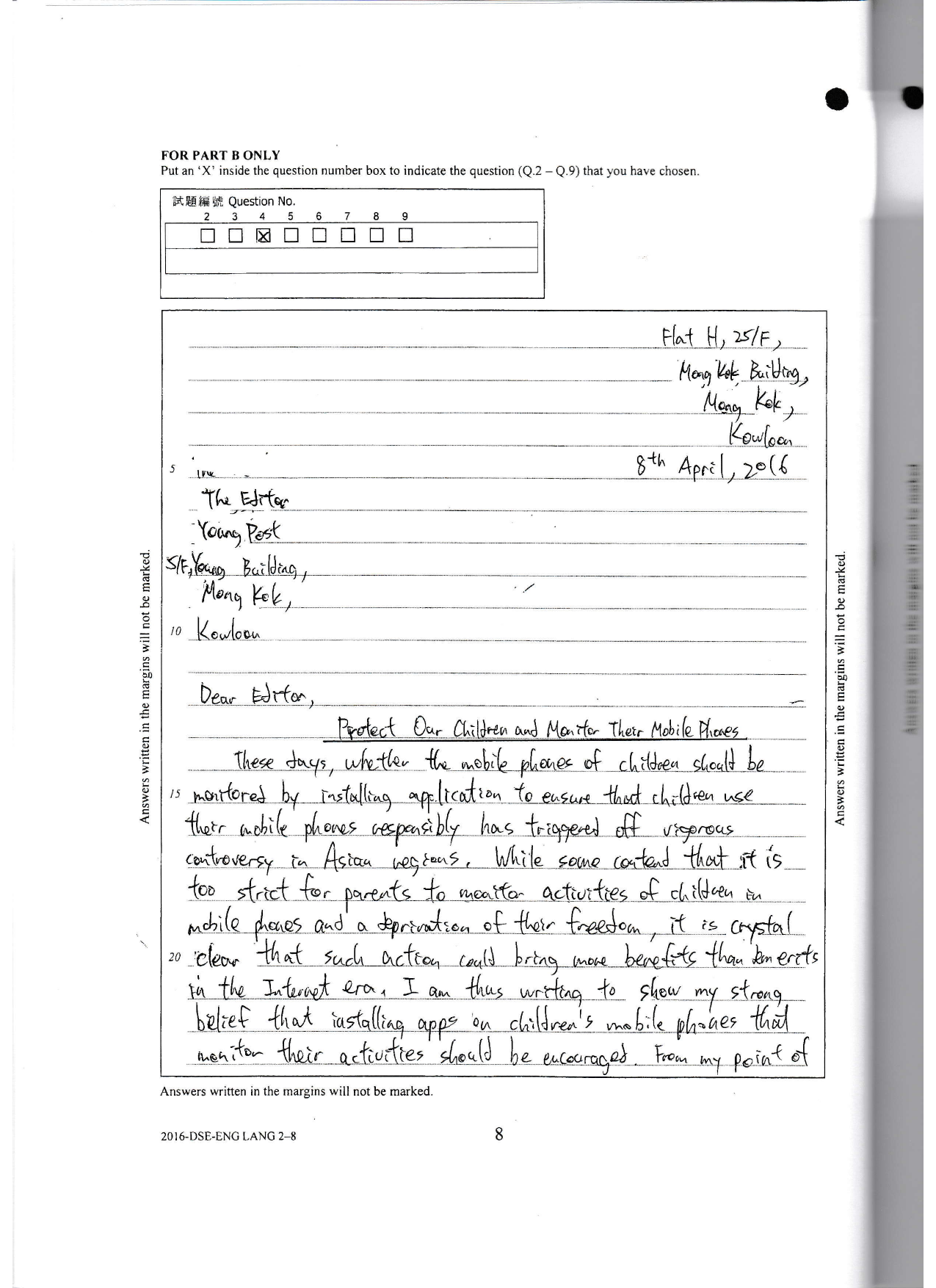
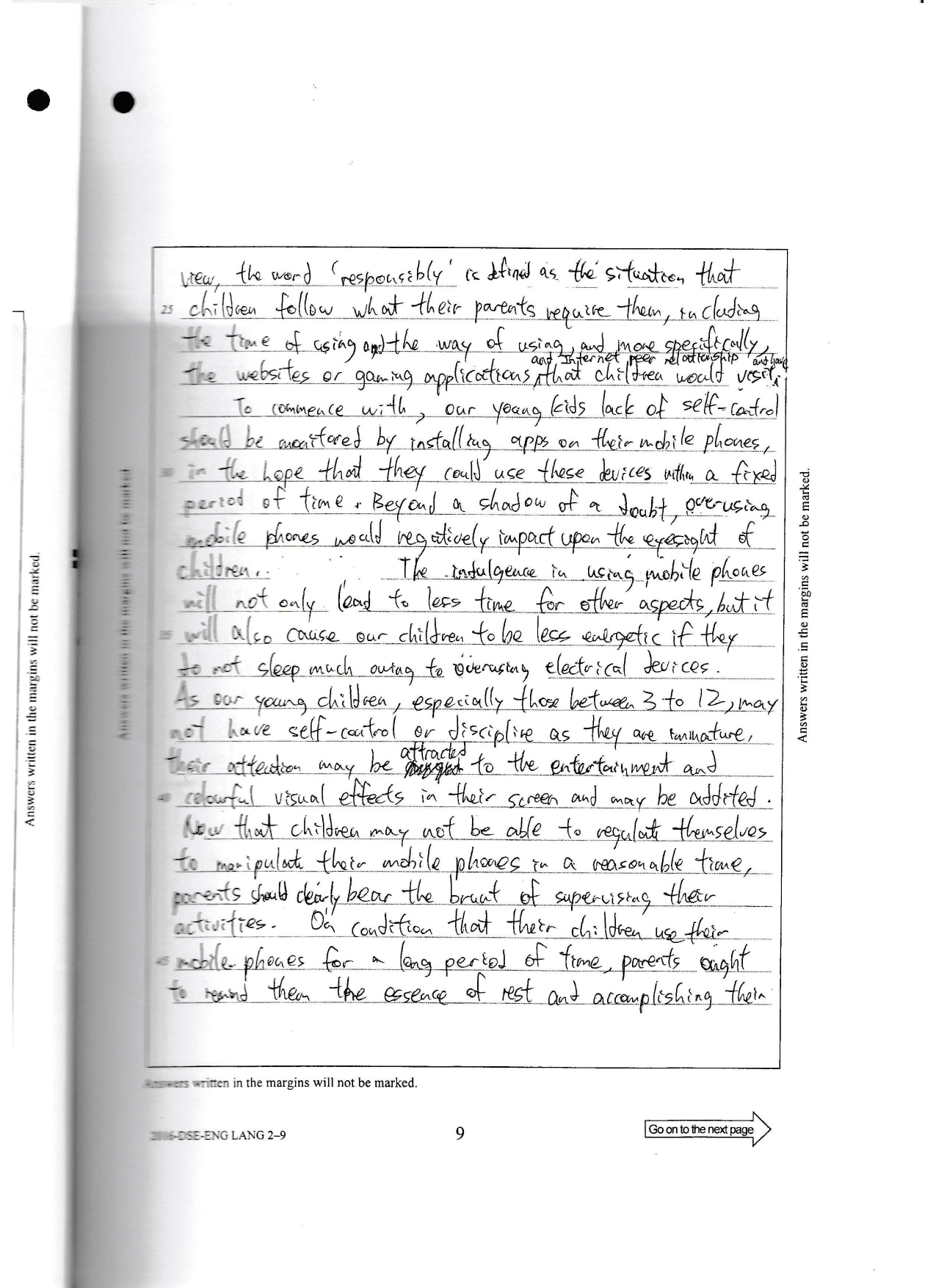
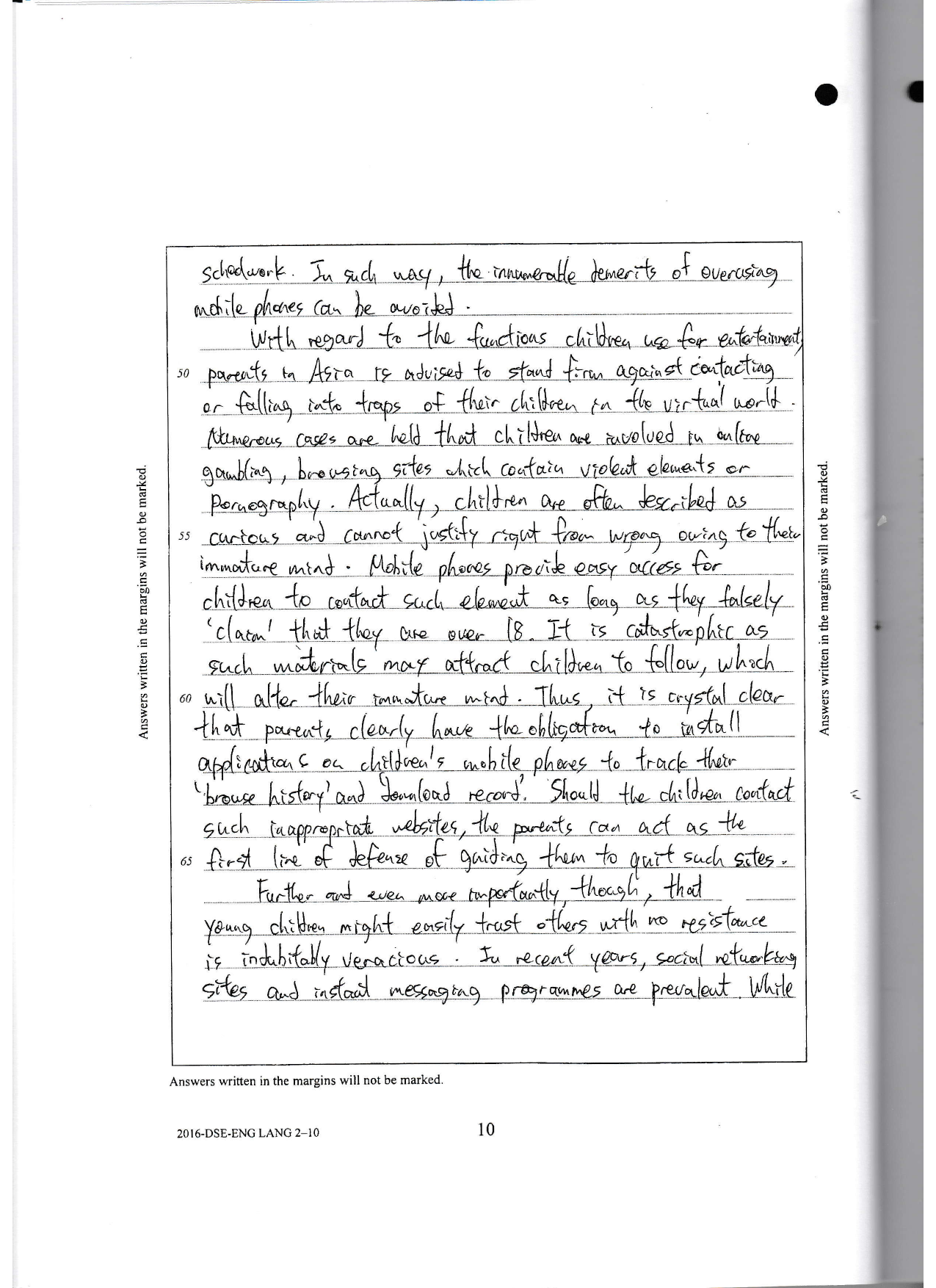
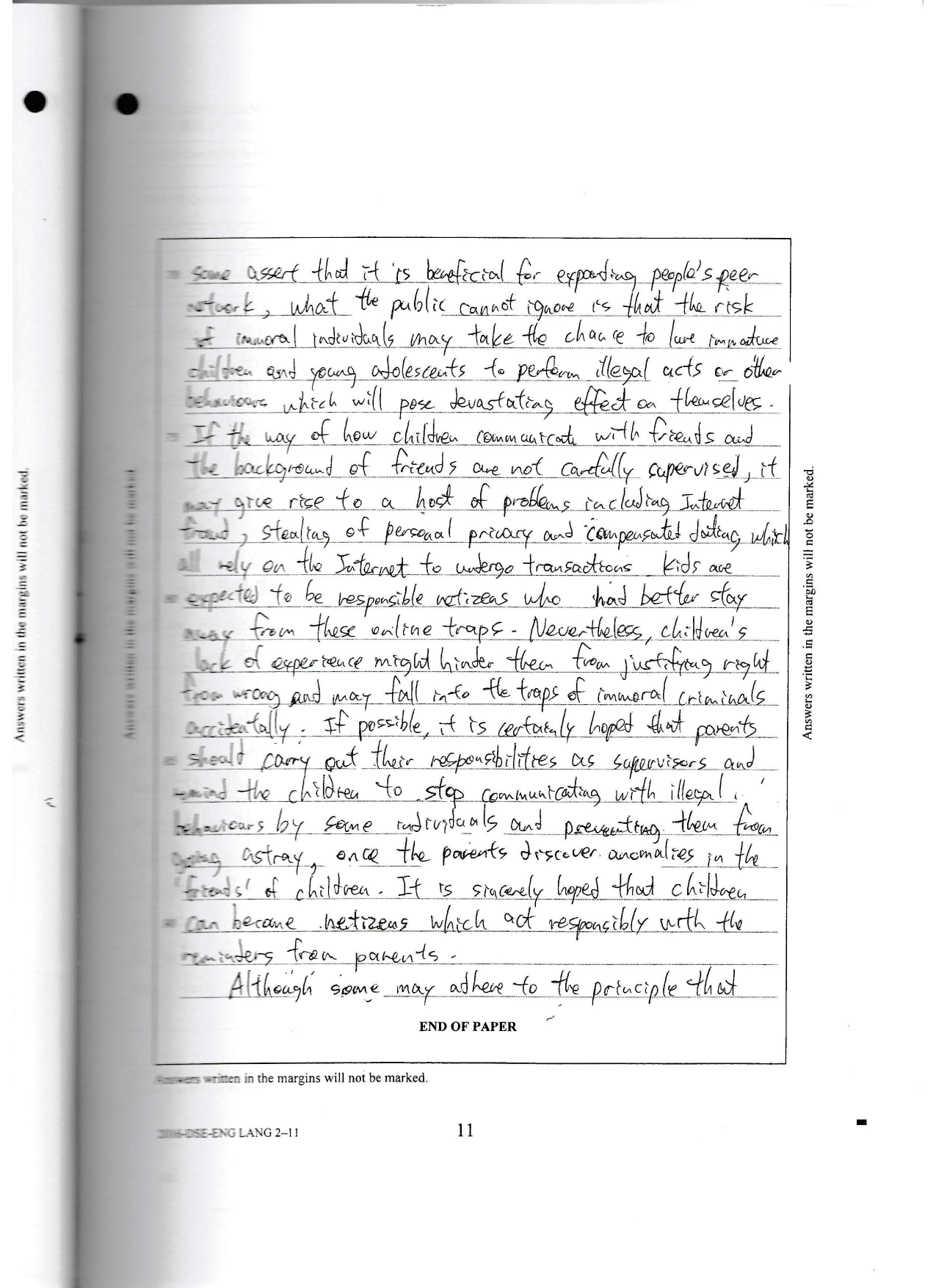
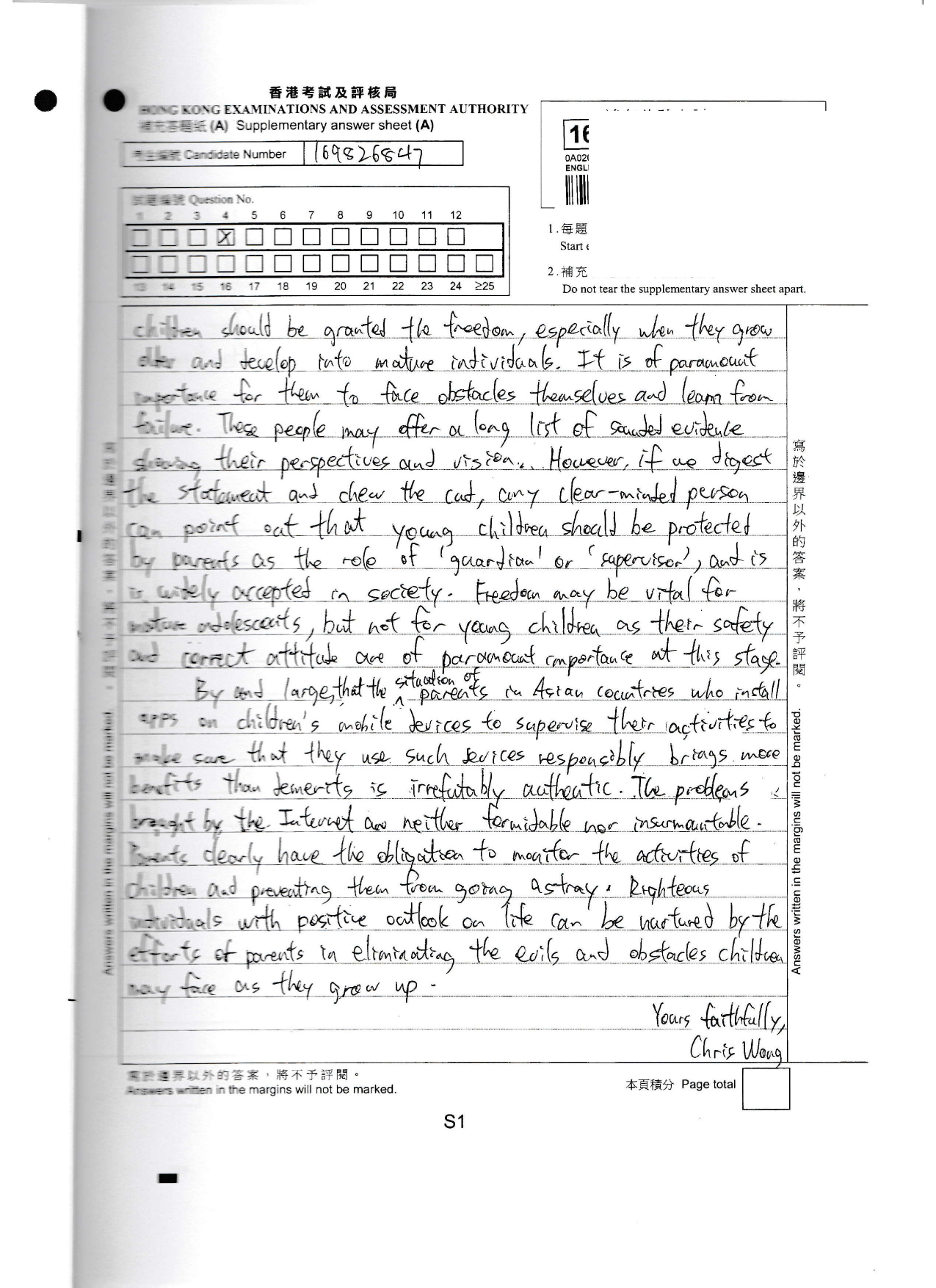
The writing, with corrections marked inline
The candidate’s position. The candidate supports the parents’ actions. The title Protect Our Children and Monitor Their Mobile Phones reads almost as a campaign slogan — the title itself is the thesis. Across the body the candidate offers three lines of justification: (1) responsibility-formation & physical-health protection (eyesight, sleep); (2) avoidance of mobile addiction and peer-pressure effects; (3) protection from online dangers (immoral individuals, the lure of illegal acts, loss of personal privacy, unsupervised exposure).
Word count. Roughly 620 words across the main booklet plus supplementary sheet S1 — about 55% over the 400-word brief. Unlike the Part A in the same script, the over-shoot here costs the candidate marks: the second-half thirds of paragraphs 2 and 3 carry the most syntactic collapse, and tightening would have rescued them.
Why this isn’t a 5**. The closest-pair-adjusted marks of 16 + 17 sit at the top of the 5* band, just below the 5** floor (~38). The argumentative substance — three-pronged thesis, opposition acknowledged, conclusion that loops back to the title — is at the 5** level. What docks the piece is sentence-level: at least four sentences run on for 60+ words without a finite verb stabilising them; several collocations are off (save children from failure, chew the cud, the inverts); and the closing paragraph ends with neither formidable nor insurmountable, which is logically inverted (the right reading is not insurmountable; neither…nor… with both adjectives positive collapses the contrast).
How this compares with candidate 2016-002’s Part B. Both candidates earn 5* on Part B in 2016. Candidate 2016-002 wrote on a different prompt; the structural backbone is similar (three reasons, opposition steel-man, looping close). The distinguishing feature of 2016-003’s Part B is the title — using the headline of the letter itself as the rhetorical thesis is a move neither 2016-001 nor 2016-002 makes.
Persona. The candidate signs Chris Wong — consistent with the Part A persona. The return address is the candidate’s residential block in Kwun Tong; the editor’s address is a plausible Sing Tao Building. The opening date 8th April 2016 is exactly the date of the 2016 DSE Paper 2 examination.
Strengths to praise
“Protect Our Children and Monitor Their Mobile Phones” — the title couples the means (monitor their phones) to the end (protect our children) with a coordinating conjunction. The reader knows the candidate’s position before reading the first sentence, and the title is itself a memorable seven-word slogan. No other 2016 Part B script in the collection uses the letter title this aggressively.
Reason 1 (responsibility / physical health), reason 2 (addiction / peer pressure), reason 3 (online dangers / privacy / lure of immoral individuals). The prompt asked for three reasons; the candidate produces three, each in its own paragraph, none repeating the other. The structural compliance with the brief is exact.
“Young children should be protected by parents as the role of ‘guardian’ or ‘supervisor’, and is widely accepted in society. Freedom may be vital for mature adolescents, but not for young children.” The candidate names the parents’ role with two clean noun phrases (guardian, supervisor), then uses the maturity distinction (young children vs mature adolescents) to head off the obvious counter-argument about teen autonomy.
“While some contend that it is too strict for parents to monitor activities of children … , I am of the view that installing apps on children’s mobile phones shall be encouraged.” Stating the opposition’s position in the same sentence as one’s own thesis is a debate-grade rhetorical move. The candidate doesn’t wait until the rebuttal paragraph to acknowledge the other side.
The closing paragraph ends with “Righteous individuals armed with a positive outlook on life can be nurtured by the efforts of parents in eliminating the evils and obstacles children may face as they grow up.” The phrase eliminating the evils and obstacles children may face echoes the title’s Protect Our Children. Title and close are bound together — closed-loop composition.
Return address (writer’s home), date, recipient address (editor with publication name), Dear Editor, centred headline, body, Yours faithfully, signature. None of these are missing. The Young Post genre is a published-letter genre, and the candidate has produced a publishable shell.
Grammar notes
| Issue | Explanation |
|---|---|
Three days, whether the mobile phones … has triggered off → These days, whether the mobile phones … have triggered off |
Two slips. Three for These — near-homophone error. And the subject of has triggered is the embedded clause (or the implicit plural the questions); plural have is the safer agreement here. |
While some content that… → While some contend that… |
Content (adj. = satisfied) for contend (v. = assert in argument). A homophone-class slip; the meaning the candidate wants is contend. |
I show that … shall be encouraged → I am of the view that … should be encouraged |
The candidate writes I show, which has the meaning I demonstrate — too strong for a thesis statement. I am of the view that… is the conventional letter-to-editor opener. Also: shall be encouraged reads as legislative; should be encouraged is the right modal in opinion writing. |
installing application to ensure → installing applications to ensure |
The plural applications is needed because each child’s phone has its own installation. |
save children from failure → protect children against physical harm |
Save from failure is a translation of a Chinese phrase; in English, failure means academic / business failure, not physical harm. The candidate means protect from physical or moral harm; rewrite accordingly. |
chew the cud → think it over / look at it carefully |
Chew the cud is a literal idiom from livestock farming meaning to think slowly. In an opinion letter to a teen newspaper it is a register mismatch. Think it over or look at it carefully is what the candidate intends. |
as the role of ‘guardian’ or ‘supervisor’, and is widely accepted → in the role of ‘guardian’ or ‘supervisor’ — a role widely accepted in society |
Two fixes: in the role of (preposition: in, not as) and a free-standing predicate (and is widely accepted) that has no subject. The corrected version names a role as the implicit subject of the second clause. |
neither formidable nor insurmountable → not insurmountable |
The closing sentence intends to say the problems can be overcome. Neither formidable nor insurmountable says neither hard nor impossible — logically the candidate wants the problems to be formidable but not insurmountable (= challenging but solvable). The single word not insurmountable says it cleanly. |
Righteous individuals armed with positive outlook on life → Righteous individuals armed with a positive outlook on life |
Outlook in this sense is countable and takes the article a: a positive outlook on life, a negative outlook. |
trigger off → trigger |
The verb trigger is transitive on its own — the particle off is redundant. Compare set off (which does take the particle). |
the inverts (page 27) → candidate’s intent unclear — probably the introverts or the youngsters |
An unclear noun on page 27. From context, the candidate seems to be referring to children or to the introverted side of children’s online behaviour. Either reading is a stretch; the sentence works better without the noun (and such monitoring brings more benefits than drawbacks). |
going astray — correct usage |
One to keep. Go astray meaning ‘take a wrong turn morally or behaviourally’ pairs well with children and with the guardianship argument the candidate is making. Standard idiom, used correctly. |
vigorous controversies → vigorous debate |
Controversies is plural where the candidate means a single ongoing debate. Vigorous debate in the singular is the more natural collocation. |
at this stage — correct usage |
One to keep. At this stage for ‘at this point in life / development’ is the right preposition (not in this stage). |
Style suggestions (where the 5* could become 5**)
Chris Wong
Form 6 student, Kwun Tong”
For comparison only, not a correction. The candidate’s opening and first reason carry the most syntactic collapse — not because the thinking is unclear, but because the sentences run on. The rewrite shows the same argument in roughly 65% of the words, with the same three rhetorical moves (thesis, opposition, first reason).
The candidate’s opening + reason 1 (corrected, abbreviated)
Rewritten by a professional Young Post letter-writer
The first reason is the simplest. Young children are not yet ready for the freedom an unmonitored phone gives them. A 9-year-old left alone with TikTok at 1 am is not exercising autonomy; she is being kept awake by an algorithm built by adults. Parents have always played the role of guardian — the dictionary’s definition has not changed because the threat has moved from the street to the screen. Monitoring apps simply give the guardian a modern tool. They do not replace trust; they make sure the child is alive and rested enough to be trusted tomorrow.
- The opening is four short sentences, each with one job. Setup → observation → counter-observation → thesis. The candidate’s opening tries to do all four in one sentence-cluster.
- The first reason gets a concrete child. A 9-year-old left alone with TikTok at 1 am — one image that the reader can picture, instead of an abstract claim about negative effects on eyesight.
- The ‘guardian’ line gets a metaphor. The dictionary’s definition has not changed because the threat has moved from the street to the screen. The candidate’s guardian / supervisor framing is preserved but extended into the digital era, which is the actual subject of the letter.
- The closing of the paragraph addresses the trust objection directly. They do not replace trust; they make sure the child is alive and rested enough to be trusted tomorrow. The candidate’s piece carries the same idea (monitoring helps build responsibility) but never says it this directly.
- Word count. The rewrite is ~180 words versus the candidate’s ~220 for the same content — about 80% as long. Multiplied across all three reasons + opposition + close, this is roughly how to get from ~620 words to ~400.
Vocabulary to notice
| Word / phrase | Definition | Usage notes | Synonyms / alternatives |
|---|---|---|---|
| contend (that) | (v.) to assert or maintain in argument. | Followed by a that-clause. Distinct from content (adj. = satisfied). Pairs with some contend, critics contend, the author contends. | argue, claim, maintain, assert |
| vigorous (debate) | (adj.) strong, energetic, and active. | Common with debate, discussion, opposition, defence, exercise. Slightly more formal than lively. | energetic, robust, lively, spirited |
| trigger | (v.) to cause to happen suddenly. | Transitive on its own — no particle. Trigger off is unnecessary; set off is the comparable form that does take a particle. | cause, prompt, set off, spark |
| controversy | (n.) prolonged public disagreement. | Often singular when referring to one issue (a controversy); plural when listing separate disputes (two recent controversies). The candidate’s vigorous controversies reads as singular meaning. | dispute, debate, argument, disagreement |
| monitor | (v.) to observe and check the progress of over time. | Common in technology and parenting contexts: monitor activities, monitor traffic, monitor health. The activity is ongoing, not one-off. | observe, supervise, oversee, keep watch on |
| supervise | (v.) to observe and direct the execution of something. | Stronger than monitor — implies authority. Pairs with children, students, project, staff. | oversee, direct, manage, control |
| guardian | (n.) a person responsible for the care of someone unable to care for themselves; a defender or protector. | Legal sense (parent/legal carer) and figurative sense (protector). The candidate uses both senses interchangeably, which is appropriate here. | protector, custodian, caretaker, keeper |
| paramount | (adj.) more important than anything else; supreme. | Common in of paramount importance, paramount concern, paramount duty. Formal register. | supreme, foremost, chief, greatest |
| go astray | (idiom) to become lost; to take a wrong moral or behavioural path. | Often used of children or weaker individuals being misled. Pairs with prevent from going astray, leading astray, gone astray. | be led astray, take a wrong turn, fall into bad ways |
| nurture | (v.) to care for and encourage the growth or development of. | Used with abstract goods: nurture talent, nurture confidence, nurture values, nurture relationships. | cultivate, foster, develop, encourage |
| righteous | (adj.) morally right or justifiable. | Slightly old-fashioned but still in use. Common in moral / religious discourse. Compare self-righteous (pejorative). | upright, virtuous, moral, principled |
| outlook (on life) | (n.) one’s general attitude or point of view. | Countable; takes article a in this sense: a positive outlook on life, an optimistic outlook. Different from outlook = future prospects (the economy’s outlook). | attitude, perspective, view, mindset |
| demerit | (n.) a fault or disadvantage of a person or thing. | Pairs as opposite of merit: weighing the merits and demerits. Also a school-discipline term (a demerit point). | drawback, disadvantage, fault, shortcoming |
| formidable | (adj.) inspiring fear or respect through being impressively powerful or difficult. | Used both positively (a formidable opponent) and negatively (a formidable obstacle). The candidate uses it in the obstacle sense. | daunting, intimidating, awe-inspiring, fearsome |
| insurmountable | (adj.) too great to be overcome. | Pairs with obstacle, problem, barrier, difficulty. Often used in the negative: not insurmountable = solvable. | insuperable, unconquerable, impossible to overcome |
| advocate (for) | (v.) to publicly recommend or support. | Direct object (advocate change) or for (advocate for change). Both are now accepted. | support, champion, promote, endorse |
| irrefutably | (adv.) in a manner that cannot be denied or disproved. | Adjective: irrefutable. Pairs with evidence, proof, conclusion. Formal. | undeniably, indisputably, conclusively, beyond doubt |
Leave a Reply