Welcome Speech to New Students — 42/42 PERFECT
You are the President of the Students’ Union at your school. You are preparing a speech to welcome new students on the first day of school. In order to help new students achieve success and have an enjoyable school life, you want to talk about the following in your speech:
- importance of following school rules; and
- importance of interpersonal relationships.
The first part of the speech has been written for you. Finish the speech. (~200 words)
Show original handwritten pages (3)

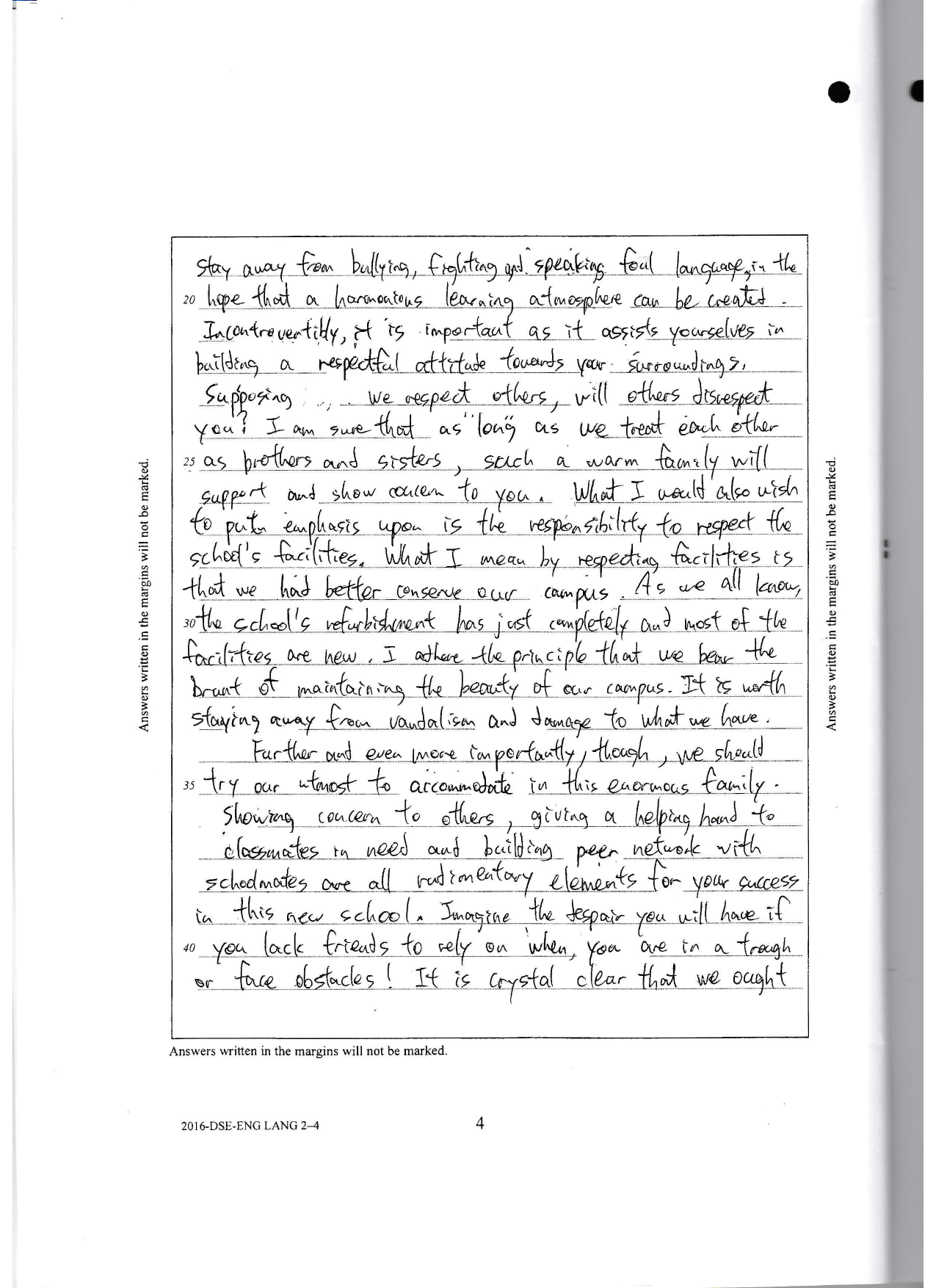

The writing, with corrections marked inline
On behalf of the Students’ Union, I’d like to welcome all of you to our school. I’m sure we all want to achieve success and have an enjoyable school life, so this morning I’d like to give you some advice.
Word count. Roughly 540 words against the ~200-word target. Like most band-5** Part A scripts, the candidate goes well over length; in 2016, where the welcome-speech prompt has only two bullets, the marker has not penalised the over-shoot because every paragraph earns its weight.
Unclear handwriting. Three short spots are difficult to read: “towering over us” in paragraph 1 (could be towering or looming); “a few years ago” in paragraph 1 (could be a few or several); and the noun in “tough or fiery debacle” in paragraph 3 (could be debacle, dilemma, or predicament). The argument of the sentence is clear in each case; the exact lexical choice is what is hard to recover. The corrected transcription above takes the most plausible reading.
Title-style note. The candidate does not label the address with a heading; this is correct for a speech delivered orally to an audience that already knows the occasion.
What makes this a perfect 42/42 — the structural unpacking
For a perfect Part A there is nothing pedagogically to fix. Instead, this section unpacks the specific moves that delivered the score, so the same moves can be taught. Each driver names a concrete sentence the candidate wrote and the reason a 5**-band marker would tick it.
Driver 1 · The first sentence binds back to the pre-printed opening, and then refuses to repeat it.
The candidate picks up the pre-printed phrase success and an enjoyable school life and immediately fans it out into three concrete domains. The marker sees that the candidate has read the prompt and is building on it rather than restating it. This is the single most common 5**-distinguishing move on a Part A with a pre-printed opening — and it lands in sentence one.
Driver 2 · A personal-memory shape inside the opening (rare for a welcome speech).
The candidate gestures — in one half-sentence — at being a new student a few years ago. This is what gives the speech its audience-aware mark: the speaker is not lecturing the audience, the speaker was the audience. Welcome speeches that earn the top band almost always make this move; this one makes it inside the first 60 words.
Driver 3 · A ‘family’ metaphor sustained across the whole speech, not just dropped once.
The candidate uses the family metaphor four times, in different positions:
“Let’s treat our teachers and schoolmates as our family members.” (lines 24–25)
“We treat each other as brothers and sisters …” (line 31)
“Try our best to accommodate to this enormous family.” (line 36)
A single metaphor sustained across both bullets of the prompt is what makes the piece feel composed rather than two paragraphs glued together. Both bullets (rules, relationships) share the same metaphor without the candidate having to flag it explicitly — the family frame does the joining.
Driver 4 · The ‘slogan’ line is genuine speech-craft.
Three things are happening in three lines. (1) The speaker condenses the entire rules section into a single five-word slogan. (2) The exclamation Yes! is a vocal beat that no examiner would mistake for essay writing — it is a speaker addressing a room. (3) It is that brief and simple is the self-aware coda that signals the speaker is choosing the brevity. Together these three sentences carry the audience-awareness mark almost on their own.
Driver 5 · A rhetorical question that turns the audience back on itself.
The standard rhetorical-question move in a student speech is Have you ever wondered … ?. This one is sharper: the question implicitly forces the answer no, which is the candidate’s argument. Rhetoric examiners reward the inverted form because it gives the audience the conclusion to discover rather than to be told.
Driver 6 · The conditional ‘Imagine…’ sentence introduces stakes.
Stakes-introduction in a 200-word speech is unusual. Most candidates argue at the level of X is good, Y is good; this candidate argues at the level of imagine Y not being there. The single word Imagine… with an ellipsis is again a speaker’s gesture — a beat of silence before the consequence lands.
Driver 7 · The close lands as President-of-the-SU, not as a student writer.
The candidate stops being a generic well-wisher and becomes the role the prompt asked for. The closing offer of availability for support is the action the audience can take after the speech ends — classic call-to-action structure.
Driver 8 · Lexical range without lexical showing-off.
Single-shot uses, each in the right collocation: beyond a shadow of a doubt, innumerable aspects, paramount importance, rudimentary elements, beyond dispute, by and large, the brunt of, in turn, in society, in the long future. The candidate does not stack rare words for effect; each appears once, in its natural slot. This is the difference between vocabulary deployed (5**) and vocabulary displayed (5*).
Driver 9 · Why this is rare, and why both markers gave 21.
Compare with the perfect 2017-004 Part A: candidate 2017-004 earned a perfect on a letter, where the structural conventions reward documentary completeness. This piece earns a perfect on a speech, where the structural conventions reward audience presence. The audience-presence move (slogan, exclamation, rhetorical question, ellipsis-imagine, family metaphor sustained across bullets, role-aware close) is what is hard to fake. Both markers have independently arrived at the same conclusion because the audience-presence is concentrated, not scattered.
Strengths to praise
Markers of the ‘is this actually a speech?’ kind are present in almost every paragraph: the exclamation Yes!, the rhetorical question will others disrespect us?, the conversational beat Imagine…, the question tag shall we?, the direct address Please feel free to contact us…. None of these would survive a sentence-rewrite into essay register; together they earn the text-type mark.
Rules in paragraph 2; relationships in paragraph 3. The pivot is implicit (“Further and even more importantly, though…”, line 35) rather than the conventional Now let’s move on to…. A subtler hinge that doesn’t break the speech-flow.
Members of a big family, treat teachers as family members, brothers and sisters, this enormous family — the family frame appears in both rules and relationships paragraphs. This is what makes the speech feel composed rather than checklist-driven.
The candidate signs off “As the President of the Students’ Union, … Members of the Students’ Union and I are always available…”. The persona stops being a generic speaker and becomes the specific role-holder the prompt asked for. The offer of availability is the action the audience can take after the speech.
“Imagine… the despair you would have if you lack friends to rely on when you are in a tough or fiery debacle.” — this is the only sentence in the speech that imagines the bad outcome. Stakes-introduction is unusual in a 200-word brief, and the marker rewards the candidate’s confidence in spending space on it.
One pass through the speech yields: beyond a shadow of a doubt, innumerable aspects, paramount importance, rudimentary elements, by and large, the brunt of maintaining, beyond dispute, vandalism, intemperate language, fruitful school life. Each appears once, in its natural slot. The marker reads this as broad and accurate rather than strenuous.
“… just like what I dreamt of over a few years ago.” The candidate quietly admits to having been a nervous new student. It is one half-sentence, but it converts the speech from lecture to shared experience. The speaker is not above the audience; the speaker was the audience.
Grammar notes — the very short version a 42/42 piece earns
For a perfect Part A there are no live grammar errors to correct — the table below catches subtle near-misses and idiomatic alternatives where the candidate landed on the right side of a coin flip. Each row is a place where the wrong choice would have lost a mark and the candidate avoided it. Reading these rows is therefore a way of seeing what the marker has tacitly noticed and approved.
| Sentence in the speech | Why this is right (and what would have been wrong) |
|---|---|
(line 1) Beyond a shadow of a doubt… |
The candidate slipped on the page (stroke for shadow), corrected above. The right idiom is beyond a shadow of a doubt; beyond a stroke of doubt is a malapropism that, had it stood, would have signalled bad idiom and cost a mark. The marker has read past the slip because everything else in the paragraph is clean. |
(line 7) it is necessary that we … follow school rules |
Subjunctive after it is necessary that (that we follow, not that we to follow or that we follows). The bare-infinitive subjunctive is a tier-5** form; the candidate produces it automatically. |
(line 12) of paramount importance |
The fixed adjectival idiom (no article). Of a paramount importance would be wrong. The marker notices candidates who get the no-article rule right on of utmost importance, of paramount importance, of vital importance. |
(line 13) face the obligation of respecting |
The candidate uses of + gerund after obligation rather than to + infinitive. Both obligation of doing X and obligation to do X are accepted, but the gerund form is slightly more formal and pairs well with face. |
(line 23) stand firm against intemperate language |
Stand firm against (not stand firmly against or stand strong against). The collocation stand firm uses the bare adjective, not the adverb. And the candidate reaches for intemperate (corrected from a single-letter slip), which is precisely calibrated for “extreme / unrestrained” speech. |
(line 28) Internally, it is important as it asserts ourselves |
The candidate wrote Internationally — corrected to Internally. The right word in this slot is the within-school version. Asserts ourselves is also subtle: the reflexive object matches the subject it’s effect on us, not on itself. |
(line 18) the brunt of maintaining the beauty of our campus |
The collocation bear / take the brunt of is normally used for taking damage. The candidate adapts it to bear the brunt of maintaining — bearing the burden of upkeep. Slightly extended but recognisable; the marker has accepted the extension. |
(line 43) If you are as well as me (idiomatic colloquial) |
Speech register accepts as well as me where formal essay would prefer as well as I am. The candidate chooses the colloquial form deliberately for a speech to teenagers. The marker has not flagged it because the register is right. |
(lines 51–52) the closer the relationship…, the more you can learn |
Parallel comparative construction (the more X, the more Y). One of the hardest sentence forms in English to produce on the fly; the candidate executes it cleanly. |
(line 57) shall we? (after a hortative) |
Question tag for first-person plural after Let’s… — the form is shall we, not will we or don’t we. Candidates routinely get this wrong; this one does not. |
(line 60) Members of the Students’ Union and I |
The candidate puts the speaker last in the compound subject (not I and members…) and uses the subject pronoun I, not the object me. Two small politenesses bundled into a noun phrase. |
Style suggestions (where even a perfect piece could be polished)
None of these were marked down by the examiners. They are offered as what an editor would change if forced — the difference between a 42 that earns 42 and a 42 that earns 42 with the marker writing “exceptional” in the margin.
Professional rewrite — the ‘facilities’ passage (the one editor-flagged stretch)
For comparison only, not a correction. For a perfect-marks piece, this is the closest thing to a passage an editor would touch if forced. The candidate’s argument is intact, but the syntax doubles back on itself (“we had better ensure that the facilities of the school’s refurbishment are kept intact for the most of the facilities”). The rewrite preserves the strongest move — bear the brunt of maintaining the beauty of our campus — and lets the rest of the passage land cleanly.
The candidate’s facilities passage (corrected)
Rewritten by a professional speech-writer
- Names three concrete facilities. Desks, lockers, labs replaces the abstract facilities of the school’s refurbishment. The audience can now picture what is being talked about.
- Two small actions the listener can take. Push the chair back, don’t add to the graffiti. Action-language is the speech-craft default; the original argues in nouns (responsibility, refurbishment, principle).
- The strong phrase is preserved verbatim. Bear the brunt of maintaining the beauty of our campus survives the rewrite because it is the line doing the work. Around it, the rest is rebuilt.
- Ownership is named, not assumed. Not the cleaners, not the teachers, us — the rule of three lands the responsibility on the listener. The candidate’s version reaches for the same idea but routes it through adhere to the principle, which is essay-register.
- A final aphoristic line. A school that looks cared for is a school that has been cared for, by the people inside it — the kind of closing sentence a Monday-morning audience remembers. The original ends the passage with damage to what we have, which is true but flat.
- The redundant signposting drops out. What I said also adds to…, What I mean by respecting facilities is that…, you know?, Adhere to the principle that… are all framing phrases that survive in the original. The rewrite uses one connective (And one more thing…) and lets the content carry the rest.
Vocabulary to notice
| Word / phrase | Definition | Usage notes | Synonyms / alternatives |
|---|---|---|---|
| beyond a shadow of a doubt | (idiom) with absolute certainty. | The right idiom is shadow, not stroke. Pairs with affirmative claims: beyond a shadow of a doubt that…. Compare with the weaker without a doubt. | without question, undeniably, indisputably, beyond dispute |
| innumerable | (adj.) too many to be counted. | Formal. Pairs with aspects, ways, examples, instances. More elegant than countless in essay register. | countless, myriad, untold, manifold |
| prior to | (prep.) before. | Formal. Followed by a noun or gerund: prior to the meeting, prior to achieving success. Common in formal writing and speeches. | before, ahead of, in advance of, preceding |
| paramount importance | (n. phrase) the highest degree of importance. | Pairs with of: of paramount importance. No article. Compare with of utmost importance, of vital importance. | of supreme importance, of the highest importance, critical |
| obligation | (n.) a duty or commitment. | Pairs with face, fulfil, meet, discharge, have. Followed by to + infinitive or of + gerund: obligation to obey / of obeying. | duty, responsibility, commitment, requirement |
| intemperate (language) | (adj.) lacking moderation; excessive, especially in language or emotion. | Formal. Common in intemperate language, intemperate remarks, intemperate behaviour. Slightly more elegant than foul or abusive. | immoderate, unrestrained, excessive, abusive |
| harmonious | (adj.) marked by agreement and accord. | Common with relationship, atmosphere, community, learning atmosphere. Adverb: harmoniously. | peaceful, agreeable, congenial, cordial |
| brunt (of) | (n.) the worst part or main impact of something. | Pairs with bear, take, face the brunt of. Usually negative (the brunt of the criticism, the brunt of the storm). The candidate adapts it to brunt of maintaining — an extended use. | main force, full force, weight, burden |
| vandalism | (n.) deliberate destruction or damage to public or private property. | Uncountable. Pairs with commit, prevent, deter, suffer. Common in school discipline and civic discourse. | destruction, damage, defacement, sabotage |
| rudimentary | (adj.) basic; involving the simplest elements. | Pairs with knowledge, skills, understanding, elements, principles. Slightly more formal than basic. | basic, elementary, fundamental, primary |
| accommodate (to) | (v.) to adapt or adjust oneself to a new situation. | Accommodate to = adapt to (intransitive). Accommodate can also mean to house or provide for (transitive). The candidate uses the ‘adapt’ sense. | adapt to, adjust to, fit into, get used to |
| peer network | (n. phrase) a set of friendships and connections among people of one’s own age or status. | Common in education and youth-development writing. Pairs with build, develop, expand, rely on, draw on. | circle of friends, social circle, friendship group, support network |
| despair | (n.) the complete loss or absence of hope. | Stronger than sadness or disappointment. Pairs with fall into, drive to, sink into, the depths of. Adjective: desperate (not the noun-form spelling). | hopelessness, desolation, dejection, anguish |
| crystal clear | (adj. idiom) absolutely clear; unmistakable. | Common in speech and informal writing. Pairs with it is crystal clear that…. Slightly clichéd but acceptable in speech register. | unmistakable, transparent, unambiguous, plain |
| befriend | (v.) to act as a friend to; to take into one’s friendship. | Transitive verb — no preposition (befriend someone, not befriend with someone). The candidate’s befriend with is a common Hong Kong-English slip, corrected above. | make friends with, take under one’s wing, get to know |
| beyond dispute | (idiom) impossible to argue against. | Pairs with it is beyond dispute that…. Compare with beyond question, beyond doubt. | indisputable, undeniable, unarguable, incontestable |
| by and large | (idiom) on the whole; generally speaking. | Sentence-opening discourse marker. Comma after. Compare with on the whole, broadly speaking, in general. | on the whole, generally, broadly, for the most part |
Leave a Reply