Should Graduates Look for Jobs in Asia? — 35/42 (5**) [working title — student did not provide one]
Many Hong Kong graduates complain about the lack of employment opportunities in the city. It has been suggested that the graduates who fail to find a job in Hong Kong could look for opportunities in other cities in Asia. Do you support this suggestion?
Write an article for the Young Post explaining your views. Provide an appropriate title for your article. (~400 words)
Show original handwritten pages (5)
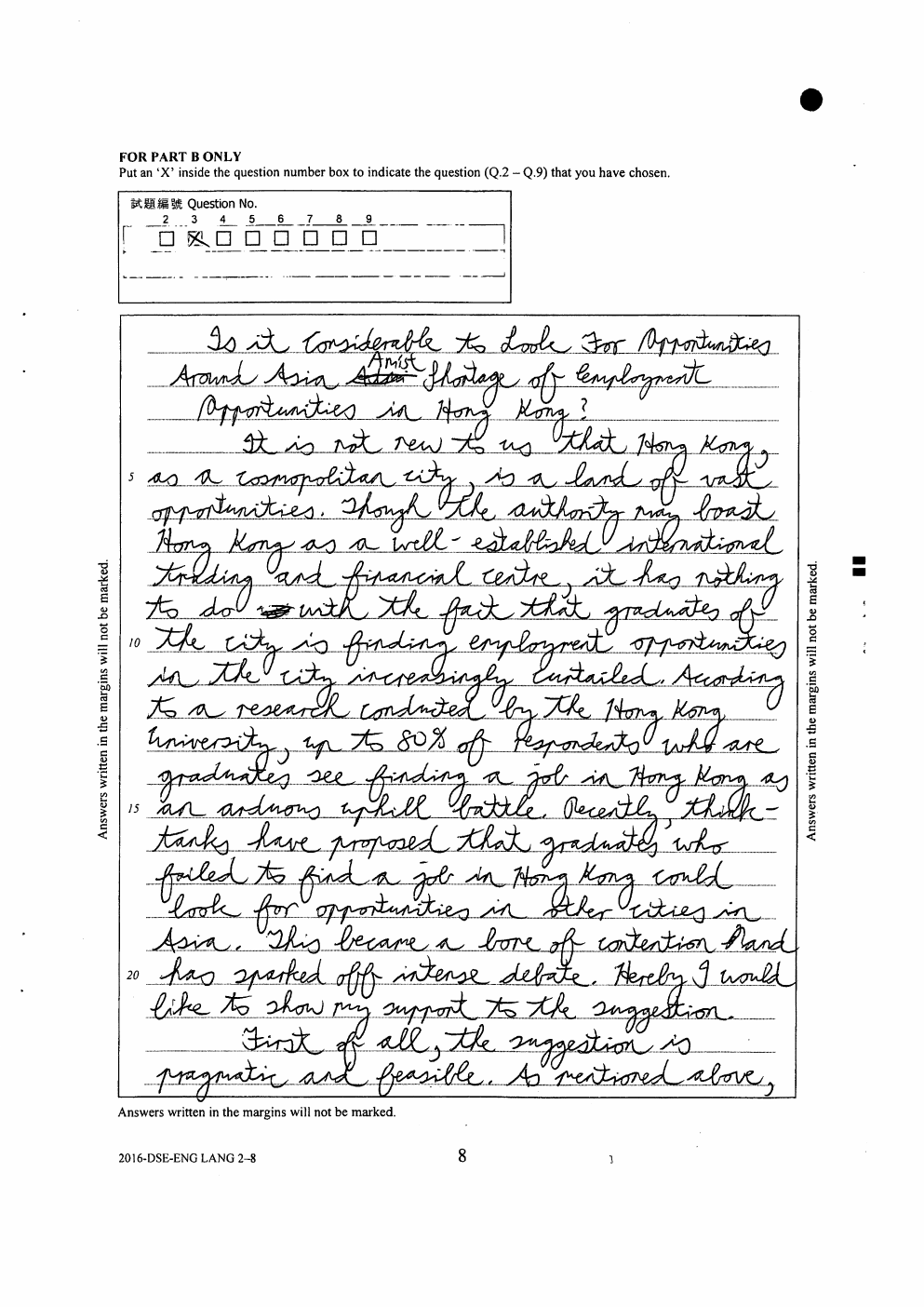
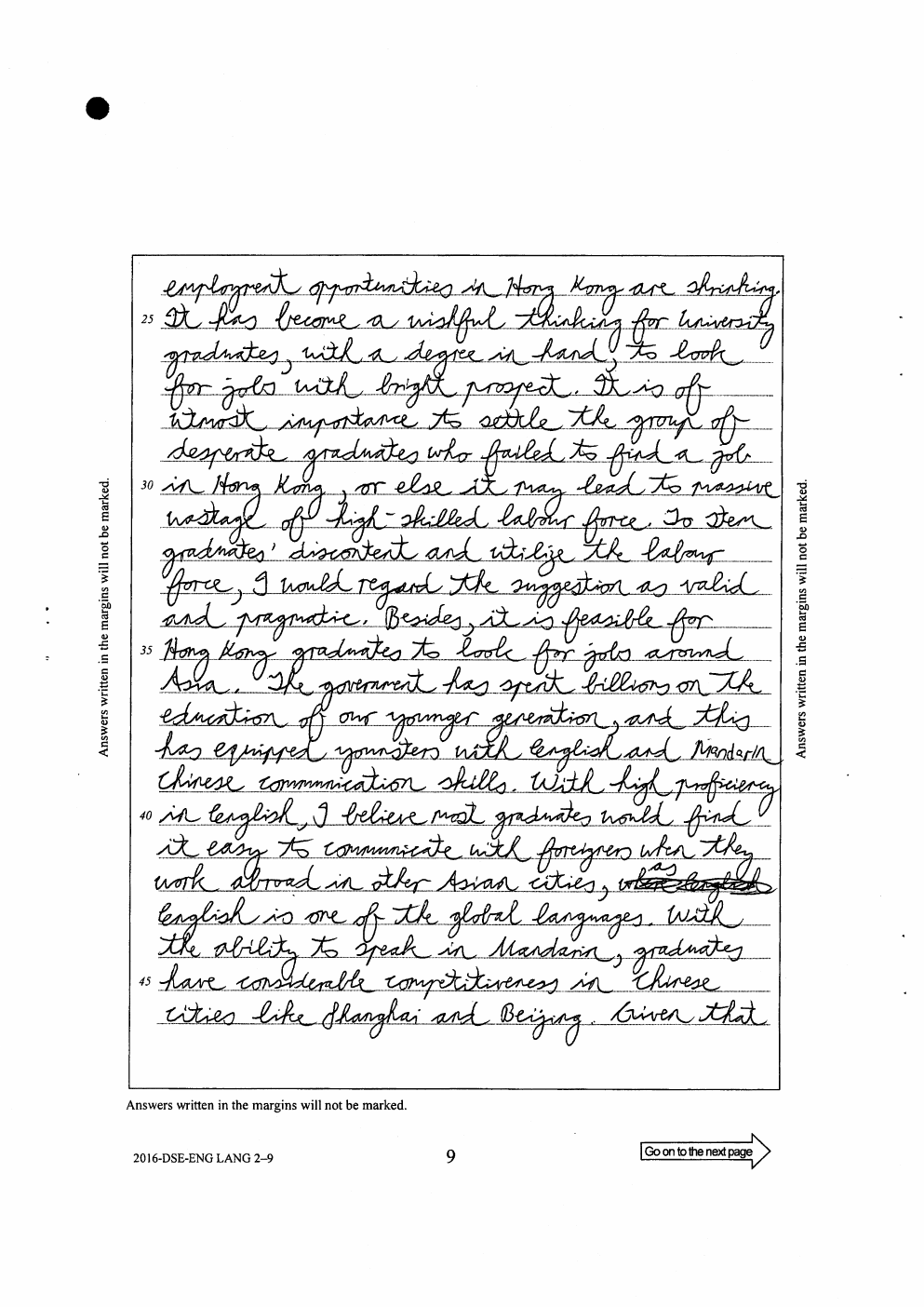

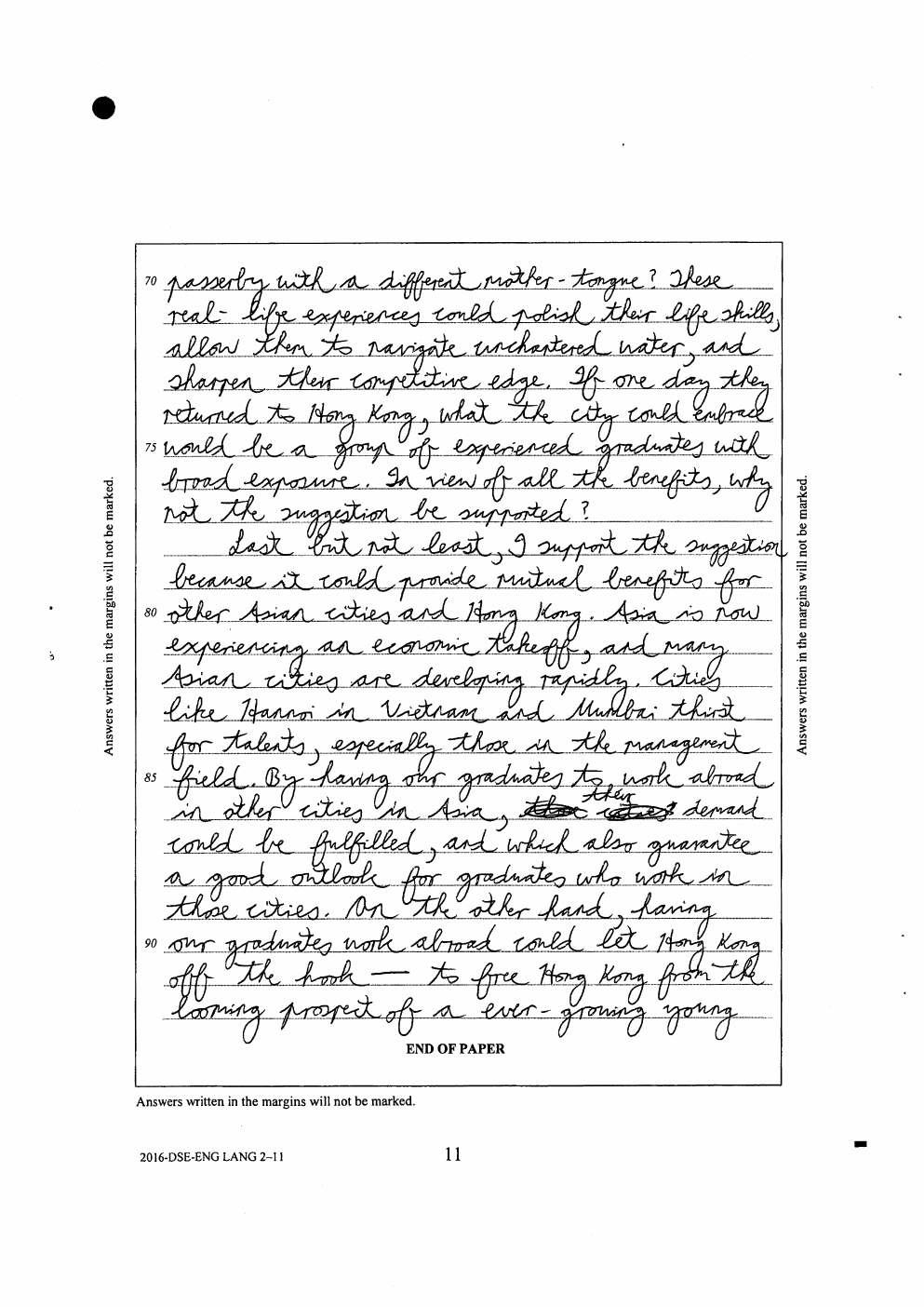
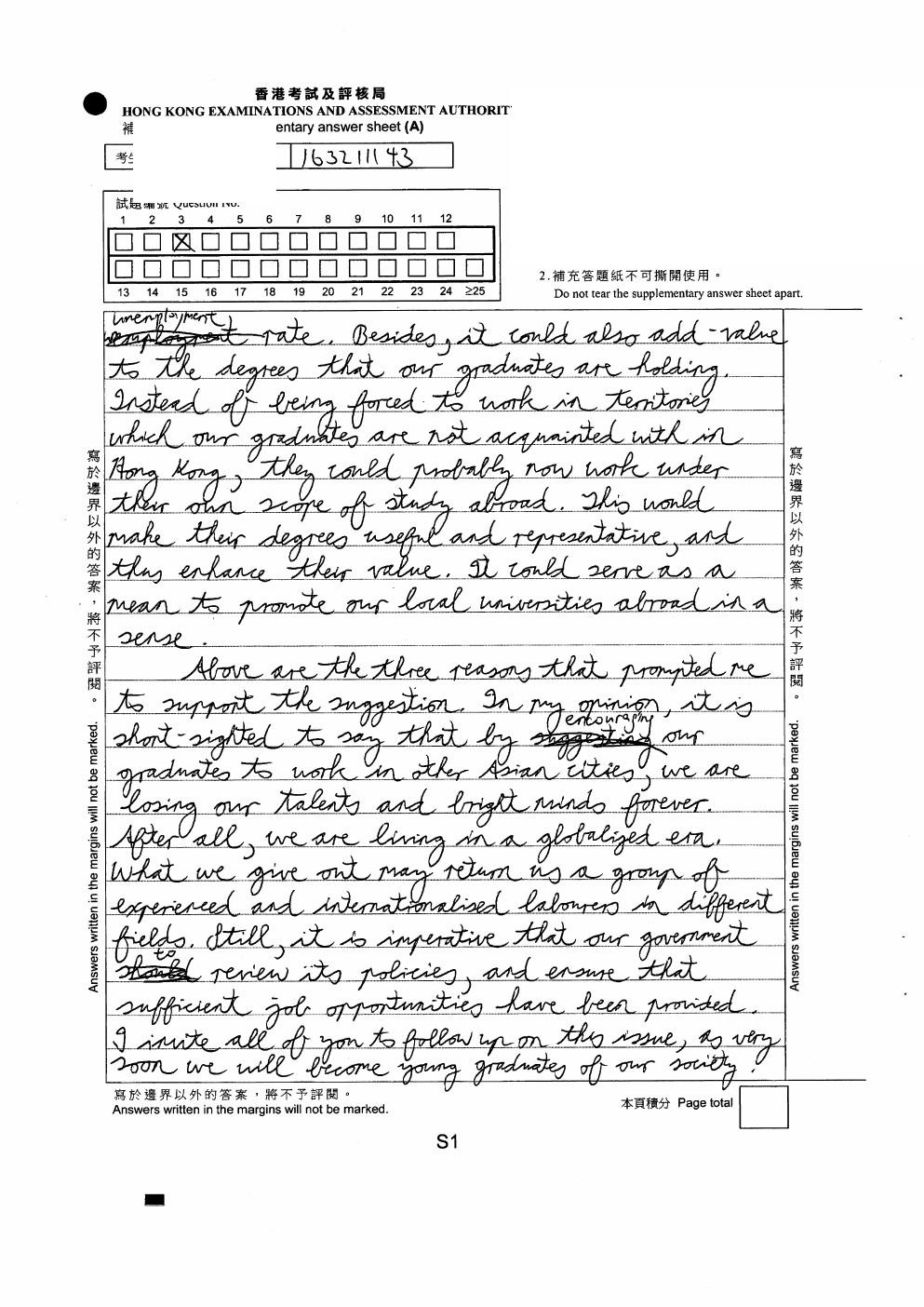
The writing, with corrections marked inline
Continuation on a supplementary answer sheet. The student ran out of space in the main answer book (which ended on page 30 / booklet p.11) and continued the final paragraph + conclusion on Supplementary Answer Sheet A (page 32 of the PDF, labelled S1). The Question No. box on the supplementary sheet correctly shows Q3 ticked. The corrected version above stitches the two pages together. Without the supplementary sheet the article would have appeared to break off mid-sentence at “ever-growing young…”.
Word count note: the full piece (main answer book + supplementary sheet) runs to roughly 700 words — well over the 400-word target. Length is no longer the issue it appeared to be before the supplementary sheet was found, but the article would still benefit from a tightening pass.
Inserted word on page 27: “Amid” appears above the opening line; the student inserted it to make “amid a shortage of employment opportunities”. Kept in the corrected version.
Strengths to praise
The article opens with a direct rhetorical question (“Is it advisable to look for opportunities around Asia amid a shortage of employment opportunities in Hong Kong?”) and then immediately concedes the broader context (“Hong Kong, as a cosmopolitan city, is a land of vast opportunities”) before introducing the problem. This is exactly the move that opinion-piece writers make: hook, frame, then pivot.
The student uses a real-sounding statistic (“up to 80% of respondents who are graduates see finding a job in Hong Kong as an arduous uphill battle”) and names a source (HKU). Whether the figure is exact or not, it gives the argument empirical weight before the opinion arrives.
The article uses a textbook three-reason structure with clear sign-posting: First of all… (pragmatism / feasibility), Apart from concerns over feasibility… (benefits to graduates), Last but not least… (mutual benefits). Each reason gets its own paragraph and its own example.
The piece names Shanghai, Beijing, Hanoi (Vietnam), Mumbai — not just “other Asian cities.” Specificity is one of the strongest markers of mature argumentative writing.
An arduous uphill battle, a bone of contention, sparked off intense debate, fallen prey to, flex their creative muscles, uncharted waters, sharpen their competitive edge, off the hook, looming prospect. These are deployed in their natural collocations — the student has internalised them, not just memorised them.
The middle paragraph briefly concedes that HK education is flawed (“having a degree is not a manifestation of one’s maturity… our education system emphasizes too much on paperwork drilling”) and uses that concession as a springboard for the next argument — graduates need to leave precisely to learn the skills HK didn’t teach them. Sophisticated rhetorical move for a 17-year-old.
Grammar notes
| Issue | Explanation |
|---|---|
(line 9) graduates of the city is finding → graduates of the city are finding |
Subject-verb agreement. Graduates is plural; the head noun isn’t city. (A common slip when there’s a singular noun nearer the verb.) |
(lines 5–6) boast Hong Kong as a…centre → boast about Hong Kong being a…centre |
Boast as a transitive verb (boast a feature) means “have proudly.” It doesn’t take X as Y. The construction wanted here is boast about X being Y, or simpler — tout Hong Kong as…. |
(line 12) up to 80% of Respondents → up to 80% of respondents |
No reason to capitalise respondents — it’s a common noun. |
(line 25) It has become a wishful thinking → It has become wishful thinking |
Wishful thinking is an uncountable phrase (like good news, hard work) and takes no article. |
(line 27) jobs with bright prospect → jobs with bright prospects |
In the sense of “future possibilities,” prospects is almost always plural (career prospects, marriage prospects, bright prospects). |
(line 87) By having our graduates to work abroad → By having our graduates work abroad |
The causative pattern have someone do something takes the bare infinitive (no to): have them work, have her sing, have him wait. |
(line 89) and which also guarantee → and this would also guarantee |
Two issues: and which is grammatically clunky (a relative pronoun shouldn’t follow and here), and the verb should agree with the singular subject and use modal would for the hypothetical. |
(line 59) I am not actually referring to graduates who have fallen prey |
The logic of this sentence seems inverted: the surrounding paragraph clearly is about those graduates. Likely intended: “I am actually referring to graduates who have fallen prey…” (drop not). |
(line 55) education system emphasize → education system emphasizes |
Subject-verb agreement. System is singular. |
(line 58) skills that really makes → skills that really make |
The verb agrees with the plural antecedent skills, not the nearer singular noun. |
(line 62) basic life skills as communication → basic life skills such as communication |
As alone introduces a role or capacity (works as a doctor); to introduce examples, use such as, like or including. |
(line 66) shift for themselves → fend for themselves |
The fixed idiom is fend for oneself — to look after oneself without help. Shift for oneself exists in older English but is archaic. |
(line 73) unchartered waters → uncharted waters |
Common confusion. Uncharted means “not on any map.” Unchartered would mean “without a charter / licence,” which is unrelated to navigation. |
(line 68) flex their creativity muscles → flex their creative muscles |
The idiom is flex one’s creative muscles: creative is the adjective. Creativity is a noun and doesn’t modify muscles. |
(lines 64–66) Working in other Asian cities not only could allow our graduates… |
The not only…but also… construction reads more naturally with inverted word order: Not only could working in other Asian cities allow our graduates to look for jobs — it could also force them to fend for themselves. |
(line 94) ever-growing young unemployment rate → ever-growing youth unemployment rate |
Young is an adjective for people (young people, young workers); the standard collocation for the social-economic indicator is youth unemployment. The student bridged the two pages with young; the correction picks the right form. |
(line 103) It could serve as a mean → a means |
Means in the sense of “a method or instrument” is always written with the -s, whether singular or plural (a means to an end, by means of, a means of transport). Mean without the -s is the verb or a statistical average. |
(line 103) promote our local universities abroad in a sense → promote our local universities abroad |
In a sense hedges a claim the student has just made positively; it weakens the line. If you mean X, just say X. |
(line 104) that prompted me to support → that prompt me to support |
The argument is being made in the present (these are the reasons that currently motivate the writer’s position), so the simple present prompt fits better than past prompted. |
(lines 112–113) imperative that our government would review → imperative that our government review |
After it is imperative / essential / crucial / vital that…, English uses the bare subjunctive form of the verb — no would, no -s. The student crossed out would mid-sentence, sensing the issue. |
(line 114) sufficient job opportunities have been promised → are provided / are made available |
Jobs aren’t promised — promises sit in the mouths of politicians but not in the world of work. Provided, secured, made available, created all carry the meaning the sentence wants. |
(lines 115–116) so very soon, we will become young graduates of our society |
The final line is muddled. The speaker is themselves about to become a young graduate, so the line is meant to call the audience to action while positioning the speaker among them. A cleaner version: “…because very soon, we too will be the young graduates standing in their shoes.” See the professional rewrite below. |
| Title missing | The question explicitly asks for an appropriate title. The student went straight into the opening line. A working title appears at the top of this analysis in square brackets for reference. |
Style suggestions (where strong writing could become outstanding)
For comparison only, not a correction. The student does land the article (on the supplementary sheet), but the conclusion is the weakest stretch of an otherwise impressive piece — the recap is plain, the counter-argument is rebutted only briefly, the government’s role is tucked in awkwardly, and the final line is muddled. The rewrite shows what a finished, paid columnist would do with the same three ideas in roughly the same word count.
The student’s conclusion (corrected for grammar)
Rewritten by a professional columnist
But the government cannot simply wave them goodbye. It must review its policies and ensure that, when our young people are ready to come home, there are jobs worthy of them.
The rest is up to us — because very soon, we too will be the graduates standing at this same crossroads. Where we choose to start matters less than that we choose, with our eyes open and our ambitions intact.
- An elegant inversion of “losing talents.” “Talent does not leave — it travels.” The student’s “losing our talents and bright minds forever” is the cliche; the rewrite reframes it with a five-word epigram that the reader can quote.
- Three short paragraphs instead of one long one. Each paragraph carries one idea (counter-argument rebuttal → government’s role → call to peers). Opinion pieces benefit from white space in the conclusion.
- The government gets its own paragraph. The student’s “Still, it is imperative that our government review its policies…” is grafted onto the end of the previous thought. Giving it a paragraph of its own grants the imperative its full weight.
- A final line that lands. “Where we choose to start matters less than that we choose, with our eyes open and our ambitions intact.” — one sentence, memorable, addresses the audience and the speaker as a single we. The student’s ending (“we will become young graduates of our society”) reaches for this register but fumbles the syntax.
- Anticipates the strongest counter-argument by name. “To dismiss this approach as a ‘brain drain’…” puts the opponent’s phrase in quotes and addresses it head-on. Opinion writers gain credibility by naming the very objection they’re rebutting.
Vocabulary to notice
| Word | Definition | Usage notes | Synonyms / alternatives |
|---|---|---|---|
| cosmopolitan | (adj.) including or containing people or elements from many different countries or cultures; familiar with many countries. | Used of cities (a cosmopolitan city) and people (cosmopolitan tastes). Positive in both senses. | international, multicultural, worldly, urbane |
| curtailed | (v., past) reduced or limited; cut short. | Formal. Used of rights, freedoms, opportunities, programmes (budgets were curtailed). Compare with cut (everyday) and truncate (more technical). | reduced, restricted, limited, trimmed |
| arduous | (adj.) involving or requiring strenuous effort; difficult and tiring. | Pairs with journey, task, climb, process, battle. Stronger than difficult; carries the image of physical effort. | strenuous, gruelling, taxing, demanding |
| think tank | (n.) an organisation that performs research and advocacy on policy matters. | Two words, no hyphen (older British texts may hyphenate). Common in political and economic journalism. | research institute, policy institute, advisory body |
| bone of contention | (idiom) the subject of an ongoing dispute or disagreement. | Vivid metaphor (dogs fighting over a bone). Best in argumentative writing about contested issues. Idiomatic; don’t try to extend the bone metaphor further. | point of dispute, contentious issue, sticking point |
| spark off | (phrasal v.) to cause something (usually a debate, reaction, or conflict) to start suddenly. | Always followed by an event noun: sparked off a debate, sparked off protests, sparked off a controversy. | trigger, ignite, set off, provoke |
| pragmatic | (adj.) dealing with things sensibly and realistically; concerned with practical results. | Positive word, often contrasted with idealistic, theoretical, dogmatic. A pragmatic approach, a pragmatic solution. | practical, realistic, sensible, level-headed |
| feasible | (adj.) possible to do easily or conveniently; practicable. | Often paired with plan, suggestion, option, solution. Compare with possible (more general) and viable (capable of working successfully). | practicable, viable, workable, achievable |
| wishful thinking | (n., uncountable) the formation of beliefs based on what one wishes rather than what is real or likely. | Uncountable — no article. Carries a tone of gentle criticism (just wishful thinking, mere wishful thinking). | fantasy, daydreaming, optimistic delusion, pipe dream |
| utilize | (v.) to make practical and effective use of. | More formal than use. Common in management and policy writing. British spelling utilise. | use, employ, deploy, harness |
| manifestation | (n.) an event, action, or object that clearly shows or embodies something abstract or theoretical. | Pair with abstract nouns: a manifestation of power, of grief, of unrest. Slightly formal. | expression, display, embodiment, sign |
| exam-oriented | (adj.) focused on examinations as the primary measure of success. | Hyphenated. Often used (slightly critically) of East Asian education systems. Compare with results-driven. | test-focused, results-driven, examination-centred |
| fallen prey to | (idiom) become a victim of something harmful. | Strong verb phrase. Pairs with abstract enemies: fallen prey to scams, to addiction, to propaganda, to the system. | become a victim of, succumbed to, been ensnared by |
| fend for oneself | (idiom) to look after and provide for oneself without help. | Common across British and American English. Slightly informal but acceptable in opinion writing. | look after oneself, manage on one’s own, get by alone |
| flex one’s (creative) muscles | (idiom) to put one’s skill or ability into practice. | Can take any modifier: creative muscles, intellectual muscles, political muscles. Creative, not creativity. | exercise one’s skills, put one’s abilities to use |
| uncharted waters | (idiom) a situation that is unfamiliar or has not been experienced before. | Literally: parts of the sea not on any nautical chart. Spelled uncharted — not unchartered. | unfamiliar territory, new ground, terra incognita |
| competitive edge | (n. phrase) a quality or advantage that gives one a superior position over competitors. | Business and economic register. Pair with gain, sharpen, lose, maintain. | advantage, edge, head start, upper hand |
| broad exposure | (n. phrase) wide experience or contact with many different things, situations, or ideas. | Common in CVs and recommendation letters: broad exposure to different markets / cultures / industries. | wide experience, varied background, extensive contact |
| economic takeoff | (n. phrase) the stage at which an economy begins rapid, sustained growth. | From W. W. Rostow’s stages-of-growth theory (1960). Useful for writing about developing economies. | economic boom, surge, lift-off |
| thirst for | (v. + prep.) to have a strong desire for. | Used with abstract objects: thirst for knowledge, for power, for revenge, for talent. Slightly literary. | crave, hunger for, yearn for, long for |
| looming prospect | (n. phrase) an anticipated event or possibility approaching in a threatening way. | Loom as a verb means to appear large and threatening. Looming prospect, looming threat, looming deadline, looming crisis. | impending threat, approaching danger, gathering storm |
| off the hook | (idiom) released from blame, responsibility, or an obligation. | Originally from fishing. Often used in negotiation or accountability contexts. Watch the tone — can sound a bit casual for a formal article. | off the line, in the clear, absolved, released |
| imperative | (adj.) of vital importance; crucial. (Also a noun: an essential or urgent thing.) | Followed by that + bare subjunctive (“it is imperative that he be informed”, “it is imperative that we act”) — no would, no -s on the verb. | essential, crucial, vital, urgent |
| globalized / globalised | (adj.) shaped by global integration of economies, cultures and societies. | British globalised, American globalized. Common in opinion writing about trade, migration, and labour markets. Pair with era, economy, world, workforce. | international, transnational, interconnected, borderless |
| internationalised | (adj.) having become international in character; exposed to or shaped by multiple countries. | British spelling; American internationalized. Used of people (an internationalised workforce), institutions (an internationalised curriculum), or capital. | cosmopolitan, global, multinational, worldly |
Leave a Reply