Argumentative Essay — ‘International Talent: Accept or Reject?’ (a balanced case, with a ‘2Ps’ solution)
Hong Kong, like many places, is debating whether to accept more international talent. Write an argumentative essay on the question: “International Talent: Accept or Reject?”
About 400 words. Booklet pages 8–11, continuing onto the Part B supplementary sheet. A genuinely balanced essay: three benefits (filling HK’s talent gaps, diversifying the pool, pushing locals to improve), three challenges (stress/unemployment, cultural conflict), and a structured ‘2Ps’ solution — Preparation and Preference — before returning to the title question. Ambitious vocabulary and structure carry it to 5*, though the dense argument strains the grammar in places.
Show original handwritten pages (5)

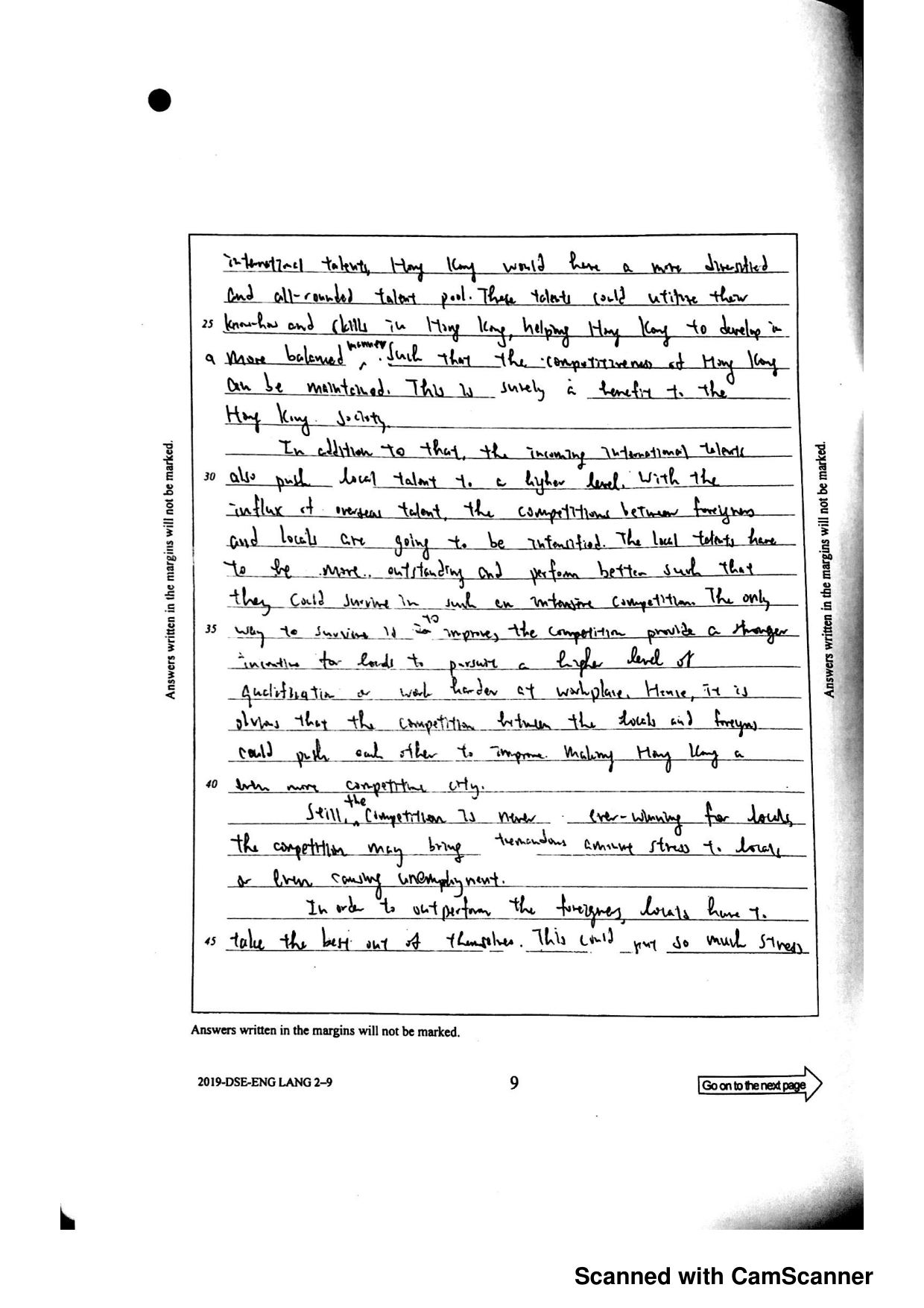


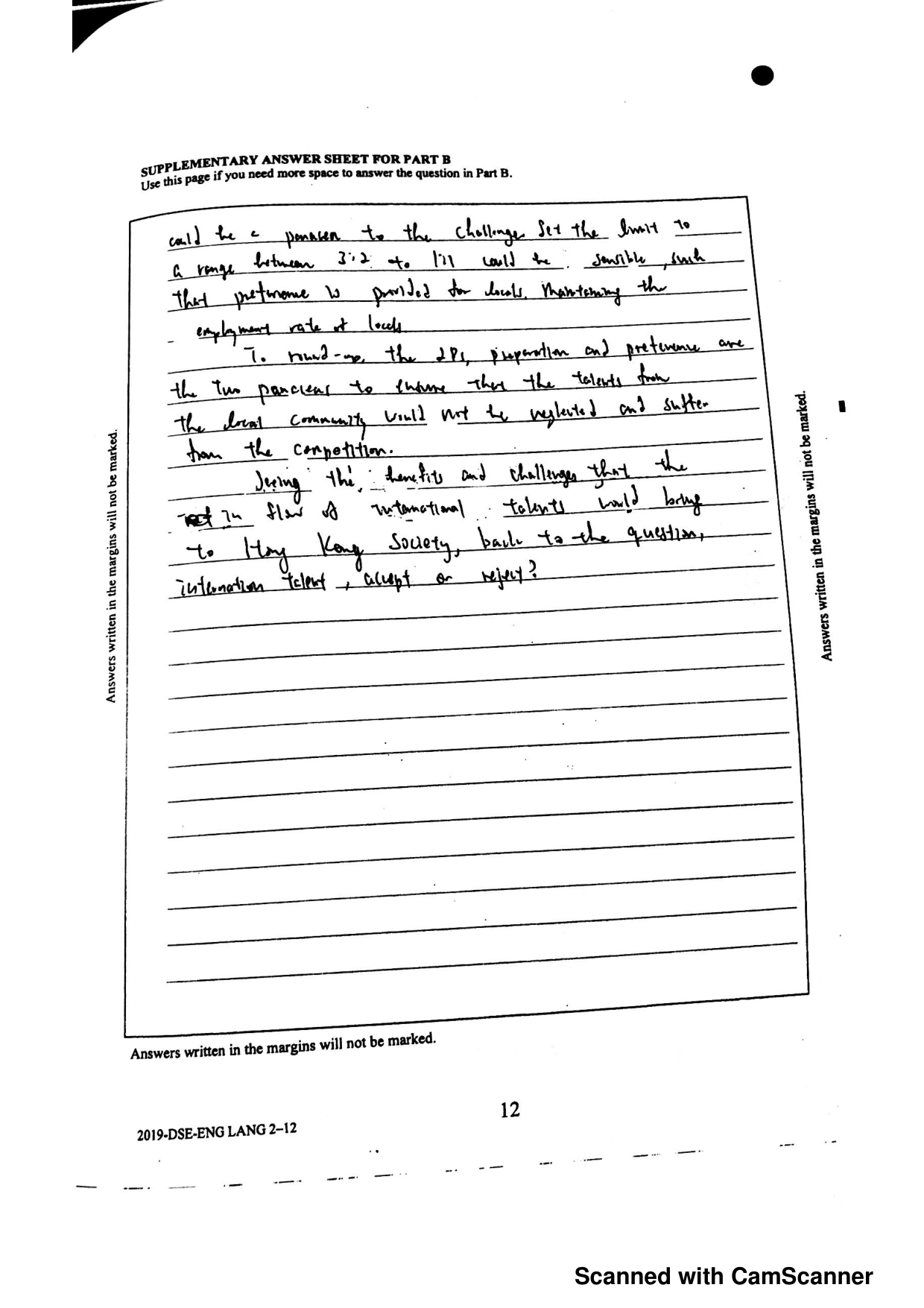
The writing, with corrections marked inline
Strengths to praise
The essay weighs both sides at length — three benefits (filling talent gaps, diversifying the pool, raising local standards) and real challenges (stress, unemployment, cultural conflict) — before reaching a position. Treating the question as a genuine debate, not a one-sided rant, is exactly what Q2 rewards.
Rather than vague calls to ‘do something’, the writer offers a named, two-part plan — “the first P, is preparation… the second P, is preference” — with concrete measures (upskilling locals; a government hiring ratio). A labelled framework makes a solution easy to follow and remember.
“Yet, what about technology? What about Medical? What about Engineering?” The quick triple question dramatises Hong Kong’s talent gaps far more effectively than a flat statement would.
“second-to-none”, “a cultural hub”, the two cultures “like chalk and cheese… poles apart”. The figurative reach is well above the ordinary and the idioms are used correctly.
Clear signposts carry the reader: “Up and foremost…”, “In addition to that…”, “Still…”, “What’s further…”, “As mentioned…”. Each new point is flagged, so the essay never loses its thread.
The conclusion sums up the ‘2Ps’ and loops back to the exact title — “back to the question, International talent, accept or reject?” Returning to the question shows the whole essay has stayed on task.
Grammar notes
| Issue | Explanation |
|---|---|
fix (line 2) no matter it is the capital market → no matter whether it is the capital market | Missing word. no matter needs a question word: no matter whether it is the capital market… (or no matter what the market is). |
fix (line 31) the competition between foreigners and locals are going → …is going | Subject–verb agreement. The head noun is the singular competition, so the verb is singular: the competition… is going to be intensified. |
fix (line 34) the competition provide a stronger incentive → …provides a stronger incentive | Subject–verb agreement. Singular competition takes provides. |
fix (lines 37–38) the competition between the locals and foreign could push → …the locals and foreigners… | Noun form. The people are foreigners, not foreign (an adjective): between the locals and foreigners. |
fix (lines 38–39) making Hong Kong a even more competitive city → …an even more competitive city | Article. Use an before a vowel sound: an even more…. |
fix (lines 46–47) people in Hong Kong is having a hard life → people in Hong Kong are having a hard life | Subject–verb agreement. The subject is the plural people, so are: people in Hong Kong are having a hard life. |
fix (line 54) upmost concern to firms → utmost concern to firms | Word form. The word is utmost (= greatest): the utmost concern. (Upmost/uppermost means highest in position.) |
fix (lines 64–65) poles apart in workplace → poles apart in the workplace | Article. the workplace needs the definite article: poles apart in the workplace. |
fix (line 66) relationship between colleague → relationships between colleagues | Number. A relationship is between two or more, so plural colleagues (and usually plural relationships). |
fix (lines 69–70) a challenge that is needed to be tackled → a challenge that needs to be tackled | Verb pattern. Use need to be + past participle: a challenge that needs to be tackled (not is needed to be). |
fix (lines 78–79) competition with the foreigns → competition with the foreigners | Noun form. foreigners (people), not foreigns. |
fix (lines 82–83) The locals could be upgrade themselves → The locals could upgrade themselves | Verb form. After the modal could, use the base verb — and drop be: the locals could upgrade themselves (active), or could be upgraded (passive, no ‘themselves’). |
fix (line 85) put productivity as the first place → put productivity in the first place | Preposition. The idiom is in the first place: to put productivity in the first place (or put productivity first). |
notice (line 15) second-to-none | Idiom. ‘Second to none’ (= the best) is used correctly of Hong Kong’s financial talent — a confident, idiomatic claim. |
notice (line 64) poles apart | Idiom. ‘Poles apart’ (= as different as possible), reinforcing ‘chalk and cheese’ — two apt idioms for the East–West culture gap. |
notice (line 72) paramount importance | Collocation. of paramount importance (= supremely important) is a precise, formal phrase, well used to introduce the solution. |
Style suggestions
“From the point of view of the companies, having individuals with skills and talent they meet the standard of challenge is undeniable that it helps the companies to grow.”
“From a company’s point of view, hiring skilled individuals who meet its needs undeniably helps it grow.”
The original packs three clauses together; splitting out the subject and verb makes the claim land.
“productivity is the upmost concern… competition with the foreigns”
“productivity is the utmost concern… competition with foreigners”
Two near-miss words; the correct forms keep the otherwise-strong register intact.
“the situation would likely to be distorted… Hong Kong talents a even harder, a even tougher, a even more stressful life”
“…giving Hong Kong’s talents an even harder, tougher and more stressful life”
Add the verb (‘giving’), use one article, and let the three adjectives share it.
“The first P, is preparation… The second P, is preference”
“The first P is Preparation… The second P is Preference”
Drop the stray commas and capitalise the two Ps so the framework reads cleanly.
“…back to the question, International talent, accept or reject?”
“…the answer is clear: accept — but only with the 2Ps in place.”
Returning to the title is good; an argumentative essay is stronger if it then commits to an answer.
“Still, the competition is more overwhelming for locals, the competition may bring tremendous amount stress…”
“Still, the competition can be overwhelming for locals, bringing a tremendous amount of stress…”
Repeating ‘the competition’ and the comma splice slow the sentence; one subject and a participle fix both.
Strong moment worth teaching from
Tidy the labels (‘The first P is Preparation’) and it’s textbook. The framework idea is the lesson.
“Here comes the 2Ps, to address the problem. The first P, is preparation… The second P, is preference…” (lines 74–85)
Many essays drift when they reach ‘solutions’. This one invents a little device — the “2Ps” — and hangs two concrete measures on it (prepare locals through upskilling; give them preference via a hiring ratio). A named, numbered framework does two jobs at once: it organises the writer’s thinking and it makes the argument easy for a reader to hold. That packaging instinct is well worth borrowing.
Professional rewrite — the stress / unemployment paragraph
A model of the most strained paragraph — where the dense argument breaks the grammar — kept in the writer’s own voice and meaning.
Student (verbatim)
Professional version
- Agreement: people… is having → people… leading; workload and pressure is → workloads and pressure are.
- Word form: being workload → heavy workloads.
- List: a even harder, a even tougher → one verb (giving) + one article + three adjectives.
- The point — pressure spreading as talent arrives — is untouched.
Vocabulary to notice
| Word & alternatives | Definition | Usage notes |
|---|---|---|
| globalised internationalised, interconnected, borderless | (adj.) operating or connected across the whole world. | “the current economy is all globalised”. British spelling -ised; the key framing word for the whole essay. Noun globalisation. |
| influx inflow, arrival, stream, wave | (n.) the arrival of large numbers of people or things. | “the influx of international talents”. Collocates with of; precise for inward movement of people or capital. |
| second to none unrivalled, the best, unbeatable | (idiom) better than all others. | “talents that are second-to-none”. A strong, ready-made superlative; here applied to HK’s financial talent. |
| omnipresent ever-present, ubiquitous, everywhere | (adj.) present everywhere at once. | “prevalent and omnipresent”. Formal and emphatic; pairs naturally with prevalent for something inescapable. |
| cultural hub cultural centre, melting pot, crossroads | (n. phrase) a place where many cultures meet and activity concentrates. | “Hong Kong is well-known as a cultural hub”. A current, idiomatic label for a cosmopolitan city. |
| paramount supreme, foremost, of the highest importance | (adj.) more important than anything else. | “of paramount importance”. The set phrase is of paramount importance; a high-register way to flag priority. |
| ratio proportion, balance, split | (n.) the relationship in number between two things. | “limiting the ratio of locals to foreigners”. Written with a colon (3:2, 1:1); a precise, policy-flavoured word for the proposed hiring balance. |
Leave a Reply