Yearbook Entry — Class 6C: a love of PE, and a united class that ‘walked the journey together’
The Yearbook Committee is putting together a book for all graduating students. You are a student in Class 6C at Kowloon Secondary School. Complete the following yearbook entry (about 200 words, on pages 2–3).
1.2 Student Life — Write about what you will miss most about being a student in Class 6C.
A warm, full-length entry (using the supplementary sheet): 1.1 enjoys PE for the chance to try every sport (and a break from exam pressure); 1.2 is a heartfelt thank-you to a united Class 6C that “walked the journey together”.
Show original handwritten pages (3)
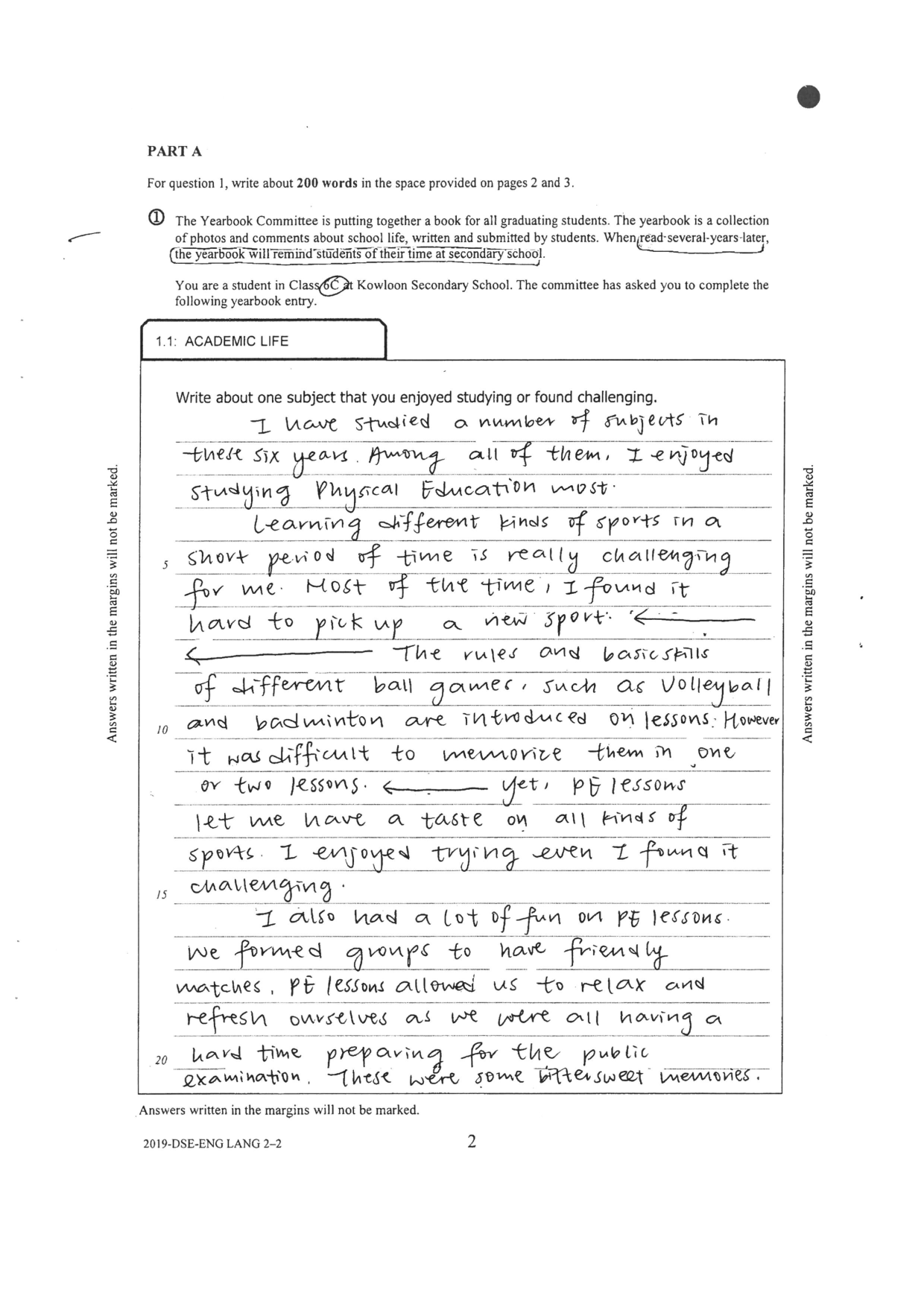

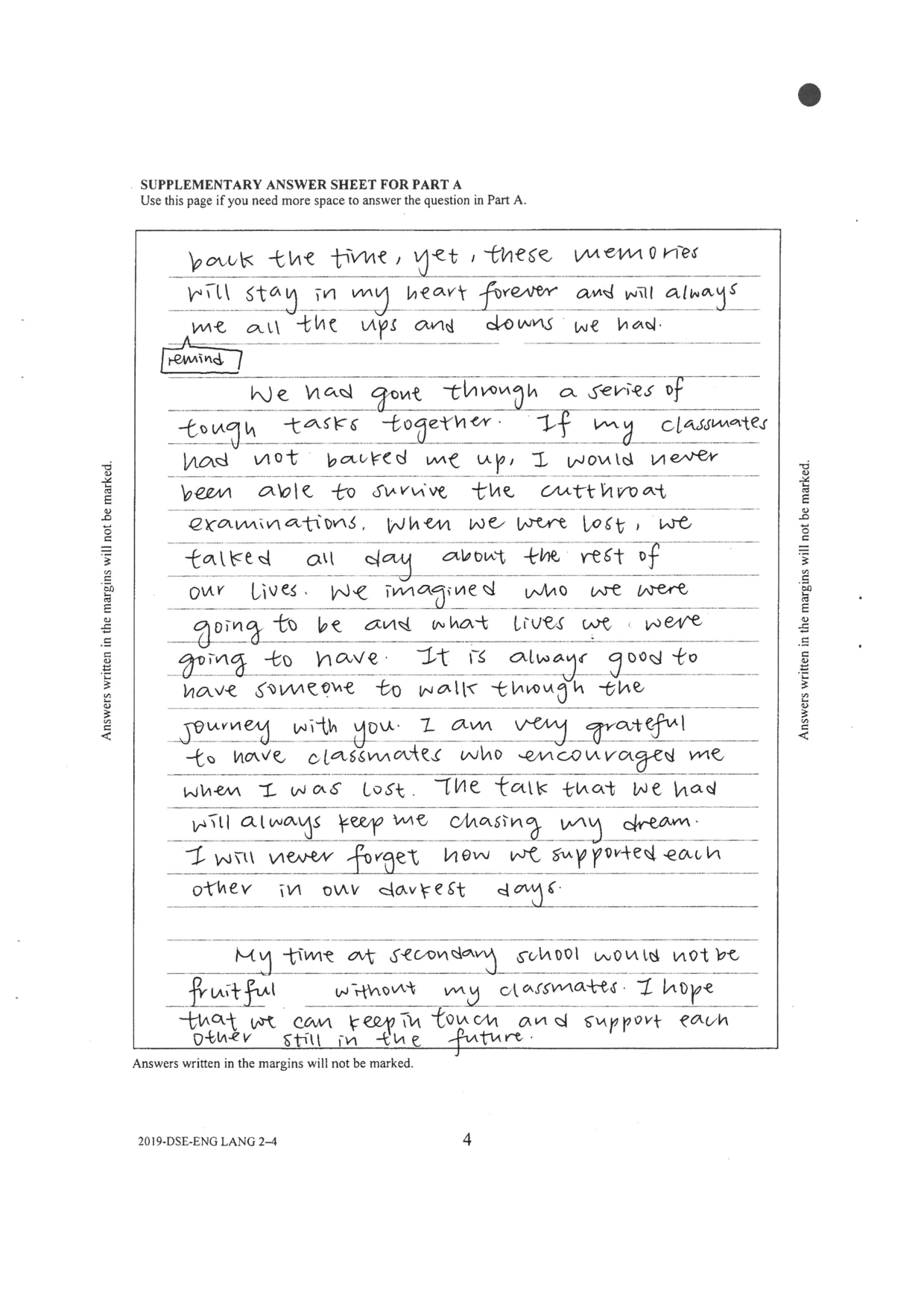
The writing, with corrections marked inline
Strengths to praise
“It is always good to have someone to walk through the journey with you… I will never forget how we supported each other in our darkest days.” The register is heartfelt and personal — exactly the tone a yearbook entry calls for.
Choosing PE — valued both for the chance to “have a taste of all kinds of sports” and as a way to “relax and refresh… preparing for the public examination” — answers ‘enjoyed or found challenging’ from two angles, ending neatly on “bittersweet memories”.
“friendly matches with other classes… the fun… at the school picnic, how we cheered for each other on Sports Day and how hard we cried on our last school day.” Specific occasions make the class bond vivid rather than generic.
The idea of classmates who “walk through the journey with you” and “keep me chasing my dream” ties the Student Life section together and gives the reflection a clear emotional centre.
“bittersweet memories”, surviving the “cutthroat examinations”, a school life made “fruitful” by classmates. The word choices are exact and lift the register.
The two sections speak to each other — PE’s “friendly matches” reappear as a shared class memory — so the entry reads as one coherent reflection rather than two disconnected answers.
Grammar notes
| Issue | Explanation |
|---|---|
fix (line 10) introduced on lessons → introduced in lessons | Preposition. Things are introduced / taught in lessons. |
fix (line 13) a taste on all kinds of sports → a taste of all kinds of sports | Preposition. The idiom is a taste of something (a sample/experience of it). |
fix (line 14) I enjoyed trying even I found it challenging → …even though I found it challenging | Conjunction. The contrast needs even though (a conjunction), not bare even. |
fix (line 16) fun on PE lessons → fun in PE lessons | Preposition. You have fun in a lesson/class. |
fix (line 22) I still remembered → I still remember | Tense. ‘Still’ points to the present, so use the present: I still remember. |
fix (line 32) the fun that we had in the school picnic → …at the school picnic | Preposition. You have fun at an event (a picnic, a party). |
fix (line 38) remind me all the ups and downs → remind me of all the ups and downs | Preposition. remind someone of something. |
fix (lines 41–42) I would never been able to survive → I would never have been able to survive | Verb form. The third conditional needs have: I would never have been able to survive (if my classmates had not backed me up). |
notice (line 21) bittersweet memories | Vocabulary. ‘Bittersweet’ (happy and sad at once) perfectly captures PE as both fun and a relief from exam stress. |
notice (line 42) cutthroat | Vocabulary. ‘Cutthroat examinations’ vividly conveys how fierce the public exams felt — a strong, idiomatic adjective. |
notice (line 52) chasing my dream | Voice. ‘Keep me chasing my dream’ is a warm, idiomatic way to credit classmates with sustaining the writer’s motivation. |
Style suggestions
“I still remembered how hard I tried to blend in…”
“I still remember how hard I tried to blend in…”
‘Still’ signals an ongoing present feeling, so the present tense fits.
“a taste on all kinds… fun on PE lessons… fun… in the school picnic”
“a taste of all kinds… fun in PE lessons… fun… at the school picnic”
Small preposition fixes (of / in / at) make the writing read as natural English.
“If my classmates had not backed me up, I would never been able to survive…”
“If my classmates hadn’t backed me up, I would never have survived…”
The third conditional needs would have + past participle.
“Yet, PE lessons let me have a taste… I also had a lot of fun in PE lessons. We formed groups… PE lessons allowed us to relax”
Vary the subject: “they let me try every sport… we also formed groups… and they let us relax”
‘PE lessons’ opens three sentences in a row; pronouns and rephrasing add variety.
“My time at secondary school would not be fruitful without my classmates. I hope that we can keep in touch…”
“6C, my time at secondary school wouldn’t have been the same without you. Let’s keep in touch…”
A direct address to classmates suits the yearbook’s farewell purpose.
“No one can turn back the time, yet, these memories will stay in my heart forever”
“No one can turn back time, but these memories will stay with me forever”
‘Turn back time’ (no ‘the’) is the usual phrasing; ‘yet’ → ‘but’ reads more smoothly.
Strong moment worth teaching from
Just the conditional (‘would never have survived’) to mend. The image itself is the lesson.
“If my classmates had not backed me up, I would never have been able to survive the cutthroat examinations… It is always good to have someone to walk through the journey with you… The talk that we had will always keep me chasing my dream.” (lines 40–52)
Rather than simply listing what she’ll miss, the writer settles on a single controlling idea — classmates as fellow travellers who ‘walk the journey’ and keep her ‘chasing her dream’. A recurring metaphor like this gives a reflective piece coherence and emotional weight, turning a list of memories into one clear feeling.
Professional rewrite — the ‘PE lessons’ paragraph
A light polish — varying the repeated ‘PE lessons’ and fixing the prepositions — keeping the meaning intact.
Student (verbatim, edits folded in)
Professional version
- Repetition: three sentences starting ‘PE lessons’ → varied subjects.
- Conjunction: ‘even I found it’ → ‘even when it was hard’.
- Flow: short sentences combined for rhythm.
- The point — PE as fun and a relief from exam stress — is kept.
Vocabulary to notice
| Word & alternatives | Definition | Usage notes |
|---|---|---|
| pick up learn, get the hang of, acquire | (phrasal v.) to learn a skill, often casually or quickly. | “hard to pick up a new sport”. Natural and idiomatic for learning a skill; separable (pick it up). |
| blend in fit in, mix in, belong | (phrasal v.) to become part of a group without standing out. | “how hard I tried to blend in with the rest of the class”. Pairs with with; a precise phrasal verb for fitting in socially. |
| bittersweet poignant, mixed, happy-sad | (adj.) bringing both happiness and sadness at once. | “some bittersweet memories”. Exactly captures fond memories tied to a stressful exam year. |
| united close-knit, together, unified | (adj.) joined together; acting as one. | “how united we were”. Strong for class solidarity; verb unite, noun unity. |
| cutthroat ruthless, fierce, intense | (adj.) extremely competitive or harsh. | “the cutthroat examinations”. Vivid for the pressure of public exams; also used of business/competition. |
| grateful thankful, appreciative, indebted | (adj.) feeling or showing thanks. | “I am very grateful to have classmates who…”. Pairs with to (do) / for / that; noun gratitude. |
| fruitful rewarding, productive, worthwhile | (adj.) producing good or useful results. | “My time at secondary school would not be fruitful without…”. A figurative use (a rewarding experience); opposite fruitless. |
Leave a Reply