Newspaper Article — The Rise of Athleisure
‘Athleisure’ is currently one of the biggest trends in the fashion industry. This is a term for clothes that can be worn both for exercise and as everyday wear.
Write an article for the local newspaper explaining possible reasons for the rise in popularity of athleisure. (~400 words)
Show original handwritten pages (3)
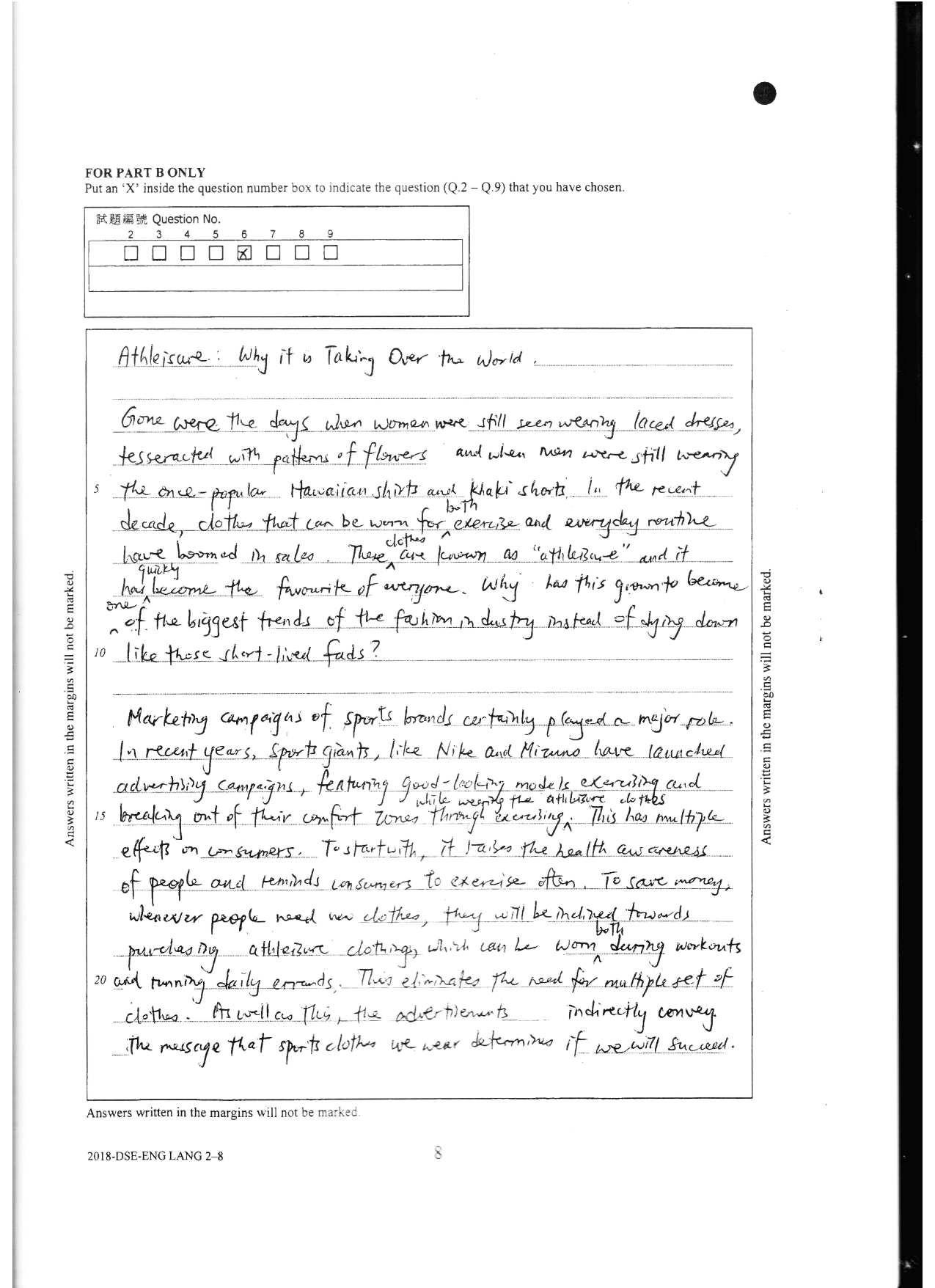

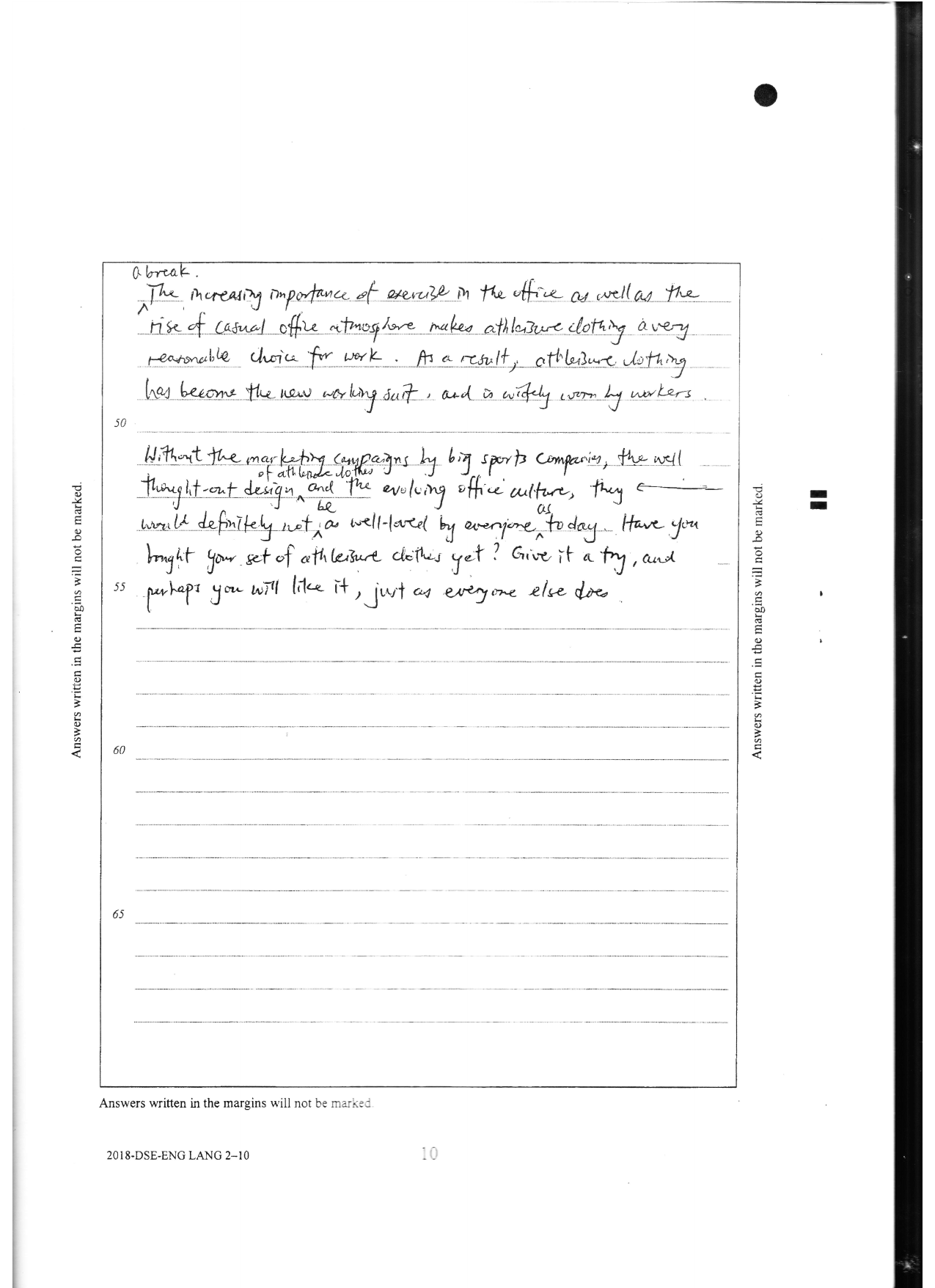
The writing, with corrections marked inline
Dual-band convention. Per-piece reported as 5* (this piece) · 5 overall.
Word count. Approximately 500 words against the ~400 brief — about 25% over. More disciplined than the comparable 2018 Q4/Q5 pieces (which ran 600 words).
First Q6 piece in the collection. The athleisure prompt is new to the 2016–2018 set in this collection — until now Part B has been covered only by speech, letter, and report genres. This is the first newspaper-article piece in the collection (2017 had article-format Part B’s from candidates 2016-001 and 2016-002 but on different topics). The companion piece in this batch (candidate 2018-009, 40/42) provides the natural pair-piece comparison.
Why this is 5* not 5**. The three-reason structure (marketing → comfort → workplace) is clean and the vocabulary range is genuine (athleisure, perspiration, breathable, rocketing, evolution, prescribe, meditation, atmosphere, tuxedo, charismatic). What holds it back is sentence-level execution: several stretches collapse mid-clause (the marketing-campaign details, the ‘wick sweat efficiently’ line, the close with remaking of the workplace), and a small number of authenticity stumbles (brutal Sundeck, refreshing breath of comfort, very much yearn to pulled out). The architecture would carry a 5** if the sentences could.
Genre choice. The candidate opens with a centred title (Athleisure — Why It Is Taking Over the World), uses a then-now contrast (Gone are the days), and closes with a direct question to the reader (Have you bought your set yet?). All three are genuine newspaper-article moves — the candidate has clearly read the kind of trend piece this prompt is modelled on.
Strengths to praise
Title at the top (Athleisure — Why It Is Taking Over the World), a then-now opener (Gone are the days…), three reasoned sections, and a direct-to-reader close. The piece reads, from the first line, as something published in a paper rather than as an essay. Many candidates write Q6 as an essay with no title and no second-person address; this one commits to the genre.
Marketing campaigns (Nike, Adidas push) → functional design (comfort, breathability) → workplace culture (relaxed office, tech-industry casual). Each cause operates in a different domain (commercial, material, sociological), giving the piece coverage without overlap. This is the kind of analytic structure trend articles in SCMP or the Standard use.
“Sports giants like Nike and Adidas… particularly those in the technology industry.” Naming actual brands and naming a specific industry sector (tech) anchors the abstract claims in a recognisable world. The 2017 article pieces in the collection rarely name brands; this candidate’s instinct is right.
“Have you bought your set of athleisure clothes yet? Give it a try, and perhaps you will like it.” Closing on a question to the reader is one of the clearest signals of newspaper-article register — it implies the reader is part of the trend, not just observing it. The candidate has nailed the close.
“Athleisure pants and T-shirts are designed to allow perspiration of the skin. They are highly soft and breathable, and wick sweat efficiently.” The candidate moves past the surface-level they’re comfortable to name actual material properties (perspiration, breathable, wick sweat). This is the move that distinguishes a trend article from a sales pitch.
Rocketing, attributed, evolution, prescribe, atmosphere, tuxedo, charismatic, meditation, perspiration, breathable, instills. These aren’t decorative additions — each does work in its sentence. The vocabulary suggests a candidate who reads beyond the textbook, which is exactly what the markers are rewarding at 5* level.
Grammar notes
| Issue | Explanation |
|---|---|
(line 1) Gone were the days when women were still seen wearing → Gone are the days when women wore | The fixed phrase is gone are the days (present tense). The candidate’s were still seen wearing is a passive that doesn’t pair with the past-as-disappeared sense of the opener. |
(lines 5–6) They are known as ‘athleisure’, and is now one of the biggest trends → They are known as ‘athleisure’, and are now one of the biggest trends | Subject-verb agreement: subject is they (the clothes), so are, not is. |
(line 5) have boomed in color → have boomed in popularity | Boom in color doesn’t parse — boom in this commercial sense pairs with popularity, sales, demand, not color. (Boom + color would imply an explosion of vibrancy, which isn’t the meaning.) |
(line 11) sport-celebrity → sports celebrities | Plural form (the next sentence discusses multiple). Sport as a prefix is rare; sports celebrities, sports figures, sports stars is the standard collocation. |
(lines 14–15) instills viewers to exercise more → instills in viewers the desire to exercise more | Instill takes in + person, the X: instill in him a love of music, instill in students discipline. The verb requires both an object (what is instilled) and a recipient (in whom). |
(line 12) refreshing breath of comfort → refreshing image / (unclear) | Refreshing breath of comfort is non-standard. The mixed metaphor (breath + comfort) doesn’t cohere; likely a coined phrase the candidate didn’t test. |
(lines 27–28) jeans don’t have the best construction or material. They are extremely stiff for our legs → ok / minor refinement | Acceptable. Stiff against the legs reads slightly more natural than stiff for our legs. |
(lines 29–30) allow perspiration of the skin → allow the skin to breathe / wick perspiration away from the skin | Allow perspiration of the skin is ambiguous — what is allowed to do what? The textile claim is that the fabric lets sweat evaporate, which is best stated as allow the skin to breathe or with the technical verb wick. |
(lines 31–32) are even more easy → are much easier | Comparative form: easier, not more easy. Single-syllable adjectives like easy use -er. |
(line 33) more and more people opt for athleisure clothes → ok | Standard. The verb opt for is appropriate to the trend-article register. |
(lines 37–38) no tuxedos and suits are gradually becoming a thing of the past → tuxedos and suits are gradually becoming a thing of the past | The candidate inserts no at the start, which inverts the meaning. The intended sense is that tuxedos are disappearing — the no needs to come out. |
(lines 39–40) prescribe a relaxed office atmosphere that is required to innovation → encourage a relaxed office atmosphere required for innovation | Two fixes: prescribe usually pairs with rules or treatments (prescribe medication); for office culture, encourage, foster, promote. And required to innovation needs the preposition for. |
(line 49) thought-out designs → well thought-out designs | Thought-out as a compound adjective usually takes well- as the standard intensifier: well thought-out designs, well-considered plans. |
(line 52) perhaps you will like it, just as everyone else does → ok | Standard close. The future-tense + just as comparison is appropriate. |
Style suggestions (where 5* writing could become 5**)
Professional rewrite — the workplace-culture paragraph (text-type fit + authenticity)
This is the candidate’s strongest analytic move: linking athleisure not to fashion or comfort alone, but to a real shift in how workplaces dress. The original collects the right ideas (no dress code, tech industry, meditation, casual office) but stitches them with phrasing that flickers (no tuxedos and suits are gradually becoming a thing of the past, prescribe a relaxed office atmosphere). A professional rewrite preserves all three observations and lands them with named companies and named practices. Text-type fit (newspaper-trend register) and authenticity (named brands + named behaviour) drive the rewrite.
The student’s paragraph (corrected)
Rewritten by a professional trend journalist
- The argument opens with a one-sentence claim. The biggest shift, though, has been at work. Newspaper paragraphs lead with the assertion; the candidate’s version takes a full sentence of setup (can be attributed to the evolution of workplace culture, especially overseas) before the claim arrives.
- Named companies do the analytic work. Google, Spotify, the major HK tech firms that have moved into Quarry Bay. The original’s many employers, particularly those in the technology industry is generic; named brands make the sociology observable.
- The wellness details land as physical objects. Gyms in the basement, yoga rooms on the eleventh floor, standing desks at every workstation. Three concrete office features the reader can picture. The candidate’s gym facilities… meditation is right but abstract.
- The trend is stated in a sentence the reader will remember. Hoodies and joggers aren’t a Friday relaxation any more; they’re what people wear to important meetings on a Tuesday. The candidate’s athleisure clothing has become the new working outfit is correct but procedural. The rewrite’s contrast (Friday vs Tuesday) carries the same point with rhetorical force.
- The closing sentence is the keeper. The clothes followed the chairs. Five words. A trend-piece signature line, naming the causal direction the rest of the paragraph has been arguing.
Vocabulary to notice
| Word | Definition | Usage notes |
|---|---|---|
| athleisure | (n.) clothing designed for athletic activities but worn for everyday casual wear. | Newer English word (2010s). Always lowercase. The genre-defining vocabulary item for this prompt. |
| trend | (n.) a general direction in which something is developing or changing. | Pairs with fashion, social, recent, rising, declining: a rising trend, the latest fashion trend. Standard vocabulary for trend articles. |
| rocketing / skyrocketing | (adj./v.) rising or increasing very quickly. | Pairs with prices, popularity, sales, demand: rocketing popularity, skyrocketing prices. Newsy register, appropriate for trend pieces. |
| attribute (to) | (v.) to regard as caused by or belonging to. | Takes to: attribute the rise to social media, attribute the change to economic factors. Standard cause-claim verb in journalism. |
| evolution | (n.) the gradual development of something. | Pairs with workplace, language, culture, technology: the evolution of workplace culture, the evolution of design. More elevated than change. |
| perspiration | (n.) sweat; the act of sweating. | Pairs with cause, induce, allow, prevent. More formal than sweat; appropriate for technical claims about fabrics. |
| breathable | (adj.) (of fabric) allowing air to pass through. | Pairs with fabric, material, clothing, mesh: breathable mesh, breathable fabric. The standard textile term. |
| wick (away) | (v.) to draw moisture away by absorption. | Pairs with sweat, moisture, water: fabrics that wick sweat away from the skin. The technical verb for moisture-management textiles. |
| tuxedo / suit | (n.) formal men’s evening wear / a set of clothes (jacket + trousers). | Together they signal formal business attire. The Monday-morning suit, the boardroom tuxedo. |
| prescribe / encourage / promote | (v.) to recommend or advise. | Prescribe is medical / authoritative; encourage / promote for workplace and cultural contexts. The company encourages a casual atmosphere. |
| dress code | (n.) a set of rules about what clothing may be worn in a particular setting. | Pairs with strict, relaxed, business-casual, formal: a strict dress code, a business-casual dress code. |
| charismatic | (adj.) exercising a compelling charm that inspires devotion in others. | Pairs with leader, presence, personality, vibe: a charismatic leader, charismatic energy. Suits trend-piece registers. |
| instill (in) | (v.) to gradually cause (an attitude, feeling, or quality) to be established in someone. | Takes in + person, the X: instill in her a love of music, instill discipline in students. Not instill X to Y. |
| opt for | (phr. v.) to choose. | Pairs with option, alternative, product: opt for the cheaper version, opt for athleisure. Slightly more formal than choose; suits journalism. |
| opt out (of) | (phr. v.) to choose not to participate in. | The opposite of opt for. Opt out of the meeting, opt out of the system. Useful pair to know. |
| meditation / mindfulness | (n.) the practice of focused mental awareness. | Pair with practice, session, app, programme: meditation app, mindfulness session. Increasingly common in workplace-wellness discourse. |
Leave a Reply