Blog Entry — “Seize the Opportunity, Don’t Let It Go”
You have just heard this song about opportunities:
If you had /
One shot /
Or one opportunity /
To seize everything you ever wanted /
In one moment /
Would you capture it /
Or just let it slip?
You have been inspired to share your feelings about opportunities on your online blog. In your blog write about an opportunity that you missed or seized and the lessons that you have learnt.
(~400 words)
Show original handwritten pages (3)
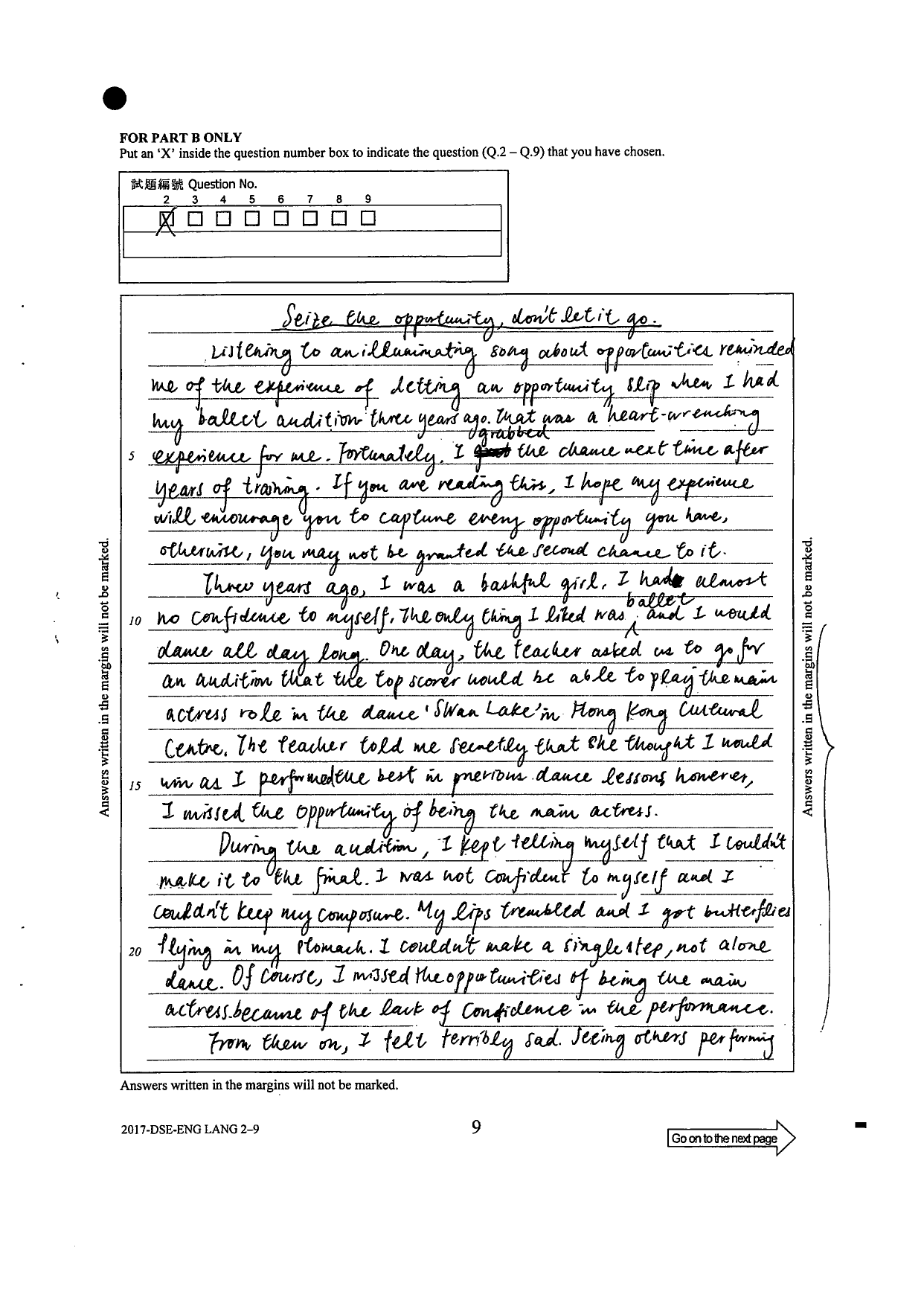
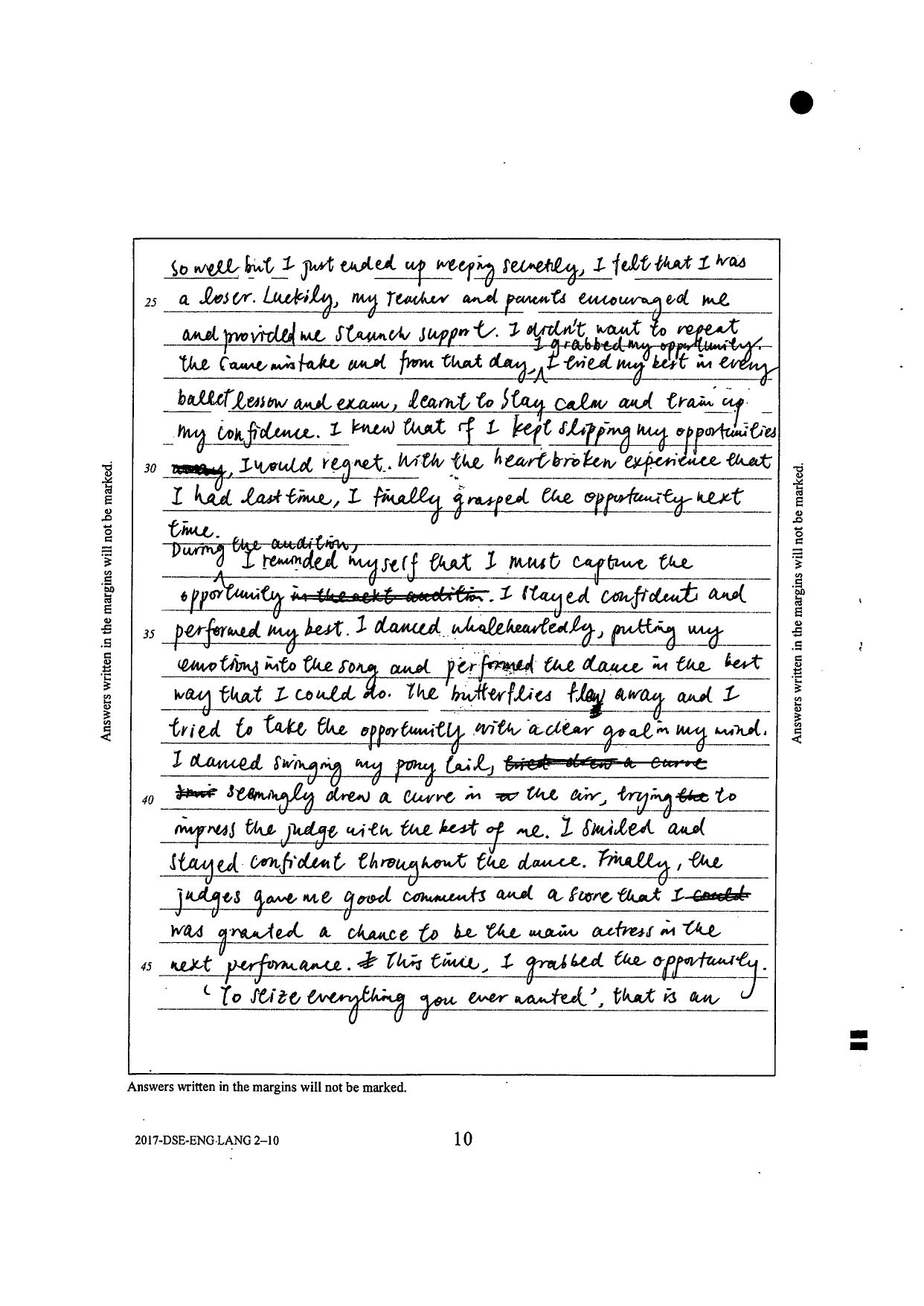
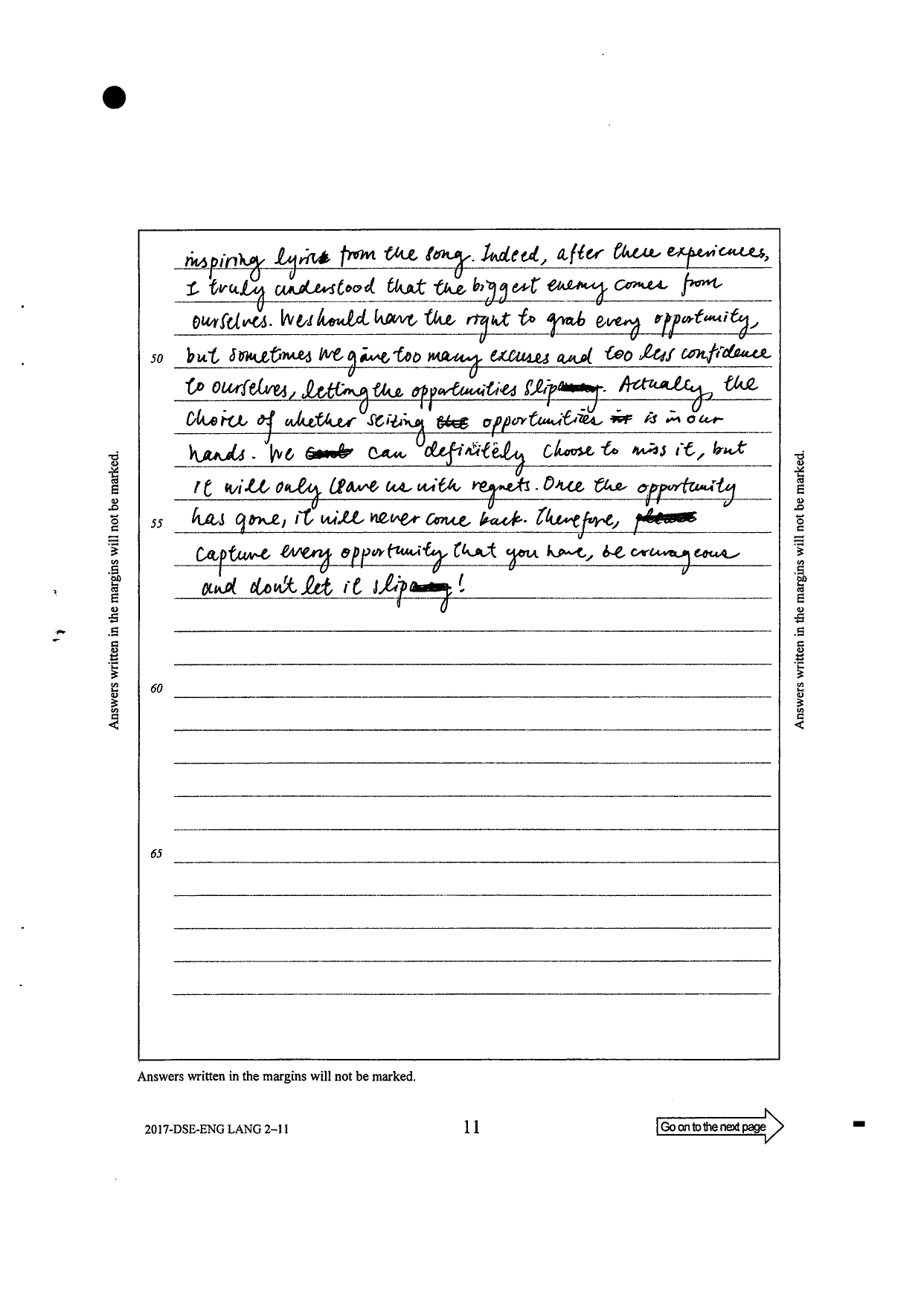
The writing, with corrections marked inline
Word count. The kept blog runs to roughly 560 words against the 400-word brief — about 40% over. Like the candidate’s Part A, this is a long script, but it stays within the booklet’s 11-page allocation.
Self-corrections preserved. The candidate works in real time and re-shapes sentences in flight — the false start “I tried my best in every” is struck through (twice) and replaced with “I grabbed my opportunity”; the second-audition paragraph rewrites the opener (“During the audition,” → “I reminded myself…”); the closing’s “please” is struck so the imperative lands cleaner. All in-flight edits are transcribed.
Marks earned (^18 + ^16 = 34 / 42, closest-pair adjusted). A Band 5* per-piece score. The two markers landed two marks apart (18 / 16), which the cover records as a closest-pair adjustment. M1 (18) is rewarding the genuine emotional arc (bashful girl → missed chance → aftermath → training → second seizing), the strong physical detail at the audition (lips trembled, butterflies, can’t make a single step, swinging pony tail), the structural return to the lyric in the close, and the direct-address frame (“If you are reading this…”) that respects the blog text-type. M2 (16) is pulling down for the surface-level slips (not alone → let alone, too less, confidence to myself, swinging my pony tail trick drew a curve), the over-length, and the slightly compressed lesson section where the inspirational close re-states the same idea three times.
Per-piece 5* vs. overall 5*. Part B scores 34/42 = piece-level 5*; the candidate’s Part A scores 41/42 = piece-level 5**. The overall subject level is 5* — so on this piece, the per-piece band and the overall band align. (Unlike Part A, which over-shoots the overall band.)
Strengths to praise
“Listening to an illuminating song about opportunities reminded me of the experience of letting an opportunity slip when I had my ballet audition three years ago.” Two moves in one sentence: the song is named as the trigger (matching the prompt’s ‘You have been inspired’ framing), and the specific event (ballet audition three years ago) is announced. The reader knows by the end of sentence one what this blog is about and what set it off — the prompt’s text-type expectations are satisfied before the story begins.
The prompt offers a binary: an opportunity that you missed OR seized. This candidate elects to do both — the first audition is missed, the second is seized — which lets the blog dramatise the and the lessons that you have learnt clause through the contrast itself rather than asserting the lesson at the end. The architecture is more demanding than the single-act version, and the candidate manages the pivot cleanly (“I didn’t want to repeat the same mistake … I finally grasped the opportunity next time”).
“My lips trembled and I got butterflies flying in my stomach. I couldn’t make a single step, let alone dance.” The candidate doesn’t tell the reader I was nervous; they show the body refusing to cooperate. Three concrete signs (lips, butterflies, can’t move) stack into one image. Let alone dance is the load-bearing escalator — even the precondition (a single step) is impossible, so the main task (dancing) is beyond reach. This is showing-not-telling at the right scale for a blog.
The first-audition paragraph plants the image: “I got butterflies flying in my stomach.” The second-audition paragraph pays it off: “The butterflies flew away and I tried to take the opportunity with a clear goal in my mind.” One nervous-body image, set up and then released. The callback signals to the marker that the writer planned the structure before writing — and that the ‘seized’ second audition is the answer to the ‘missed’ first one, not a re-statement of it.
“I danced, swinging my pony tail, seemingly drew a curve in the air, trying to impress the judge with the best of me.” Even through the in-flight rewrites visible on the manuscript (trick drew a curve, knit…), the final sentence lands a precise visual — a curve described in the air by a ponytail. The image is observational rather than abstract (compare the more generic I danced well), and it captures the precise moment of confidence returning. The single most cinematic detail in the piece.
The frame opens with reader address (“If you are reading this, I hope my experience will encourage you…”) and the close returns to it (“capture every opportunity that you have, be courageous and don’t let it slip!”). The middle three paragraphs stay in first-person narrative, but the bracketing is unambiguously blog-register: a writer with an audience in mind, addressing readers who haven’t met them, with a takeaway. Many candidates on Q.2 write a short story that happens to be on a blog template; this candidate writes a blog post that contains a story.
“‘To seize everything you ever wanted’, that is an inspiring lyric from the song. Indeed, after these experiences, I truly understood that the biggest enemy comes from ourselves.” The single most rewarded move on Q.2 (Poems and Songs) is the one where the candidate quotes the stimulus and translates it into their own truth. This blog does exactly that — the lyric is quoted verbatim, attributed to the song, and then reframed as the writer’s own conclusion (the biggest enemy comes from ourselves). The reframing is small but crucial: the lyric becomes a discovered truth, not a borrowed slogan.
Grammar notes
| Issue | Explanation |
|---|---|
(line 9) I had almost no confidence to myself → I had almost no confidence in myself |
The preposition is in, not to: confidence in oneself, confidence in a plan, confidence in the future. The same slip recurs in the second-audition paragraph (“I was not confident to myself”, line 17 → confident in myself). |
(line 11) the top scorer would be able to play the main actress role → the top scorer would be able to play the lead role / the leading role |
Main actress role doubles the head: actress already specifies the gender, and main role already specifies the importance. The standard English collocations are the lead role, the leading role, the main role (gender-neutral) or simply the lead. In a ballet context, the lead is the natural word for the principal dancer. |
(lines 12–13) in the dance ‘Swan Lake’ in Hong Kong Cultural Centre → in the ballet ‘Swan Lake’ at the Hong Kong Cultural Centre |
Three small slips. (i) Swan Lake is a ballet, not a dance; dance here is a hyponym, and the more precise word is ballet. (ii) The performance venue takes at, not in: at the Hong Kong Cultural Centre. (iii) The venue takes the definite article: the Hong Kong Cultural Centre. |
(line 14) as I performed the best in previous dance lessons → because I had performed best in previous dance lessons |
Two slips. (i) The best with the article reads as a superlative noun (the best of us); the adverb modifying performed is just best, no article (he performed best, she sang best). (ii) Tense — the teacher’s judgement is grounded in lessons that happened before the conversation; the past perfect (had performed) marks the sequence cleanly. |
(lines 19–20) I couldn’t make a single step, not alone dance → I couldn’t take a single step, let alone dance |
Two slips. (i) The fixed phrase is let alone (= not to mention, much less): X, let alone Y. Not alone isn’t the idiom — this looks like a mishearing. (ii) The collocation is take a step, not make a step: I couldn’t take a single step. |
(line 25) provided me staunch support → gave me their unwavering support / stood by me steadfastly |
The student’s staunch support is a legitimate collocation (compare a staunch supporter), but the verb provide sits oddly with the abstract object — provide support is administrative register (the government provides support), not the warm-family register the sentence is reaching for. Gave me unwavering support or stood by me sits better in the emotional context. |
(lines 28–29) I knew that if I kept slipping my opportunities, I would regret → I knew that if I kept letting my opportunities slip, I would regret it |
Two slips. (i) Slip is intransitive in this idiom — opportunities slip, you don’t slip them. The standard expression is let an opportunity slip (transitive let + intransitive slip). (ii) Regret is transitive in standard English — you regret something; the sentence needs an object (regret it) or a gerund (regret doing so). |
(lines 34–35) I danced wholeheartedly, putting my emotions into the song and performed the dance → I danced wholeheartedly, putting my emotions into the song and performing the dance |
Parallel structure. The first participle is putting (-ing form, adverbial); the second one needs to match: performing, not performed. The switch from participle to past tense breaks the parallel and shifts the second action out of the simultaneous frame. |
(lines 38–39) swinging my pony tail, seemingly drew a curve in the air → swinging my pony tail so that it seemed to draw a curve in the air |
Dangling adverb. Seemingly needs a finite verb it can modify; placed before drew in a participial frame, the subject of drew is ambiguous (the dancer? the ponytail?). The rewrite makes the agent of the curve explicit (it = the ponytail) and converts seemingly into the parenthetical seemed to. |
(lines 42–43) a score that I was granted a chance to be the main actress → a score that granted me a chance to be the lead / a score high enough to grant me a chance to be the lead |
The original sentence has a score as the antecedent and then a passive (I was granted) that breaks the relative clause — the score is the subject of granted, not the object. Either make the score the subject (a score that granted me a chance) or convert it to a result clause (a score high enough to grant me a chance). |
(lines 49–50) we gave too many excuses and too less confidence to ourselves → we give ourselves too many excuses and too little confidence |
Three slips. (i) Tense — the generalisation is present, not past: we give, not we gave. (ii) Too less isn’t a phrase. With uncountable nouns (confidence) the correct form is too little; with countable nouns it would be too few. (iii) The natural word order is give X to Y → give Y X: give ourselves confidence, not give confidence to ourselves. |
(line 51) Actually, the choice of whether seizing opportunities is in our hands → Actually, the choice of whether to seize opportunities is in our hands |
After whether, the complement is normally a to-infinitive (whether to do) or a finite clause (whether we seize), not a gerund (whether seizing). The cleanest fix is whether to seize. |
(line 52) We can definitely choose to miss it → We can certainly choose to miss it / leave as is |
Minor register note. Definitely is acceptable but slightly emphatic for a reflective closing; certainly sits more naturally in a philosophical generalisation. (The candidate’s underlying word choice is fine; this is a polish, not a correction.) |
(lines 53–54) Once the opportunity has gone, it will never come back. → Once an opportunity has gone, it rarely comes back. |
Two notes. (i) The generic statement reads more naturally with the indefinite article (an opportunity) than the definite (the opportunity), which would refer back to a specific opportunity already in play. (ii) Will never come back is absolute; rarely comes back is more defensible and less melodramatic for a reflective close. (Stylistic note, not strictly an error.) |
Style suggestions (where strong writing could become outstanding)
Professional rewrite — the closing lesson paragraph (weak moment)
For comparison only, not a correction. After a vivid two-act narrative, the closing lesson is where the blog turns generic and is at its weakest: it re-states the same idea three times (the choice is in our hands · we choose to miss it · the opportunity won’t come back) and carries the most language friction in the piece (too less confidence, whether seizing, slip away trailing off). After the earned drama of the second audition, the reflection coasts on slogans. The rewrite keeps the candidate’s own conclusion (“the biggest enemy comes from ourselves”) and the borrowed verb (capture), but gives each sentence a different job, in roughly the same word count.
The candidate’s closing paragraph (corrected)
Rewritten by a professional blogger
- The lyric is woven in, not announced. The candidate’s “that is an inspiring lyric from the song” labels the quotation for the reader; the rewrite lets the line do its own work (“that one line… has been chasing me”), which is how a blog keeps the stimulus alive instead of footnoting it.
- The candidate’s own conclusion is kept and made concrete. “The biggest enemy comes from ourselves” is the strongest idea in the close, but it is stated as an abstraction. The rewrite names the enemy in the candidate’s own terms (the judges, the nerves, the girl who took her place) so the truth is discovered, not asserted.
- One image replaces the three-fold repetition. The original makes the same point three ways (the choice is ours · we choose to miss · it won’t come back). The rewrite consolidates it to a single, smaller obstacle — “the excuse I made in the half-second before I reached for what I wanted” — so the moral arrives once, hard.
- The reader pivot is sharpened. “The choice was always mine, and right now it is yours” turns the frame back to the blog’s audience in one line, honouring the direct-address opening (“If you are reading this…”) the candidate set up.
- The close lands on the song’s own verb. The candidate’s three-part imperative (capture · be courageous · don’t let it slip) stacks the same advice three ways; the rewrite ends on the two-word “Capture it,” quoting the stimulus directly and closing the loop the prompt set up.
Vocabulary to notice
| Word | Definition | Usage notes | Synonyms / alternatives |
|---|---|---|---|
| illuminating | (adj.) helping to clarify or explain (something); throwing light on a topic. | Pairs with conversation, article, study, comment, comparison, anecdote. The student’s “an illuminating song” uses the word slightly broadly — songs tend to be moving, haunting, stirring rather than illuminating (which is more analytical). See Style suggestion 2. | enlightening, revealing, eye-opening, instructive |
| heart-wrenching | (adj., compound) causing intense grief or anguish. | Hyphenated. Pairs with experience, story, scene, decision, moment, separation. Strong negative-emotional register; the student’s “a heart-wrenching experience” is precisely on-pitch for a failed audition that mattered. | devastating, agonising, heartbreaking, gut-wrenching |
| bashful | (adj.) reluctant to draw attention to oneself; shy. | Slightly old-fashioned and gentle in tone; suggests an inward shyness rather than awkwardness. Pairs with smile, glance, child, manner. The student’s “a bashful girl” uses the word in the right register for a young self-portrait. | shy, timid, diffident, self-conscious |
| composure | (n.) the state of feeling or appearing calm and in control of oneself. | Pairs with keep, lose, regain, maintain, retain. Slightly formal. The student’s “I couldn’t keep my composure” is the standard collocation for losing one’s nerve in a performance setting. | calmness, poise, self-control, equanimity |
| butterflies (in one’s stomach) | (idiom) a fluttery, nervous feeling in the stomach, especially before performing or speaking in public. | Standard fixed idiom. The student adds the participle (flying in my stomach) which is technically redundant but lyrically effective — it animates the metaphor. The callback in the second audition (“The butterflies flew away”) is a clean structural reuse. | nerves, jitters, the heebie-jeebies |
| let alone | (idiom) used after a negative statement to emphasise that the second possibility is even less likely. | Always after a negative: I couldn’t take a single step, let alone dance. The student writes not alone, which isn’t a phrase — almost certainly a mishearing. See Grammar row 5. | much less, never mind, to say nothing of |
| staunch | (adj.) very loyal and committed in attitude. | Pairs with supporter, ally, defender, advocate, friend, opponent. Slightly formal; carries political-loyalty connotations. Staunch support is a legitimate collocation but reads slightly cooler than the warm-family register the sentence is reaching for. See Grammar row 6. | unwavering, steadfast, loyal, firm |
| grasp (an opportunity) | (v.) to seize or take hold of (an opportunity) with eagerness. | Standard collocation with opportunity, chance, nettle, meaning. Slightly more literary than grab or seize; reads as deliberate rather than impulsive. The student’s “I finally grasped the opportunity next time” is on-register. | seize, take, grab, snatch |
| wholeheartedly | (adv.) with complete sincerity and commitment. | Pairs with agree, support, recommend, embrace, throw oneself into, dedicate. The student’s “I danced wholeheartedly” is a small lexical reach beyond the obvious word (fully) and signals committed effort cleanly. | completely, fully, sincerely, unreservedly |
| capture (an opportunity) | (v.) to take or seize (an opportunity, moment, attention). | Pairs with attention, imagination, market, audience, moment, opportunity. The song’s verb (capture it or just let it slip) is the stimulus the candidate quotes back; the verb’s reuse in the blog (“capture every opportunity you have”) is the load-bearing intertextual echo. | seize, take, snatch, grasp |
| slip (away) | (v., intransitive) to escape or get away gradually and unnoticed. | Pairs with opportunity, chance, time, moment, secret. Intransitive in the idiom (the chance slipped away); transitive only via let X slip. The student’s “letting the opportunities slip” uses the standard pattern; “slipping my opportunities” earlier in the same paragraph breaks it. See Grammar row 7. | escape, get away, pass by, elude |
| courageous | (adj.) showing courage in the face of difficulty or danger. | Pairs with act, decision, choice, leader, stance, fight. Stronger than brave and more deliberate — suggests considered courage rather than reflexive bravery. The student’s closing imperative (“be courageous”) is on-register for a reflective blog close. | brave, bold, valiant, fearless |
| inspiring | (adj.) making someone want to do or create something; arousing enthusiasm. | Pairs with story, speech, example, leader, music, words, lyric. The student’s closing “an inspiring lyric from the song” is the right description for a stimulus that has triggered the whole blog — it brings the prompt and the narrative full circle. | uplifting, motivating, stirring, rousing |
| lyric | (n., countable in this sense) a single line or short passage of words in a song. | Common confusion: lyrics (plural) = all the words of a song; a lyric (singular) = one line or short passage. The student’s closing originally writes “an inspiring lyrics” — mixing the singular article with the plural noun. An inspiring lyric is the cleaner singular form. | line, verse, words, refrain |
| regret | (v. / n.) to feel sad or sorry about (something one has done or failed to do). | Transitive in standard English — you regret something, not just regret. The verb takes a noun object (regret it), a gerund (regret doing X), or a that-clause (regret that I did X). The student’s “I would regret” (with no object) reads as truncated. See Grammar row 7. | be sorry, lament, rue, repent |
Leave a Reply