Debate Speech — “Watching TV Makes Us Smarter”
As captain of the debate team you have been asked to write a debate speech. The task is to argue that ‘Watching TV Makes Us Smarter’.
In your speech you should include three reasons to support the statement.
Write your speech. (~400 words)
Show original handwritten pages (3)
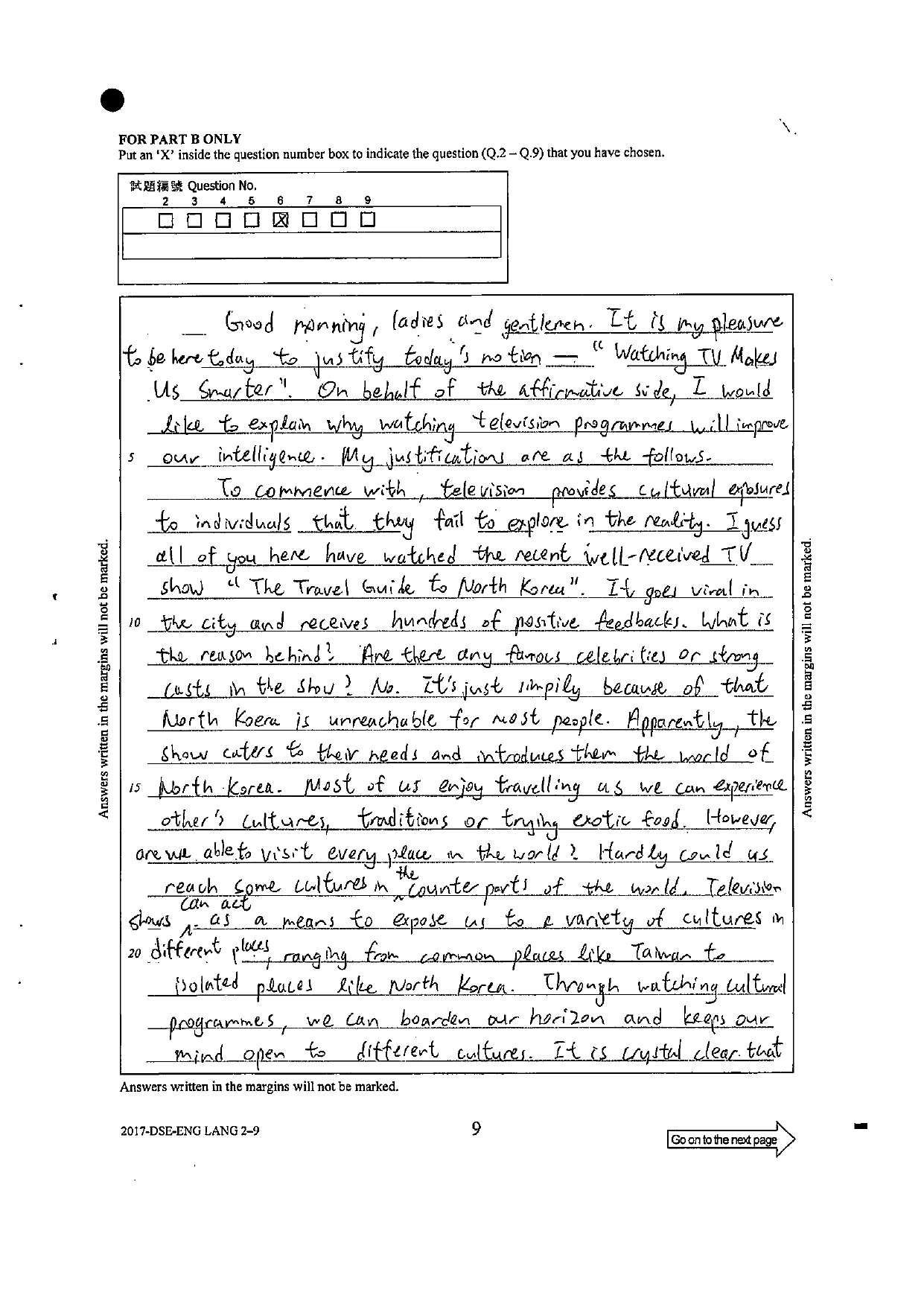
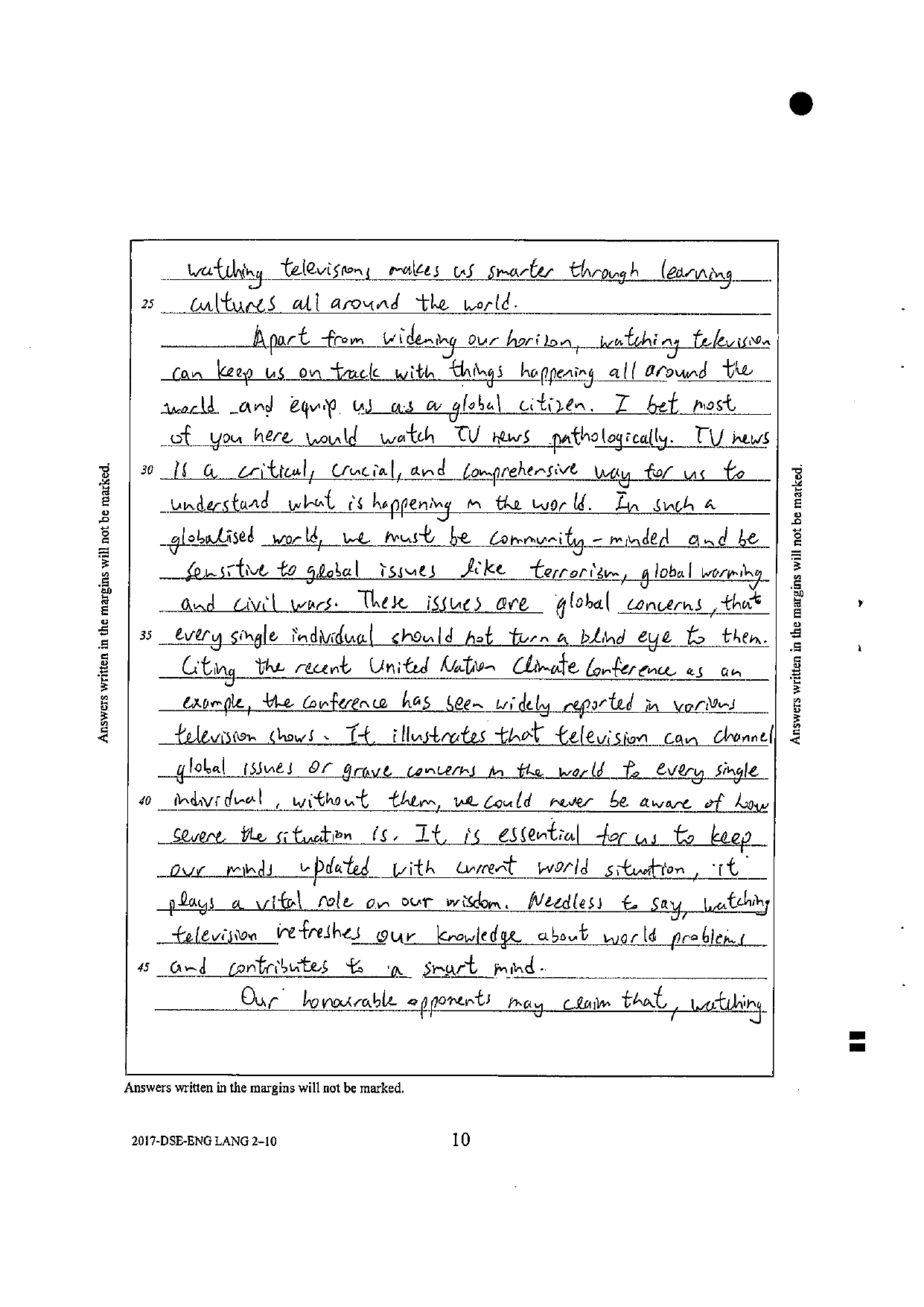
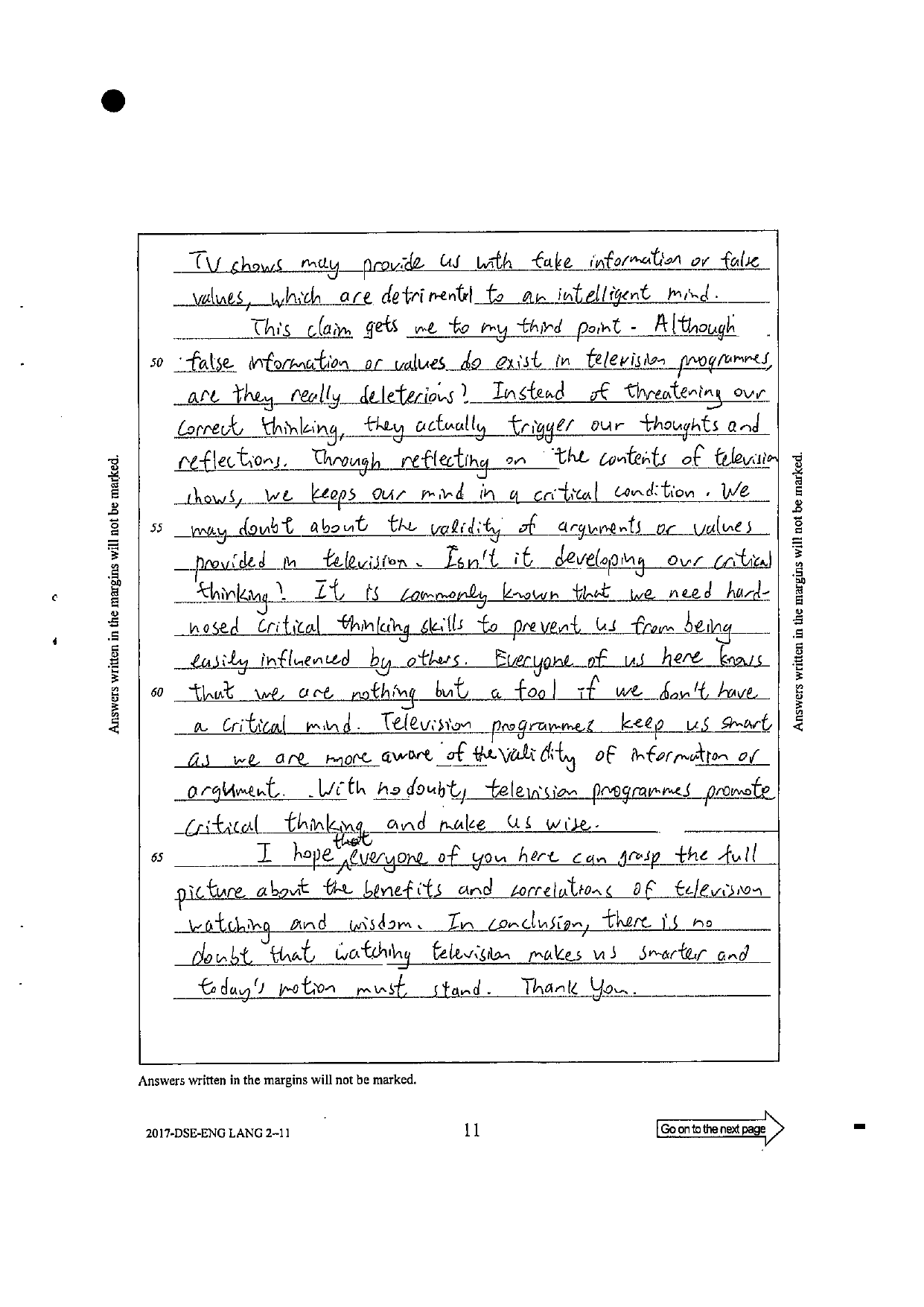
The writing, with corrections marked inline
The opening lapses motion/notion (line 2). The candidate writes “today’s notion” in the opening — the wrong word, on the most important line of the speech. Motion (the proposition being debated) and notion (an idea or impression) are easily confused; in a debate speech the slip is unmissable. The closing line (line 69) restores motion correctly.
Word count. The speech runs to roughly 600 words against the 400-word brief — about 50% over. The first reason (cultural exposure, lines 6–25) is the longest at ~225 words; the third reason / rebuttal hybrid is the most efficient.
Strengths to praise
Each reason is anchored in a specific TV programme or event: The Travel Guide to North Korea (line 9) for cultural exposure, the United Nations Climate Conference (line 36) for global citizenship, and the implicit fake-news ecosystem for critical thinking. Naming a specific show and a specific recent international event — not a category — is what separates a 5* speech from a 4. Each named instance carries the abstract claim above it.
“What is the reason behind it? Are there any famous celebrities or strong casts in the show? No.” The candidate sets up the audience’s wrong guess and demolishes it, before delivering the right answer (North Korea is unreachable for most people). That is the rhetoric of a real debater — controlled use of the audience’s expectations.
Instead of the conventional three reasons + rebuttal, the rebuttal IS the third reason. The opponent’s strongest counter-argument is named in the rebuttal’s usual position, then re-framed as evidence for the candidate’s own case (the false values trigger reflection, which develops critical thinking). A difficult move to land — you have to give the opposition a clean run before turning their gun on them — and the candidate makes it work.
Four rhetorical questions, each at a paragraph’s argumentative pivot rather than for decoration: “What is the reason behind it?” (line 10); “However, are we able to visit every place in the world?” (line 17); “are they really deleterious?” (line 51); “Isn’t this developing our critical thinking?” (line 56). Each gives the audience a beat to reach the right answer with the speaker.
The compound modifier hard-nosed (tough-minded, no-nonsense) shifts critical thinking from a school-curriculum phrase to something muscular and active. Most candidates would write strong or good critical thinking; hard-nosed is reaching for a register higher.
The idiom (ignore something one knows about) is exactly the right metaphor for the speech’s subject — the speech is about not turning the eye away from what TV could show us. Pre-emptive of the opponent’s line that TV is passive consumption: the candidate is implying that TV-watching is the active opposite of looking away.
“In conclusion, there is no doubt that watching television makes us smarter and today’s motion must stand. Thank You.” The motion is repeated exactly, the formal debating-room verdict phrase is used (the motion must stand), and the speech lands on the brisk Thank You. This is the standard top-band debate close, executed cleanly.
Grammar notes
| Issue | Explanation |
|---|---|
(line 2) today’s notion → today’s motion |
The wrong word at the worst possible moment. Motion = the proposition being debated; notion = a vague idea or impression. The candidate uses motion correctly in the closing line (line 69), which suggests this is a one-off slip — but it’s the second sentence of the whole speech. |
(line 5) My justifications are as the follows → My arguments are as follows |
Two slips. (i) Justification means “the reason something is morally acceptable”, not “the reasons supporting a position”. The right word in a debate is arguments or reasons. (ii) The fixed phrase is as follows (no article). |
(line 6) cultural exposures → cultural exposure |
Exposure in the sense of “contact with new ideas, cultures or experiences” is uncountable: exposure to art, exposure to risk, exposure to different cultures. The plural exposures is the photographic sense. |
(line 7) fail to explore in the reality → fail to experience in reality |
Two slips. (i) Explore is the verb of investigation; the candidate wants the verb of contact (experience). (ii) In reality (no article) is the fixed phrase; in the reality is a literal-translation slip. |
(lines 9–10) It goes viral… and receives hundreds of positive feedbacks → It went viral… and received hundreds of positive reviews |
Three slips. (i) Tense: the show went viral (past) — a completed action being cited as evidence. (ii) Feedback is uncountable in modern English: not feedbacks. (iii) For the public response to a TV show the right noun is reviews, not feedback. |
(line 12) simpily → simply |
Spelling slip. Sim-ply (no i): the -ply is the adverbial ending. (Compare deeply, sharply, quickly.) |
(line 14) introduces them the world of North Korea → introduces them to the world of North Korea |
Introduce X to Y is the fixed pattern. Without to, the verb reads as if them and the world were both direct objects. |
(line 16) other’s cultures → others’ cultures |
Apostrophe placement. Other’s = belonging to one other person; others’ = belonging to multiple. The candidate means “other peoples’” cultures, so the plural possessive is needed. |
(line 16) traditions or trying exotic food → traditions, or try exotic food |
Parallel-structure slip. Experience cultures and experience traditions share the head verb, but trying exotic food is a gerund phrase. Either keep the verb (try exotic food) or make all three nouns. |
(line 17) Hardly could us reach some cultures → Hardly could we reach some cultures |
Subject pronoun in an inverted clause. After fronted hardly, the auxiliary inverts with the subject, and the subject is in the nominative case (we), not the accusative (us). |
(lines 22, 26) broaden our horizon → broaden our horizons |
Idiomatic plural. Broaden / widen / expand one’s horizons is the fixed phrase — always plural. The singular horizon is the literal sense (the line at the limit of vision). |
(lines 22, 24, 54) keeps our mind, we keeps, watching televisions makes → subject-verb concord |
A cluster of agreement slips. We takes keep. Watching television (gerund subject) is singular and takes makes, with television here as mass (no -s). |
(line 28) equip us as a global citizens → equip us as global citizens |
Determiner-noun mismatch. A global citizens mixes the singular determiner with the plural noun. The plural is the right fit for the plural object us. |
(line 29) would watch TV news pathologically → watch TV news habitually |
Pathologically means “in a way related to disease” or “compulsively in an unhealthy way” — wrong for “regularly”. The intended sense is habitually or religiously. Would watch also reads as conditional; present watch fits a habitual claim. |
(line 36) United Nation Climate Conference → United Nations Climate Conference |
Spelling of a proper noun. The body is the United Nations (always plural), even attributively: the United Nations Charter, a UN report. |
(line 37) the conference has seen widely reported → the conference was widely reported |
Tense/voice slip. The candidate is reaching for the passive but writes has seen reported, which mixes the present perfect of see with the past participle of report. Simple past passive: the conference was widely reported. |
(line 43) plays a vital role on our wisdom → plays a vital role in our wisdom |
Preposition slip. Play a role in X, not on X. |
(line 55) doubt about the validity → doubt the validity |
Doubt as a verb is transitive — direct object with no preposition. The construction with about exists only with the noun: have doubts about. |
(line 56) arguments or values provided in television → provided on television |
Preposition slip. Content appears on television, not in. |
(line 60) we are nothing but a fool → we are nothing but fools |
Number agreement. The subject we is plural, so the predicate noun is plural: we are fools. |
(line 51) deleterios → deleterious |
Spelling slip on an ambitious word. De-le-ter-i-ous (-ious ending like spurious, gracious). The misspelling looks like a phonetic reach. |
(line 66) grasp the full picture about the benefits → grasp the full picture of the benefits |
Preposition slip. The picture of X, not about X. |
Style suggestions (where strong writing could become outstanding)
Professional rewrite — the third-point / rebuttal hybrid (the speech’s most sophisticated structural move)
For comparison only, not a correction. The candidate’s third-point structure (lines 46–64) is the speech’s most interesting move: instead of a conventional three reasons + rebuttal, the rebuttal IS the third reason — the opponent’s counter is named, then re-framed as evidence for the affirmative case. The rewrite below shows what the move looks like when the candidate names what they are doing out loud, lets each step land as a short sentence, and closes on a single short declarative.
The student’s version (lightly corrected)
Rewritten by a professional debater
- Names the rhetorical move out loud. “Now I want to do something unusual. Let me make my opponents’ argument for them.” Telling the floor what you are about to do, before you do it, is the highest-status debating move — it shows the adjudicators you understand the structure of the argument, not just its content.
- The opponent’s case is stated more generously than the opponent will state it. The rewrite gives the opposition three specifics (fake news, dishonest advertising, shallow values) where the candidate gives two. Steel-manning the opposition is what makes the rebuttal that follows look unanswerable — you are seen to have refused their best version, not their easiest one.
- The pivot is one short sentence. “They are entirely wrong about what it does to the viewer.” A short declarative after the long opposition setup is the rhetorical hinge. In a debate room the speaker would pause here.
- The river metaphor does the heavy lifting. “A river of half-truths and dubious values is exactly the environment in which a critical mind learns to swim.” The image converts the abstract claim into something the audience can picture: critical thinking is a survival skill in a wet environment.
- Two concrete examples follow the metaphor. The teenager who has watched a thousand commercials; the viewer who has seen the same event spun three ways. Naming two specific viewer-learning experiences makes the claim verifiable in the audience’s own life.
- The closing inverts the opposition’s assumption. “The screen does not protect us from bad information. It trains us to recognise it.” The rebuttal lands on a sentence that converts the opponent’s case into a statement of the candidate’s thesis. “Not despite the noise, but because of it” is the verdict line the adjudicators will write down.
- Word count is similar. Student version ~175 words; rewrite ~190 words. Same length, sharper rhetoric.
Vocabulary to notice
| Word | Definition | Usage notes | Synonyms / alternatives |
|---|---|---|---|
| motion | (n.) the proposition being debated. | Always with the verbs propose, support, oppose, second, table, withdraw. Key phrases: the motion stands, the motion falls, today’s motion is…. The candidate uses motion correctly in the closing but slips to notion in the opening. | proposition, resolution, proposal, question |
| affirmative side | (n. phrase) the side in a debate that argues for the motion. | Paired with negative side (against). Standard debating-room vocabulary; signals genre fluency. The candidate uses the term correctly: on behalf of the affirmative side. | proposing side, the “Yes” side, for the motion |
| commence | (v.) to begin (formal). | The fixed debating-speech connector To commence with is the candidate’s opener for reason one — equivalent to To begin with or First of all. Slightly more formal than First. | begin, start, kick off, open |
| cater to | (phrasal v.) to provide what someone wants or needs. | Slightly negative in some uses (cater to popular taste); neutral in others (cater to dietary needs). The candidate’s “the show caters to their needs” is the standard collocation. | serve, accommodate, satisfy, address |
| exotic | (adj.) characteristic of or coming from a distant foreign country; strikingly unusual. | Pairs with fruit, food, location, dancer, plant, bird. Carries a slight tourist-gaze register. The student’s “trying exotic food” is the right register for the travel-anecdote frame. | foreign, unusual, novel, unfamiliar |
| go viral | (idiom) (of an image, video, or piece of information) to be circulated rapidly and widely through the internet. | Modelled on the medical sense of viral — spreading like an infection. The candidate’s “It went viral in the city” is the right phrase but should be in the simple past for a completed circulation event. | spread rapidly, blow up, take off, trend |
| unreachable | (adj.) unable to be reached or contacted; not accessible. | Two senses: physical (an unreachable peak) and social (an unreachable celebrity). The candidate’s “North Korea is unreachable for most people” uses the physical-political sense well. | inaccessible, out of reach, off-limits, isolated |
| global citizen | (n. phrase) a person whose identity transcends geography or political borders. | Common in education, NGO, and journalism contexts since the 1990s. Pairs with raise, educate, develop, become. The candidate’s “equip us as global citizens” uses the phrase in the standard pedagogical sense. | world citizen, cosmopolitan, internationalist |
| community-minded | (adj. compound) considerate of and willing to act in the interests of the wider community. | Pairs with be, become, raise (children to be), citizen, approach. Slightly civic-vocabulary register; common in policy and education contexts. The candidate’s use is exact. | civic-minded, public-spirited, socially conscious |
| turn a blind eye (to) | (idiom) to pretend not to notice; ignore something one knows about. | Pairs with injustice, abuse, wrongdoing, problem, issue. The expression originates from Admiral Nelson’s deliberate use of his blind eye to ignore a signal to retreat. The candidate’s usage is the standard idiom. | ignore, overlook, look the other way, disregard |
| channel (something to) | (v.) to direct (something) towards a particular end or via a particular medium. | Pairs with energy, anger, funds, message, information. The candidate’s “television can channel global issues… to every single individual” uses the verb in its “conduit” sense. | convey, direct, route, transmit |
| grave concern | (n. phrase) a serious worry or matter for anxiety. | Pairs with cause for, of, raise, express, share. Grave is slightly formal / journalistic. The candidate’s “global issues or grave concerns” hits the right level of formality for a debate speech. | serious worry, deep anxiety, pressing issue |
| hard-nosed | (adj. compound) realistic and tough-minded; not influenced by sentiment. | Pairs with businessman, journalist, approach, attitude, skills, critical thinking. Carries a hint of approval. The candidate’s “hard-nosed critical thinking skills” is a small lexical jewel — the modifier shifts the noun from school-curriculum register to active-defence register. | tough-minded, no-nonsense, pragmatic, unsentimental |
| detrimental (to) | (adj.) tending to cause harm. | Pairs with health, environment, interests, development, performance, mind. Slightly formal; often in policy or scientific writing. The student’s “detrimental to an intelligent mind” is on-register for a debate. | harmful, damaging, injurious, deleterious |
| deleterious | (adj.) causing harm or damage. | Near-synonym of detrimental but more formal / Latinate. Pairs with effect, consequence, impact, influence. Worth the lexical reach but only if spelt correctly — the student writes deleterios, which costs the credit. | harmful, damaging, detrimental, injurious |
| validity | (n.) the quality of being logically or factually sound. | Pairs with question, doubt, test, assess, establish, of an argument, of a claim. The candidate’s “the validity of arguments or values” is the right collocation for testing whether something is well-founded. | soundness, legitimacy, cogency, accuracy |
| honourable opponents | (n. phrase) the polite-formal way to address the opposing team in a debate. | Modelled on parliamentary address (my honourable friend, the honourable gentleman). Always plural in school debates. The candidate’s “Our honourable opponents may claim that…” is the textbook opening to a rebuttal section. | worthy opponents, the opposing team, my colleagues across the floor |
| refresh (knowledge) | (v.) to update or renew (information held). | Pairs with memory, knowledge, skills, brief, account, page. The student’s “watching television refreshes our knowledge about world problems” uses the verb in its “keep current” sense, which is correct — though updates is more usual for current-affairs knowledge specifically. | update, renew, revise, brush up on |
Leave a Reply