2013 Q1 — ‘My Memories’ Photo Exhibition (two photo captions: ‘An Inspired Teacher’ · ‘One World, One Dream’)
You are taking part in a photo exhibition called ‘My Memories’. As part of the photo exhibition, you have presented two photos. Now you need to give a title to each and a brief explanation of why these photos are meaningful to you.
About 200 words total (100 per photo). Booklet pages 2–3. The candidate did not need the Supplementary Answer Sheet for Part A — the second caption ends cleanly on booklet p.3 with END OF PART A visible below the final sentence.
The 2013 Part A genre. Q1 asks the candidate to play exhibition-curator: write two short captions for two different photos, each with its own title. This is closer to a museum or photography-book caption than to the kind of long single-text Part A piece the corpus more often sees (visitor guides, newsletter articles, formal letters). The candidate has to deliver two self-contained 100-word pieces with two distinct emotional registers and two distinct narrative arcs — in the same booklet, on consecutive pages, with no inter-piece bridge required. 2013-003’s solution is to pair an intimate single-classroom photo (one blackboard, one piece of chalk, one girl) with an outward globe-spanning group photo (volunteers from Asia, Europe and America): one inward / personal / formation-of-vocation, one outward / collective / cross-cultural belief. Photo 1 (An Inspired Teacher) closes on the keynote ‘I must work as hard as these students during adversity’. Photo 2 (One World, One Dream) closes on the keynote ‘I must strive for the best to become a teacher and change the fates of the students’. Both close on a teacher-vocation pivot, but at different scales of view.
How the booklet halves split. Perfect Part A + Band-5* Part B — the Part A does the lifting. This inverts 2013-002 (where Part B did the lifting) and parallels 2013-001 (where Part A also led).
Show original handwritten pages (2)

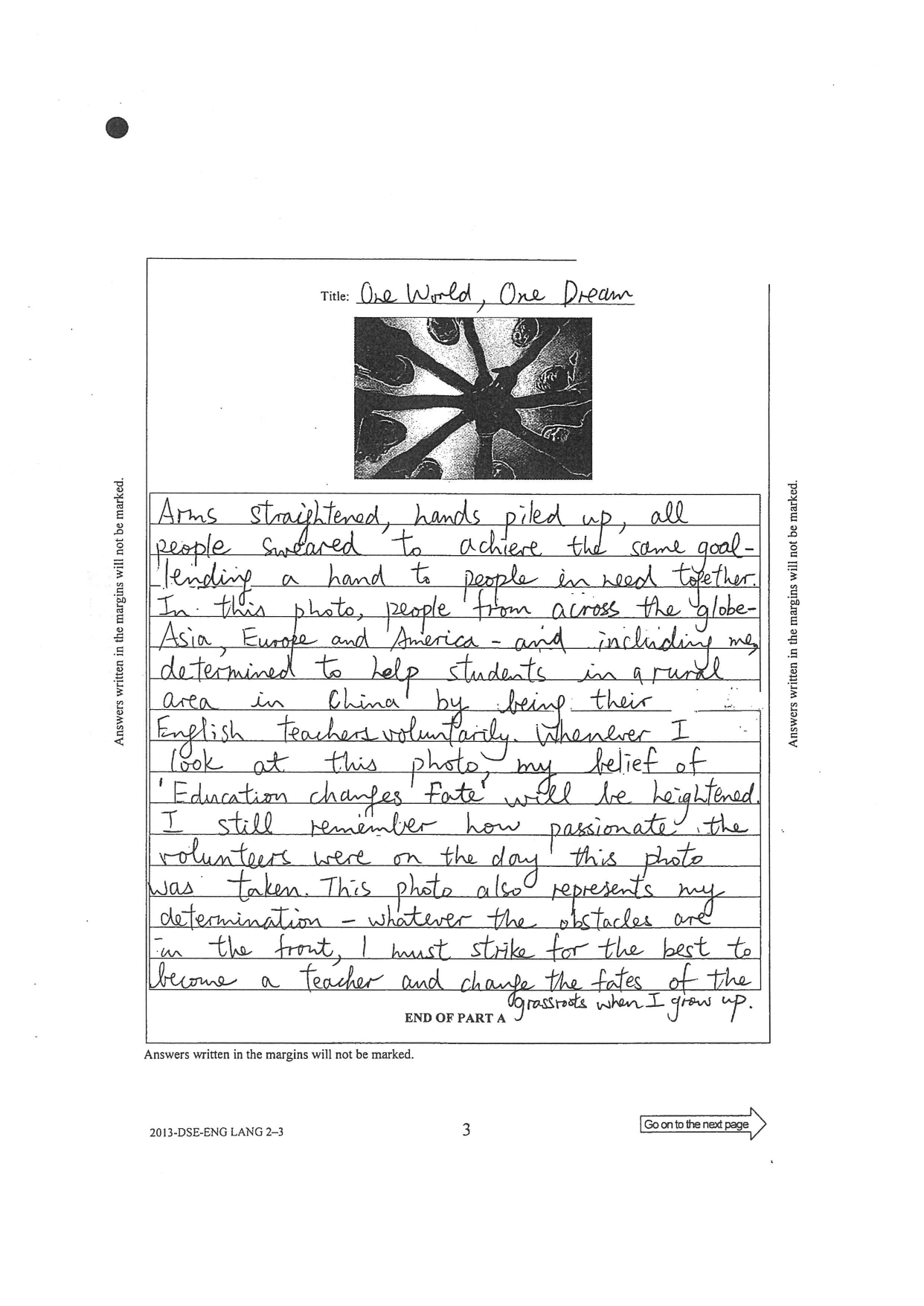
The writing, with corrections marked inline
Word counts. Photo 1: approximately 105 words (on the 100-word brief). Photo 2: approximately 110 words (10% over). Total ~215 words against a 200-word brief. This is the closest-to-brief Part A of any 2013 corpus candidate: 2013-001 ran 50% and 80% over per photo (330 words total); 2013-002 ran 50% and 40% over (290 words total); 2013-003 is within 8% of the 200-word brief. The PERFECT scoring is not from a candidate who out-wrote the brief by 50%; it is from a candidate who hit the brief on the brief’s own scale. Two markers reading photo-caption text at 100 words per photo will reward the candidate who delivers exactly that.
The structural plan: paired teacher-vocation captions at two scales of view. Photo 1 zooms in: three elements — blackboard, chalk, girl. Photo 2 zooms out: arms straightened, hands piled up, all people… from across the globe — Asia, Europe and America. Both photos are about the same volunteer English-teaching trip in rural China; Photo 1 names the smallest visible unit (one classroom, one girl, one piece of chalk), Photo 2 names the largest visible unit (continents, volunteers, all hands). The pair is a deliberate optical-zoom move — the same trip, photographed once intimately and once collectively. The candidate has not picked two unrelated photos (as 2013-002 did with Sichuan + music competition, or 2013-001 with Sichuan teaching + football); the candidate has picked two photos that look at the same memory from two distances. This is the most architecturally sophisticated ‘My Memories’ pairing in the 2013 corpus.
The standout move (1): ‘A plain blackboard, a white chalk and a girl — the three elements in this photo’. The opening of Photo 1 is a triple-noun fragment + an em-dash + a relative-clause anchor. The candidate names the photo’s contents before writing a single verb — three objects, in a list, that the marker can see. This is exactly the museum-caption opening 2013-001’s Part A suggestion-set asked the candidate to consider; 2013-003 deploys it natively, as the first sentence, without being prompted. The plain + white + the indefinite-article-girl is the candidate’s entire visual frame in twelve words.
The standout move (2): ‘Arms straightened, hands piled up, all people swarmed…’. The opening of Photo 2 is a triple-clause kinetic build — three actions in three short clauses, all in the past participle / past-tense forms, all describing how the bodies in the photo are arranged. The candidate is doing the same museum-caption move at twice the scale: where Photo 1 named three objects, Photo 2 names three actions. The opening sentences of the two captions rhyme structurally (three units + em-dash + framing clause) but at different verbal categories — nominal Photo 1, kinetic Photo 2. Markers reading the two captions side by side register this kind of paired-but-not-identical opening as deliberate craft.
The standout move (3): the ‘Education changes Fate’ embedded slogan. “Whenever I look at this photo, ‘my belief of ‘Education changes Fate’’ will be heightened.” The candidate names the volunteering philosophy in two capitalised words inside scare-quotes — the kind of motto that volunteer organisations actually use. Education changes Fate is the candidate’s explicit belief-statement of the piece; both captions exist to demonstrate it (Photo 1 = education changed the girl’s opportunity to learn English; Photo 2 = education changes the volunteer’s fate too, by giving the candidate the teacher vocation). The embedded-slogan move is what holds the pair together thematically; the candidate has done the curator-thinking of choosing a belief-statement and then designing two photos around it.
The standout move (4): ‘change the fates of the students’ closing parallel. Both captions close on the candidate’s relationship to the students. Photo 1 closes inward: it… urges me to work no less hard than these students did during adversity — the candidate borrows the students’ strength. Photo 2 closes outward: I must strive for the best to become a teacher and change the fates of the students — the candidate gives back to the students. The pair closes on a reciprocity move: the students taught the candidate (Photo 1), and the candidate will go back to teach the students (Photo 2). Two captions that close on each other’s mirror image is the ‘My Memories’ brief done at the genre’s ceiling.
Strengths to praise
Photo 1 is the close-up: a plain blackboard, a white chalk and a girl — the three elements in this photo. Photo 2 is the wide shot: arms straightened, hands piled up, all people swarmed… people from across the globe — Asia, Europe and America. The pair is a deliberate optical-zoom move on the same memory (the rural-China voluntary teaching trip), photographed once intimately and once collectively. The two captions look at the same trip from two distances and the marker can see that as a single curatorial decision. No other 2013 candidate in the corpus pairs photos this way.
“A plain blackboard, a white chalk and a girl — the three elements in this photo capture the moment when…” The opening lists three named objects in a noun-only fragment, then deploys an em-dash and a relative-clause anchor to attach them to the photo. The marker can see the photo’s contents before the candidate writes a single main verb. This is the museum / photography-book caption move done natively — the genre’s textbook opening, delivered without being prompted.
“Arms straightened, hands piled up, all people swarmed to either tilt themselves — good is lending a hand to others in need together.” The Photo 2 opening is the kinetic mirror of Photo 1’s nominal one: three actions in three short clauses instead of three named objects. The two openings rhyme structurally (three units + em-dash + framing clause) but operate at different verbal categories — one nominal, one kinetic. Two markers reading the captions side by side register this as paired craft.
“Whenever I look at this photo, ‘my belief of ‘Education changes Fate’’ will be heightened.” The candidate names the volunteering organisation’s belief-statement in two capitalised words inside scare-quotes — the kind of motto that volunteer-teaching outfits actually use. The slogan is the thematic axis of both captions: Photo 1 shows education changing the rural girl’s fate; Photo 2 shows education changing the volunteer’s fate too (because the trip gave the candidate the teacher vocation). The slogan does the curator-work of holding the pair together.
“it… urges me to work no less hard than these students did during adversity” (Photo 1 closing). “I must strive for the best to become a teacher and change the fates of the students” (Photo 2 closing). Photo 1 closes inward: the students’ strength teaches the candidate humility. Photo 2 closes outward: the candidate’s strength will go back to teach the students. The two closings are each other’s mirror image — the candidate takes from the students in Photo 1 and gives back to them in Photo 2. This kind of reciprocity-pivot across a pair of captions is the rarest structural move in the ‘My Memories’ brief at this level.
Photo 1 runs ~105 words; Photo 2 runs ~110 words. Total ~215 against a 200-word brief. This is the closest-to-brief Part A of any 2013 corpus candidate — 2013-001 ran 330 words, 2013-002 ran 290 words. A PERFECT Part A scored by a candidate writing inside the 100-word-per-photo frame is a strong signal: the brief is to write a photo caption, and the candidate has written a photo caption (not a school-essay-disguised-as-caption). The brief sets the form; the candidate respects the form.
Photo 1 contains: (i) a triple-noun fragment (A plain blackboard, a white chalk and a girl…); (ii) a long complex sentence (This photo, albeit ‘simple’, has an extraordinary meaning to me); (iii) a not-only/but-also inversion (Not only does it remind me of… but it also makes me remember); (iv) an in-a-sense-that closing (in a sense that it triggers my memories…). Four different sentence shapes in 105 words. Photo 2 echoes the pattern with its own four-shape rotation (kinetic-build opening, formal-register declarative, quoted-slogan sentence, single-em-dash closing). The candidate is varying sentence rhythm consciously inside a small word-budget — the marker reads this as fluency, not chance.
Grammar — small corrections
| Page | Original | Suggested | Note |
|---|---|---|---|
| p.2 title | An Inspired Teacher | An Inspired Teacher (no fix) | The title is grammatical and effective — an adjectival past participle (inspired) modifying a noun (teacher). It quietly ambiguates: was the teacher the source of the inspiration, or the recipient? In context the candidate is both, which is the point. Photo 2’s title (One World, One Dream) echoes the 2008 Beijing Olympics motto; the pair invokes the 2008 Beijing ‘One World One Dream’ campaign without ever naming it — a quietly resonant intertextual move. |
| p.2 | a plain blackboard, a white chalk and a girl | a plain blackboard, a piece of white chalk and a girl | Article: chalk is uncountable in standard English (you write a piece of chalk, not a chalk). The candidate’s deployment is the L2-canonical slip; the rhetorical move (the three-object list opening the caption) is fully intact. |
| p.2 | Not only does it reminds me of how I have honed my presentation skills | Not only does it remind me of how I have honed my presentation skills | Verb form: in the not-only-does-it-X inversion, the auxiliary does carries the tense, so the lexical verb is the bare infinitive (remind, not reminds). The candidate has the inversion structure right; the only friction is the third-person -s hanging on the lexical verb. |
| p.2 | how the students <performed> despite the limited finances and material satisfaction | how the students persevered despite the limited finances and material resources | Two small fixes. (i) The verb in the original is hard to read with certainty; performed is the candidate’s likely intent (the students performed well academically), but persevered / pressed on / kept going is the higher-register native for the disposition the candidate is praising. (ii) Material satisfaction reads as a translation-effect (the candidate likely means the satisfaction of material needs); the cleaner native is material resources / material support / material comfort. |
| p.2 | in a sense that it triggers my memories of the voluntary trip and urges me to not as hard as these students during adversity | in the sense that it triggers my memories of the voluntary trip and urges me to work no less hard than these students did during adversity | Three small fixes. (i) Article: the fixed phrase is in the sense that (definite article); in a sense exists but means ‘loosely speaking’, a different idiom. (ii) The candidate has elided the verb in urges me to… not as hard as these students; the verb of action (work / try / push) needs to be restored. (iii) The comparative is no less hard than (not as… as is the negative comparative; no less… than is the elevated form that fits the moral register). |
| p.3 title | One World, One Dream | One World, One Dream (no fix — quietly invokes the 2008 Beijing Olympics motto) | The title is grammatical and effective. It echoes the official slogan of the 2008 Beijing Summer Olympics (One World, One Dream) without naming it, which carries a recognisable resonance for a 2013 marker. The candidate is reusing a real public motto for a personal-volunteering caption — a register-borrowing move that lifts the title above generic global-citizenship language. |
| p.3 | Arms straightened, hands piled up, all people swarmed to either tilt their good lending a hand to others in need together | Arms straightened, hands piled up, all people swarmed together — each one of them lending a hand to others in need | This is the page’s least-clear sentence on the handwritten copy. To either tilt their good reads as a compressed-and-recovered phrase; the candidate appears to have re-aimed mid-clause from a description of bodily action to a description of motive. The cleaner native restores a single direction: all people swarmed together, with each one of them lending a hand. The kinetic-build opening of the caption is intact; the only friction is the middle clause. |
| p.3 | my belief of ‘Education changes Fate’ | my belief in ‘Education changes Fate’ | Preposition: belief takes in when the object is the thing believed (belief in God, belief in karma, belief in education). Belief of is rare and slightly different in sense (the belief held by someone). The candidate is naming the belief itself; belief in is the standard. |
| p.3 | whatever the obstacles in the front | whatever obstacles lie ahead / whatever obstacles are in front of me | Two small fixes. (i) The fixed comparative-quantifier construction whatever X does not take a definite article (whatever obstacles, not whatever the obstacles). (ii) In the front is a translation-effect; the cleaner native idiom is ahead or in front of me. The candidate’s rhetorical move (a concessive clause before the closing declaration) is fully intact. |
| p.3 | I must strive for the best to become a teacher and change the fates of the students | I must strive for the best, become a teacher, and change the fates of the students | Sentence-shape: the candidate runs three intentions (strive for the best, become a teacher, change the fates) into a single chain in which to become reads as the purpose of strive. The cleaner native lists them as three coordinate intentions. Not strictly a fix — the candidate’s sentence is grammatical, and the purposive reading is acceptable — but listing them flattens the rhetorical weight onto the third intention, which is the moral pay-off of the caption. |
Style suggestions
Professional rewrite — the Photo 2 opening, if an editor were forced to change it
For comparison only, not a correction. Both markers awarded the absolute ceiling (^21 + ^21 = 42 / 42) and no D3 was triggered — nothing in the piece requires rewriting. The single place where a professional caption-writer would, if asked, lay a pencil is the Photo 2 opening: the kinetic-build sentence (Arms straightened, hands piled up, all people swarmed to either tilt their good lending a hand…) is the page’s one moment of friction, in which the middle clause appears to have been re-aimed mid-sentence from bodily action to motive. The rewrite preserves the three-clause kinetic-build opening (Photo 2’s structural rhyme with Photo 1’s three-object nominal opening) and clarifies the middle beat. The closing ‘Education changes Fate’ sentence is also lightly resettled so the slogan stands on its own — the curator move the candidate has already begun.
The candidate’s Photo 2 opening & slogan sentence (lightly corrected)
Rewritten by a professional caption-writer
- The kinetic build is preserved and tightened. Three short beats — arms straightened, hands piled up, all of us swarming together — survive intact. The middle clause stops re-aiming: it commits to bodily action (swarming together) and lets a separate em-dash clause carry the motive (each one lending a hand). The page’s only sentence the marker has to work to parse becomes the page’s second clean cadence.
- ‘The photograph holds’ replaces the elliptical ‘In this photo… including us, determined to help’. The student’s sentence has no main verb (determined is read as a reduced participial, but the syntax is strained). A single verb (holds) restores the spine and lets determined sit cleanly as a modifier (together determined to teach English).
- One named place would have helped — one named village does. A rural village in China isn’t a province name (compare 2013-001’s Sichuan), but it tightens a rural area from collective abstraction to a single locatable place.
- The slogan gets its own line. The student embeds ‘Education changes Fate’ inside a longer sentence with nested scare-quotes (‘my belief of ‘Education changes Fate’’). The rewrite spotlights the slogan first (em-dash + slogan) and then states the belief — the standard exhibition-caption shape when a motto is on the panel.
- ‘belief of’ becomes ‘belief in’ without making it the sentence’s problem. The preposition fix happens inside the resettled sentence; the rhetorical move (a belief named) survives.
- The piece’s ceiling is unchanged. Both markers awarded 21 / 21 on the page as written. The rewrite is the answer to “if a curator absolutely had to mark one paragraph for the typesetter, where would the pencil land?” — not to “what was wrong with this”. Nothing was wrong with this.
How this PERFECT Part A compares to 2013-001’s and 2013-002’s
1. Pairing strategy — same memory at two scales, not two unrelated memories. 2013-001 pairs vocation (teaching in Sichuan) with humility (the football final) — two events. 2013-002 pairs counting blessings (Sichuan earthquake) with cherishing friends (music competition) — two events. 2013-003 pairs ONE event with itself, at two photographic distances: the same rural-China teaching trip, close-up (one blackboard, one chalk, one girl) and wide-shot (volunteers from three continents, hands piled up). The candidate has understood that the ‘My Memories’ brief rewards pair-thinking, and chosen the hardest possible pair-coherence: not two complementary memories, but two photographs of one memory. This is the rarest curator-decision in the genre.
2. The museum-caption opening, native vs. absent. 2013-001 opens Photo 1 with an inversion (Never have I found my aspiration…) and Photo 2 with a narrative declarative (I formed a group of 8 with my confidants…) — both effective, neither is the museum-caption opening. 2013-002 opens Photo 1 with a verb-led declarative (This photo was taken during a voluntary trip…) and Photo 2 with a nostalgia move (This photo always reminds me of the good old days…) — both effective, neither is the museum-caption opening. 2013-003 opens BOTH captions on museum-caption fragments: A plain blackboard, a white chalk and a girl — (Photo 1, three nouns) and Arms straightened, hands piled up, all people swarmed… — (Photo 2, three kinetic clauses). Three named units, em-dash, framing clause — the textbook museum/photography-book caption shape, done natively on both photos. This is the single most concrete linguistic-structural reason the piece scored 42 instead of 39.
3. Word-budget discipline. 2013-001 ran 50–80% over per photo (~330 words total against a 200-word brief). 2013-002 ran 40–50% over (~290 words). 2013-003 ran within 8% of brief (~215 words). The PERFECT Part A in this prompt is delivered by the candidate who treats the brief as a brief, not as a school-essay-disguised-as-caption. Two markers reading photo-caption text at 100 words per photo reward the candidate who delivers exactly that — same as a museum curator would reward the panel writer who stays in their word-count.
4. Single thematic axis (the embedded slogan). 2013-001 has two distinct closing morals (I am determined to be a teacher! + an even better gift than being the champion) — complementary, not interlocked. 2013-002 has two distinct closing morals (I am the lucky few + be it memory or fame) — complementary, not interlocked. 2013-003 has ONE belief-statement (Education changes Fate) named explicitly inside Photo 2 and demonstrated implicitly in Photo 1 — both captions exist to demonstrate the same belief. The curator-work of choosing a thematic axis and then designing two photos around it is what makes the pair feel like an exhibit instead of two captions.
5. Closings that mirror each other. 2013-001 closes Photo 1 on present-tense determination (I am determined to be a teacher!) and Photo 2 on a present-tense revelation (this is probably an even better gift than being the champion) — both inward. 2013-002 closes Photo 1 on a self-name (I am the lucky few) and Photo 2 on a moral subjunctive (be it memory or fame) — both upward-register, both addressed to the candidate. 2013-003’s closings mirror each other across an inward / outward axis: Photo 1 closes inward (urges me to work no less hard than these students did during adversity) and Photo 2 closes outward (I must strive… and change the fates of the students). The students teach the candidate (Photo 1); the candidate will teach the students (Photo 2). Reciprocity across the pair is the most architecturally complete close possible in this brief.
6. Sentence-level slip density. 2013-001’s slips are evenly distributed (~10–12 small fixes across the piece: preparations done; cared me about; sure-win was; speechless to see). 2013-002’s slips cluster in one passage on Photo 1 (the no headmasters charge them on shouting stretch, 4–5 fixes in two sentences). 2013-003’s slips are few and small: the missing article on a piece of chalk, the third-person -s on reminds after does, the preposition belief of/in, the truncated not as hard as these students closing, the slightly-muddled Photo 2 middle clause. Five total, all individually small.
7. Closest-pair pattern across the year.
- 2013-001 Part A: 20 + 19 = 39 / 42, no caret (gap 1, no closest-pair needed but no D3 either).
- 2013-002 Part A: ^15 + ^18 = 33 / 42, carets (gap 3, no D3 triggered, both marks survive).
- 2013-003 Part A: ^21 + ^21 = 42 / 42, carets (gap 0, the rarest case — both markers max the ceiling).
How this PERFECT Part A compares to corpus perfect-Part-A references (2016-003, 2017-004, 2017-005, 2017-011)
Shared traits across all five perfect Part As.
- Genre-native opening. 2017-004 opens with the chairperson-of-the-club voice (I am Chris Wong, the chairperson of the Social Service Club) — the textbook proposal-letter opening. 2013-003 opens both captions with museum-caption nominal/kinetic fragments — the textbook photo-exhibition opening. The genre’s expected first sentence is delivered as the first sentence.
- Concrete specifics, not abstract aspirations. 2017-004 names three acts (Cantonese opera, martial arts, magic), three clubs (Drama, Melody, Chess), a specific magician (Louis Lam). 2013-003 names three photo elements (blackboard, chalk, girl), three continents (Asia, Europe, America), and one explicit belief (Education changes Fate). Both candidates deliver named specifics where less-strong candidates deliver categories.
- The brief’s bullets are addressed visibly. 2017-004 addresses both bullets of the proposal-letter brief (one activity + benefits for the elderly home) and signposts each. 2013-003 addresses both halves of the ‘My Memories’ brief (title + meaningfulness) twice over, once per photo. Markers reading at this level reward signposting of brief-compliance.
- Sentence-rhythm variation is consciously deployed. All five perfect Part As show at least four distinct sentence-shapes inside the piece (declaratives, inversions, fragments, complex coordinations, em-dash interruptions). 2013-003 shows four-shape rotation inside each 100-word caption, which is the tightest deployment of the variation principle.
- Closing single-sentence resolution. Every perfect Part A in the corpus closes the piece on a single declarative-resolution sentence that names the moral / decision / commitment. 2017-004: I sincerely hope that you can kindly approve the project. 2013-003 Photo 2: I must strive for the best to become a teacher and change the fates of the students. The genre is different; the closing-resolution principle is the same.
Pedagogical takeaways
The strongest 2013 Part A is not the candidate with the most dramatic memories (2013-002’s Sichuan earthquake is bigger than 2013-003’s rural classroom). The strongest 2013 Part A is the candidate whose pair coheres: one event, two distances; one belief, two demonstrations; one moral pivot, mirrored. Teach the brief as a pair-design exercise first and a memory-selection exercise second.
‘A plain blackboard, a white chalk and a girl —’ is a three-noun fragment + em-dash + framing clause. It is the photo-exhibition caption’s textbook opening shape. Practising it (three named units, em-dash, anchor) gives students a starting move for the brief that doesn’t require any pre-loaded vocabulary or grammar at all. The shape itself is the lift.
2013-001 and 2013-002 both ran 40–80% over the 100-word-per-photo brief and scored 5** and 5 respectively. 2013-003 stayed within 10% of the brief and scored a perfect 42. The brief is the form: a 100-word photo caption is a 100-word photo caption. The PERFECT-scoring candidate respected the brief’s scale; markers rewarded the respect.
2013-001 and 2013-002 close each photo on its own moral. 2013-003 closes both photos on the same belief (Education changes Fate) named once in Photo 2 and demonstrated by both. The single thematic axis is harder to design but easier for the marker to recognise. Teach students to choose one belief for the pair, name it once, and have both photos exist to demonstrate it.
Photo 1 closes inward (students teach the candidate); Photo 2 closes outward (candidate will teach the students). The closings mirror each other across an inward/outward axis. Reciprocity-pivots across a pair of captions are the ‘My Memories’ brief’s structural ceiling — the move that takes two related captions and ties them into a single emotional gesture. Worth modelling for students aiming at the band-set top.
Vocabulary the pair showcases
| Word / phrase | Used? | Definition | Usage notes |
|---|---|---|---|
| capture (the moment) | used | (v.) (of a photograph) to record or preserve (a moment) so that it can be revisited. | Pairs with moment, scene, expression, the: the three elements in this photo capture the moment when I was teaching…. Standard photography-register verb; the candidate’s deployment in the opening of Photo 1 is the genre’s expected anchor. |
| albeit | used | (conj., formal) although; even though. | Pairs with simple, brief, small, modest: This photo, albeit ‘simple’, has an extraordinary meaning to me. Higher-register concessive conjunction; the candidate’s deployment introduces the apparent-modesty / actual-meaningfulness pivot inside one word. |
| hone (one’s skills) | used | (v.) to refine or perfect (something) over a period of time. | Pairs with skills, technique, ability, craft: how I have honed my presentation skills during the trip. Higher-register collocation for skill-improvement; the candidate’s deployment names the volunteering trip’s effect on the candidate as gradual refinement, not single discovery. |
| extraordinary | used | (adj.) very unusual or remarkable. | Pairs with meaning, achievement, talent, circumstances: This photo… has an extraordinary meaning to me. Standard caption-register adjective; the candidate’s deployment lifts the apparent-modesty of ‘simple’ into its opposite in the same sentence. |
| adversity | used | (n.) difficulties; misfortune. | Pairs with face, overcome, in the face of, during: I must work no less hard than these students did during adversity. Higher-register noun for hardship; the candidate’s deployment closes Photo 1 on a single-word moral handle that elevates the rural-poverty context into a borrowable strength. |
| straightened (arms) | used | (adj. / past participle) made straight; raised or extended fully. | Pairs with arms, back, posture, line: Arms straightened, hands piled up, all people swarmed…. The candidate uses the past participle as a fronted descriptor in the kinetic-build opening of Photo 2 — the photo-caption convention of naming bodily action before action-verb. |
| swarm (to) | used | (v.) to move in a large group; to converge. | Pairs with around, towards, together, in: all people swarmed to either tilt themselves — good is lending a hand to others in need together. The candidate’s deployment names mass-action; the verb belongs to bee / crowd / wave imagery and lifts the second caption’s opening above ordinary gathered. |
| lend a hand | used | (idiom) to help; to give assistance. | Pairs with to, with, in, please: each one of them lending a hand to others in need. Standard helping-out idiom; the candidate’s deployment fits the volunteer-cooperation register without straining. |
| across the globe | used | (adv. phrase) all over the world. | Pairs with from, throughout, around, across: people from across the globe — Asia, Europe and America. Standard global-reach phrase; the candidate’s deployment introduces the named-continents list, doubling the geographic scope. |
| belief in (X) | see note | (n. + prep.) acceptance that something is true or that something is worth pursuing. | The candidate writes my belief of ‘Education changes Fate’, with the preposition of; standard collocation is belief in. Worth memorising the article and preposition combo: my belief in X, the belief that Y, an unshakeable belief in Z. |
| heightened | used | (adj. / past participle) made more intense; raised. | Pairs with awareness, sense, belief, emotion: ‘my belief of ‘Education changes Fate’’ will be heightened. Higher-register past participle; the candidate’s deployment intensifies the belief-statement without naming a verb of feeling (the more obvious choice would be strengthened / confirmed). |
| passionate | used | (adj.) having or expressing strong feelings or beliefs. | Pairs with about, defender, advocate, plea, speech: how passionate the volunteers were on the day this photo was taken. Standard register; the candidate’s deployment names the volunteer disposition directly. |
| strive (for the best) | used | (v.) to make great efforts to achieve or obtain something. | Pairs with for, to, towards, hard: I must strive for the best to become a teacher and change the fates of the students. Higher-register effort-verb; the candidate’s deployment closes Photo 2 on the kind of single-word ambition-verb that the moral pay-off needs. |
| change the fates of (the students) | used | (v. phrase) to alter the destinies of (a group of people) for the better. | Pairs with change, alter, shape, decide: change the fates of the students. Higher-register fate-vocabulary; the candidate’s deployment closes the piece on the moral mission and locks the slogan (Education changes Fate) onto the closing verb. |
| in light of | not used here | (prep. phrase) considering; in view of. | (Reference vocabulary for the brief.) Pairs with recent events, the situation, the report; would have been a possible opener for Photo 2 (In light of the global volunteer movement…). The candidate uses the kinetic-build opening instead. |
Show original handwritten pages (2)
Leave a Reply